The Senior Developer's Resume Strategy: A Torrent of Keywords
Why is this Career HR meme funny?
Level 1: Throw Everything at the Wall
Imagine you have a big box of toys and gadgets that you’ve collected over 10 years. Now, someone asks you what you can do or what you’re good at. Instead of picking a few favorite toys to show them, you get excited (or maybe nervous) and throw all your toys into the air at once, yelling “Here, look at EVERYTHING I have!” It’s a huge, jumbled display – toy cars, action figures, Lego bricks, a yo-yo, even that old Tamagotchi – all flying around chaotically. The person watching is a bit overwhelmed and not sure what to focus on.
This meme is saying that sometimes very experienced programmers do something similar with their résumés (which is like a report or list of their skills and jobs). After many years, they’ve learned and used lots of different tools and technologies. When it comes time to show a company what they know, they list every single thing – even if it’s kind of random or too much all at once. It’s like a superhero who has been collecting gadgets for a decade and then tries to use all the gadgets at the same time.
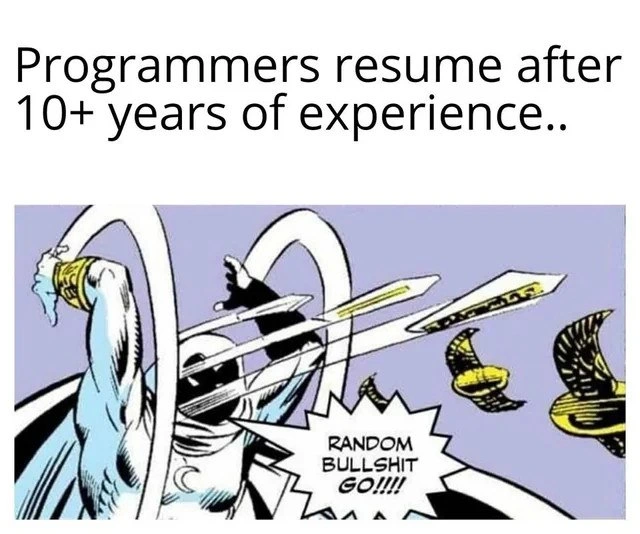
The picture shows a superhero throwing a bunch of moon-shaped blades and shouting “Random bullshit, go!” That’s a funny way to portray the idea of “throwing a bunch of random stuff out there.” It makes us laugh because it’s over-the-top and silly. In real life, a resume filled with too many buzzwords (fancy tech words) looks kind of funny and confusing, just like that hero’s wild attack. The core idea is simple: sometimes people who have been working a long time will try to impress others by showing everything they know, even if it comes out a bit crazy and jumbled. The meme jokes about this in a playful way, using the superhero scene as an example.
So, it’s funny because instead of calmly showing a few strong skills (like a hero carefully aiming one weapon), the experienced dev’s resume is like dumping out a whole toy chest or launching all the weapons at once. It’s an exaggerated, goofy image that helps us laugh about how silly it can be when someone overstuffes their resume with too much information. In short, the meme is saying: “After 10 years, some programmers have so many things on their resume that it looks a bit random and crazy – and that’s pretty funny.”
Level 2: Resume Keyword Soup
Let’s break this down in simpler terms. The meme shows a superhero (Moon Knight from Marvel comics) throwing a bunch of random weapons in every direction while yelling “Random bullshit, go!”. The top caption says “Programmers resume after 10+ years of experience…”. This is comparing an experienced developer’s résumé to that crazy scene of throwing random stuff. Why? Because after a decade in the tech industry, many programmers have a long list of technologies on their resume – sometimes so many that it feels random or excessive. It’s poking fun at how senior developers often list every programming language, framework, tool, or buzzword they’ve ever encountered, almost like a big scattershot attack of terms.
First, what do we mean by buzzword? In tech (and business in general), a “buzzword” is a popular or trendy term that people like to mention because it sounds important. For example, words like “Cloud Computing”, “Blockchain”, “Microservices”, “DevOps”, or “Machine Learning” have been big buzzwords in recent years. They represent real technologies or ideas, but they also get overhyped – everyone starts throwing them around, sometimes without fully understanding them, just to sound up-to-date or in-the-know. The meme jokes that a programmer with 10+ years experience will pack their resume with all these buzzwords (and more), kind of like dumping every spice you own into a soup. That’s why we call it a “buzzword soup” or “keyword salad”. It can come across as nonsense if it’s just a giant mix of unrelated terms.
Now, why would someone’s resume get like this after 10 years? Think about a developer’s career path: over time, they work on many projects and each project might use different technologies. For example, in one job a programmer might use Java, then a few years later they might switch to a job using Python, then later work with JavaScript for web development, and maybe learn some Cloud services (like AWS) along the way. After a decade, they’ve touched a lot of tools and languages. When they go to make or update their resume, they might feel the need to list everything they know or have used, to show their breadth of experience.
Also, there’s a practical reason: job listings and hiring practices. Many job descriptions list a whole bunch of required skills (sometimes unrealistically many!). For instance, a posting might say “Looking for a developer with 5+ years experience, proficient in C++, Python, and JavaScript, experience with React and Angular, knowledge of AWS, Docker, and Kubernetes, familiar with Agile methodologies.” That’s a lot, right? To get noticed by recruiters or HR, developers often ensure their résumé contains those keywords somewhere. In fact, companies frequently use software called Applicant Tracking Systems (ATS) to scan resumes for specific keywords. If your resume lacks the right buzzwords, it might not even be seen by a human. So, after years in the field, developers preemptively cram in every relevant term that might help. This strategy is humorously referred to as “keyword stuffing” or in developer jokes, “buzzword bingo.”
(Buzzword Bingo, by the way, is a joking reference to playing bingo with buzzwords: people in meetings or reading resumes tick off a box each time a cliché or buzzword is mentioned. If you get enough, you win – it’s a way to poke fun at how predictable corporate/tech talk can be.)
Let’s decode the meme’s text “Random bullshit go!” in this context. It’s basically saying “Here’s a bunch of random nonsense, take it!” On a senior programmer’s resume, that “random nonsense” would be the huge mix of technology names and jargon that they blast out. For example, a 10-year experienced developer’s skills section might look like: “Languages: Java, C#, Python, JavaScript, PHP, Ruby… Frameworks: Spring, .NET Core, React, Angular, Django… Tools: Git, Docker, Kubernetes, Jenkins… Methodologies: Agile/Scrum, TDD, DevOps…” and so on. To a recruiter or another developer, that list might feel overwhelming or unfocused – kind of like throwing a hundred different items and seeing what lands. That’s why the meme compares it to a superhero just hurling a barrage of random weapons.
The humor also comes from the idea that more isn’t always better. A resume is supposed to highlight what you’re best at. But here, the senior dev’s resume has turned into a cluttered inventory of everything, even if some of those skills are only minor or were used ages ago. It’s funny because we imagine the dev thinking, “I have no idea what this company really wants, so I’ll just list every tech buzzword I can – Random stuff, go!”. Many developers find this relatable; they’ve either seen resumes like that or felt pressure to beef up their own with extra buzzwords.
Additionally, the meme uses Moon Knight (the superhero) for a reason. In that comic panel (which is famously turned into a meme), Moon Knight is basically using a frantic, unfocused tactic – instead of one well-aimed throw, he’s tossing everything in desperation. That’s exactly the joke about a 10+ year resume: it can feel desperate or scattershot. The CareerHumor here is poking fun at how the tech industry rewards having lots of skills on paper, even if it’s a wild mess. It’s calling out both the developers who pad their resumes and the hiring process that kind of encourages this “shotgun” approach.
To someone early in their career (say 1-2 years in), their resume might be short and sweet: a few languages, maybe a couple of frameworks they’re comfortable with, some school or project experience. But when you reach 10+ years, you’ve possibly worked at multiple companies, each with different tech stacks, or you’ve had to learn new tools as the field evolved. For instance, if you started coding in 2010, you might have begun with HTML/CSS and PHP, then around 2012 picked up jQuery (a popular JavaScript library back then). By 2015, you might have been doing AngularJS or Ruby on Rails. Come 2018, you were learning about Docker containers and Kubernetes for deploying applications. By 2020, maybe you dipped toes into Machine Learning or microservices architecture, and in 2021 you’re exploring Cloud (AWS/Azure). And let’s say in 2022, you tried out React or Vue.js for front-end because it’s the new hot thing. That’s a lot of different tech over those years! If you list all of that, it’s going to look like a jumbled chronology of buzzwords. It tells a story of growth, sure, but out of context it appears as a “random tech word dump.”
The meme’s phrase “After 10+ years, dev resumes become buzzword shuriken storms of nonsense” is a colorful way to say that a veteran programmer’s resume often turns into a flashy yet somewhat nonsensical list. Shuriken are throwing stars (ninja weapons), and in the image those crescent blades look like shuriken. So, a “buzzword shuriken storm” implies a storm of sharp buzzwords being thrown out. It’s nonsense in the sense that no one person can truly be master of all those things at once; some of it might be fluff or old experience. But it’s there on the resume anyway, much like a dramatic over-the-top attack.
In simpler terms, imagine you’re trying to get a job by impressing someone with all the things you know. If you’ve been around long enough, you start just naming everything — hoping the interviewer or HR will latch onto the one thing they care about. It’s a bit scatterbrained, and that’s the joke: experienced developers sometimes feel the need to act like a jack-of-all-trades on their CV, and it can border on the absurd. The meme uses humor to highlight a real tendency in the tech world, where quantity often seems to win over quality in résumés (at least to applicants – whether that’s effective is another story).
To sum up this level: The meme is ridiculing the way a developer’s resume can look after many years in the field. It’s stuffed with buzzwords (trendy tech terms) to the point of looking chaotic or silly, much like a superhero blindly throwing a bunch of random weapons. People working in tech find it funny because it’s a bit too real – they’ve seen it or done it. It highlights the pressure in the industry to keep up with IndustryTrends_Hype and to advertise a wide range of skills, even if it comes off as “random nonsense”. It’s career humor about how we present ourselves after years of chasing the next big thing in technology.
Level 3: Buzzword Bingo Blitz
In the meme’s top panel, the caption “Programmers resume after 10+ years of experience..” sets the stage. Below, we see Moon Knight (a masked Marvel hero) unleashing a frenzied volley of crescent darts and batons while yelling “RANDOM BULLSHIT GO!!!!”. This chaotic attack perfectly satirizes what a senior developer’s résumé can become: a buzzword shuriken storm of every technology, framework, and methodology they’ve ever touched. After a decade in tech, many developers have ridden multiple industry hype cycles – from monoliths to microservices, jQuery to React, on-prem to cloud. Each new trend or tool leaves its mark on their CV. The result? A dense list of buzzwords and acronyms, flung out in all directions, hoping one will hit the target (or rather, impress a recruiter). It’s a classic case of “buzzword bingo”, where resumes and interviews turn into games of checking off trendy terms. Seasoned devs swap war stories of having to cram every popular tech onto their profile just to get a foot in the door. The meme humorously exaggerates this: our hero isn’t aiming carefully – he’s just tossing everything he’s got. Likewise, a 10+ year résumé sometimes reads like a random grab-bag of tech “experience”, from DevOps to Blockchain to Agile to NoSQL, whether or not those skills are deep or relevant to the job at hand.
Why does this happen? The cynic in me (and many battle-weary developers) will tell you it’s largely driven by hiring practices and the nature of tech careers. In the Career_HR realm, companies often filter candidates through automated systems and recruiters who keyword-match resumes to job descriptions. If a job post asks for experience with AWS, Kubernetes, Docker, React, and CI/CD, guess what a senior dev’s resume starts to look like after a while? They’ll make sure every one of those terms (and then some) appears somewhere on the page. After 10+ years, a developer has likely worked on a dozen projects using different stacks. They’ve survived legacy code in one role, built a shiny microservice in the next, maybe dabbled in machine learning on a side project, and picked up some DevOps tooling because their team was understaffed. Each time they switch jobs or update their CV, there’s pressure to tack on the latest hot tech keywords to remain competitive. Over time, this accumulates into a “buzzword soup” – a dense broth of acronyms and jargon swirling around. The meme crystallizes that absurdity: Moon Knight isn’t deploying a precision tool; he’s launching every gizmo in the arsenal simultaneously. That’s the senior dev’s CV after a decade: less a sharp-edged samurai sword, and more a shotgun blast of tech keywords, hoping at least one projectile impresses the target audience (hiring managers).
This resonates as RelatableHumor because any veteran developer has seen or created a resume like this. You open someone’s LinkedIn or CV and it’s “Random Tech Go!!!” — a long list that might read: Kubernetes, Docker, AWS, GCP, Azure, Terraform, Ansible, React, Angular, Vue, Node.js, Django, Flask, Ruby on Rails, C#, Java, Python, Go, Rust, SQL, NoSQL, GraphQL, REST, SOAP, Kafka, Hadoop, Spark, Agile/Scrum, TDD, CI/CD… and on and on. It’s like an overstuffed résumé piñata; whack it and a bunch of unrelated tech buzzwords fall out. Sure, each term on its own is meaningful – maybe the dev did use all these at some point – but together it can sound incoherent or exaggerated. The meme lampoons that incoherence. Moon Knight’s battle cry of “Random bullshit!” could just as well be a senior dev proudly proclaiming their skillset in an interview, only for the hiring panel to wonder how all those pieces fit together.
Let’s be honest: part of this comes from survival instinct in a fast-paced industry. We even joke about CV-driven development – choosing projects or tools not only because they’re the right tool for the job, but because they’ll look good on your CV. 🙃 After 10 years, the average developer has accumulated a graveyard of obsolete and current skills. Instead of dropping the outdated ones, many just keep adding more. The logic is, “Why not list everything I know? Who knows what the employer is looking for.” It’s a “throw everything and see what sticks” strategy – exactly what Moon Knight is doing with those thrown weapons. From the perspective of a grizzled dev (hello, CynicalVeteran here), it’s both amusing and a little tragic. We’ve seen job postings that basically demand a one-person tech army (“Must have 10+ years in Java, Python, JavaScript, C++, experience with AWS, Azure, and GCP, AI/ML knowledge, mobile development, and willing to be on-call 24/7”). To face those absurd expectations, you arm your resume to the teeth with keywords, rationality be damned. If you don’t mention a technology, you risk being filtered out by the almighty Applicant Tracking System (ATS), which is often just a glorified regex or keyword scanner. The meme’s “GO!!!!” captures that urgency — you fling out all your skills in the hope that one or two hit the hiring manager’s bullseye before your application is tossed aside.
To illustrate just how overloaded these resumes can get, imagine a snippet from a 10-year veteran’s CV:
- Languages: C, C++, Java, C#/.NET, Python, JavaScript/TypeScript, Ruby, PHP, Go, Rust (toy project),
Visual Basic 6 - Frameworks & Libraries: Spring, ASP.NET, Rails, Django, Flask, Node.js, Express, AngularJS, Angular 14, React, Vue, jQuery,
Struts, Boost, Qt - Databases: MySQL, PostgreSQL, Oracle, MongoDB, Redis, Cassandra, GraphQL (okay, that’s an API tech, but it still gets listed),
MS Access - DevOps/Infra: AWS, Azure, GCP, Docker, Kubernetes, Jenkins, Terraform, Ansible, CI/CD pipelines, Linux, serverless architectures, Kubernetes (yes, listed twice for good measure 😜)
- Methodologies & Other Buzzwords: Agile (Scrum/Kanban), TDD, BDD, DevOps culture, Microservices, Blockchain, IoT, Big Data, Machine Learning, NFT, AI, and “synergy” (just kidding about that last one… mostly).
It’s both impressive and ridiculous. No human can be deeply expert in all of these, just like no hero realistically throws every weapon with perfect accuracy. But on paper, it can look like this superhero of a developer who “knows it all.” The humor is that veteran devs themselves chuckle at this practice – we know it’s nonsense to some degree, but we feel compelled to do it. It’s a defensive maneuver in the job market. If the industry is going to reduce me to a set of buzzwords, I might as well give them a truckload of buzzwords. Thus, the BuzzwordBingo resumes keep flying around.
The Moon Knight meme panel screaming “Random bullshit go!” encapsulates the frustration and irony perfectly. It’s as if the senior dev, geared up with years of disparate tech experiences, finally just says “Alright, time to update my resume… RANDOM BUZZWORDS, GO!” and slings every tech term onto the page in one go. Each thrown crescent in the image could be a keyword: one shuriken is labelled “Cloud”, another “SQL”, another “Kubernetes”, one boomerang screams “Agile Coach”, another says “GraphQL” — a flurry of sharp buzzwords flying outward. Anyone who’s been in the industry long enough recognizes this resume inflation phenomenon. It’s both a badge of honor (look at all I survived!) and a running joke (did I really claim proficiency in all this?). The meme exaggerates it to comedic effect, but it’s poking fun at a real truth in developer careers and hiring trends.
This also hints at an underlying commentary: the tech industry’s obsession with hype. Over 10 years, fads come and go. There was a time when simply having “AJAX” or “Web 2.0” on your resume made you cool. A few years later it was “Big Data” and “Hadoop”, then “DevOps” and “Docker”, then “Microservices” and “Kubernetes”, and lately “Blockchain” and “AI/ML”. A savvy dev keeps up – or at least sprinkles these terms on their resume to signal they’re not a dinosaur. The IndustryTrends_Hype tag is spot on: much of that random resume jargon is driven by hype waves. We collectively chuckle because we know some of those words are just fluff or were included after a single weekend tutorial. But ironically, those fluff entries can make the difference in getting a callback. It’s a perverse game and everyone knows it – hence the dark humor. The Cynical Veteran perspective is basically: “Sure, I’ll list Kubernetes and Terraform on my resume. I deployed hello-world with them once – close enough, right?” That’s the wink-nudge truth behind many a bulging senior CV. We laugh because it’s true 👴💼.
It’s worth noting that this is a shared joke even among hiring managers and recruiters. They’ll receive these résumés that practically flex every technology under the sun. They know and we know that no single person could be deep in all of it. But appearances matter in hiring. So the game continues. Everyone is effectively playing Resume Keyword Pokémon – gotta catch ’em all! The meme’s absurd visual of a hero randomly flailing weapons captures how scattershot this approach is. It’s not targeted like “I am an expert in X, Y, Z”; it’s “I’ve done A, B, C, D…X, Y, Z, and also L, M, N, just in case!” Senior devs often bond over this silliness: “Remember when you could fit your skills on one line? Now it’s a whole page of jargon.” As a battle-scarred coder, I’ve seen colleagues literally keep old skills in tiny font at the bottom of their resume just to not lose that keyword (looking at you, <font size="1">Assembly language</font> hidden in the corner). It’s simultaneously strategic and comical.
To further highlight how mechanical this can get, consider a pseudo-hiring filter script scanning resumes:
required_keywords = ["java", "python", "react", "kubernetes", "aws", "docker", "agile"]
resume_text = candidate_resume_text.lower()
score = sum(1 for word in required_keywords if word in resume_text)
if score >= 5:
shortlist(candidate) # Resume passes the keyword threshold
else:
reject(candidate) # Not enough buzzwords, oops
The above snippet is a tongue-in-cheek representation of how Applicant Tracking Systems often work: a simple keyword count becomes the gatekeeper of your career. It’s an exaggeration (real systems might be a bit more sophisticated… maybe), but not far from the truth. No wonder experienced devs feel compelled to shotgun-blast their resume with every tech term imaginable. The meme exaggerates it as “random bullshit”, implying even the hero knows a lot of it is arbitrary. That’s the senior perspective: after 10 years, you accumulate plenty of legitimate knowledge and a healthy sense that much of the hiring process is B.S. So you lean into it and put on a show – “You want buzzwords? I’ll give you buzzwords!” It’s a defiant bit of comedy born from the frustrations of tech careers.
In summary at this level: The meme hilariously captures a universal DeveloperHumor moment. A seasoned developer’s resume can become an everything-and-the-kitchen-sink inventory, and the Moon Knight: “Random bullshit go!” panel is a perfect metaphor. It skewers the absurdity of overstuffed résumés and the industry’s proclivity for buzzword bingo, while also hinting at the survival tactics devs use in a hype-driven job market. We laugh (perhaps a bit nervously) because we’ve all been Moon Knight in that image at some point: tossing out every skill we’ve got, praying something sticks – and kind of aware that it’s all a bit, well… bullshit.
Description
A meme built on the 'Moon Knight Go!' comic panel. The top text on a white background reads, 'Programmers resume after 10+ years of experience..'. Below this is a cropped comic book panel depicting the Marvel superhero Moon Knight, in his white and black costume, energetically throwing a handful of various crescent-shaped darts and other projectiles. A starburst-shaped speech bubble originating from him contains the all-caps phrase, 'RANDOM BULLSHIT GO!!!!'. The meme humorously portrays the resume of a seasoned developer not as a refined, curated document, but as a chaotic barrage of every technology, language, framework, and buzzword they've ever encountered. This approach is a cynical but relatable take on trying to satisfy automated resume scanners (ATS) and the ever-expanding list of requirements in job descriptions
Comments
12Comment deleted
After 10 years, your resume evolves from a document into a denial-of-service attack against a recruiter's keyword filter. You're not just listing skills; you're proving you survived two dozen hype cycles
Updating my 15 -year résumé is literally `history | tr ' ' '\n' | sort -u >> skills.md` - just spray the buzzword shurikens and let the ATS guess my actual job
After a decade in tech, your resume reads like a museum catalog of deprecated frameworks, sunset APIs, and that one COBOL migration you did in 2019 that somehow makes you a 'blockchain expert' - because at this point, you've touched everything from jQuery to quantum computing simulators, and recruiters can't tell the difference anyway
After 10+ years, a senior engineer's resume becomes a archaeological dig site of dead frameworks, deprecated APIs, and technologies that peaked during the Obama administration. You list everything from jQuery to microservices to blockchain to AI/ML - not because you're an expert in all of them, but because you've survived them. The real skill isn't the tech stack; it's knowing which buzzwords will pass the ATS filter while maintaining enough self-respect to not claim 15 years of experience in a 7-year-old framework
After a decade, the resume becomes a Bloom filter for ATS - happy to accept false positives as long as every Kubernetes/Kafka/GraphQL token hashes in
After 10+ years, your resume's secret weapon: Turning 'herded cats on a monolith rewrite' into 'orchestrated distributed bullshit at scale.'
After 10+ years, a résumé is tuned for recall over precision - a Bloom filter of buzzwords optimized for ATS; the hiring manager can debug the false positives later
I think it other way around actually. You remove all random stuff, cause you have more than enough concrete experience Comment deleted
real. Comment deleted
Because it's been "random bullshit go" for the most part of these 10 years, goddamnit 😂 Comment deleted
Based Comment deleted
Relatable Comment deleted