Skip to content
DevMeme
4676 of 7435
A Developer's Early Journey: A Bite of Every Language, Mastery of None
Learning Post #5126, on Apr 12, 2023 in TG

A Developer's Early Journey: A Bite of Every Language, Mastery of None

Why is this Learning meme funny?

Level 1: Trying Every Flavor

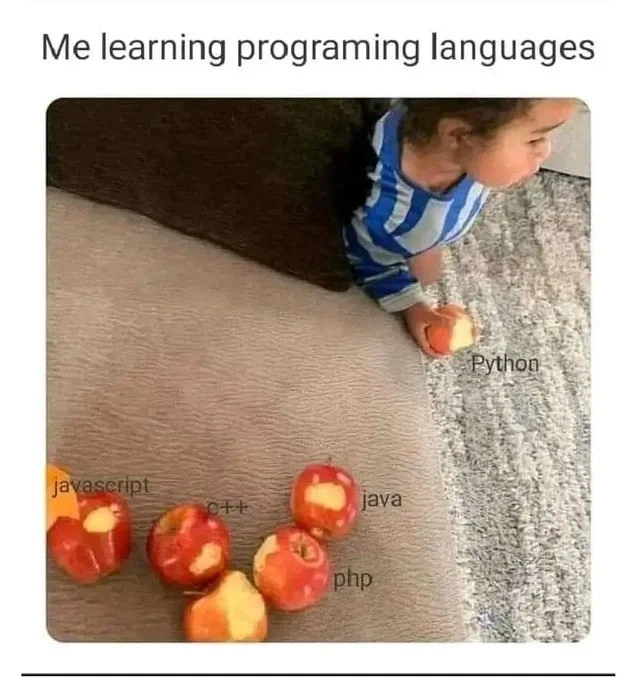
Imagine you’re at a big dessert table with lots of different cakes and candies. Everything looks so yummy that you can’t decide what to eat first – so you decide to try a bit of everything. You take one bite of a chocolate chip cookie, then one bite of a strawberry cake, then a lick of a lollipop, then a spoon of ice cream, one after another. In the end, you’ve tasted many flavors, but you never actually finished any single treat! It’s a little silly – you have a plate full of desserts each with one bite missing, and you’re not really full because you didn’t stick with one long enough. This meme is like that, but with coding. The little kid in the picture is like a new coder who is very excited about all the programming languages (the apples stand for those languages). The kid takes a bite from each apple one by one, just like someone trying one small lesson in each new coding language and then moving to the next. It’s funny because the child’s behavior is cute and chaotic – and it reminds us of how, when we’re really excited and curious, we sometimes jump from one thing to another without finishing. The feeling behind the joke is “I want to try EVERYTHING!” even though, in the end, we might have a bunch of half-eaten apples and not a whole apple in our tummy. In simple terms: the meme is showing the joy and goofiness of being so eager to learn that you end up sampling everything but not consuming any one thing completely. And anyone who’s ever been excited to learn a bunch of new things at once can smile and say, “Yep, I’ve done that!”

Level 2: Bite-Sized Learning

On a more concrete level, this meme is about learning programming languages and the tendency to jump between them without sticking to one. The toddler in the picture represents a beginner coder, and the apples stand for different programming languages. Each apple is labeled: one for JavaScript, one for C++, one for Java, one for PHP, and one in the child’s hand labeled Python. The kid has taken a single bite out of each apple and then moved on to the next. Likewise, many novice developers try out multiple languages one after the other – they write a little bit of code in one language, then get distracted or excited by another language and switch, leaving behind a trail of partially learned languages.

Let’s break down the languages shown, and why a learner might pick them up or put them down quickly:

  • JavaScript: A very popular language, especially for making web pages interactive. It runs in web browsers, which means you can see results instantly – great for beginners who want quick feedback. For example, you can write console.log("Hello, world"); in a browser console and immediately see the output. But JavaScript can be confusing once you go beyond the basics. It’s dynamically typed (you don’t declare variable types) and has some odd behaviors (like how 0 == "0" is true but 0 == [] is also true, which is not obvious at first!). A newcomer might start with JavaScript because it’s everywhere, but after a small bite (maybe a simple button click script), they might get tripped up by these quirks or by the complexities of the web (HTML, CSS, and JavaScript all together) and wander off to try something else.
  • C++: A powerful compiled language often used for games, engines, and high-performance software. Beginners are drawn to C++ when they hear it’s what big software like operating systems or game engines are built with. Initially, one might try a simple C++ program using #include <iostream> and std::cout << "Hello, World";. That prints “Hello, World” to the console – doable enough. But C++ has a steep learning curve: you have to manage memory (using new and delete or smart pointers), deal with complex syntax, and compile your code with a compiler program. It’s easy for a beginner to get frustrated by cryptic compiler errors or a program that crashes because of a bad pointer (for instance, using memory incorrectly can cause a crash called a segmentation fault). So a student may take one bite of C++ (learn a bit of syntax, struggle with a small program) and decide, “hmm, maybe I should try an easier language next.”
  • Java: A well-established language often taught in computer science classes and used in many enterprise (business) applications. Java code is compiled to bytecode and runs on the Java Virtual Machine (JVM), which is a lot of technical setup for a beginner, but many tutorials help with it. A typical “Hello, World” in Java looks like:
    public class Hello {
        public static void main(String[] args) {
            System.out.println("Hello, World");
        }
    }
    
    As you can see, there’s quite a bit of structure (a class, a main method, System.out.println to print). For someone new, Java might feel verbose and heavy – there’s a requirement to understand concepts like classes and static methods from the start. However, Java is also appealing because it’s statically typed (you must declare the type of each variable, which can prevent some errors) and it’s known for “write once, run anywhere” portability. A beginner might attempt Java because it’s seen as a serious language or because an intro course uses it, but after writing a simple program or two, they might get impatient with how much code is needed for simple tasks. The meme’s single bite out of the Java apple represents that scenario: you learned a bit of Java (maybe got a simple program running), then decided to move on to something that feels less cumbersome.
  • PHP: A scripting language primarily used for server-side web development. PHP code can be embedded in HTML pages, which made it very accessible for creating dynamic websites quickly – one reason it powered platforms like WordPress, and many beginners in the 2000s started with it. An example usage is writing <?php echo "Hello, World"; ?> inside an HTML file and opening it on a PHP-enabled server to see the greeting on a webpage. PHP has a low entry barrier (you can get results with simple scripts), so a newbie might take a bite because it’s straightforward to connect a webpage to a script. However, PHP has its own oddities; for instance, function names and argument orders can feel inconsistent (strpos vs str_replace, etc.), and historically people criticized it for encouraging quick-and-dirty code. These inconsistencies can confuse new learners, especially if they’re reading mixed-quality tutorials. In the meme, the partly eaten PHP apple suggests someone tried making a basic website or form, then dropped PHP perhaps due to confusion or hearing “PHP isn’t cool anymore” chatter, and went looking for a different solution.
  • Python: A high-level programming language known for its clean syntax and readability. Python often tops the list of beginner-friendly languages – many learn it as their first language nowadays. You can write your first program as simply as:
    print("Hello, World")
    
    …and that’s a complete program that prints to the screen. No need for special structure like Java’s classes or explicit compile steps; you just run the script with the Python interpreter. Python is interpreted, meaning you run code directly without a separate compile step, and the interpreter executes each line. It’s dynamically typed and very flexible. A key feature (and potential stumbling block) is that Python uses indentation (spaces or tabs) to define code blocks instead of curly braces or keywords. This makes code visually clean, but if a beginner mixes tabs and spaces or mis-indents, the code won’t run. Still, Python’s design is very forgiving and intuitive for newcomers – you usually get clear error messages and can accomplish a lot with little code. In our meme, the child is holding the Python apple, likely indicating it’s the current favorite. After tasting the others, many beginners stick with Python longer because it yields quick, satisfying results (like small games, simple data analysis, or automation scripts) without a lot of fuss. It’s often the language that beginners actually complete a first real project in.

Now, why is this scenario so relatable for developers, especially those learning to code? It’s because many people have a learning journey exactly like this:

  • You start with one language (maybe you heard “JavaScript is the language of the web”, so you try that).
  • Then you hit a roadblock or see something cooler. Perhaps you run into difficulty understanding JavaScript’s asynchronous nature or its strange behavior with types, and then you hear someone say “Python is much easier!” So you switch to Python.
  • While doing Python, you read that “learning C++ makes you understand how computers really work,” so you take a bite of C++ to be a “real programmer.” Soon, you find it quite challenging and time-consuming to even compile things.
  • Next, maybe a friend mentions they got an internship and they mostly use Java at work, so you feel you should know Java too—chomp, another apple.
  • If you’re interested in web development, you might also sample PHP when tinkering with a WordPress site or an old tutorial, since it was historically big in web backends.

This learning curve can feel like a series of small hills rather than one big climb because you never stay on one path long enough to hit the steep part. A learning curve means how hard it is to learn something over time; a steep curve means it suddenly gets hard. What happens to many beginners (depicted by the meme) is that as soon as one language’s curve steepens, they hop to a new gentle slope in another language. For example, instead of pushing through C++ pointer logic (steep hill ahead!), they switch to the easier terrain of Python. The downside is they accumulate lots of half-finished knowledge. It’s like knowing a little of many spoken languages: “I can say hello in Spanish, count to 10 in French, and ask for coffee in Italian, but I’m not fluent in any.” In coding terms, they might be able to print output or write a basic loop in several languages, but can’t yet build a full program in any one of them.

The meme’s visual metaphor with the apples makes this idea concrete. Apples are something you normally finish one of before starting another (most people eat one apple fully instead of nibbling all and leaving them out). Seeing a child with five apples each with one bite missing is silly in a literal sense – it’s a mess and none of those apples are actually eaten. Translating that to coding: it’s pointing out the impractical way some of us try to “consume” knowledge. We start consuming one programming language, then drop it for the next, ending up with a table (or GitHub account) full of unfinished little learning projects. The text “Me learning programing languages” directly tells us the child is representing the meme creator’s own habit of learning languages in a bite-sized, incomplete way. The humor has an element of self-deprecation – the meme creator is admitting “Haha, I do this!” in a lighthearted way that others find funny because they’ve done it too.

Some key real-world insights and terms here:

  • Programming languages: These are formal languages used to give instructions to a computer. Each one has its own syntax (rules and structure of code) and often its own purpose or domain where it shines. For instance, JavaScript is great for web pages, while C++ is great for high-performance programs. Learning a new programming language means learning those rules and the mindsets or paradigms (like object-oriented, functional, procedural, etc.) that come with it.
  • Compiled vs Interpreted: A compiled language (like C++ or Java) is transformed by a compiler into machine code (or bytecode) before it runs, which can make it run faster but requires that compile step and tends to be stricter about errors upfront. An interpreted language (like JavaScript as it runs in the browser, Python, or PHP) is executed on the fly by an interpreter program, which can be more flexible and easier to test quickly (no separate compile step each time), but might run a bit slower and you often find errors only when that line of code is reached.
  • Statically typed vs Dynamically typed: This refers to whether you have to declare types for your variables and whether those types are checked before the program runs. Java and C++ are statically typed, meaning if you say int x = 5; you’ve declared x must always hold an integer; if later you try to assign a string to x, the program won’t compile. Python, JavaScript, PHP are dynamically typed, meaning you can just do x = 5, then x = "hello" later, and it’s allowed (the type of x can change). Dynamic languages are often easier for beginners to start with (less upfront detail), but the flexibility can lead to runtime errors or unexpected behavior if you’re not careful. Each approach has pros and cons, and a learner jumping between them has to adjust their thinking each time.

For a junior developer or someone learning to code, this meme is a friendly reminder (or warning!) that while it’s awesome to explore different languages, you should also try to stick with one long enough to build something meaningful. Every language requires a certain investment of time to really understand its idioms and ecosystem (its tools, libraries, and best practices). If you constantly reset to “Hello, World” in a new language, you’re always at the shallow end of the pool. The apples in the image are all low-hanging fruit (pun intended) – easy to grab, take a quick taste, and drop. The meme encourages a laugh because we recognize that feeling of wanting to taste everything at once.

In summary, at this level we understand the meme as a playful take on the learning-to-code journey. It uses the apples and toddler to show what dabbling in many programming languages looks like. Each labeled apple corresponds to a real programming language that new coders commonly try out. The single bite from each apple represents starting to learn each language just a little. The child’s behavior of hopping from one apple to the next mirrors a beginner coder’s short attention span or excitement in hopping from one language to another. This is common and relatable: many of us have done a “language hopping” spree when we weren’t sure what to focus on. It’s funny to developers because we see our younger selves (or current over-caffeinated selves) in that toddler, surrounded by half-eaten projects and code tutorials, enthusiastically messy but definitely learning something along the way.

Level 3: One Byte Stand

At the highest level, this meme pokes fun at the shiny new language syndrome in software development. We see a toddler who’s taken a single bite out of multiple apples labeled with programming languages. It’s an absurdly relatable scenario for seasoned devs: the junior version of ourselves eagerly sampling JavaScript, C++, Java, PHP, and now Python, but never finishing any of them. The caption "Me learning programing languages" (with "programming" ironically misspelled, a subtle nod to newbie energy) perfectly frames the joke. The humor works because so many of us have been that over-enthusiastic learner, jumping between languages like a context-switching CPU thread and ending up with null nothing concrete to show. We recognize the pattern of dabbling in multiple languages – a bit of JavaScript for a web idea here, a dab of C++ for a school project there – leaving behind a trail of half-written “Hello, World” scripts (the developer equivalent of partially eaten apples).

From a senior developer’s perspective, the meme highlights how short attention span coding sabotages deep learning. Each apple represents a distinct technology ecosystem with its own syntax and paradigm. Taking a single bite from an apple equates to doing the easy 5-minute tutorial in a language, then getting distracted by the next shiny tech trend. The result? You experience a dozen “flavors” of syntax but never digest the full meal of building something substantial. The industry inside-joke here is that true proficiency requires finishing at least one apple – i.e., sticking with one language long enough to build real projects – but early on many of us were guilty of one-byte stands with every language that caught our eye.

This comedic combination of elements resonates because each of those labeled languages has a reputation that might cause a newbie to take a quick taste and move on:

  • JavaScript – The bright red apple in the bunch, ubiquitous for web development. It’s sweet and accessible at first bite (you can pop open a browser and start coding without heavy setup), but it has some quirky aftertaste. Many beginners nibble on JS for instant gratification, only to stumble over its weird language quirks (like undefined vs null, or why [] + [] results in an empty string). That sudden confusion can send a learner scurrying to the next apple.
  • C++ – This one’s like a tough-skinned, hard apple. It promises low-level power and performance (games, engines, OS level coding!), but one bite in and you hit a seed: manual memory management and complex syntax. Beginners often chomp through a simple "Hello, World" in C++ only to choke on pointers or mysterious compiler errors (segmentation fault, anyone?). It’s no surprise a newbie might spit this out and grab a “softer” fruit next time.
  • Java – A hefty, fibrous apple that’s very filling but takes effort to chew. Popular in academia and enterprise, it demands a lot of boilerplate ceremony (classes, static types everywhere, public static void main just to print text) for a first program. A student taking a bite of Java might get nutrients in the long run (strong object-oriented principles, widespread use), but it can feel bland and heavy for someone craving quick results. After wrestling with the JDK and fighting a compile error or two, an impatient learner might drop this apple halfway and reach for something more instantly gratifying.
  • PHP – The somewhat bruised apple of the bunch. It’s actually pretty easy to take a bite (just embed some code in a .php page and refresh your browser), which attracted countless beginner web developers in its heyday. But the flavor can be inconsistent – PHP has quirky function naming conventions, a mix of paradigms, and a reputation for messy code if you’re not careful. A newcomer might make a simple form or WordPress tweak with PHP (a small bite) but then hear "PHP is outdated" or encounter confusion with $weird_syntax, prompting them to drop it for a trendier fruit without finishing.
  • Python – The crisp, sweet Golden Delicious of programming languages. Its appeal is that it’s easy to bite into: clean English-like syntax, no need for semicolons or curly braces, and immediate results running scripts. It’s often recommended as a first language because of its gentle learning curve. In the meme, the toddler is currently holding the Python apple, suggesting this is the flavor they’ve settled on (for now!). After sampling the others, Python’s simplicity and versatility (from web to data science) might finally keep the young dev munching longer than one bite. But seasoned developers know even Python will be dropped if a new enticing apple (maybe Go, Rust, or some new framework) rolls into view.

Through these apples, the meme encapsulates that learning-to-code journey where enthusiasm outpaces focus. Each apple’s single missing bite humorously represents a half-finished project or cursory tutorial. The toddler’s carpet picnic of bitten apples is a perfect visual metaphor for the pile of abandoned GitHub repositories and half-read programming books that many of us accumulated early in our careers. It’s funny and a bit painfully true – a form of coding humor that is instantly recognizable. The senior dev chuckles because they remember being that toddler with a compiler: wide-eyed and hungry to taste every new language (especially those hyped on Reddit or Hacker News), yet ending up with lots of context-switching overhead and shallow knowledge. We’ve learned the hard way that constantly switching languages incurs a real cognitive context switching cost – much like an OS thrashing between threads – and that commitment (finishing one apple) yields deeper skill. But in hindsight, those frantic early experiments were a necessary phase of figuring out what we enjoyed and which tools fit which tasks. It’s both a satire of our impatient younger selves and a celebration of the exploratory spirit that drives people to become polyglot programmers eventually.

In essence, this meme lands so well because it exaggerates a common developer rite of passage: the buffet-style sampling of programming languages. It gently mocks the contradiction of being a “Jack of all syntax, master of none”. Seasoned engineers smile (or wince) because we’ve seen this movie before – either lived it ourselves or watched newbies struggle with it. Yet, there’s also an endearing optimism in the toddler’s pose: a genuine excitement for learning. The image is saying, “Yes, I’m all over the place, but I’m learning!” And every experienced coder knows that enthusiasm – however scattered – is the spark that eventually lights the path to expertise. This blend of truth and humor makes the meme highly relatable in developer culture.

Description

A meme humorously depicting the common struggle of learning to code. The top text reads, 'Me learning programing languages' (with 'programming' misspelled). The image shows a young toddler in a blue and white striped shirt, standing on a grey carpet next to a beige couch. The toddler is holding a half-eaten apple labeled 'Python'. On the floor are five other red apples, each with bites taken out of them, labeled 'javascript', 'c++', 'java', and 'php'. The visual metaphor is clear: the toddler represents a new developer who starts learning multiple programming languages (takes a bite of each apple) but lacks the focus to master any single one, instead moving from one to the next. This perfectly captures the feeling of being overwhelmed by choice and the 'shiny object syndrome' that affects many newcomers to the tech industry


Comments

11
Anonymous ★ Top Pick This is how you end up with a resume that says 'Proficient in: Yes'. You can write 'Hello, World' in twelve languages, but your only production-ready skill is generating a perfectly-centered div in an empty HTML file
  1. Anonymous ★ Top Pick

    This is how you end up with a resume that says 'Proficient in: Yes'. You can write 'Hello, World' in twelve languages, but your only production-ready skill is generating a perfectly-centered div in an empty HTML file

  2. Anonymous

    Twenty years in: HR calls my dozen half-bitten language PoCs a “skills matrix,” the slide deck calls it a “polyglot strategy,” and ops just call it “nothing we can run in prod.”

  3. Anonymous

    After 15 years in the industry, I've realized the bitten apples aren't a learning problem - they're architectural decisions. Each one represents a microservice written in a different language because 'it was the best tool for the job' according to whoever was reading Hacker News that week

  4. Anonymous

    The meme perfectly captures the polyglot programmer's journey: you start with Python thinking 'this is elegant and clean,' then JavaScript introduces you to callback hell and prototype chains, C++ reminds you that memory management is a thing, Java makes you question why everything needs to be a factory factory, and by the time you reach PHP... well, let's just say the fruit has seen better days. The real kicker? After 15 years, you realize they're all just different ways to move bytes around, but you'll still have strong opinions about which damaged fruit tastes best

  5. Anonymous

    All these apples taste similar until you realize each bite chooses a package manager - npm drama, Maven transitive hell, CMake rituals, or pip roulette

  6. Anonymous

    Senior polyglot lifecycle: C++ and Java stopped at hello-world, a JS POC marooned at node-gyp, and the Python test script quietly becomes the “temporary” migration job in prod

  7. Anonymous

    Tried them all for that perfect bite: JS async hell, C++ segfaults, Java verbosity, PHP footguns - Python's the only one without instant regret

  8. @azizhakberdiev 3y

    Where's HTML?

    1. @dst212 3y

      It's been directly thrown away

  9. MINe 3y

    I only love HTML🥰💔

  10. @lilfluffyears 3y

    But usually this is what recruiters want xD

Use J and K for navigation