Skip to content
DevMeme
4132 of 7435
The Elusive Heisenbug
Bugs Post #4507, on Jun 21, 2022 in TG

The Elusive Heisenbug

Why is this Bugs meme funny?

Level 1: Problem Solved

Imagine you and your friends have a jar of cookies that none of you can open. You all try really hard, taking turns, making funny strained faces, but that jar’s lid is stuck super tight. Now, while you’re struggling, the one person who knows how to open it – say, your big brother – has been out of the house on a short trip. Finally, your big brother comes back home. He sees you all frustrated with the jar. He chuckles, takes the jar, and with one confident twist Pops! the lid loosens. Cookies for everyone! 🎉 You all feel so relieved and start cheering, because the problem that seemed impossible for you is suddenly gone, thanks to him.

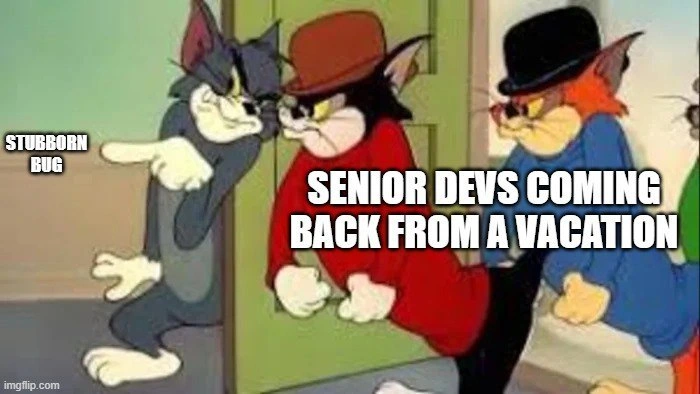
That’s exactly what this meme is saying, but with computer bugs and programmers. The stubborn bug is like that stuck jar nobody could open, and the senior devs coming back from vacation are like the big brother who just returned and easily fixed everything. It’s funny because it shows how sometimes a really tough problem waits for the right person to come and solve it. Everyone else was struggling and maybe a bit worried, but when the experienced helper arrives, the problem is solved almost instantly. The cartoon picture makes it extra silly by showing the two experienced characters literally pushing the troublemaker out the door. In real life, it just means the experts fixed the bug and everyone is happy and relieved, kind of like finally getting that jar open and enjoying those cookies. 🍪

Level 2: Calling the Experts

Let’s break this down in simpler terms. In software, a bug is a flaw or error in the code that makes a program act in ways it shouldn’t. Sometimes you encounter a stubborn bug – one that’s really hard to fix or keeps coming back despite attempts to squash it. In the meme, that stubborn bug is represented by Tom (the cartoon cat) who clearly does not want to go out the door. The ones doing the pushing are labeled “Senior devs coming back from vacation.” Senior developers are the more experienced engineers on the team. They’ve been around that codebase (and others) for a long time, so they often know all the ins and outs of the system. When they’re “coming back from vacation,” it means they were away for a bit, and presumably a tricky bug emerged or remained unresolved during that time. Now they’ve returned, and everyone is expecting them to fix the issue with their expertise. The meme humorously shows them as two tough cartoon cats physically forcing the bug out, as if the bug has no choice once the experts show up.

Why is this funny to developers? Imagine a real work scenario: a weird problem popped up in the software while the most knowledgeable person was out. The team tried their best to troubleshoot. Debugging (finding and fixing bugs) can be like detective work — you search through error logs, test different parts of the code, and try to figure out what’s wrong. Less experienced devs might spend days on this without success, especially if the bug is hiding in a tricky part of the system. Meanwhile, the experienced devs were away on holiday, perhaps sipping a drink on a beach, unaware that back at the office their teammates are pulling their hair out over this glitch. There’s a bit of playful irony here: of course the big bad bug shows up when the seniors are OOO (Out Of Office)! This is a common joking complaint in tech teams: major ProductionBugs love to surface at the worst times — like when the primary expert is absent.

Now, when the senior engineers finally return, the whole team breathes a sigh of relief. These seniors have probably tackled similar issues before or maybe they even wrote the code where the bug lives. They often can quickly pinpoint the cause. Maybe the program was crashing because of a null pointer exception in a rarely-used function, or a database query was super slow due to a missing index. A junior might not immediately see those, but the senior goes "aha!" right away. That moment is exactly what the meme shows in an exaggerated way: the strong cartoon cats (seniors) basically grabbing the problem (Tom, the bug) and yeeting it out the door. It’s visual shorthand for “we’ve finally gotten rid of that pesky issue.”

Let's clarify a few terms and ideas here:

  • Bug Triage: This is like medical triage but for software issues. The team reviews a new bug, determines how severe it is, and decides who should address it. In our context, they likely said, "This bug is really stubborn and critical, but only Alice (our senior dev) truly knows that part of the system. Let’s hold off major changes until she’s back."
  • On-call: Some teams have an on-call rotation, meaning one engineer is responsible for handling urgent production issues at any given time (even at night or weekends). If a major bug hits production while seniors are away, an on-call engineer might do a quick hotfix or a rollback to keep things running. A hotfix is a fast emergency change meant to patch the problem temporarily. But a hotfix might not fully solve the underlying cause; it’s more like putting a bandage on. The real cure often has to wait for someone who knows the system deeply (here come the seniors to the rescue!).
  • Institutional Knowledge: This is a fancy term for the understanding of a system that people gain over time working on it. For example, a senior dev might remember that the last time they saw a similar error message, it was due to a misconfigured setting in an unlikely place. That kind of “I’ve seen this before” knowledge isn’t in the documentation; it lives in the heads of experienced team members. In the meme scenario, the institutional knowledge gap is evident: while the seniors were gone, the team may have lacked some crucial piece of knowledge to fix the bug.
  • Debugging & Troubleshooting: For a newcomer, debugging can feel like trying to find a needle in a haystack. You know something's wrong (the program is crashing or giving wrong output), but you have to systematically find out where and why. This might involve checking logs (DebuggingFrustration is real when logs are sparse!), using a debugger tool to step through code, or adding print statements to see what’s happening. Junior devs are still building these skills and learning the system, so a complex bug can really stump them. Meanwhile, a senior dev often has a structured approach: they form a hypothesis (“maybe the user authentication token is null here”), test it, narrow down, and zero in on the cause. They make it look almost easy.

So, putting it all together in a narrative: The team has a stubborn software bug sticking around, symbolized by Tom who doesn’t want to leave. Everyone tried to push Tom (the bug) out the door but lacked the strength or strategy. Then the senior engineers return from vacation, and they are like, “Alright, step aside, we’ve got this.” They come in with confidence and deep knowledge, identify exactly how to squash the bug, and push that problem out decisively. The “bulldozing” implies they might employ a more drastic fix — maybe refactoring the code or rewriting the problematic part entirely (something less experienced folks might be hesitant to do). They’re not literally violent at work, of course 😄, but the cartoon captures the attitude: no more messing around, time to kick this bug out.

For a junior developer (or someone new to the industry), this meme is also a lighthearted hint at how teams operate:

  • Senior devs often act as mentors and problem-solvers for the toughest issues. When they’re away, things can feel a bit shaky if no one else has their level of insight into a given area.
  • It underlines the importance of team knowledge sharing. Ideally, even if Alice is on vacation, Bob or Carol should be able to handle the bug. But in practice, sometimes only Alice knows the magical incantation to fix it because maybe she initially wrote that complex piece of code. Teams try to avoid this by doing code reviews, writing docs, and cross-training, but it’s not always perfect.
  • Vacation aftermath: It’s common culture in many dev teams to jokingly fear taking a long vacation because “What if something breaks while I’m gone?” Conversely, folks left behind might jokingly or earnestly say, “We saved this nasty bug for you, welcome back!” – exactly what the meme visualizes.

The Tom & Jerry image is a classic, recognizable to many. Using it makes the meme immediately funny even before you read the text: you see poor Tom being booted out by two gangsters. In the show, Tom is often the troublemaker or at least in trouble. Here Tom is cast as the trouble itself (the bug). Those gangster cats are secondary characters from the cartoon known for being tough, which is a clever choice to represent senior devs—the tough problem-solvers. It’s an exaggerated cartoon way to show how a gnarly bug finally gets handled when the proper experts apply force (figuratively).

In summary, at this level: the meme jokes that when senior developers return from vacation, they will handle any stubborn bugs in the codebase with ease and authority, much to the relief of everyone else. It’s funny because it’s often true in real life teams, and it highlights how crucial experienced devs (the “experts”) are in debugging tough problems.

Level 3: The Bug Hit Squad

In this meme, two mean-looking cartoon cats in flashy suits (think gangster enforcers) are shoving a reluctant Tom (the famous gray cat) out the door. Tom is labeled "STUBBORN BUG," and the two tough cats are labeled "SENIOR DEVS COMING BACK FROM A VACATION." It's a hilarious visual metaphor for a scenario every seasoned dev knows too well: a persistent software bug that refuses to budge until the heavy hitters return to work. The humor here comes from exaggeration—senior developers are portrayed as mob enforcers literally booting the bug out of the codebase. This captures the relief and aggressive determination that often accompanies a senior engineer's return to a thorny issue.

On a deeper level, this is poking fun at institutional knowledge silos and the reality of bug triage in teams. Why did the bug linger? Perhaps only the seniors knew the system well enough to fix it, or others were nervous to make sweeping changes without them. Real-life debugging can feel exactly like this: a stubborn bug might resist all gentle attempts to fix it (multiple patch tries, numerous print statements or log spelunking) and then a senior dev strides in after PTO and resolves it in one fell swoop. It's equal parts impressive and comical. Seasoned engineers often have a mental catalogue of weird issues and production bugs they've seen over the years. They might recognize “Oh, this is that user encoding issue we patched last year” or have the debugging know-how to quickly corner the bug that's been eluding others.

There’s real truth in the meme’s subtext: teams sometimes tread water on a tough bug until the right expert is back on deck. This reflects the dreaded "bus factor" in software projects—when critical knowledge is concentrated in one person, and if they're unavailable (on vacation, out sick, etc.), progress stalls. Here, the bus factor bit the team; that nasty bug hung around waiting for the one who knows how to squash it. The senior devs are the cavalry, coming in with fresh energy (after vacation) and often a no-nonsense approach to troubleshooting. They might bulldoze through layers of legacy code or tear apart a convoluted module with the confidence of someone who's wrestled similar BugsInSoftware before. The image’s comedic violence (the bug being manhandled) mirrors how a returning engineer might take a forceful, focused stance to finally eradicate the problem: no more half-measures, they dive into the stack trace, add detailed logging, attach debuggers, and root-cause the issue with surgical precision.

From an operations perspective, this is a nod to OnCall_ProductionIssues nightmares: ever notice how the worst outages or bugs often occur when the experienced person is on vacation? Murphy’s Law of DevOps! The team might have been firefighting in the senior’s absence, applying temporary fixes or workarounds to keep systems running. Perhaps they even commented out a feature or restarted services every few hours as a stop-gap, all while counting down the days for the senior's return. It’s funny because it’s relatable tech humor—the instant the senior dev comes back, they drop their suitcase and immediately turn into a bug-squashing machine, much to everyone's relief. Picture an urgent Slack message: “Thank goodness you’re back! That login bug has been driving us crazy.” The senior, still sipping their post-vacation coffee, cracks knuckles and gets to work. Moments later, commit pushed, bug vanquished. The junior devs rejoice as if the SWAT team just saved the hostages.

This scenario also highlights the gap in debugging skills and context between team members. It’s not that junior or mid-level devs are incapable, but often the seniors carry historical knowledge of why the code is the way it is (the bizarre edge case, the third-party API quirks, the ancient curse legacy configuration from 2015). They’ve seen the Tom (bug) before and know how to grab it by the scruff. So, when they return from vacation, they can quickly apply a targeted fix that others didn’t think of. It's almost magical, except it’s really experience and familiarity at work. If we break down the “bulldozing” metaphor: sometimes debugging frustration among less experienced devs leads to cautious, iterative pokes at the problem (trying one thing after another). The senior dev, by contrast, might not hesitate to refactor a chunk of code or rewrite that fragile script entirely — the equivalent of those cartoon cats bodily throwing Tom out the door. They’ve earned the confidence to do that because they understand the system’s architecture and constraints deeply.

To seasoned developers, this meme also carries a wry lesson: knowledge sharing matters. The company shouldn’t have to halt serious bug fixes awaiting one person’s return. Ideally, code shouldn’t have secret areas only “Bob” or “Alice” can fix. But reality often laughs at idealism; tight deadlines and complex systems mean we rely on heroes from time to time. The meme’s comedic setup implicitly asks, “Why didn’t anyone else fix the bug?” and the answers hint at common industry pitfalls:

  • Knowledge silo: Perhaps the bug was in a module only the senior dev understood fully (e.g., the finicky payment gateway integration). Others were hesitant to touch it without breaking something else.
  • Limited debugging experience: The team might have seen the error but misdiagnosed it. Senior devs often have refined debugging techniques: binary-search through commits, deep familiarity with reading stack traces or using performance profilers, etc.
  • Risk aversion: In a high-stakes production issue, junior engineers might apply a safe workaround (restart the service, roll back to a previous version) rather than attempt the big fix which, if done wrong, could make things worse. They leave the bold move for when the senior returns.
  • Bandwidth and stress: If the issue occurred during off-hours, the on-call team may have been focused on damage control rather than permanent fixes. The senior coming back fresh can now do the thorough fix without the 3 A.M. pressure.

The meme exaggerates the moment of resolution for comedic effect, but anyone who's been that returning dev (or the team waiting for them) is chuckling knowingly. The phrase "bulldozing that stubborn bug" evokes an image of an unstoppable force meeting an immovable object—and the force winning. Senior devs are like that unstoppable force thanks to experience, while the bug’s “immovable” nature just reflects how stuck it was when less experienced attempts failed. It’s a celebration of SeniorEngineerLife: one minute you’re on a beach, the next you’re a bug bounty hunter back in action. The tech humor lands because it’s an exaggerated truth. We’ve all seen a critical fix frustrating everyone for days, then the vacationing expert logs in and says, “Oh, I see the problem,” and swiftly deploys a patch. Cue the team’s collective face-palm and laughter of relief.

To sum up this level: The meme humorously encapsulates a real software development dynamic – the cavalry of senior engineers returning to save the day, using their seasoned debugging skills and insider knowledge to troubleshoot and eliminate a stubborn bug that resisted all others. It’s funny, a bit cathartic, and a gentle reminder of both the power of experience and the pitfalls of relying too much on it.

# Before: the team tries a temporary workaround for the stubborn bug
while bug.is_active():
    restart_application()  # keep restarting to mitigate impact (not a real fix)

# After: senior dev returns and delivers a proper fix
bug.find_root_cause()      # identify the actual underlying issue
bug.apply_patch()          # squash it for good, no restarts needed
print("Bug solved! 🎉")

Description

This meme likely depicts the frustration of dealing with a 'Heisenbug' - a bug that seems to disappear or alter its behavior when one tries to study it. It might use a format like a character from a cartoon chasing a ghost, or a magician performing a disappearing act. The bug is there one moment, and gone the next, especially when a debugger is attached. This is a particularly maddening experience for developers, as it makes the bug incredibly difficult to reproduce and fix. The humor comes from the shared pain of hunting for these ghostly, elusive bugs


Comments

7
Anonymous ★ Top Pick A Heisenbug is a bug that's also a Schrödinger's cat. You don't know if it's there or not until you look, and by then it's already gone
  1. Anonymous ★ Top Pick

    A Heisenbug is a bug that's also a Schrödinger's cat. You don't know if it's there or not until you look, and by then it's already gone

  2. Anonymous

    That “stubborn” bug survived a week of war-rooms - then the seniors came back, ran one git blame, muttered “ah, 2017 me,” and flipped the env var still named TEMPORARY_WORKAROUND=true

  3. Anonymous

    The bug survived three weeks of junior devs adding console.logs everywhere, but it won't survive two seniors arguing about whether it's a race condition or a cache invalidation issue over coffee

  4. Anonymous

    The classic post-vacation experience: you return refreshed and ready to tackle that new feature, only to find production has other plans. That 'quick fix' deployed while you were gone has evolved into a Heisenbug that only manifests under load, disappears when you attach a debugger, and somehow passed all tests in staging. Now it's you and two other senior devs doing the distributed systems equivalent of wrestling a greased pig - except the pig is a race condition that's been costing the company $10k/hour in failed transactions, and management is asking for an ETA

  5. Anonymous

    PTO-driven debugging: the bug only reproduces while the staff engineer is out, then dies in 30 seconds when they return, purge the zombie cache, and flip the legacy flag nobody admits exists

  6. Anonymous

    Senior dev post-vacation: the bug had two weeks to entrench, but forgot the dev who wrote the original strace script in '09

  7. Anonymous

    PTO is basically an L1 cache flush for a senior engineer’s brain - come back, scan one trace, spot the missing await that spawned three sprints of “observability,” and ship a one‑line fix with a four‑page RCA

Use J and K for navigation