Skip to content
DevMeme
2672 of 7435
The Infinite Loop of Senior Developer Stress
MentalHealth Post #2952, on Apr 12, 2021 in TG

The Infinite Loop of Senior Developer Stress

Why is this MentalHealth meme funny?

Level 1: Leaky Bucket Brain

Imagine your brain is like a bucket holding water. Water is your memories and information. Normally, if the bucket is solid, it keeps the water safely. But now imagine you’re super stressed or really tired – that’s like your bucket getting holes in it. What happens? The water starts leaking out of the holes! You pour more water (more information or things people tell you) into the bucket, but it just drips out and doesn’t stay. This meme is joking that when a programmer is working while stressed, their brain becomes a leaky bucket for memories.

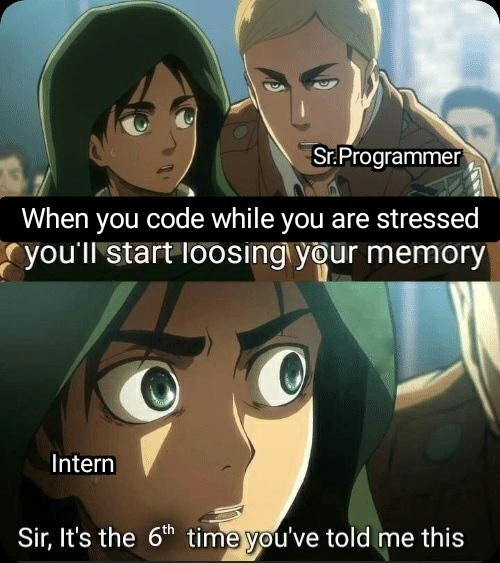
In the picture, a teacher-like figure (the senior programmer) is telling the student (the intern) a warning: “Don’t code when you’re stressed, or you’ll lose your memory.” It’s like a teacher saying “Don’t study when you’re exhausted, you won’t remember anything.” And the student, with a confused face, replies, “Sir, this is the 6th time you’ve told me.” That means the student already forgot that the teacher told him the same thing five times before! It’s a funny way to show that the teacher’s warning is true – the student is so frazzled that he can’t even remember the advice not to be so frazzled.

Why is this funny in a simple way? We’ve all had moments when we’re so overworked or anxious that we keep forgetting stuff. Like when you’re nervous about a test, and you keep asking your parent the same question, and they say, “I just answered that!” You didn’t mean to forget; your brain just leaked the answer because you were so worried. This meme takes that everyday “uh-oh, I forgot again” feeling and shows it in a big, dramatic cartoon scene. It’s saying: even big tough coders have the same problem – if they stress out too much, they forget what they’re doing, just like anyone else. The humor comes from recognizing ourselves in that forgetful intern and realizing, “Oh, I guess I really should calm down a bit when working, or I’ll be like a computer with a glitchy memory.” It’s a playful reminder that taking care of your mind (keeping your bucket patched up) helps you remember things and be a better coder (or student, or anything). So, the big idea is: being too stressed makes you forgetful, and that’s as useless as a leaky bucket – so we should try not to let stress poke holes in our brain bucket!

Level 2: Brain 404: Memory Not Found

Let’s break down the meme in simpler terms. The phrase “code while you are stressed” refers to those times when a developer is frantically programming under pressure – maybe there’s a tight deadline or a nasty bug in production. Stress in tech is a huge topic: being under pressure can lead to developer fatigue (feeling very tired and mentally drained) and even developer burnout (a state of chronic exhaustion and lose of motivation caused by long-term stress). When the meme says “you’ll start losing your memory,” it means that if you try to work in a very stressed state, you might become forgetful – like you can’t remember things you just did or were just told. This plays on the technical term “memory leak.”

In computer programming, a memory leak is a kind of bug where a program accidentally keeps using more and more memory without releasing it. Think of memory like a library of books: a program is supposed to check out some books (use some memory) and then return them when done (free the memory). If the program never returns the books, soon the library runs out of books for others! In a memory leak, the program forgets to give back memory to the operating system. Over time, the computer’s memory fills up because the program is hoarding it due to a mistake. This is bad because it can slow down or crash the program/computer. Developers consider memory leaks serious bugs, and we use tools to find them (like Valgrind for C/C++ code) or strategies to avoid them (like using smart pointers in C++ or relying on Java/Python’s automatic memory management).

Now, the meme jokingly compares that programming problem to a human problem: being so stressed that your brain’s memory “leaks” away. Of course, people don’t literally leak memory like a computer does. What it means is you have trouble remembering things when you’re under too much pressure. Maybe you have experienced this: imagine you pulled an all-nighter trying to finish a project or crammed for an exam. The next day, someone asks you a simple question or reminds you of something they told you, and you go “Huh? You told me that? I don’t remember at all!” It’s not that you weren’t paying attention; it’s that your brain was so overloaded that the information just didn’t stick. In other words, stress can make your mind drop information – similar to how a leaking program drops memory references.

In the image, which uses an Attack on Titan anime scene, we see two characters in a dark room: the one with the hood (labeled “Intern”) and the blond senior-looking guy (labeled “Sr. Programmer”). The top text (big and white on a black bar) is the format often used for meme captions – it’s the main joke setup. It reads: “When you code while you are stressed you’ll start losing your memory.” This is presented as something the senior programmer is saying, like a wise caution. In the bottom panel, the intern character has a shocked face with subtitle-style text (the meme creator put it in to mimic anime subtitles). The intern says, “Sir, it’s the 6th time you’ve told me this.” That line is the punchline. It implies the intern has already forgotten that the senior told him the exact same thing five times before! So the joke comes full circle: the senior says “If you code stressed, you’ll forget things,” and apparently the intern is so stressed that he forgot hearing that very advice repeatedly. It’s a perfect illustration of the point using humor.

The categories here (MentalHealth, DeveloperProductivity) tell us the meme is also commenting on a serious issue: developers under too much stress can have reduced productivity. Being forgetful or having a fuzzy memory is one of the signs of burnout. The tags like StressManagementInTech and DeveloperBurnout are often discussed in developer communities. People share memes like this to remind each other that working nonstop or in high anxiety mode can backfire. You think you’re being productive by coding through stress, but you might start making so many mistakes (or forgetting what you were doing) that you lose time. The meme uses a funny scenario to convey: “Hey, take a break, clear your head, otherwise you’ll be like this intern forgetting even the advice that stress is harmful.”

Also, for context, the Attack on Titan template is popular in memes because it’s very dramatic. In that show’s scene, a leader figure often is giving important instructions or revelations, and a younger character reacts in shock. By using this format, the meme exaggerates a small everyday office scenario (giving an intern advice) into something as epic as an anime plot point. That contrast – treating programmer stress with the same gravity as fighting giants – adds to the humor, especially among anime-loving developers. Even if you don’t know the specific anime, you can tell from the art style and expressions that it’s a serious conversation being repurposed for a jokey message.

In simpler tech terms, think of the intern’s brain as a cache that’s constantly being invalidated by stress. Each time the information is loaded (senior’s advice), it gets evicted before it can be used effectively. The intern labeling shows this is likely a newbie developer who might be overwhelmed learning many new things at once (as interns often feel). Senior devs know that look of panic and the endless cycle of repeating instructions. They’ve probably been on the other side of it too at some point. So the meme is both poking fun at forgetful newbies and empathetically highlighting a common pitfall: if you’re too stressed, your “mental RAM” is over capacity.

Key technical term explained: Memory leak (in code) = when a program loses track of memory it’s using and can’t release it, causing waste. Key human term: Stress-induced forgetfulness = when a person can’t recall info they normally would because stress or fatigue is messing with their concentration. The meme connects these by punning “losing your memory” (forgetting) with the idea of a memory leak. In summary, the senior dev is basically giving a heads-up: “Take care of yourself. If you don’t, you might as well be a program with a bug – you’ll keep forgetting what you’re doing and end up less productive.” And the intern unknowingly proves that point exactly. It’s educational wrapped in humor, which is why it resonates in developer circles concerned with work-life balance and efficiency.

Level 3: Out-of-Memory Experience

From a senior engineer’s perspective, this meme hits on a painfully relatable truth: trying to code while you’re extremely stressed or burnt out is like running a server at 100% memory usage – something’s bound to give. The scene labels set the stage: a Sr. Programmer imparting wisdom and an Intern on the receiving (or not receiving) end. The senior drops the warning: “When you code while you are stressed, you’ll start losing your memory.” This line plays on the double meaning of memory: the RAM-like mental capacity of a dev’s brain, and the literal memory in a computer. The humor intensifies in the second panel when the intern, eyes wide in anime-style shock, says, “Sir, it’s the 6th time you’ve told me this.” In other words, the poor intern already forgot the prior five times the advice was given – proving the senior’s point in real-time! It’s a comedic depiction of developer burnout and cognitive fatigue: we laugh, but also nod knowingly because many of us have been that person who can’t remember a conversation from this morning after a marathon coding session.

This is a common scenario in high-pressure tech environments (hence the tags like StressManagementInTech and DeveloperBurnout). Perhaps the intern has been pushing 14-hour days trying to meet a deadline, or freaking out about a production bug. The senior, a battle-worn veteran, recognizes the signs of memory leaks in the human brain – repeated questions, forgetting recent discussions, losing train of thought – all classic symptoms of a fried developer. It’s the human equivalent of a program that keeps allocating memory for the same data over and over because it forgot it already loaded that data. In meetings and code reviews, senior devs often share tips on avoiding burnout: take breaks, don’t code when your brain is melting, get some sleep instead of introducing bugs at 3 AM. They know from experience that a stressed developer is prone to mistakes: missing semicolons, merging the wrong branch, or indeed introducing actual memory leaks by forgetting to close file handles or free resources. This meme exaggerates it in a fun way – the intern’s brain literally resets every time due to stress.

Let’s connect this to real code for a second. Here’s a snippet in C illustrating a memory leak bug that might happen if you’re coding on autopilot under stress:

#include <stdlib.h>

int main() {
    for (int i = 0; i < 1000000; ++i) {
        // Allocate 1 KB chunk
        void *block = malloc(1024);
        // Oops, forgot to free(block)! 
        // Under stress, it's easy to overlook releasing memory.
    }
    // After the loop, we've "leaked" ~1 GB of memory that can't be used again
    return 0;
}
// Imagine the above loop runs many times or in a long-lived service.
// Each iteration grabs memory and never gives it back.
// The OS tries to keep up, but eventually there's no memory left to allocate.
// The program might crash with an "out of memory" error or slow to a crawl due to swapping.
// This is what a memory leak looks like in code.

The intern in the meme is essentially doing the mental equivalent: each time the senior shares the advice, the intern’s brain “allocates” that information but stress immediately evicts it or dereferences it unintentionally, so it never gets committed to long-term memory. Next time the senior speaks, it’s like a brand new allocation with no recollection of the previous ones. The intern’s face in the anime panel – shocked and a bit lost – is perfect: you can almost hear them thinking “Wait, you told me that already? I have no memory of this!” That expression resonates with any dev who’s had a brain freeze after too much debugging.

On a broader level, the meme highlights the importance of mental health in software development (MentalHealth is explicitly tagged). There’s an increasing awareness in tech that stress management isn’t just touchy-feely stuff; it directly impacts code quality and productivity (DeveloperProductivity). A mind that’s overtaxed is like an overfilled memory buffer – eventually, things overflow or leak out. We’ve all had an “I swear you never told me that” conversation, only to realize later it was said multiple times – a clear sign we were mentally maxed out. In extreme cases, developers under chronic stress start forgetting meetings, missing obvious solutions, or duplicating work because they simply can’t remember. The meme uses the popular Attack on Titan anime template to dramatize this common tech workplace situation. (In the actual anime, characters often have to remind each other of grim truths or strategies in a war against giant monsters – a fittingly intense parallel to an overworked dev combating monstrous code problems!). The green cloaks and serious expressions give the scene a grave importance, which makes the utterly mundane truth “stress makes you forgetful” seem ironically epic.

For seasoned devs, this juxtaposition is hilarious: we’re treating forgetting a piece of advice with the same dramatic weight as an anime plot twist. The senior’s role here is almost like a mentor who’s seen too many comrades fall to the Titans of burnout. The intern is the new recruit experiencing their first real crunch time brain fade. There’s an implicit camaraderie in this humor: the meme says “we’ve been there, and we know how absurd it is that we do this to ourselves.” It’s a gentle ribbing of both the newbie (for panicking to the point of forgetfulness) and the industry (for creating conditions where memory loss is a running joke). Ultimately, the message aligns with what every senior dev tries to impart: take care of your brain like you take care of your code. Because a leaking brain – much like a memory-leaking app – will eventually crash. And no one wants a core dump at stand-up meeting, right? 😅

Level 4: Heap vs Hippocampus

At the deepest technical level, this meme riffs on memory management in computing vs. memory in our brains. In software, a memory leak happens when a program allocates heap memory and then forgets to free or release it. Over time, leaked memory accumulates: the program holds onto chunks of RAM it no longer needs, leading to wasted resources and eventually an out-of-memory crash. Operating systems try to mitigate this via virtual memory and swapping, but fundamentally if the code keeps grabbing memory without giving any back, you’ll exhaust the system. In low-level languages like C or C++, avoiding memory leaks is a serious concern – every malloc() should pair with a free(). Higher-level languages have garbage collectors to automatically reclaim unused memory, but even those can be fooled (holding global references or large caches unintentionally). Seasoned developers have battled mysterious slowdowns caused by tiny leaks that balloon over long uptimes. A classic paper or two in the annals of computer science analyze how memory fragmentation from leaks can degrade performance. In short, a memory leak in code is like filling a bucket with water without ever emptying it – eventually it overflows or runs dry elsewhere.

Now consider the human brain. The hippocampus is the part of our brain heavily involved in forming new memories. Under chronic stress, the brain is flooded with the hormone cortisol. Elevated cortisol over time literally makes it harder for the hippocampus to encode and retrieve memories – it’s as if the brain’s “write to memory” operation is failing. In extreme cases of burnout or fatigue, you might experience mental blanks or “fuzzy head,” analogous to a computer thrashing its swap file when RAM is low. The meme’s dark humor lies in equating a programmer’s stressed brain to a leaky program. When extremely stressed, a developer might read the same documentation or get the same advice five or six times and still not retain it – their brain’s memory allocation is glitching. It’s a real neurological phenomenon: fight-or-flight mode directs energy away from higher cognition (like an OS suspending non-critical processes under heavy load). The program (our thought process) effectively loses track of pointers to recently learned info, simulating a neural memory leak. So on this level, the meme isn’t just a joke – it’s backed by science and systems theory. The brain under stress and an app with a memory leak both suffer from resource mismanagement. The punchline is practically a neuroscientific truth wrapped in an Attack on Titan reference. It’s a clever convergence of two worlds: the arcane art of manual memory management, and the all-too-familiar experience of a burnt-out mind. In both cases, the memory allocated isn’t doing what it should – either not being freed in a program, or not being retained in a human mind.

Description

A two-panel meme using a scene from the anime 'Attack on Titan.' In the top panel, a serious-looking character labeled 'Sr. Programmer' is speaking to a younger character. The text overlay reads, 'When you code while you are stressed you'll start loosing your memory' (with the typo 'loosing'). In the bottom panel, the younger character, labeled 'Intern,' has a look of shock and concern. The caption below him says, 'Sir, It's the 6th time you've told me this.' The humor is self-referential and deeply relatable for experienced developers. The senior programmer is warning the intern about the cognitive effects of stress, while simultaneously proving his own point by repeating himself. This perfectly captures the mental exhaustion and burnout that can occur in high-pressure tech roles, where juggling complexity leads to forgetfulness, creating a darkly funny and ironic loop
Comments

33
Anonymous ★ Top Pick He's not losing his memory, he's just stuck in a `while(isStressed) { warnIntern(); }` loop with no break condition
  1. Anonymous ★ Top Pick

    He's not losing his memory, he's just stuck in a `while(isStressed) { warnIntern(); }` loop with no break condition

  2. Anonymous

    Told the war-room at 4 AM that coding under stress causes memory leaks; by 4:05 they asked why I was repeating myself - turns out the only GC humans get is REM sleep

  3. Anonymous

    The senior dev's garbage collector is working overtime but keeps deallocating the wrong pointers - like the memory of having given this advice before. Classic case of a memory leak in production... of life advice

  4. Anonymous

    The senior developer's advice about stress-induced memory loss is perfectly valid - chronic context switching, deadline pressure, and cognitive overload genuinely impair working memory and executive function. The delicious irony here is the self-referential demonstration: they've context-switched so many times between incidents, PRs, and architecture reviews that they've lost track of having already delivered this wisdom five times before. It's the programming equivalent of a recursive function without a proper base case - eventually you hit a stack overflow, except in this case it's the senior's mental stack that's overflowing. The intern's weary recognition captures that moment every junior experiences when they realize their mentor's accumulated wisdom comes with accumulated wear and tear. Perhaps the real lesson isn't about memory management in code, but about managing the human memory constraints that emerge after years of production incidents at 3 AM

  5. Anonymous

    Stress coding: senior's mental stack trace loops the same frame six times, no debugger in sight

  6. Anonymous

    Coding under crunch is the human equivalent of swap thrashing - 100% context switches, 0% recall, and every variable mysteriously renamed tmp

  7. Anonymous

    Stressed coding: my brain disables GC and rebrands the leak as a cache

  8. @TERASKULL 5y

    not again, but reminding the 6th time.

  9. @deerspangle 5y

    Yesssss

  10. @Sa_Yaku 5y

    I want more reminders

  11. @alhimik45 5y

    a joke repeated two three four five six times becomes two three four five six times funnier (no)

    1. @nuntikov 5y

      (yes)

  12. @a_desant 5y

    Пожалусто хвотит

  13. @cfyzium 5y

    "Loosing" memory. The only loose thing here is grammar.

  14. @feskow 5y

    Ok, it's been funny 5 times, but it goes downhill from here

  15. @abel1502 5y

    Sir, it's the 6'th time you posted cringe

    1. @qwnick 5y

      5th, are you loosing your memory?

      1. @abel1502 5y

        To be honest, more like (unsigned)-1'th, if we count every time)...

        1. @qwnick 5y

          1th W A T

          1. @feskow 5y

            what happens when you subtract 1 from unsigned 0?

            1. @abel1502 5y

              You don't subtract anything, you reinterpret -1 (0xffffffff) as unsigned, giving you the biggest possible unsigned

          2. @abel1502 5y

            You've misinterpreted my c code. First, you cast -1 to unsigned and get 2**32-1 (and actually compute it), and only then you add -th

  16. @SuperiorProgramming 5y

    This is getting old pretty quickly

  17. @viljamiv 5y

    Fukking stop reposting this shit

  18. @viljamiv 5y

    Plz

  19. @viljamiv 5y

    I beg

  20. @BotMike 5y

    It's the Rule of... Six?

    1. dev_meme 5y

      It’s the rule?

    2. dev_meme 5y

      I heart only about rule34, you know 🌚

  21. @RichYor 5y

    I'm starting to see a pattern here, but i don't quite remember which

  22. @Demiid2 5y

    This is the 3rd time he posts this

    1. @nuntikov 5y

      Should be 6th

      1. @f3rr0us 5y

        Dunno, feels like 1th to me

Use J and K for navigation