Skip to content
DevMeme
2673 of 7435
When a Database Bug Becomes Your Official Surname
Databases Post #2953, on Apr 12, 2021 in TG

When a Database Bug Becomes Your Official Surname

Why is this Databases meme funny?

Level 1: Filling in the Blank

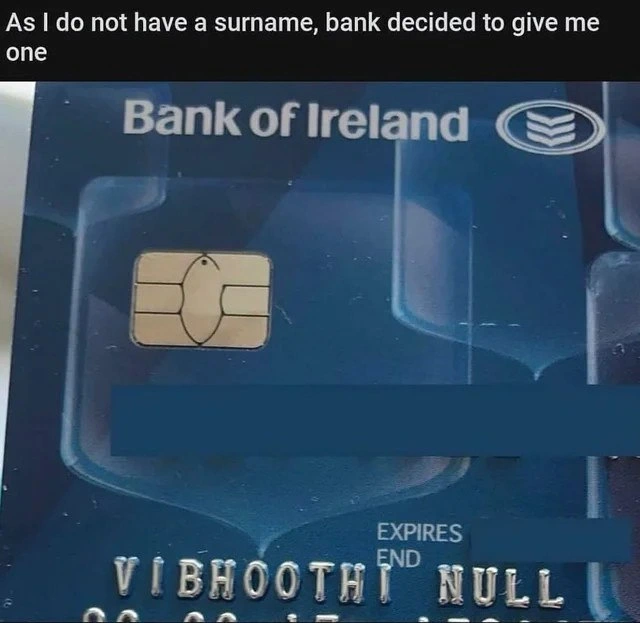
Imagine you’re at school and you don’t have a last name. You tell the teacher, “I don’t have a last name,” and the teacher writes “No Lastname” on your name tag because the form had to have something. Now you’re walking around with a name tag that literally says you’re called "No Lastname"! That’s what happened here, but with a bank card. The computer didn’t know what to do when the last name was empty, so it just picked a filler word – “NULL” – and treated it like your real name. It’s as if the bank said, “Oh, you don’t have a surname? We’ll just give you one.” The funny part is that NULL is techie language for “nothing,” yet it ended up printed as if it were something. In everyday terms, the system tried to fill in a blank space and did it in the silliest way possible. It’s like leaving a question on a form empty and the system decides your answer must literally be “Empty.” 🤦‍♂️ It’s silly, it’s a little dumb, and that’s why it makes people laugh. The computer was too literal and ended up printing nonsense on an official card – a simple mistake that anyone can understand when you compare it to writing “No last name” as someone’s last name.

Level 2: Null vs "NULL"

So, what exactly is going on with this NULL stuff? Let’s break it down in simpler terms. In the world of databases (and many programming languages), NULL is a special value that means “no data” or “unknown.” It’s like a placeholder saying, “there’s nothing here.” For example, if a customer hasn’t provided a last name, the database could store NULL in that spot to mark it as empty. Now, that is very different from the four-letter word "NULL" with quotes around it. Quotation marks mean it’s a normal text string, just like "Smith" or "Johnson" or any other name. So "NULL" (in quotes) is actually the literal word NULL, which is definitely not a typical surname! The entire joke hinges on confusing these two: the concept of null (nothing) versus the actual text "NULL". It’s a classic null_string_vs_null_value mix-up. A computer doesn’t automatically know you meant “nothing” unless you use the proper NULL value; if you accidentally use the word "NULL" (quotes included in your code or data), the computer treats it as just another piece of text.

In this meme’s scenario, the bank’s database expected a last name because of a not_null_constraint. A NOT NULL constraint is basically a rule that says “this field cannot be left empty.” Banks love their rules, so likely the last_name column was not allowed to be truly NULL (empty). When our user left the surname blank, the system had to put something there to satisfy the rule. Ideally, a well-designed system would either allow an actual null value (and handle it appropriately when printing the card), or have a safe default like a blank string ("") that doesn’t show up visibly. But here, it looks like they used "NULL" as a database_default_value or a quick patch. That means instead of leaving it empty, they literally put those four characters N-U-L-L into the last name field. In plain SQL terms, it’s the difference between doing this:

-- Storing an actual NULL (no surname):
INSERT INTO Customers(first_name, last_name) 
VALUES('VIBHOOTHI', NULL);

-- vs. storing the string "NULL" (the word):
INSERT INTO Customers(first_name, last_name) 
VALUES('VIBHOOTHI', 'NULL');

The first INSERT uses NULL correctly to represent no last name. The second one, however, isn’t empty at all – it puts the word "NULL" as if that were the last name. If the system or developer didn’t distinguish these cases, they might have thought “okay, we put something there so it’s not empty.” This is a DataQualityIssue because the data is technically present, but it’s garbage from a real-world standpoint. It’s like putting fake data in just to pass a validation rule. The term placeholder_values_in_production refers to exactly that: dummy or placeholder text that ends up in the live system’s data. It’s usually something you want to avoid.

Now, why didn’t anyone catch it? This could be a lapse in InputValidation on the front end and the back end. Input validation means checking user input to make sure it’s sensible and clean. In our case, the user had a perfectly valid scenario – they simply have no last name. The system should have been designed with that in mind (maybe by allowing the last name to be genuinely empty or by handling that case gracefully). Because it wasn’t, the software fell back to a default that wasn’t properly vetted. Maybe the form required typing something, and an overzealous clerk typed “NULL” thinking it meant no name. Or perhaps the code automatically did this behind the scenes without telling anyone. Either way, it wasn’t caught during testing. Often, developers test with typical data (like John Doe, Jane Smith) and might hardly ever test edge cases like a missing surname. It’s a lesson for junior devs that edge cases (rare or unusual inputs) can lead to very real bugs if you ignore them. Especially with something as personal as names – there are many human_name_edge_cases: some people have only one name, some have very long names, some have hyphenated names, etc. Good systems account for this diversity.

Let’s talk about what should have happened versus what did. In a robust system, if a last name is missing, the database might allow a true NULL (no data) or perhaps use a harmless default like an empty string. Then the card printing program could either leave the space blank or print just the first name. That would respect the fact that the person has no surname. But in our buggy scenario, the database had a not-null rule and likely a lazy schema_validation workaround filled in the blank with "NULL". When the card was being produced, the software probably just concatenated first name and last name without any sanity check. It got "VIBHOOTHI" from the first name field and "NULL" from the last name field and joined them. The machine that embosses text on the card isn’t smart; it just prints whatever characters it’s given. So out came VIBHOOTHI NULL in raised plastic letters, for the whole world (or at least the bank teller) to see. Talk about an embarrassing outcome! This is a prime example of null_handling_mistakes turning into user-visible bugs.

For a junior developer, the big takeaway here is understanding the importance of proper null handling and data validation. DataIntegrity isn’t just about preventing crashes – it’s also about making sure your data makes sense in the real world. A field might technically have a value (it’s not empty, so the database is “happy”), but that value might be nonsense, like "NULL" as a last name or "12345" as a postal code that doesn’t exist. It’s our job to write code and design schemas that catch these issues. If you ever design a form or database for names, remember this meme: allow for the possibility that some people truly have no last name, or whatever “mandatory” field you’re dealing with might legitimately be blank. And if something is supposed to be blank, don’t fill it with junk data just to make your code easier – because that junk might slip out and cause laughter (and maybe some customer frustration) down the line. In short, input validation and understanding the difference between no value and placeholder text is crucial. This meme is funny, but it’s also basically a tiny case study in why those concepts matter.

Level 3: Hello, Mr. Null

This meme captures a classic database bug that makes seasoned developers both cringe and chuckle. Imagine a bank's system encountering a customer who truly has no last name. Somewhere in the backend, the code or database couldn't handle a blank surname. Instead of leaving it empty (or handling it gracefully), the system ended up assigning the literal string "NULL" as the last name. So the poor card-holder's name got printed as if their surname is Null! For developers, this is hilariously absurd because NULL is supposed to mean "no data" in a database – yet here it became actual data printed on a bank card. It’s as if the software said, “No surname? Fine, your surname is now ‘NULL’.” This is the kind of inside joke that makes devs smirk, because we've seen similar quirks where a program’s placeholder or default value leaks out into the real world.

Under the hood, what likely happened is a mix of rigid data rules and a lack of proper validation. Many enterprise DatabaseSystems enforce a NOT NULL constraint on certain columns – meaning, for example, the last_name field in the customer table must not be empty. But real life is messy: some people don’t have a surname (a known human_name_edge_case in global applications). In a well-designed system, you'd allow that field to be truly empty or NULL (the special marker for "no value") and handle it appropriately when printing the card. Here, though, there was a schema_validation_miss: the system wasn’t built to accept a missing last name. Maybe the developers panicked when they saw an empty value and used a quick fix – like inserting the word "NULL" (as a stand-in) to satisfy the NOT NULL rule. It’s a classic null_handling_mistake: they used a placeholder string instead of properly handling the absence of a name. And then the unthinkable happened – that placeholder made it all the way to the final product. In other words, a dummy value intended for internal use became a placeholder_value_in_production. Oof!

From a senior dev perspective, this is a textbook example of why InputValidation and careful data handling are crucial. The bank’s software should have caught that the surname was blank before printing, or better yet, allowed a genuine empty value that the card printing logic could skip. Instead, the pipeline treated "NULL" like any other last name. This hints at deeper DataQualityIssues: perhaps the data integration between systems was fragile, or the developers never included a rule for “no last name” because they assumed every customer must have one. Seasoned engineers have seen these assumptions backfire often. There’s an unwritten Murphy’s Law in software: if a weird case can happen, eventually it will happen – and likely in production. Here we have it: a mononymous person (single name) applied for a card, and the system’s simplistic approach turned a missing value into a visible bug. It’s funny on a meme, but imagine the user’s face seeing a card with a gibberish surname!

To make matters more concrete, let’s consider how the code might have behaved. In many languages and SQL databases, the keyword NULL represents a missing value. But if you mishandle it, you can accidentally convert it to the string "NULL". For example, a well-meaning developer might write logic like this pseudo-Java code:

// Pseudo-Java example of how this might have happened:
String firstName = "VIBHOOTHI";
String lastName = null;  // no surname provided by user
if (lastName == null) {
    lastName = "NULL";   // oh no: using "NULL" as a placeholder!
}
String printedName = firstName + " " + lastName;
System.out.println(printedName);
// Output: VIBHOOTHI NULL

In the snippet above, lastName was null (no value), and the code deliberately replaced it with the text "NULL" to avoid an empty field. That printedName then ends up exactly as seen on the card. A seasoned programmer instantly recognizes this pattern and probably sighs, because it shows how a quick hack can haunt you later. The intention might have been to flag the missing data, but without proper downstream handling, it slipped into the output. It’s a bit like writing COALESCE or IFNULL in SQL to substitute NULL with a default. For instance, a query might do COALESCE(last_name, 'NULL') thinking the string won’t reach the user – except it did, verbatim. This is the kind of blind spot that unit tests or QA should catch, but in legacy systems (especially in conservative industries like banking), strange things still happen. Legacy code can be full of such landmines where sentinel values (like "NULL", "N/A", or "UNKNOWN") are used as stand-ins for real missing data.

The humor here also stems from how relatable this is among developers. It’s not just about databases either – web and app developers have seen default text show up in user-facing places too. Think of emails that start with "Dear null," or a website showing "Username: undefined" because some value wasn’t set correctly. We laugh because it underscores how literally computers follow instructions. The database didn’t understand that NULL means nothing – it just stored what it was given. The card printer didn’t know "NULL" was a geeky way of saying no surname – it just embossed the characters it received. Essentially, every layer passed the buck, and no one said, “Hmm, maybe printing this is a bad idea.” The result? The customer effectively got assigned the surname NULL as if it were legally theirs. It’s absurd and a little embarrassing – a true DataIntegrity facepalm.

For veteran engineers, this meme is a tongue-in-cheek reminder of the old adage: “There are two hard things in Computer Science: cache invalidation, naming things, and off-by-one errors.” Here we have a twist on naming things – the system literally struggled to handle a missing name. 😅 It highlights the importance of accounting for real-world oddities in our schemas. Also, let’s not forget the famous tale of the “NULL” license plate: one hacker chose "NULL" as his vanity plate and ended up receiving thousands of dollars in other people’s traffic fines because some database used "NULL" for unknown plates. Different scenario, same root cause – using NULL in ways the system didn’t anticipate. In our meme’s case, no one was financially hurt, but the bank inadvertently created a goofy artifact that will live on in developer lore. A senior dev will nod at this and think: we've all been there – a seemingly minor oversight leading to a hilariously tangible bug. The silver lining is that these stories push us to design systems that handle the edge cases more elegantly. After all, when software meets the real world, even something as basic as a name can become a trap if we’re not careful!

Description

A close-up photograph of a blue Bank of Ireland credit card. A caption above the image reads, 'As I do not have a surname, bank decided to give me one'. The name embossed on the card is 'VIBHOOTHI NULL'. The humor is a classic example of a system's backend logic leaking into the real world. In databases and programming, 'NULL' is a special value used to signify the absence of data. The bank's system, upon finding a blank surname field, appears to have defaulted to printing the string representation of this null value directly onto the physical card, effectively and hilariously giving the cardholder the surname 'Null'. This is a deeply relatable bug for any developer who has dealt with data validation, sanitization, and edge cases in user-provided information

Comments

23
Anonymous ★ Top Pick SELECT COALESCE(surname, 'NULL') FROM users. Apparently, the developer took that a bit too literally
  1. Anonymous ★ Top Pick

    SELECT COALESCE(surname, 'NULL') FROM users. Apparently, the developer took that a bit too literally

  2. Anonymous

    Nothing says “seamless banking integration” like a COBOL batch writing NULL to a VARCHAR, a Java microservice treating it as a literal, and the card printer promoting you to Mr. Null

  3. Anonymous

    After 20 years in tech, I've learned that 'NULL' appearing on a production credit card is just the banking industry's way of implementing Bobby Tables' lesser-known cousin - where instead of SQL injection, we get SQL ejection straight onto physical media. At least they're consistent with their data types across all layers of the stack!

  4. Anonymous

    When your banking system's schema enforces NOT NULL constraints on the surname column but the business logic just does a .toString() on missing values instead of proper validation. Classic case of 'undefined' behavior becoming very much defined - literally printing 'NULL' on production credit cards. This is what happens when your ORM's default serialization meets legacy mainframe integration: someone's edge case becomes everyone's meme. At least they didn't use 'undefined' or throw a NullPointerException at the card printer

  5. Anonymous

    Turns out concat_ws(' ', first_name, COALESCE(last_name,'NULL')) is a great way to found the NULL dynasty

  6. Anonymous

    Fintech's take on COALESCE(surname, 'END NULL'): production-ready defaults that even the strictest schema validator can't fault

  7. Anonymous

    Bank made my surname “NULL” - classic IS NULL vs '= NULL' mix-up; now every JOIN and CSV will quietly pretend I don’t exist

  8. @TTpocT 5y

    Mom always told me I'm a null in this life

    1. @TERASKULL 5y

      at least you're null, I'm undefined.

      1. @JAUD1LA 5y

        At least you're not a ReferenceError

      2. @ipaal 5y

        At least you're not a Segmentation Fault

      3. @s_yak_dollar 5y

        At least you're not a NotImplementedError

  9. @ProAbdulrahman 5y

    Please no one said NaN

  10. @RoadManiacBaba 5y

    That's actually a real last name. I know a programmer with that last name and he is sick of null pointer jokes

    1. @TERASKULL 5y

      In this case it was not his surname, since his name looks indian, I would say that he belongs to the Singh culture, where they don't have surnames.

      1. @RoadManiacBaba 5y

        Yea i get that. He is in fact indian but vibhoothi isn't a sikh/singh name. Its a hindoo name. I was an Indian too . No longer so thank God

        1. @TERASKULL 5y

          No longer? Did you finally reincarnate?

          1. @RoadManiacBaba 5y

            Lol good one. No i emigrated to a civilized country

        2. dev_meme 5y

          this is what I found when I searched up hindoo. I don't think you meant that lol.

  11. @Roman_Millen 5y

    At first I was surprised that some banks in Ireland still print text on cards in metal color (rather than transparent). But then noticed the exp year that looks like "15".

  12. @RoadManiacBaba 5y

    Vibhoothi is a south indian hindoo name

  13. @RoadManiacBaba 5y

    Hindu hindoo whatever. I would have said donkey not horse

  14. Deleted Account 5y

    yo i wanna be with no family

Use J and K for navigation