Skip to content
DevMeme
2671 of 7435
AI's World Domination faces a minor setback
AI ML Post #2951, on Apr 12, 2021 in TG

AI's World Domination faces a minor setback

Why is this AI ML meme funny?

Level 1: Not So Scary After All

Imagine someone bragging that their new robot friend is going to be the smartest, most powerful thing in the world – like it could be the boss of all humans one day. Sounds a bit scary, right? But then you meet this robot and show it a picture of your pet cat. The robot looks at it and says, “Aw, what a nice snail!” 🐌🚫🐱. You’d probably burst out laughing. The big, bad “genius” robot can’t even tell what a cat is! Suddenly it doesn’t seem scary at all, just kind of silly. That’s what this meme is showing. People talk about AI (artificial intelligence) like it’s going to rule us, but here the AI makes a really goofy mistake – calling a cat in a box a snail. It’s like thinking a new student in class is a super genius, but then they point at an elephant and call it a mouse. You’d giggle because it’s such a funny mistake. The heart of the joke is that we don’t need to fear this “AI overlord” right now; it’s too busy getting basic stuff wrong. It reminds us that even things that sound super smart can mess up in a simple, human way. And it just feels good to laugh at that mismatch – scary expectation on top, silly reality on bottom. It’s a way of saying, “See, the AI isn’t as all-powerful as people say. In fact, it can be pretty cute in how it fails.” So, we’re left both amused and a bit relieved – our future robot rulers might need to learn their animals before taking over the world!

Level 2: Cat or Snail?

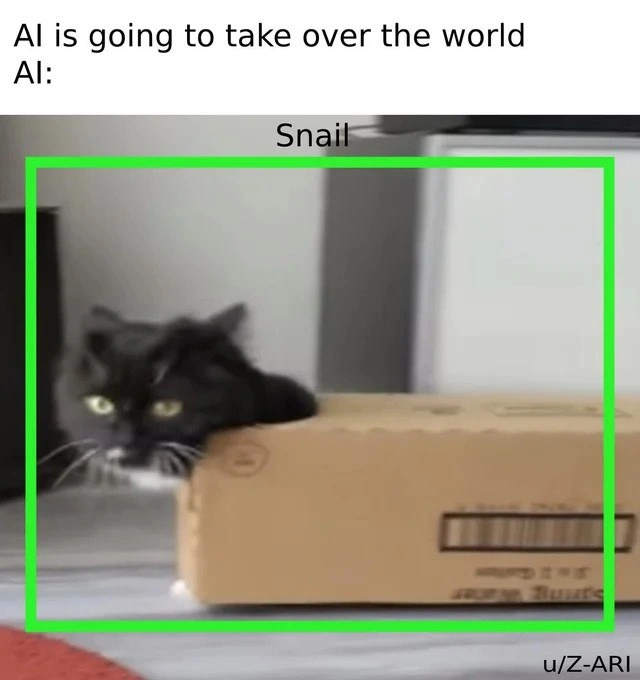
Let’s break down the joke in simpler terms. AI means Artificial Intelligence – basically, computers trying to act smart. One popular kind of AI is a machine learning model that looks at pictures and tries to tell you what’s in them. This is part of a field called computer vision (teaching computers to “see” like humans do). One common task in computer vision is object detection. That’s when the AI not only guesses what’s in the image, but also draws a box around it. You might have seen this in real life with your phone camera or in videos: a colored rectangle locking onto a face or an object with a label. In the meme’s photo, we see a bright green rectangle (a bounding box overlay) drawn around a real-life cat who’s halfway inside a cardboard box. The AI was supposed to detect what’s inside that green rectangle. And it did put a label – the word “Snail” – at the top of the box. The catch (and the reason this is funny) is that it’s clearly a cat in the box, not a snail! 🐱📦

So why on earth would an AI call a cat a “snail”? This is what we’d call a misclassification – the AI classified (identified) something incorrectly. These AI models learn by example: they’re shown tons of images of cats, dogs, snails, you name it, and they adjust themselves until they usually get the right answer. But they’re not perfect. If they see something weird or something they weren’t trained on, they can get confused. In this case, the cat is half-inside a box, and the photo is a bit blurry. Maybe the AI had seen lots of pictures of cats, but not many of cats in boxes (except perhaps Schrödinger’s cat memes, but that’s a physics joke!). Meanwhile, it might have seen pictures of snails – which often have a shell. A snail’s shape is basically a head sticking out of a shell. Funny enough, a cat sticking its head out of a box kinda fits that pattern if you’re a dumb computer program that only sees shapes and colors. 🐌 The AI doesn’t actually know what a cat or snail really is – it just knows patterns from pixels. If some parts of the cat+box picture matched patterns it learned for “snail,” it might guess snail. Think of it like a kid who learned from picture books: if they saw a cat peeking out of something and had never seen that before, they might call it by the closest thing they know – “snail!” – because snails peek out of shells. They don’t realize a box isn’t a shell, because that’s a bit of real-world logic the AI (or the kid in this analogy) didn’t get.

Now, the text at the top of the meme says, “AI is going to take over the world. AI:” and then shows the cat-snail example. This top caption sets up an expectation and then delivers a punchline. Lately there’s been a lot of IndustryTrends_Hype around AI – people say super-smart AIs might run everything or become our overlords (like robot bosses). That’s the “AI is going to take over the world” part, sounding all scary and dramatic. The AI: part right after is like the meme is saying “Here’s what AI actually does:” and shows the silly snail mistake. In other words, reality check! The meme is pointing out the gap between how some people talk about AI and what AI can currently do. It’s a meme variant of AIHypeVsReality. Even though we have some really advanced machine learning models, they still make laughable mistakes, like confusing a simple pet for a completely different creature. It’s highlighting an AI limitation in a funny way. For those of us who work a bit with these technologies (even juniors who might have just started), it’s a reminder: don’t believe all the hype blindly. Yes, AI can do amazing things (like recognizing faces or translating languages), but it’s not magic. It can and will screw up if you feed it something a little unusual.

If you’ve ever played around with an image recognition API or a demo app, you might have experienced something like this. Maybe you showed it a picture of your pet and it gave a bizarre answer. That’s essentially what happened here. The computer_vision_error of labeling a cat as a snail is extreme, but not impossible, as we see. And it’s funny to us because the mistake is so outlandish. Cats and snails are about as different as two animals can be – a furry, four-legged mammal vs. a slimy mollusk with a shell! The absurdity of it makes it clear that the AI got it very wrong. Even a small child wouldn’t confuse those, right? So we intuitively realize: wow, this “smart” computer isn’t so smart here. For someone new to the field, it’s a gentle introduction to the idea that AI systems have failure modes – fancy talk for “ways they mess up.” It teaches an important lesson: these systems only know what they’ve learned from data. Change the situation a bit (like show a cat in a scenario it hasn’t seen), and the AI might not generalize well. That’s why developers have to be careful and test AI models with many kinds of images.

In summary, at Level 2 we’re seeing the straightforward facts of the meme: an object detection AI put a green box around a cat and labeled it “Snail.” This is funny because it’s such a goofy, obvious mistake. The text is poking fun at people who think AI is already some unbeatable genius – by showing a case where it does something a little dumb. It’s a classic piece of MachineLearningHumor for anyone who’s learned or seen how AI can fail in surprising ways.

Level 3: Singularity at Snail’s Pace

Why is this meme so satisfying to experienced developers and ML engineers? Because it punctures the balloon of AIHypeVsReality with one perfectly absurd example. We constantly hear grand claims that “AI is going to take over the world” – buzzwords flying around in boardrooms and tech headlines about an impending AI overlord or the Singularity. But those of us in the trenches have also seen our models call a dog “toaster”, or in this case, label a beloved house cat as “Snail”. The stark contrast between the ominous hype (“AI will rule humanity!”) and the mundane reality (“It can’t tell a feline from a gastropod”) is industry insider humor at its finest.

The top caption sets up the expectation: humanity supposedly on the brink of subjugation by ultra-intelligent machines. Then the image delivers the punchline: This is the great AI you’re afraid of – one that can’t even get basic object recognition right. It’s a classic case of AIHumor rooted in truth. Seasoned engineers remember earlier hype cycles where AI was going to revolutionize everything any day now. Yet, the day-to-day reality involves combing through silly machine_learning misclassifications and dealing with brittleness in production models. We chuckle because we’ve been in meetings where non-technical folks, hyped by media, propose replacing entire workflows with AI magic. In the back of our minds we’re recalling examples like this meme. Sure, let’s have the AI “take over” – it might decide our company logo is a unicorn or something!

This meme resonates strongly with the AI_ML community because it’s “comfort humor” for anyone who’s wrestled with an overconfident model. It echoes the collective experience: deploying a computer vision system that works great in lab tests, only to facepalm later when it mistakes the CEO’s cat (on a Zoom call, hiding in a box) for something completely outlandish. Real-world scenarios like object_detection_fail are surprisingly common. For instance, Tesla’s self-driving AI once mistook a truck’s white side for open sky – a costly error. Less dramatic but common: a model trained on clear-day images fails at dusk, or calls an apple a tomato if a slice is missing. Those working on Object Detection know that a slight change in lighting or angle can drop accuracy off a cliff. In our case, maybe the blur and angle confused the poor model’s layers. The cat_misclassification here is harmless and funny, but it’s a proxy for the real challenge: AI lacks context. A human knows no snail has fluffy fur and bright green eyes peering out of a cardboard box. But an AI hasn’t lived in the world; it doesn’t know what a snail isn’t capable of. It just knows pixels and probabilities.

From a senior developer’s perspective, this meme is also a nod to the IndustryTrends_Hype we navigate. The label “Snail” in neon green is almost satirical – that’s the kind of bounding box output you’d show in a PowerPoint to execs to demonstrate your model’s prowess. Except here it demonstrates its blind spot. We laugh (perhaps a tad bitterly) because we’ve had to explain to managers or clients that “95% accuracy” still means 5 out of 100 predictions can be complete nonsense like this. It’s a shared understanding that AI limitations are very real, often glossed over in marketing. Indeed, the phrase “AI Overlord” itself is tongue-in-cheek: a senior dev sees it and immediately thinks of Skynet from Terminator or the countless sci-fi plots where AI conquers humanity. Then we look at our actual models producing bloopers, and the dissonance is comical. As the meme implies, today’s AI is closer to a precocious toddler with flashes of brilliance and frequent confusion – not exactly an all-knowing despot.

Historically, this fits a pattern: grand promises followed by a reality check. In the 1960s, perceptrons were going to soon see as well as humans – until they couldn’t even solve simple XOR logic without multi-layer networks (leading to the first AI winter when funding dried up). In the 1980s expert systems were hype, then fizzled. Fast forward to the 2010s: deep learning made genuine breakthroughs (image recognition did get superhuman on certain benchmarks), spawning a new wave of “AI will solve everything.” But insiders know the Achilles’ heels – lack of generalization, need for huge data, and bizarre errors – have not been conquered. The meme distills this perfectly: we have fancy neural networks that can beat humans at Go, yet an image slightly outside their training distribution makes them derp out. It’s both humbling and hilarious.

On a human level, there’s relief and validation in this humor. When you’re on-call for an AI product at 3 AM because it flagged all cat images on the site as “inappropriate content” due to some learned bias, you earn a certain battle-hardened cynicism. Seeing a popular meme acknowledge “AI isn’t all that just yet” is almost therapeutic. It says: AI limitations are normal, you’re not alone in fighting them. It also subtly satirizes the media narrative – we can almost hear an engineer muttering, “Take over the world? Ha! This thing thinks Mittens is a mollusk.” It’s a tiny rebellion against the notion that programmers are creating monsters they can’t control. In reality, we’re creating tools that often need a lot more training (and bug-fixing) before we’d trust them with, well, anything truly mission-critical. And until then, we’ll keep a sense of humor about our AI overlords that can be defeated by a housecat in disguise.

Level 4: The Softmax Slip-up

At the cutting edge of machine learning, misclassifications like this aren’t just humorous – they’re illuminating. Under the hood, an object detection model (think of algorithms like YOLO or Faster R-CNN) is breaking an image into numerical patterns. The cat-in-a-box image is fed through layers of a convolutional neural network (CNN) which gradually extract features: first edges, then textures, then shapes. In an ideal world, by the final layers the network activates strongly for features of a cat. However, here it lights up in a way the network misinterprets as a snail. Why? Likely due to a quirk in its training data or feature space: perhaps the combination of the cat’s round face and the box’s oval opening created a silhouette vaguely reminiscent of a snail emerging from its shell. The model doesn’t truly understand “cat” or “snail” as we do – it has learned statistical patterns. A snail’s shell and a cat-in-a-box might share some low-level visual patterns that the CNN latched onto. Without any contextual reasoning, the system’s final Softmax layer (which outputs a probability distribution) might have assigned a higher probability to the label “snail” than to “cat”. In technical terms, the image landed in the wrong region of the network’s high-dimensional feature space, closer to the learned prototype of snail than that of cat. This is a classic object_detection_fail: the bounding box is correctly drawn around the object, but the label is hilariously wrong.

It’s a reminder of how AI vision works: by generalizing from what it has seen. If the training set didn’t include many cats half-inside boxes (a pretty specific scenario), the model might not have a robust concept for it. Perhaps it learned that “small head poking out of a shell-like shape” = snail. Without a sense of scale or context, a cat head peeking from a brown box could trigger that neuron. The computer_vision_error here exposes the model’s reliance on correlation over understanding. Researchers study such mistakes using tools like saliency maps to see which pixels influenced the decision – maybe the green eyes plus round opening resembled a snail’s form in the model’s “imagination.” There’s also the matter of confidence. Object detectors often output a confidence score. It could be that the AI was, say, only 40% sure it was seeing a snail but even less sure about any other label, so “snail” wins by default. The neon-green bounding_box_overlay and label come from typical vision model output visualization, showing us exactly how certain the model was and what it chose.

This deep dive into the model’s psyche highlights a core limitation: today’s AI lacks common sense. In academic terms, we’re dealing with narrow AI specialized for one task, not a human-like general intelligence. The meme’s joke is essentially about a miscalibrated classification boundary in the algorithm’s learned model of the world. It’s as if the AI’s confusion matrix has an entry where “cat in weird setting” overlaps with “snail.” The humor lands because anyone versed in AI/ML knows that despite impressive performance on benchmarks like ImageNet, even state-of-the-art models can produce such absurd outputs. We have entire papers analyzing why neural nets think a turtle with a sticker is a rifle, or how adding some noise makes them see a school bus where there’s an ostrich. This particular cat-snail mix-up likely wouldn’t fool any human, but a neural network’s “vision” is alien to us – it’s a math-crafted tunnel vision that can be brilliant and brittle at the same time. In summary, the AILimitations on display are a direct consequence of how these models operate: they excel at interpolation (seeing familiar patterns) but stumble at extrapolation (dealing with novel situations). And nothing screams “not ready to be an overlord” like confusing a pet for a mollusk.

Description

A two-part meme that contrasts the hype around artificial intelligence with its often-flawed reality. The top section contains the text 'AI is going to take over the world' followed by 'AI:'. The bottom section is an image of a black cat with white whiskers and yellow-green eyes, peeking over the edge of a cardboard box. A bright green bounding box, typical of object detection software, is drawn around the cat and the box. The label at the top of the box confidently, and incorrectly, identifies the subject as 'Snail'. The watermark 'u/Z-ARI' is visible in the bottom right corner. The humor lies in the glaring failure of the AI to perform a simple image recognition task, mocking the grand pronouncements of AI's imminent superintelligence. For developers, this is a familiar and funny reminder of the brittleness of ML models and the vast gap between a demo and a production-ready system
Comments

7
Anonymous ★ Top Pick Our advanced AI identifies objects based on core behaviors. This one hides in a box and moves slowly. Checks out. Ship it
  1. Anonymous ★ Top Pick

    Our advanced AI identifies objects based on core behaviors. This one hides in a box and moves slowly. Checks out. Ship it

  2. Anonymous

    CV team: “97 % mAP on COCO.” Production: labels a cat-in-a-box as “snail.” Product owner: “Perfect - let’s have it drive the forklifts.”

  3. Anonymous

    This is the same model that confidently identified your CEO as "potential security threat" during the all-hands demo, but somehow has 99.2% accuracy on the benchmark dataset nobody's ever seen in production

  4. Anonymous

    When your production model has 99.9% accuracy on the test set but somehow achieves 'snail' confidence on a cat in prod, you realize the real AI takeover is convincing stakeholders that edge cases are just 'opportunities for model improvement' in the next sprint

  5. Anonymous

    AI takeover? At this inference velocity, it'll lap our legacy monolith migrations by 2050

  6. Anonymous

    “AI will take over the world.” Meanwhile our vision model labeled my cat-in-a-box as “snail” with 0.97 confidence - mAP looks great on the deck, but NMS still stands for Not My Species

  7. Anonymous

    Nothing says “AI takeover” like [email protected] bragging rights while a detector boxes the entire frame, confidently calls my cat a snail, and lets non‑max suppression conquer the slide deck instead of the world

Use J and K for navigation