Skip to content
DevMeme
5491 of 7435
The Unsolicited Sermon of the Linux Evangelist
OperatingSystems Post #6018, on May 23, 2024 in TG

The Unsolicited Sermon of the Linux Evangelist

Why is this OperatingSystems meme funny?

Level 1: Stubborn Toys and New Toys

Imagine you have a friend who absolutely loves a different toy than the one you use. Let’s say you’re super happy playing games on your Xbox every day. It has all your favorite games and you know exactly how everything works. Now, your friend comes over with a custom-made game system (let’s call it the “Penguin Station”) that he built himself from free parts. He’s really excited about it. He tells you, “Hey, you should stop using your Xbox and play on my Penguin Station! It’s totally free, you can get lots of free games, no viruses or anything bad, and you can change anything you want on it! If a game is missing, you can even make your own because the system is open for you to tinker with!” He keeps going on and on with all these reasons why his DIY game system is the best.

Now, even though your friend’s Penguin Station sounds kind of cool and very customizable, you’re thinking about your Xbox and all the games you already have and love on it (like maybe Valorant or Halo on Xbox, which might not work on his system). You also love using your paint program on the Xbox (imagine something like Photoshop for drawing) and his system might not have the exact same one. You start feeling a bit annoyed because he’s basically saying you should throw away what you love and use his thing instead. Finally, you just shout, “I DON’T WANT TO USE IT!”

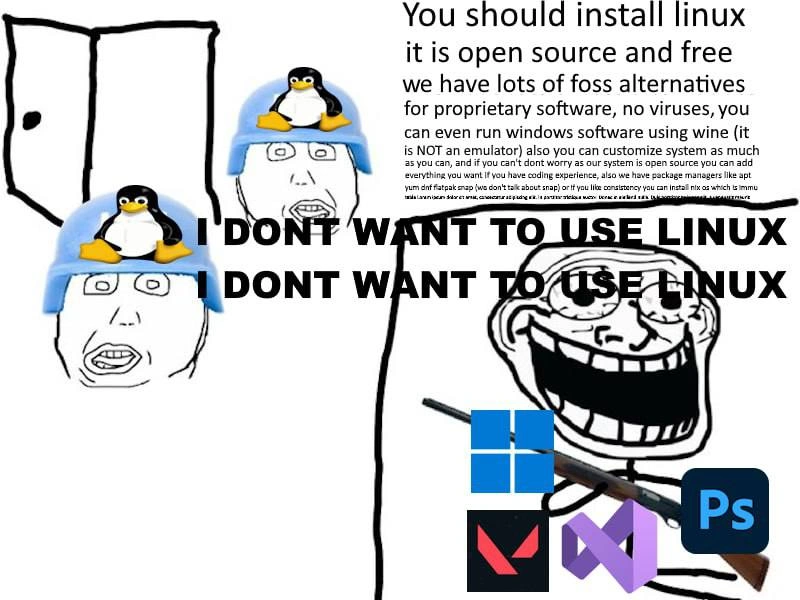
This is exactly what the meme shows, but with computers. The penguin is the symbol for Linux (a free operating system, like a DIY computer system), and the trollface guy with the rifle is like someone yelling back “No, leave me alone, I like my Windows PC!” It’s funny in the same way it’s funny when two kids argue on a playground: one kid is desperately trying to lend his favorite toy to the other, listing all the cool things about it, and the other kid just keeps saying “No, no, no, I don’t wanna!” The silly part is how over-the-top both are being. The Linux side just won’t drop it, and the Windows side is comically yelling in all caps.

So, in simple terms: the meme is joking about how people can get very intense about their favorite computer systems. One person is like, “Mine is the best, you should use it!” and bombards the other with reasons, and the other person just refuses loudly because they’re happy with what they have (and maybe a bit tired of being told what to do). It’s a goofy exaggeration of something that really happens among friends and online: tech enthusiasts trying to “convert” others, and those others not wanting to change. The humor is in the drama of it all – we know real life isn’t usually this cartoonish, but seeing it played out this way makes us laugh and maybe remember to not take these arguments too seriously. In the end, just like kids on a playground with different toys, it’s okay for everyone to play with the toy (or computer) they like best.

Level 2: FOSS vs. Proprietary Showdown

Let’s break down what’s happening in this meme in simpler terms. On one side, we have a person (pictured with Tux the penguin helmet) vigorously promoting Linux, and on the other side, a grinning trollface character adamantly sticking with Windows. This reflects a common situation in tech circles: one friend or community member passionately insists “Linux is the best, you should use it!” while another person stubbornly replies “I don’t want to!”. It’s a tug-of-war between open-source culture and proprietary comfort.

Linux here represents a family of free, open-source operating systems (an operating system is the core software, like Windows or macOS, that runs your computer and manages hardware and other programs). Linux enthusiasts love it because it’s free (you don’t have to pay for the OS or most of its software), and open source (anyone can read and modify the code that it’s made of). They often refer to “FOSS” alternatives – that stands for Free and Open-Source Software. For almost every paid Windows application, there’s usually some free counterpart on Linux created by the community. For example, instead of Photoshop (which costs money and is closed-source), Linux users might use GIMP or Krita (free image editors). Instead of Microsoft Office, they might use LibreOffice. The meme’s big block of text is basically this Linux fan rattling off all these selling points at high speed, which is both humorous and a little overwhelming.

Some key terms and claims from that rant, explained:

  • “Open source and free” – Linux can be downloaded by anyone at no cost, and its source code (the human-readable instructions that make the program) is available for the public to inspect or improve. This is unlike Windows, which is closed-source (code is secret) and normally requires purchasing a license or coming pre-installed on a PC.

  • “We have lots of FOSS alternatives for proprietary software” – For many popular paid programs (proprietary software), the Linux community has built free alternatives. Proprietary just means you don’t have access to the source code, and usually you have to pay for it or it’s restricted (like Microsoft or Adobe products). The evangelist is saying: “Whatever you do on Windows with expensive or closed tools, we can do on Linux with free ones.” They’re trying to allay the fear that switching to Linux means losing important functionality.

  • “No viruses” – It’s a common boast that Linux doesn’t get viruses, at least nowhere near as frequently as Windows does. Technically, it’s not that Linux can’t ever get malware, but in practice it’s rare. Windows has a larger user base and historically had more security issues, so most malware targets Windows users. Linux’s structure (user permissions and how programs are installed) also makes it less vulnerable to the typical viruses that plague Windows (for instance, on Linux you typically install software from trusted package managers rather than downloading random files from the internet, which reduces the chance of accidentally running a virus). The meme’s Linux advocate is using this as a selling point: “Switch and you won’t have to worry about those pesky viruses/antiviruses.”

  • “You can even run Windows software using WINE (it is NOT an emulator)” – Now this line is a bit geeky. WINE is a compatibility layer that lets you run some Windows programs on Linux. People often misinterpret what it is, so Linux fans cheekily clarify “WINE Is Not an Emulator” (that phrase is actually what WINE stands for). In simple terms, WINE tricks Windows applications into thinking they are running on Windows by providing alternative implementations of Windows libraries on Linux. For example, if a game tries to call a Windows-specific function, WINE catches that and provides its own Linux-friendly version of that function. This means you can double-click some .exe files on Linux and, thanks to WINE, they might run as if they were on Windows. It’s not perfect – some programs run well, others crash or won’t even start – but it’s constantly improving. The evangelist mentions WINE to counter the Windows user’s likely objection: “But I’ll lose my Windows-only apps!” He’s basically saying, “Don’t worry, we can still run those, too.”

  • “Customize the system as much as you can” – Linux is famous for being highly customizable. You can change the look and feel entirely (there are different desktop environments like KDE, GNOME, XFCE, etc.), tweak system behaviors, and since the code is open, if you’re really advanced, you can even modify how the OS works at a low level. The advocate believes this freedom to tailor your system is a huge plus. It’s like having a car that you can mod endlessly versus a car with the hood welded shut. To a tinkerer, that’s heaven.

  • “If you can’t [do something], don’t worry… you can add everything you want if you have coding experience” – This line shows the zealot’s mindset: even if Linux lacks a feature out-of-the-box, you (or the community) can create a solution since nothing is locked down. It assumes the user might be or become technically skilled enough to code their own tools or at least use community-made plugins/kernel modules. It’s a bit idealistic – not every user can or wants to program their OS – but it underscores the philosophy of empowerment.

  • “We have package managers like apt, yum, dnf, flatpak, snap (we don’t talk about pacman)”Package managers are tools on Linux that handle installing and updating software for you automatically. They’re like very advanced app stores, often command-line based. For example, on Ubuntu (a popular Linux distribution), you can install Google Chrome by opening a terminal and typing sudo apt install chromium-browser (Chromium is the open-source version of Chrome). Apt will fetch the program from an online repository and install it, all with one command, including any needed dependencies. The evangelist lists apt, yum, dnf – these are package managers used by different Linux distributions (Debian/Ubuntu use apt, older Red Hat used yum, newer Fedora uses dnf). Flatpak and snap are newer “universal” package formats that work across many distros, kind of like containers for apps. The aside “(we don’t talk about pacman)” is a joke. Pacman is the package manager for Arch Linux, which has a bit of a cult following – Arch is known for being super advanced and its users are notoriously proud of it. Saying “we don’t talk about pacman” humorously implies “let’s not even get into that can of worms right now.” It’s the meme acknowledging, with a wink, that there are so many options it’s dizzying, even though the advocate is trying to make it sound like a plus. (It’s a bit like someone trying to get you to read, saying “There are so many books: fiction, non-fiction, mystery, sci-fi… okay maybe let’s not dive into encyclopedias yet.”)

Now, opposite this enthusiastic Linux sales pitch, the Windows user is having none of it. He yells “I DON’T WANT TO USE LINUX” repeatedly. The huge bold text and the trollface indicate he’s either extremely frustrated or intentionally being a stubborn “troll” to annoy the evangelist. Let’s identify why he’s so resistant, via the icons around him:

  • The Windows 11 logo shows he’s a committed Windows user. He’s comfortable with the OS that came with his PC. Maybe he enjoys the interface, or he simply doesn’t see a need to change. Switching an OS is a big deal – it’d be like moving to a new house. He’s basically shouting “I’m happy where I am!”

  • The Valorant icon (red V) represents a popular online shooter game. Here’s a key point: Valorant (and many other games with anti-cheat systems, like Easy Anti-Cheat) doesn’t run on Linux. The company behind Valorant hasn’t made a Linux version, and its anti-cheat is deeply tied into Windows. So if our friend loves playing Valorant, moving to Linux means losing access to that game. For a gamer, that’s a deal-breaker. No amount of “free and open source” is going to replace the actual game they want to play. Linux advocates might counter, “There are thousands of Linux-compatible games, Steam supports Linux, etc.” – which is true – but if the one game you’re hooked on isn’t supported, it doesn’t matter.

  • The Visual Studio icon (the purple infinity symbol) stands for Microsoft Visual Studio, a professional integrated development environment (IDE) primarily for coding in languages like C# and C++ on Windows. If this guy is a developer using Visual Studio, he might be working on Windows-specific applications (like .NET Framework apps) or he just really likes that tool. While there are equivalents on Linux, or alternatives like Visual Studio Code and JetBrains IDEs that run on Linux, the full Visual Studio (with all its GUI designers, Profilers, etc.) is a Windows product. He might be thinking, “I can’t do my job on Linux because my main dev tool is Windows-only.”

  • The Adobe Photoshop icon (“Ps”) indicates he uses Photoshop, which doesn’t have a native Linux version. Creative professionals stick with Photoshop because it’s the industry standard for image editing, with a specific workflow and feature set. The Linux world offers alternatives (GIMP is the closest, and there’s also Krita for painting, Inkscape for vector art, etc.), but for someone used to Photoshop, those might feel insufficient or just too different. He’s effectively saying, “I can’t abandon my workflow and the software I know.”

All these icons bolster the Windows user’s stance: he has legitimate reasons to stay on Windows. It’s not merely stubbornness; it’s practicality and personal preference. To him, the Linux advocate’s promises might sound hollow, because he knows that in practice switching OS means giving up or complicating the things he enjoys or needs daily. He might also just not want the hassle of learning a whole new system.

The trollface meme character adds an extra layer of humor: trollface is usually used to depict someone who is provocatively stubborn or playing devil’s advocate just to get a rise out of others. So the Windows user in the meme might also be exaggerating his refusal partly to tease the Linux guy – as if he’s aware how to push the evangelist’s buttons by flatly rejecting him in all caps. This mirrors how real online “OS wars” often go: one person’s overly passionate argument can turn into a spectacle where the other side responds with mock outrage or trolling, and the thread derails into a shouting match (often entertaining to onlookers).

In developer communities (DevCommunities), this exchange is practically archetypal. Someone mentions they use Windows for development or gaming, and inevitably a well-meaning Linux user jumps in: “Have you considered Linux? It’s so much better for developers and power-users!” The conversation that follows is predictably what the meme shows. The tags given like linux_evangelism and windows_gamer sum it up: it’s the ardent believer trying to convert the gamer who just wants to be left alone to play Valorant on Windows.

For a newer developer or someone not deeply familiar with these OS debates, the key takeaway is: both sides have their reasons. Linux offers freedom, community-driven software, and efficiency for certain tasks (it’s very popular among programmers, especially for servers and development environments). Windows offers ease of use, broad commercial software support, and is the default for PC gaming. The meme is funny because each side is portrayed in hyperbole – the Linux side as an unstoppable info-dump, and the Windows side as an immovable object screaming “no.” It’s poking fun at how extreme and unproductive these arguments can become. In real life, of course, you can use what works for you; there’s no need to shout anyone down. But seeing it in meme form, we laugh because we recognize a truth: sometimes, tech enthusiasts (like the Linux fan here) can be a bit pushy, and users can be stubborn, and neither truly listens to the other.

Level 3: The Eternal OS War

This meme distills a classic standoff in developer communities: the zealous Linux evangelist versus the entrenched Windows power-user. It’s a scene we’ve witnessed in countless forum threads and chat arguments: one side unleashes a torrent of FOSS advocacy, extolling every virtue of Linux and open source, while the other side digs in with an exasperated “I don’t want to switch!” The humor comes from the overkill of enthusiasm met by an equally exaggerated refusal. The Linux advocate (represented by Tux the penguin, the Linux mascot, essentially wearing a crusader’s helmet in the meme) floods the conversation with a wall of text – a laundry list of why Linux is superior:

  • Free and Open Source (no licenses, full transparency)
  • No viruses (immune by reputation and design)
  • FOSS alternatives for every proprietary app (why pay for Photoshop when there’s GIMP? why Visual Studio when you have VS Code or Vim?)
  • The ability to run Windows software via WINE (“which is NOT an emulator,” as they pedantically clarify)
  • Infinite customization (tweak anything, swap out your desktop environment, tailor the OS to your workflow)
  • A rich ecosystem of package managers (apt, yum, dnf, flatpak, snap… and hush, **“we don’t talk about pacman”*, a cheeky side-joke about Arch Linux’s tool)

This enthusiastic spiel is all too familiar – it reads like a copy-paste from countless “Why you should use Linux” blog posts or that one friend in the group chat who can’t stop singing Linux’s praises. The meme humorously exaggerates it by literally plastering a massive block of evangelizing text in the frame. It’s practically techno-babble overload from the Windows user’s point of view, and that’s intentional comedy: we imagine the poor Windows guy’s eyes glazing over as the Linux fan bombards him with acronyms and options. (Five different package managers? Snap vs apt vs yum – it’s ironically overwhelming, not convincing!)

Meanwhile, the Windows user is depicted by the classic trollface wielding a rifle, flanked by the logos of Windows 11, Valorant (the red “V”), Visual Studio, and Adobe Photoshop. This imagery screams: “I’m sticking with Windows because of these!” Each icon represents a proprietary stronghold:

  • Windows 11: The familiar OS he knows and perhaps paid for (or came with his PC). It’s stable (for him), it’s comfortable, and it runs all his stuff out of the box.
  • Valorant: A popular competitive game incompatible with Linux (its anti-cheat system won’t run on Linux/WINE). Gamers often cite this: “I literally can’t switch because I’ll lose my games!”
  • Visual Studio (the big purple infinity logo): A heavyweight IDE for .NET and C++ development, Windows-only. Maybe our Windows user is a dev who relies on the full Visual Studio suite (not to be confused with Visual Studio Code). He’s deeply invested in the Windows-specific developer ecosystem.
  • Photoshop (“Ps” icon): Industry-standard image editing software. Yes, there’s GIMP on Linux, but many creatives find Photoshop indispensable — its features, performance, or simply their workflow aren’t easily replicated.

With those four icons, the meme encapsulates why many developers and gamers won’t abandon Windows: their favorite games, tools, and workflows revolve around proprietary software unavailable (or less optimized) on Linux. The trollface grin and rifle imply he’s not just passively resisting; he’s gleefully ready to fight off the Linux crusaders. It’s tongue-in-cheek: the Windows user is almost portrayed as a troll, intentionally riling up the FOSS folks by flat-out shouting “I DON’T WANT TO USE LINUX” (twice, in giant bold text). In internet culture, responding in all-caps is comedic hyperbole for someone at wit’s end or spoiling for a fight. The repetition emphasizes how fed up he is with the preaching – it’s the battle cry of every person who’s tired of being told to install Linux for the umpteenth time.

Why is this so spot on for seasoned devs? Because it lampoons a real communication gap. The evangelist believes they’re offering enlightenment: “If you just try Linux, you’ll be free of your shackles! You’ll see the light (of open source)!” But the target audience hears an inflexible zealot ignoring their actual needs. To a veteran developer, this scene might spark a knowing chuckle – perhaps you’ve been on one side or the other, or just watched these debates spiral out of control on Slack, Reddit, or back in the old forum days. It’s practically a rite of passage in tech communities (OperatingSystems debates are second only to tabs vs spaces flame wars 🔥).

Let’s decode the point-counterpoint of this standoff:

Evangelist’s Claim Windows User’s Reaction
“It’s open source and free!” “Free is nice, but I already have a working setup.”
“Linux has no viruses.” “Windows works fine for me; I haven’t had a virus in years.”
“There’s a FOSS alternative for everything.” “The alternatives often feel clunky or lack pro features.”
“You can run Windows apps with WINE!” “That sounds complicated… will my game even run properly?”
“You can customize absolutely anything!” “I just want to use my PC, not tinker with internals all day.”
“If it’s missing something, you can code it!” “I shouldn’t have to code my OS to do what I need.”
“We have package managers like apt, yum, etc.” “Why are there 5 different installers? I just double-click .exe files.”

This table highlights the comic misalignment of priorities. The Linux advocate touts freedom, flexibility, and security – things engineers and power-users adore. The Windows user cares about convenience, familiarity, and specific applications – practical day-to-day needs. The evangelist’s arsenal of acronyms (FOSS, WINE, apt, DNF, RPM, etc.) is meant to impress, but it can come off as tech elitism or overwhelming detail to someone who isn’t already convinced. That’s why the meme resonates: the harder Tux pushes, the more the other guy digs in. It’s an unstoppable force (open-source enthusiasm) meeting an immovable object (closed-source contentment).

Notably, the meme text even jokes “(we don’t talk about pacman)” when listing package managers. This is a playful self-own by Linux folks – pacman is the package manager for Arch Linux, a distro famous for its hardcore users who often brag “BTW, I use Arch”. Saying “we don’t talk about pacman” pokes fun at the inner divisions among Linux users: even as they try to present a united front to convert a Windows user, they humorously sweep under the rug the fact that the Linux world itself has endless debates (Debian vs Fedora vs Arch, apt vs pacman, vi vs emacs… it never ends!). It’s an inside joke acknowledging, “Okay, okay, we won’t scare you with the really crazy stuff just yet.” 🤭

From a senior developer angle, there’s also subtext about developer experience (DX) and workflow. Many devs actually do prefer Linux for programming – the meme’s advocate echoes genuine points: package managers are great for development libraries, the open source ecosystem does produce excellent tools (compilers, editors, containerization, etc.), and being virus-resistant and customizable can save headaches. However, experienced devs also know that tooling is personal. If your work or hobbies depend on Visual Studio or Adobe Suite or a Windows-only game, switching OS isn’t trivial. There are trade-offs and lost efficiency in forcing a change. The meme captures that reality: even if one side has objectively solid arguments, people will defend what lets them get things done (or have fun) with well-worn ease. Hence the Windows user’s rifle-brandishing defiance – he’s protecting his Developer Experience (and gamer experience) from a perceived disruption.

The longer history adds a wink for the veterans: this “Linux vs Windows” feud has been raging for decades. We remember the 90s and 2000s forum wars, the slogan “Year of the Linux Desktop” (proclaimed annually, still not here 😅), and Microsoft’s old hostility toward Linux (“cancer,” they once called it) before the tides turned. Today, Microsoft ironically embraces Linux in servers and WSL (Windows Subsystem for Linux) – a nuance lost on our arguing meme characters, but amusing to those in the know. It’s a reminder that these debates often generate more heat than light. In practice, many developers just use what works (or even use both: dual-booting or running WSL to have a foot in each world). But in the meme, nuance is thrown out the window: it’s pure Comic Book extremism – the paladin of Open Source vs. the grinning troll of Proprietary Land. And for anyone who’s tiptoed into an online tech community, that absurd extremism is oh-so-familiar and downright hilarious.

Level 4: Incompatible by Design

At the operating system core, Windows and Linux speak fundamentally different languages. A Windows application isn’t magically understood by Linux because the low-level system calls and APIs it expects simply don’t exist on a Linux kernel. Windows is built on the NT architecture with its own subsystems (think of system libraries, registry, DirectX, .exe binary formats) that Linux doesn’t natively provide. WINE (a recursive acronym for Wine Is Not an Emulator) is essentially a colossal compatibility layer – it re-implements Windows APIs and library calls on Linux. This is a herculean reverse-engineering effort, translating what a Windows program wants (say, drawing a window or accessing hardware) into Linux terms on the fly. It’s not emulating a full CPU or OS; instead, it’s intercepting calls to Windows-specific functions and handing them off to Linux equivalents.

However, some software digs so deep into Windows internals (like anti-cheat drivers for games such as Valorant’s Vanguard) that a user-mode layer like WINE hits a wall. These programs expect kernel-level Windows components or specific hardware drivers that simply aren’t present on Linux (and often can’t be, since they’re proprietary or tied to the Windows kernel’s closed design). The meme’s over-eager Linux advocate breezily says “you can even run windows software using WINE (it is NOT an emulator)” – technically true, thanks to decades of open-source engineering – but a senior dev knows the caveat: not all Windows programs will run flawlessly. A complex multiplayer game with kernel anti-cheat or a cutting-edge Adobe product might break in WINE or run with glitches, because WINE’s developers must constantly play catch-up with Windows’ opaque, evolving internals. It’s a classic case of architectural mismatch: each OS was built under different philosophies (open vs. closed, monolithic Unix-style vs. hybrid NT kernel) and those design decisions create real constraints.

Even the brag “no viruses” ties back to OS design. Linux’s security model (root vs regular user accounts, strict file permissions, and the prevalence of official package repositories) makes widespread viruses much harder to pull off than on Windows, where historically a user running as Administrator and downloading random .exe installers was common. The open-source nature also means bugs (including security holes) are exposed to worldwide scrutiny and patched by the community, whereas Windows malware often exploits hidden flaws in closed code. Fewer viruses on Linux isn’t just luck – it’s partly an emergent property of Unix permissions and a centralized software distribution model. In short, many of the Linux advantages the evangelist rattles off (strong security, customizability, freedom to modify code) stem from deliberate design choices in the Unix/Linux lineage, while the Windows user’s needs (running proprietary software or games built for Windows) highlight the inherent incompatibilities that those same choices create. The two systems evolved on parallel tracks, and bridging them (whether through WINE or dual-booting a PC) is non-trivial because under the hood they are as different as a penguin and a pane of glass.

Description

A two-part Wojak-style rage comic depicting the classic conflict between a Linux evangelist and a content Windows user. On the left, two distressed-looking characters wearing blue helmets adorned with Tux, the Linux penguin mascot, are knocking on a door. On the right, a long, rambling block of text extols the virtues of Linux: 'You should install linux it is open source and free we have lots of foss alternatives for proprietary software, no viruses, you can even run windows software using wine...'. The text continues, listing various package managers like apt, yum, dnf, and snap. Inside the door, a defiant Trollface character holds a shotgun and yells, 'I DONT WANT TO USE LINUX I DONT WANT TO USE LINUX'. At his feet are the logos for Windows 11, the game Valorant, Visual Studio, and Adobe Photoshop, representing the proprietary software he is unwilling to abandon. The humor lies in its accurate portrayal of the overly zealous 'Linux evangelist' trope within the developer community. These advocates, while well-intentioned, often overwhelm people with technical details and ignore the practical reasons for sticking with a commercial OS, such as native support for essential creative software or games with invasive anti-cheat. For senior developers, this meme is a nostalgic nod to the endless 'OS wars' and a humorous critique of the communication breakdown between open-source purists and pragmatic users who are locked into specific ecosystems

Comments

77
Anonymous ★ Top Pick The Linux advocate promises freedom, but the user knows true freedom is not having to recompile your kernel just to get your Bluetooth mouse to work during a production incident
  1. Anonymous ★ Top Pick

    The Linux advocate promises freedom, but the user knows true freedom is not having to recompile your kernel just to get your Bluetooth mouse to work during a production incident

  2. Anonymous

    After two decades of designing zero-downtime microservices, I’ve learned the real liveness check is convincing the Photoshop-Valorant stack that apt-get isn’t a root-level threat

  3. Anonymous

    The real tragedy isn't that they won't use Linux - it's that after 20 years, we're still pretending Wine is a viable solution while secretly dual-booting for that one proprietary tool our workflow depends on

  4. Anonymous

    The irony here cuts deep: after 20 years in the industry, you've finally achieved the perfect development environment - WSL2 for the Unix tools, VS Code with Remote-SSH for the ergonomics, Docker Desktop for containerization, and yes, Photoshop because GIMP's UX is still a war crime. Then along comes the Linux purist with their 'just use Arch btw' energy, completely missing that your toolchain represents thousands of hours of optimization, muscle memory, and pragmatic trade-offs. Sure, you *could* spend three weeks configuring i3wm, learning pacman flags, and debugging Wine prefixes for that one proprietary tool your client mandates - or you could ship features. The real senior move? Recognizing that the OS is just a platform, not a personality trait, and that the best tool is the one that gets out of your way. Though let's be honest, we've all been that NPC Wojak at some point in our careers, haven't we?

  5. Anonymous

    The Linux pitch is irresistible until your stack depends on Photoshop assets, a Visual Studio COM add‑in, and a kernel‑level anti‑cheat - then “cross‑platform” quietly becomes WSL and a reboot

  6. Anonymous

    Every “just use Linux + Wine” pitch dies on impact with kernel‑mode anti‑cheat, Adobe color workflows, and that one VS‑only MSBuild target - portability ends where the drivers and EULAs begin

  7. Anonymous

    Linux: 'Use OSS alternatives!' Architects: 'Sure, after we port our CUDA-accelerated ML pipelines from Nvidia's Windows SDK.'

  8. @RiedleroD 2y

    lmao, true at times 😅

  9. @V0W4N 2y

    so glad people do realize that windows has its own reasons for usage 😭

    1. @noi01 2y

      For me the only reasons is fear of reinstalling os and gaming

    2. @prirai 2y

      Yes absolutely. But you should exercise caution and perform manual cleanup of Windows images before installing them on your bare machine.

  10. dev_meme 2y

    Bing wants to control your machines and sniff all that private data. Embrace your fate of corporate slave 😈

  11. @Hollow_Arigo 2y

    I use arch btw

    1. @noi01 2y

      Finally someone with taste

      1. @Br1ket 2y

        There must be someone with temple os, is not it?

    2. @chooisfox 2y

      I use Arch btw …. Oh, wait ….

      1. @sylfn 2y

        I use Arch btw

    3. @Br1ket 2y

      Nah, it has systemd, it isnt unix way

      1. @Hollow_Arigo 2y

        Unfortunaly yes. I tried Void Linux on runinit and now i wany kill myselft cuz i remebered how sufferd i am

        1. @Br1ket 2y

          Btw there is a arco linux

          1. @Hollow_Arigo 2y

            I heard it often brokes without reason

      2. @sylfn 2y

        Linux is not Unix

        1. @ZgGPuo8dZef58K6hxxGVj3Z2 2y

          I am pretty sure it is. Unix was an OS by AT&T and because of some kind of law they weren’t allowed to make profit of it so the made it an open standard and linux is based on that standard. Yes they don’t share source code with the og unix OS but unix OS doesn’t exist anymore its a standard. Correct me if I am wrong. But macOS which used at least at some point Free/Open-BSD is also a unix operating system

          1. @L2CacheGay 2y

            thats very wishy-washy

  12. @vrntctl 2y

    unfortunately there is no cure for having bad taste, so it’s better to just leave the windows users be and make money off them (by writing malware and stealing their data)

  13. @Sp1cyP3pp3r 2y

    i don't mind big corporations spying on me 🥰🥰 i feel less lonely that way

    1. @Hollow_Arigo 2y

      OKay. let me spy your ballz

      1. @Kirby_POP 2y

        Are you sure you're corpo?

        1. @Hollow_Arigo 2y

          no, bcs im a wizzard

        2. @callofvoid0 2y

          probably if they are more than one person corporating on doing that

    2. @azizhakberdiev 2y

      as long as you don't use browser you are safe

      1. @Sp1cyP3pp3r 2y

        wdym all of my software are browsers in disguise

    3. Deleted Account 2y

      i could be wholesome for the view point if you could talk with like someone from Microsoft to discuss different things.

      1. @M4lenov 2y

        just call Rashdi from tech support

  14. @Kirby_POP 2y

    Aight, that's actually more painful than you think

    1. Deleted Account 2y

      not as painfull as deppresion.

  15. @affirvega 2y

    those are not my glasses 👀

  16. @Hollow_Arigo 2y

    Can't see the linux haters

  17. @Sp1cyP3pp3r 2y

    i tried Linux once when i was about 14. It didn't had any games so i insta-downloaded windows

  18. @affirvega 2y

    i have it installed as second system but it's not configured and i'm confused and can't work

    1. @Sp1cyP3pp3r 2y

      cat with laptop experience

      1. @affirvega 2y

        meeeeeeeeeeee

  19. @Hollow_Arigo 2y

    Nice try! mending to your ass!

  20. @AmindaEU 2y

    Inaccurate. We hsve VS Code and PowerShell on Linux.

  21. @kitbot256 2y

    > No viruses Haha lol

  22. @AmindaEU 2y

    🐾

  23. @Vlasoov 2y

    best anticheat won't let you play anime counter-strike just because

    1. @Hollow_Arigo 2y

      中國對您沒有向他提供您的個人資料和系統核心的存取權限感到不高興。中國禁止你玩動漫射擊遊戲

  24. @MDSPro 2y

    😂

  25. Max 2y

    Dunno, mine was Fedora in 2006. Hosted my website via apache. But… that was created in Dreameraver on Windows, which also ran Morrowind <3 Guess it’s just a choice of the right tool for a task. Website was down at night cause I had to game and sleep 😅

    1. @Le_o_R 2y

      OpenMW, my friend.

  26. @qtsmolcat 2y

    Me who just likes when my hardware works w/o fuss on windows

  27. @Le_o_R 2y

    Guys! 2024 is the year of the Linux desktop!

  28. @Le_o_R 2y

    I know it's a joke, but I've been using Arch derivatives for over a decade and I never had issues. When I was using Ubuntu or Debian, every version upgrade was a pain. Hopefully that has changed by now. Edit: and I even use Arch testing.

  29. @sylfn 2y

    @purplesyringa its your turn to abandon the derivatives of debian

    1. @purplesyringa 2y

      how about i abandon derivations entirely

      1. @sylfn 2y

        You can still use Alpine/Arch as your main system

      2. @chooisfox 2y

        Well, there is always lfs

        1. @purplesyringa 2y

          ah yes, the Linux File System

          1. @chooisfox 2y

            Nah, I meant Linux From Scratch, but I guess Linux file system might work for you too

            1. @purplesyringa 2y

              realistically i'll just abandon the idea before it works

              1. @purplesyringa 2y

                I'm only using Ubuntu 'cause that's what I've been using for ~8 years and it works for me

                1. @chooisfox 2y

                  As for me, i’ve been stuck with Ubuntu for like a few years, cause Nvidia Jetson NX has no native support for any other distro (and they use fucking safe boot). This was like the worst experience I had with Linux over the years. Multiple times I was not able to compile something, cause for some fucking reason, the last gcc versions is like 9, WM was eating like 70% of cpu and compilation of everything took hours (I also had Orange Pi 5 plus at the same time with a YiffOS on it…. , it was like 4 times faster. Both boards had 8GB ram and similar CPU in terms of performance)

        2. @sylfn 2y

          I am not that red-eyed!

          1. @purplesyringa 2y

            you are darling

            1. @sylfn 2y

              why

  30. @chooisfox 2y

    Well, I don’t use it as my main device, I use it as part of my job (as for why I am compiling stuff on it, onnxruntime is very hard to cross compile with proper cuda support)

  31. @chooisfox 2y

    Not only devs of Onnx are ML guys, they are also from fucking Microsoft

  32. @M4lenov 2y

    wait is this real

    1. Deleted Account 2y

      yes.

      1. @M4lenov 2y

        well... i guess i do have to change my primary OS after all..

    2. Deleted Account 2y

      techlinked and ordinary gamers (mutahar) made a video about it.

  33. @ZgGPuo8dZef58K6hxxGVj3Z2 2y

    Lmao

  34. @Br1ket 2y

    Anyway, os is just a tool ©obvious cap

  35. Deleted Account 1y

    I use windows btw

  36. Deleted Account 1y

    Jkjk

  37. Deleted Account 1y

    I just went into Arch Linux 🫦

Use J and K for navigation