Enterprise-Grade Random Number Generation
Why is this Mathematics meme funny?
Level 1: Endless Rolls for One Pick
Imagine you have 10 equally yummy candies in a bag, and you want to pick one candy at random so it’s a fair choice. Now, a normal way might be to just close your eyes and grab one candy, right? But instead, someone tells you to do this crazy thing: roll a regular 6-sided die over and over and over, adding up all the numbers you get, and then use the last digit of that huge sum to decide which candy is chosen. And they say, “If you could somehow keep rolling the die forever, then each candy would be equally likely to get picked.”
You might blink in disbelief at that suggestion. 🙄 Of course if you rolled a die forever, you’d never actually get to eat a candy because you’d be stuck rolling dice nonstop! The idea is technically true in a magical math world — if you had endless time, eventually that method would make each of the 10 candies equally likely — but in real life it’s a totally silly way to do it. It’s like using an incredibly complicated machine to do something really simple. The humor here is that the person came up with a ridiculous plan (rolling a die infinitely many times) to achieve a fair random choice, instead of just doing the obvious simple thing. Even a kid can tell you: if you need to pick 1 out of 10 items randomly, don’t roll a smaller die a million times — just find a simpler random pick! The meme is funny because it highlights how absurd that over-complicated method is, making us laugh at the extreme lengths someone went to for something so basic.
Level 2: Dice Math Demystified
Let’s break down what the tweet is actually saying in plain terms, and why it’s funny:
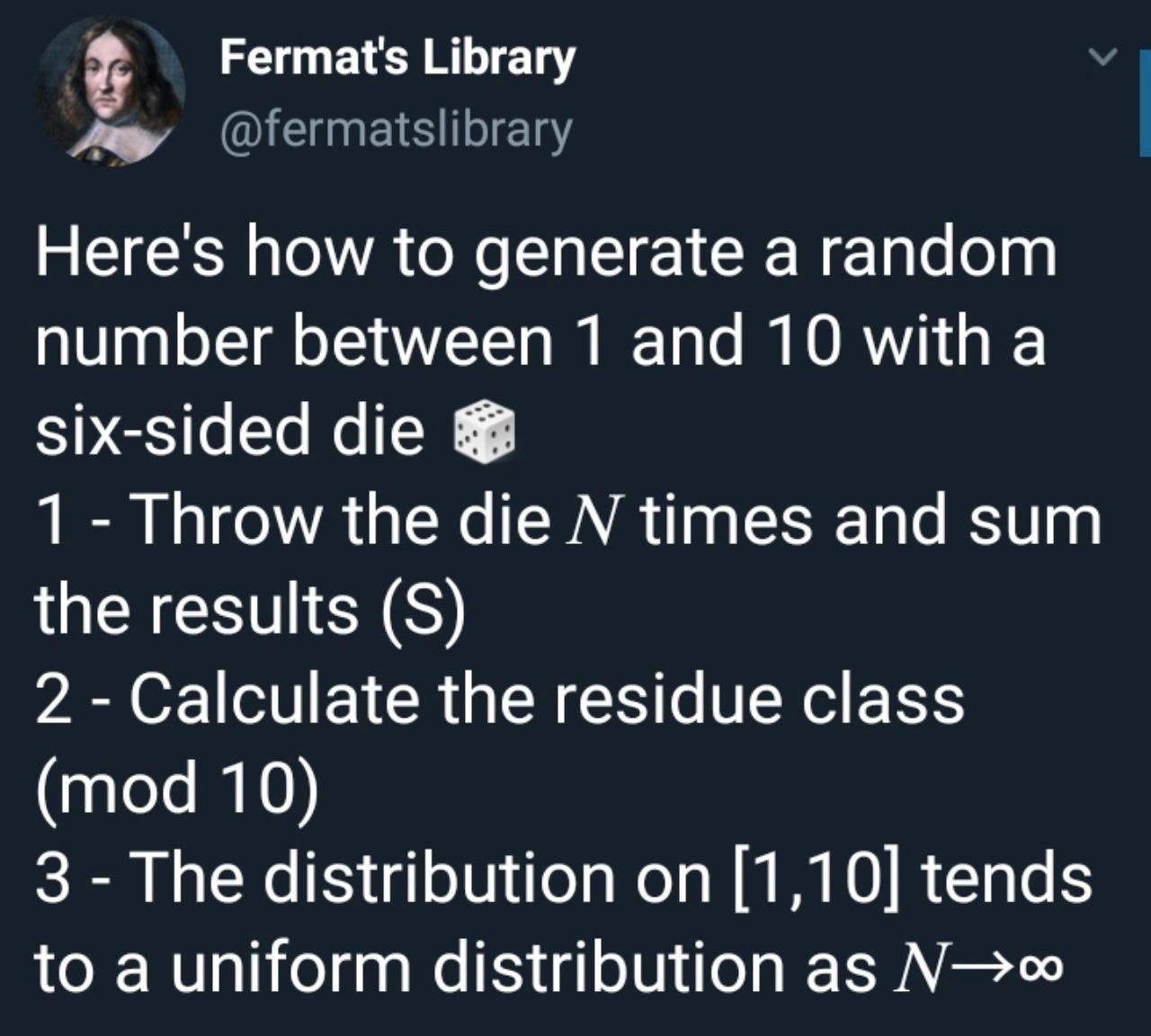
Step 1: “Throw the die N times and sum the results (S).” This means roll a standard six-sided die (a D6, which gives you a random number from 1 to 6) over and over, N times in total. Keep a running sum of all those rolls, and call that sum S. For example, if N = 5 and your die rolls come up 4, 6, 2, 5, and 3, then S = 4+6+2+5+3 = 20. Essentially, you’re accumulating a potentially very large total by throwing the die many times.
Step 2: “Calculate the residue class (mod 10).” The term residue class mod 10 is a mathematical way to say “find the remainder when S is divided by 10.” In programming, this is often done with the % operator. So if our sum S = 20, then 20 mod 10 = 0 (because 20 divides evenly by 10, remainder 0). If S = 23, then 23 mod 10 = 3 (since 23 divided by 10 is 2 remainder 3). This operation gives a result between 0 and 9 inclusive. Since the original goal is a number between 1 and 10, we can imagine that if we get 0 as the remainder, we’d interpret that as “10,” or simply add 1 to the 0–9 result to shift it into 1–10. The tweet glosses over that detail, but the idea is that after this step you have a number in the range 1 through 10. So basically, you take the huge sum from step 1 and just look at its last digit (in base 10).
Step 3: “The distribution on [1,10] tends to a uniform distribution as N → ∞.” This is the part that sounds complicated. Distribution here refers to the probabilities of each outcome (1 through 10) occurring. A uniform distribution means each of the numbers 1,2,…,10 is equally likely (in an ideal case, each would have a 10% chance). The phrase “as N → ∞” means “as N approaches infinity,” or in simpler terms, if you could repeat step 1 with an incredibly large number of rolls — literally an infinite number of rolls. So what this step is saying is: the more times you roll and sum (the larger N is), the closer the outcome’s probabilities get to being perfectly even for 1 through 10. If N were infinite (which is a purely theoretical scenario), then each of the ten numbers would come up exactly 1/10 of the time.
So put together: the tweet describes a method to get a random number 1–10 by using a six-sided die and a lot of math. Roll the die a bunch of times, sum up all those results, then use the remainder mod 10 of that sum as your final number. If you rolled forever (an infinite number of rolls), this final number would be perfectly random and fair among 1–10. With a very large finite N, the idea is you’d approximate that fair uniform randomness more and more closely.
Why is this funny or notable? Because it’s an over-engineered solution to a simple problem. In everyday programming or even just playing games, if you needed a random number from 1 to 10, you wouldn’t do all this! You could just roll a 10-sided die (if you have one) or roll a 6-sided die a couple of times and do something much simpler like rerolling certain outcomes. Most programming languages let you call a random number function directly (random.randint(1,10) would do it in Python, for example). The tweet’s method is like solving a simple puzzle with a very convoluted trick. It’s technically clever from a math standpoint: it uses the idea of asymptotic uniformity (that with enough repetition things even out). But it’s also poking fun at that approach, since “with enough repetition” here basically means “do an endless amount of work.”
In summary, the tweet is describing a real mathematical phenomenon — that if you add up lots of random 1–6 values, the distribution of the sum’s last digit becomes nearly even. However, it’s doing so in a jokey, AlgorithmHumor way: suggesting an impractical algorithm as if it were a how-to. The key terms: random number generation (picking a random value), six-sided die (a physical RNG giving 1–6), mod 10 (taking a remainder to force a number into 0–9 range), and uniform distribution (all outcomes equally likely) are combined here in an over-the-top manner. It’s the kind of thing that might show up as a prank in a computer science class — technically right, but no one would seriously implement it to solve the problem. Understanding this setup lets you in on the joke: it’s funny because it’s a lot of fancy math talk for a solution that is ridiculously impractical compared to the easy alternatives.
Level 3: Algorithmic Overkill
From a seasoned developer’s perspective, this “ultimate over-engineered hack” is hilarious because it satirizes solutions that are mathematically correct but practically ridiculous. Generating a uniform random number between 1 and 10 is a trivial task in practice — most programming languages have a built-in rand() or similar function for it, or you could just use a 10-sided die 🎲 if you have one. But here we have a convoluted method: roll a six-sided die N times, sum up the results, then take that sum modulo 10. Technically, as N becomes huge, this does approach a fair uniform selection from 1 to 10. However, any experienced engineer immediately recognizes the over-engineering. It’s like using a rocket launch to drop a pebble: massive overkill for a simple goal.
The tweet reads like a tongue-in-cheek snippet from a design document written by someone who got lost in theoretical AlgorithmDesign elegance. We’ve all seen instances of Algorithm Humor in real life where a developer or researcher proposes a solution that’s brilliant on paper but utterly impractical to implement. This is a prime example. It nods to those times when someone says, “In theory, it works perfectly,” usually followed by “…but we might need infinite resources or time.” Here the requirement “as N → ∞” is the dead giveaway — no production system can run an infinite loop of dice throws! Seasoned devs know to be wary when an algorithm’s correctness relies on a limit or an assumption that never actually occurs in reality.
This joke also highlights the gap between CS fundamentals and real-world coding. Yes, residue classes and modular arithmetic are foundational concepts (we often use mod to wrap around values, and randomness is a staple of algorithms), but using them in this way feels like an academic exercise. The idea of summing many independent rolls to smooth out probabilities is somewhat akin to a brute-force Monte Carlo approach taken to an extreme. Instead of a simple solution (like using two dice and a clever mapping or just rejecting some outcomes to get a fair distribution), the method demands you to keep rolling forever to achieve perfection. It’s poking fun at the kind of design where someone insists on absolute mathematical fairness (“uniform distribution”) at the cost of infinitely doing work. The variance of the sum S grows with N, which means the sum is all over the place — you’re basically chasing an even spread by piling on more randomness. It’s hilariously inefficient.
To put it in coding terms, imagine someone actually implementing this:
import random
def random1to10_with_d6():
total = 0
N = 1000000000 # a ridiculously large number of rolls
for _ in range(N):
total += random.randint(1, 6) # simulate a six-sided die roll
result = (total % 10) + 1 # remainder mod 10, shifted to 1-10 range
return result
print(random1to10_with_d6())
In theory, if N were literally infinite, result would be perfectly uniform from 1 to 10. But with any finite N (even one billion rolls as in the code comment!), there’s still a microscopic bias – and more importantly, it’s insanely wasteful. No one would really do this in production; the code above is a tongue-in-cheek illustration. A real engineer would either use a direct uniform RNG or at most do a small-loop method (like roll a D6 twice and reroll if the outcome isn’t in 1–10 range). The scenario in the tweet is making seasoned devs chuckle because it reminds them of the times they’ve encountered brilliant solutions in theory that are nightmares in practice. It’s the epitome of an over_engineering_randomness approach – correct by the book, but essentially a parody of proper algorithm design.
Experienced folks also appreciate the nod to how math can be technically right yet miss the point. The tweet coming from “Fermat’s Library” (a popular account sharing math curiosities) signals that this is a clever joke. It’s as if a math geek entered a programming contest requirement (“generate a random 1–10”) and came up with this purity-obsessed method. Those of us who maintain code or care about efficiency immediately recognize the humorous disconnect. It’s a gentle roast of solutions that make it into proposals or codebases just because they are theoretically neat. In short, any senior dev reading this will likely smirk and think, “Sure, it works… if you have until the heat death of the universe to wait!”
Level 4: Uniform in the Limit
At the most theoretical level, this tweet is hinting at a concept of asymptotic uniformity in random number generation. In formal terms: if you roll a fair six-sided die N times, let the sum of those rolls be S. Now look at the residue class of S modulo 10 (i.e. S mod 10, the remainder when dividing S by 10). As N grows very large, the probability that S mod 10 equals any particular value 0–9 approaches 1/10. In other words, in the limit as N → ∞, the distribution of that remainder becomes perfectly uniform over 10 outcomes. This is a consequence of deep probabilistic principles. Essentially, repeated independent rolls create a random walk on a circle of size 10, and because one of the die outcomes is 1 (which is coprime with 10), that random walk is ergodic: it eventually covers all residues equally. Mathematically, we can express the limiting probability for each result r ∈ {0,...,9} as:
$$ \lim_{N \to \infty} \Pr!\big((X_1 + X_2 + \cdots + X_N) \bmod 10 = r\big) = \frac{1}{10}, $$
where each $X_i$ is a roll of a fair D6 (a six-sided die). This is a beautiful result from number theory and probability: the convolution of enough uniform distributions on {1,…,6}, when reduced mod 10, approaches a flat distribution. It’s related to the idea that summing many independent random variables “spreads out” their distribution. In fact, as N increases, $S$ (the sum) roughly follows a bell-curve (by the Central Limit Theorem), and taking that sum modulo 10 essentially wraps that bell curve around a circle, eventually flattening it out. The larger N gets, the closer S mod 10 gets to a uniform distribution on 0–9.
Of course, this is a purely theoretical construction. The catch is hidden in the phrase “as N → ∞.” In computer science terms, that’s like saying if we had infinite time or infinite loops, we’d get a perfectly fair result. It’s a proof-of-concept that such a distribution exists in the limit, not a practical algorithm you could ever fully execute. This touches on a classic CS_Fundamentals idea: sometimes we can prove something is possible in an asymptotic or infinite sense, even if no finite implementation can achieve it exactly. The humor here is that we’ve used rigorous math to achieve something as simple as picking a random number 1–10 — but only by invoking an infinite process! It’s a delightful example of theory running far ahead of practice, using an over-engineered randomness technique that’s correct in principle and absurd in execution.
Description
A screenshot of a tweet from the account 'Fermat's Library' (@fermatslibrary) against a dark blue background. The profile picture is a classical portrait of a man. The tweet presents a complex, three-step method to generate a random number between 1 and 10 using a standard six-sided die, complete with a small die emoji. The steps are: '1 - Throw the die N times and sum the results (S)', '2 - Calculate the residue class (mod 10)', and '3 - The distribution on [1,10] tends to a uniform distribution as N→∞'. This meme finds its humor in the academic and overly-engineered approach to a simple problem. For developers, generating a random number is a trivial one-line command. The method described, while mathematically sound and related to principles like the central limit theorem, is comically impractical for a real-world application. It's a joke about the gap between theoretical computer science/mathematics and practical programming, satirizing solutions that are technically elegant but absurdly complex for the problem at hand
Comments
7Comment deleted
This is how you generate a random number when the PM asks for it to be 'enterprise-ready' and 'infinitely scalable'
Sure, it’s O(∞) in wall-clock time, but at least the statistical test suite passes in the limit - just ship it behind a feature flag called ‘eventual entropy.’
This is exactly how we designed our random number service: it achieves perfect uniformity after infinite API calls, but the infrastructure team keeps complaining about the AWS bill approaching infinity at the same rate
When your random number generator is so enterprise-grade that it requires O(N→∞) time complexity and a PhD in number theory to explain why rolling a d6 repeatedly is 'better' than just using Math.random(). Meanwhile, production is down because someone's still waiting for N to approach infinity before they can generate their first random number for the load balancer
Summing d6 rolls and taking S mod 10 is the RNG version of eventual consistency - mathematically uniform as N→∞, but your SLA and on-call both sample at very finite N
Mathematician’s RNG: a random walk on Z10 with a uniform stationary distribution; engineer: great, but what’s the p99 for N - can we just use base‑6 rejection sampling before the heat death of the universe?
rand() % 10 for juniors; real uniformity demands N→∞ dice throws and infinite patience