
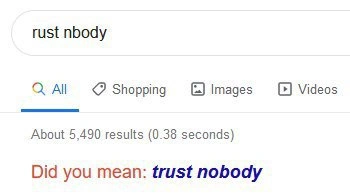
Google's Existential Advice on Rust Benchmarking
Description
A cropped screenshot of a Google search query and its result. The search bar at the top contains the text 'rust nbody'. Below the standard search category tabs (All, Shopping, Images, Videos), the results summary shows 'About 5,490 results (0.38 seconds)'. The most prominent part of the image is the line below, in larger, colored text, which reads 'Did you mean: trust nobody'. This meme captures a humorous interaction where a technical search query is misinterpreted by Google's spell-checking or suggestion algorithm. A developer searching for 'rust nbody' is almost certainly looking for implementations of the n-body simulation, a common performance benchmark, in the Rust programming language. The algorithm, however, mistakes this for a typo of the common phrase 'trust nobody,' providing a piece of cynical, existential advice instead of technical information. The humor lies in this juxtaposition and is highly relatable to developers whose niche queries are often misunderstood by search engines


Comments
7Comment deleted
Even Google's search index has a borrow checker: it saw 'rust' and immediately warned me not to trust any other references
Typed “rust nbody,” Google countered with “trust nobody” - apparently in zero-trust astrophysics, every body is an untrusted pointer until the borrow checker signs off
Google's autocorrect just summarized 20 years of production incident post-mortems in two words
When you're trying to optimize gravitational simulations with Rust's memory safety guarantees, but the search engine delivers life advice instead. Ironically, 'trust nobody' is actually solid engineering wisdom when it comes to input validation and zero-trust architecture - maybe the algorithm knows something we don't about concurrent N-body systems
Google gets Rust: trust nobody, especially those dangling C pointers begging for a use-after-free
Searched 'rust nbody' to chase microbenchmarks; Google suggested 'trust nobody' - reasonable when any crate with a build.rs gives your CI arbitrary code execution
Typed "rust nbody" and Google replied "trust nobody" - fair, because Rust fixes use-after-free, not use-after-curl | sh; the real n-body problem is your 200 transitive crates orbiting an "unsafe" FFI