A Developer's Desperate Plea for Uninterrupted Focus
Why is this DeveloperProductivity meme funny?
Level 1: No Chat Zone
Imagine you’re trying to do your homework, and you really need to concentrate. But you know if your best friend comes over or starts talking to you, you’ll end up chatting and playing for hours and won’t finish your homework at all. So, you put a big sign on your back that says, “Please don’t talk to me. I can’t stop myself from talking to you for a long time and then I won’t get my homework done.” It sounds silly, right? But it’s also kind of funny because you’re basically asking your friend to save you from getting distracted.
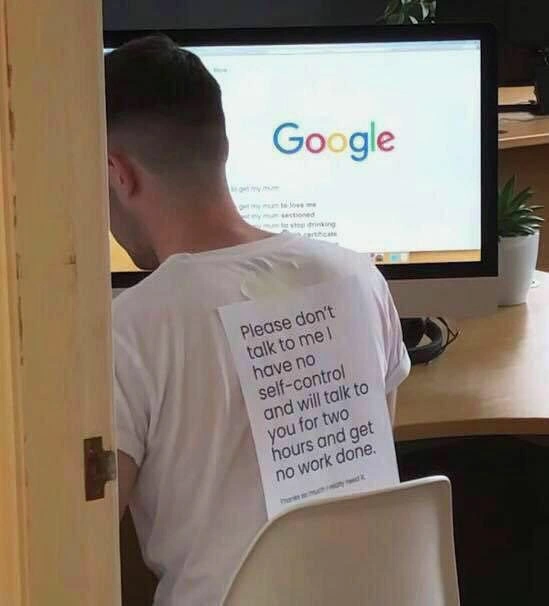
In this meme, the programmer is like that student. He wants to focus on his “work” (writing code) and not get disturbed by anyone in the office wanting to chat. He knows that if someone starts a conversation, he’ll enjoy it and keep talking for too long. Just like you might lose track of time talking about your favorite game or show, he’ll lose track of time and not get his job done. So, he made his own “Do Not Disturb” sign and stuck it on his shirt for everyone to see. It’s a funny and extreme way to guard his focus, almost like saying “I’m in the No Chat Zone right now.”
The reason it’s humorous is because usually grown-ups don’t walk around with signs on their backs to avoid talking. He’s exaggerating the situation to make a point. It shows how sometimes, when we really need to concentrate, we’ll do almost anything to avoid getting distracted – even if it means telling our friends to ignore us for a little while. So the meme makes us laugh, and at the same time we totally get it: when you have something important to do, a little quiet time can be your best friend.
Level 2: Deep Work Defense
Let’s break down what’s happening here in simpler terms. The meme is about a software developer trying to stay focused and get work done in a busy office. He’s put a literal sign on his back that says, “Please don’t talk to me. I have no self-control and will talk to you for two hours and get no work done.” Why would someone do this? It’s because programmers often need to concentrate for long periods (what some call deep work or being “in the zone”) to solve complex problems or write code. Every time someone interrupts with a question or casual chat, the programmer’s brain has to switch contexts – basically, stop thinking about the code and start thinking about the conversation. This switching is costly in terms of time and mental energy. You might have noticed this yourself: say you’re doing homework and you get a text or someone calls you; after that, it takes a while to remember where you were. That’s context switching in everyday life.
In a typical software company’s open office, people sit in one big room without many walls or private offices. This setup is great for quick communication – you can just walk over to someone and ask something – but it’s terrible for concentration. Office interruptions like a coworker dropping by to chat can break a programmer’s flow state. Flow (or “the zone”) is when you’re fully immersed in a task – for a coder, it’s when you’ve loaded all the relevant code in your head, you’re test-running ideas mentally, and writing or debugging code quickly. It’s a sweet spot of high productivity. But if someone says “Hi”, that flow breaks. You lose the thread of what you were doing. It can take 15-30 minutes to regain that level of focus, even if the interruption was just a minute or two. That’s why the joke says “talk to you for two hours and get no work done” – it underscores how a small slip can lead to a big derailment of the day’s work.
Now, developers have some common tactics to protect their focus. The headphones we see in the image are one. Many coders put on headphones (often playing music or just noise-cancelling) to signal “I’m busy” and to drown out background chatter. It usually means do not disturb. Here, the headphones are right by the keyboard, meaning he might normally use them, but perhaps they weren’t enough. Some offices even have actual “Do Not Disturb” signs or lights (like a little busy-light gadget on the desk) or policies like “No interruptions during morning coding hours.” But not every workplace has that culture, so developers improvise. In this case, taping a sign to his shirt is an improvised solution to ward off well-intentioned interrupters.
Let’s decode some of the terms and tags related to this meme:
- DeveloperProductivity: This refers to how much useful work (like writing code or fixing bugs) a developer can get done. Interruptions, as shown, can severely hurt productivity because they eat up time and focus.
- Communication: While communication is generally good in teams, here it’s the casual, constant communication that’s causing a CommunicationBreakdown of another sort. The meme highlights a breakdown in balancing communication with quiet work time.
- ContextSwitching: In computing, this is when a CPU switches from one task to another (with some overhead cost). In human terms, it’s like switching your brain from one thing to another. The tag points out that the meme is about the cost of switching mental context from coding to talking and back to coding.
- DeveloperFrustration: This scene is a form of humor that comes from frustration. The dev is basically frustrated with himself and the situation – he knows if he starts gabbing, he’ll lose track of work. It’s funny, but it’s born from a real frustration developers feel with constant distractions.
- WorkplaceHumor: A lot of offices have little jokes or signs like this. It’s part of tech culture to poke fun at our own habits. This meme’s scenario is a humorous way to address a workplace issue (too much chatting, not enough working) without directly blaming anyone.
- do_not_disturb_sign: Literally what’s on his back. We often see “Do Not Disturb” signs in hotels or on someone’s office door. Here, it’s taped to a person! It’s an explicit request: please pretend I’m not here for a while.
- flow_state_protection: Flow state, as mentioned, is that deep focus mode. Protecting it means doing things to avoid getting knocked out of concentration. The developer’s sign is an extreme form of flow state protection – like a shield against incoming distractions.
- office_interruptions: These are all the little breaks in focus that happen in an office: someone asking a question, phone calls, loud conversations nearby, impromptu meetings. They’re normal in offices, but for someone who needs concentration, they can be very disruptive.
- self_control_warning: The text on the sign literally warns others that he has no self-control if they initiate a chat. It’s a funny way to phrase it: instead of saying “Don’t distract me,” he says “I can’t resist distraction, so don’t even give me the opportunity.” It’s both a warning and an admission of a personal flaw, which makes it humorous and somewhat endearing.
- google_homepage_idle: In the photo, his screen is just showing Google’s homepage, which is kind of the default page you see when you’re not actively doing anything else on the web. This could imply that he hasn’t been working for a bit (maybe because he was talking or daydreaming). It’s a visual gag: the screen isn’t full of code or a complex diagram – it’s just Google, as if he got so distracted that all he’s doing is maybe searching random stuff or simply left his browser open. It accentuates the idea that no real work is happening. For many developers, getting stuck browsing or googling unrelated things is a telltale sign that their focus was already broken.
For a newer developer or someone early in their career, this meme is a gentle introduction to the importance of managing interruptions. When you start out, you might not realize how critical uninterrupted time is for coding. As you gain experience, you learn tricks: maybe you set your instant messenger to “Away” when you really need to concentrate, or you find a quiet corner to work in. You learn to say “Let me finish this first, I’ll come by later.” But those skills take time. Here, our friend just skipped to the nuclear option with the sign 😄. It’s an exaggerated solution, but it drives the point home: focus is precious in programming. And sometimes, protecting that focus means setting clear boundaries with your friendly coworkers, even if it feels a bit awkward or funny. In this case it’s literal and visible – everyone can see that sign – so it’s also likely to get a laugh and diffuse the awkwardness. His coworkers probably chuckled but also got the message.
The takeaway for a junior developer: it’s okay to create “focus time” for yourself. You don’t need to tape a note to your back, but you can communicate to your team when you need quiet time. Maybe it’s putting on headphones or saying, “Hey, I’m going to be heads-down for the next two hours to get this done.” Most people will understand because they’ve been there too. And if you ever feel guilty about not being instantly available, remember this meme: even the most sociable, friendly devs sometimes have to literally turn their back on conversation to get stuff done. It’s all about balance. The humor here is showing the balance tipped far to the “please leave me alone” side in a lighthearted way.
Level 3: Flow State Sabotage
On a more practical level, this meme strikes a chord with every experienced programmer who has fought to stay “in the zone” amidst an open-office interrupt storm. The elements here are immediately familiar: a developer at his desk, the ubiquitous Google homepage idling on the monitor (a tongue-in-cheek hint that not much coding is happening), and a desperate DIY “do not disturb” sign slapped on his back. The text on that paper is both hilarious and painfully relatable: “Please don’t talk to me. I have no self-control and will talk to you for two hours and get no work done.” This is funny because it’s true — we’ve all had that one quick “Got a second?” chat that snowballed into a two-hour rabbit hole, leaving our actual work in shambles. The developer openly admits a weakness (being too eager to chat) that many of us hide. By externalizing the self-control warning, he’s basically crowd-sourcing his discipline: “Help me help myself; ignore me so I can get things done!” It’s a brilliant mix of self-deprecation and problem-solving.
This scenario satirizes the constant office interruptions that plague modern DeveloperProductivity. In many tech workplaces, especially those with trendy open floor plans, programmers struggle to maintain a flow state. You might be knee-deep in refactoring some gnarly function or debugging a critical issue when — tap tap — a well-meaning colleague appears. Maybe they’re asking about lunch plans or need help with their code. You want to be a good coworker (and honestly, talking about a cool tech topic or even last night’s game sounds way more fun than your current bug). Next thing you know, your concentration is shattered and “two hours and no work done” isn’t an exaggeration; it’s office life. This meme pokes fun at that shared experience and the extreme lengths a dev might go to guard their focus. It’s the equivalent of hanging a “Gone Fishing (for Code)” sign to ward off friendly interrupters.
Why is this so relatable to senior engineers? Because they’ve been there — repeatedly. They know the cost of context switching not just in theory but in painfully missed deadlines and late-night coding sessions catching up. The sign on the back is essentially a physical status code broadcast. In web terms, he’s returning an HTTP status:
HTTP/1.1 503 Service Unavailable
Retry-After: 7200 # seconds (approx. 2 hours)
He’s effectively saying, “I’m unavailable for conversation right now; please come back later (and not instantly).” The humor is that developers often resort to tech metaphors for human problems – here the human is literally a server refusing connections to protect its throughput. It’s a bit meta and delightfully nerdy.
The presence of the headphones on the desk is another pointed detail. Headphones, especially noise-cancelling ones, are the unofficial “Do Not Disturb” flag in tech offices. When a coder puts on those big over-ear cans, it’s usually a polite way to say “I’m in deep focus, please don’t tap me on the shoulder.” But here, the headphones are off, possibly because even blasting music wasn’t enough to fend off chatty coworkers or because he got tired of pulling them off every time someone did interrupt. So he escalated to the back-sign – the workplace equivalent of a defensive moat. It’s both a clever productivity hack and a comedic cry for help.
This meme also hints at the maker’s schedule vs manager’s schedule conflict in workplaces. Developers (makers) need long uninterrupted stretches to code effectively (deep work time), whereas others might have a routine of frequent meetings or chats (managers, recruiters, etc.). In an open office, these two worlds collide: the person strolling over for a chat may not realize they just yanked the programmer out of a fragile mental architecture of classes and pointers. The result is DeveloperFrustration: that internal scream when you lose a solution because someone said “hi.” The taped sign is a dramatic demonstration of a boundary that offices often lack. It satirically says what many wish they could: “It’s not that I don’t like you; it’s that I know if I start talking about the new Game of Thrones spin-off or the latest framework, I’ll lose half my day and my ContextSwitching overhead will skyrocket.”
From an organizational perspective, this highlights a CommunicationBreakdown in how we handle focus vs. availability. Companies preach collaboration and have open spaces to encourage spontaneous interaction, but the dark side is constant context switching that kills productivity. The meme exaggerates the solution (wearing a literal sign) to show just how desperate it can feel. Senior devs chuckle because they’ve tried more socially acceptable versions: blocking calendars as “Do Not Schedule – Coding Time,” setting Slack status to 🟡 “Focusing, please DND”, or even hiding in a meeting room or remote location to get stuff done. Extreme? Maybe. Effective? Often, yes. Yet, not everyone respects these subtle signals, hence the need for bolder measures like the shirt sign. It’s an in-your-face tactic that says: flow_state_protection in progress.
There’s also an undercurrent of the guilt and self-awareness many devs have. Notice the phrasing “I have no self-control.” He isn’t blaming coworkers for bothering him; he’s blaming his own willingness to be distracted. This twist makes it funnier and more relatable. It’s essentially the programmer saying, “Hey, I’m my own worst enemy. I love nerding out in conversation, so I beg you, save me from myself!” That level of candid honesty is both amusing and endearing. It flips the usual script — instead of calling others out for interrupting, he jokingly calls himself out for lack of discipline. But in doing so, he actually does stop others from interrupting, which is the goal. It’s reverse psychology and self-deprecation rolled into one.
In summary, the meme blends WorkplaceHumor with a real pain point in DeveloperProductivity. It exaggerates a common coping mechanism (creating a do_not_disturb_sign) to highlight how crucial uninterrupted flow is to programmers. Seasoned developers laugh (perhaps a bit darkly) because they remember times they wished they could wear this sign. It’s funny because it’s absurd, and it’s funny because it’s accurate. The open office “chat culture” is effectively sabotaging the very productivity companies expect from their engineers. This dev’s solution? Loudly declare a “No Chat Zone” around himself. It’s office comedy gold with a kernel of truth: sometimes, to get serious work done, you have to politely shut out the world — even if it means taping a giant note to your back!
Level 4: Context Switch Thrashing
At a deep technical level, this meme humorously parallels context switching in computer systems. Just as a CPU suffers when it’s forced to juggle tasks too frequently, a developer’s brain can thrash when bombarded with interruptions. In operating systems, frequent task-switching causes overhead: saving CPU registers, invalidating caches, and flushing pipelines. Here, the “task” is coding in a flow state, and the “interrupt” is a friendly office chat. Each time a colleague says “Hey, got a minute?”, the developer’s mind performs a costly context switch. It’s like the L1 cache of your brain (all the juicy details of the code in your head) gets wiped out. You then have to reload that cache (reread code, remember what you were doing) after the chat — analogous to a CPU cache miss where the processor fetches data from slower memory because the fast cache was cleared. If chats happen too often, the poor brain spends all its time swapping between “work mode” and “chat mode,” making virtually no forward progress on the actual code. This is cognitive thrashing: time spent on context save/restore outweighs time spent executing the task. The taped sign is essentially the developer’s attempt at an interrupt mask — a manual SIGSTOP on any incoming human interrupts. By pleading “Please don’t talk to me,” he’s trying to disable non-critical interrupts so his mental CPU can run at full throughput without constant pipeline flushes. In effect, the developer wants to increase his time slice on the current “process” (the coding task) to complete it before another context switch occurs. Just as kernel schedulers strive to minimize context switch overhead for efficiency, this programmer is tweaking his “office scheduler policy” to favor deep work. It’s a low-tech hack to ensure that his working set (the code and logic loaded in his mind) isn’t evicted from memory every few minutes. The result? Fewer costly cache misses in his thought process and more continuous productive time — at least in theory. In short, the meme highlights a real-world analog of a classic computer science problem: too many interrupts can grind even the fastest processor (or programmer) to a halt.
# Developer's focus loop simulation
focused = True
while focused:
write_code() # Developer is in flow, executing tasks
if colleague_interrupts():
save_context() # Save current mental state (the 'registers' of the brain)
chat_with_colleague() # Handle the 'interrupt': two-hour ISR (Interrupt Service Routine) :)
restore_context() # Try to reload mental state (reload cache, pipeline)
if not in_flow_state():
focused = False # Context lost: break out to recover (thrash detected)
In the code above, a colleague interrupt forces the program (developer) to save state, execute a high-latency interrupt routine (a long chat), and then attempt to restore state. If the state can’t be perfectly restored (which is often the case when you forget where you left off in code), the flow breaks entirely. The developer has to spend extra cycles (re-reading code, rethinking the problem) to get back on track. Much like a CPU that’s interrupted too often, a developer’s throughput drops dramatically with each unplanned context switch. This flow state disruption is the very thing our sign-wearing hero is trying to avoid. It’s a comically extreme measure, but from a systems perspective, it’s about optimizing for cache locality (keeping all relevant info in your head) and minimizing costly context-switch overhead. The meme resonates because beneath the humor lies a nugget of technical truth: whether in silicon or in gray matter, too many interrupts will kill your performance.
Description
A photograph showing the back of a man with short brown hair, wearing a white t-shirt, sitting at a desk in front of a large monitor. The monitor displays the Google search homepage. Taped to the man's back is a white piece of paper with a printed message in a sans-serif font that reads: 'Please don't talk to me I have no self-control and will talk to you for two hours and get no work done.' Below this main text, in a much smaller font, it says 'Thanks so much I really need it.' The image captures a common struggle in the modern workplace, particularly in open-plan offices. For software developers, who often require long periods of deep, uninterrupted concentration (known as 'flow state') to solve complex problems, context switching due to interruptions can be incredibly costly to their productivity. This note is a humorous and relatable cry for help, a self-aware acknowledgment of the conflict between being a sociable colleague and a productive engineer
Comments
7Comment deleted
This is the analog equivalent of disabling all notifications, setting Slack to 'Focusing,' and putting on noise-canceling headphones, only to be defeated by a shoulder tap for a question that could have been an email
Treat the shirt as an interrupt mask: unmask it for small talk and you’ve triggered a two-hour context switch with full cache eviction - there goes the sprint
Wearing a shirt that says "don't talk to me" while having 47 Stack Overflow tabs open, 3 unfinished architecture diagrams, and actively googling "how to politely decline meeting invites" - the senior engineer's paradox of desperately needing help but knowing any conversation will spiral into a two-hour debate about whether Kubernetes was a mistake
This shirt perfectly captures the senior engineer's paradox: we've architected distributed systems handling millions of requests per second, but can't architect our own willpower to resist a two-hour tangent about why tabs are superior to spaces. It's the ultimate admission that our biggest bottleneck isn't the database - it's our inability to say 'let's circle back on this.' The real deep work isn't in the code; it's in the Herculean effort of not explaining our entire microservices migration story to anyone who makes eye contact
The dev's passive rate-limiter for interruptions: infinite loop detected in chit-chat handler
In the open‑office microservice architecture, he’s deployed a paper-based circuit breaker on the small_talk endpoint - because every request triggers a 23‑minute cache rebuild and a two‑hour throughput outage
Interrupt me and you've initiated a distributed transaction with a 30-minute rollback and no idempotency; that paper is our new backpressure policy