Skip to content
DevMeme
190 of 7435
Scrum-but: The Unofficial Agile Methodology
Agile Post #230, on Mar 15, 2019 in TG

Scrum-but: The Unofficial Agile Methodology

Why is this Agile meme funny?

Level 1: The Promise With Crossed Fingers

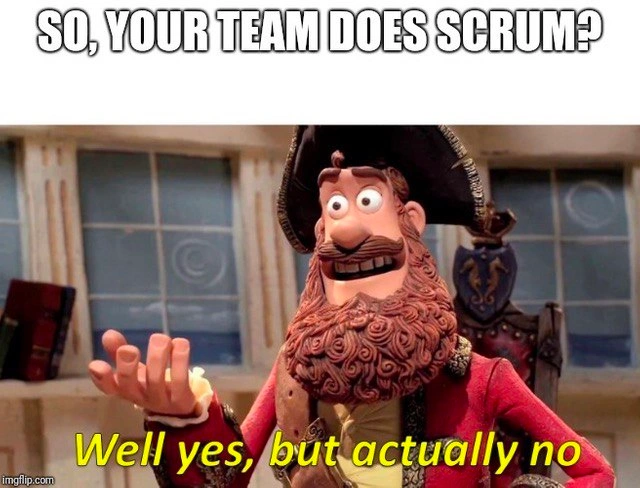
A cartoon pirate gets asked, "So, you follow the rules of the game?" and he answers with a big smile: "Well yes... but actually no." It's like a kid who says they cleaned their room — and technically they did push everything under the bed. The room looks clean, the checklist says clean, but anyone who opens the closet knows the truth. The joke is that whole companies do this with their way of working: they wear the costume, say the magic words, and skip the actual cleaning — and everyone quietly knows it, which is exactly why this pirate's half-confession makes developers laugh and wince at the same time.

Level 2: The Ceremonies, Decoded

Scrum is a framework for building software in short cycles. Its main parts, and how they look when the pirate's answer applies:

Element Supposed to be Often actually is
Sprint Fixed-scope 1–4 week cycle Scope changes mid-sprint, deadline doesn't
Daily standup 15-min team sync to unblock each other Status report performed for a manager
Retrospective Team improves its own process Skipped, or complaints logged and ignored
Story points Rough relative-effort estimates Converted to hours and treated as promises
Product Owner Single prioritizer of the backlog Committee of stakeholders with veto power

If you're early in your career and your team's "Scrum" matches the right-hand column, the useful realization is that the framework isn't failing you — it was never actually installed. Knowing the textbook version matters mostly so you can tell the difference, ask good questions in retros (if you have them), and avoid concluding that all process is theater.

Level 3: Scrum-But and the Cargo Cult Fleet

The claymation pirate captain's hedge —

Well yes, but actually no

— is the most honest answer ever given to "So, your team does Scrum?", and the Agile community even has a formal name for it: Scrum-but. As in: "We do Scrum, but we skip retrospectives because there's no time." "We do Scrum, but the standup is where the manager collects status." "We do Scrum, but the sprint backlog changes whenever sales lands a deal." Each individual but sounds like pragmatic tailoring; collectively they amputate exactly the parts of the framework that were supposed to deliver the benefits.

The pattern being satirized is cargo cult Agile — the term borrowed from Feynman's cargo cult science, describing Pacific islanders who built bamboo control towers hoping planes would land. Teams adopt the ceremonies (standups, sprints, story points, a board with swimlanes) while discarding the mechanisms (empowered teams, protected sprint scope, inspect-and-adapt loops). The runway is there; no planes land. The most common terminal form is waterfall in sprints: requirements still arrive fixed from above, deadlines are still set before estimation, and the two-week sprint is just a finer-grained Gantt chart with daily confessionals.

Why does every organization converge here? Incentives, as usual. Real Scrum redistributes power — the team owns the how and the sprint scope, management owns priorities, and estimates are forecasts rather than promises. That redistribution is precisely the part middle management has the least appetite for, so what gets adopted is the vocabulary (which costs nothing and looks great in transformation slide decks) without the authority transfer (which costs everything). Story points get converted back into deadline commitments, the Scrum Master becomes a meeting scheduler, velocity becomes a performance metric to be gamed — and Goodhart's law does the rest. The Agile-industrial complex of certifications and consultants happily sells the ceremony layer, because the ceremony layer is the billable layer.

The pirate is the perfect messenger because his answer isn't a lie — it's a negotiated truth. "Yes" is what the org chart reports upward; "actually no" is what every engineer in the standup knows. The comedy is the gap, and the gap is where burnout lives: teams held to Agile's promises (predictability, sustainable pace) while denied its preconditions.

Description

This meme uses the popular 'Well yes, but actually no' format, which features a claymation pirate captain from the movie 'The Pirates! In an Adventure with Scientists!'. The top text, in a bold white impact font, asks, 'SO, YOUR TEAM DOES SCRUM?'. The pirate captain, with a hesitant and slightly misleading expression, gestures as the bottom text, in yellow, delivers the punchline: 'Well yes, but actually no'. This meme perfectly encapsulates the widespread phenomenon in the software industry known as 'Scrum-but' or 'cargo cult Agile,' where teams adopt the ceremonies and terminology of Scrum (like sprints and stand-ups) but fail to embrace the core principles of continuous improvement, feedback loops, and empowerment. For senior developers, this is a deeply familiar and often frustrating scenario, representing a superficial adoption of Agile practices that yields none of the benefits and often adds more overhead

Comments

8
Anonymous ★ Top Pick We're technically doing Scrum. Our sprints are six weeks long, the daily stand-up is a two-hour status report for management, and 'done' means it compiles on one developer's machine
  1. Anonymous ★ Top Pick

    We're technically doing Scrum. Our sprints are six weeks long, the daily stand-up is a two-hour status report for management, and 'done' means it compiles on one developer's machine

  2. Anonymous

    Our “Scrum” playbook: 1) rename the Monday status call to “stand-up,” 2) export the Gantt chart to PNG and label it “burn-down,” 3) keep the annual release - congratulations, we’re agile now

  3. Anonymous

    We do Scrum, except sprints are quarterly, the PO writes all the stories during planning, retrospectives are optional, and our definition of done changes based on who's asking - but we have daily standups, so we're definitely Agile

  4. Anonymous

    We do Scrum: two-week waterfalls with daily confessionals and a retro nobody acts on

  5. Anonymous

    Every team 'does Scrum' until you ask about their Definition of Done, observe their two-hour daily standups, notice the six-month sprints, or discover that their 'Product Owner' is actually a committee of twelve stakeholders who've never seen the backlog. It's Scrum in the same way that renaming your waterfall phases to 'Sprint 1' through 'Sprint 47' is 'agile transformation.'

  6. Anonymous

    Classic Scrumbut: WaterScrum-Fall - waterfall requirements, Scrum theater, waterfall delivery

  7. Anonymous

    Yes, we do Scrum - full ceremony, zero empiricism: Sprint Goal is “cope,” DoD ends at “merged,” and velocity is calibrated to the quarterly slide deck

  8. Anonymous

    We “do Scrum”: two‑week waterfalls, standups as status, points pegged to hours, and velocity as the KPI - aka Water‑Scrum‑Fall as a Service

Use J and K for navigation