Willful Ignorance as a Bug-Fixing Strategy
Why is this Bugs meme funny?
Level 1: Out of Sight, Out of Mind
Think of it like this: imagine you spill a big cup of juice on the kitchen floor. Instead of cleaning it up, you just toss a rug over the puddle and walk away. You can’t see the spill anymore, so you pretend the floor is clean. For a short while, it seems “fine” because no one notices the mess. But underneath that rug, the juice is still there, making everything sticky and attracting ants and cockroaches (bugs!). Eventually it’s going to smell really bad or someone will lift the rug and go “Eww, this is awful!” Ignoring the spill didn’t fix it – it just hid the problem for a while, and now it’s even worse.
That’s exactly what this meme is about, but with computer bugs. The developer in the cartoon put all the errors under a “rug” (he catches errors in code and then ignores them). He’s basically saying, “If I don’t see the errors, they aren’t my problem.” Meanwhile, the bugs in the code are like those ants and cockroaches under the rug, having a party. In the picture, we see big cockroach bugs behind the window because the developer never dealt with them. The joke is that if those bug-creatures could read the sign he put up (“I ignore all errors so I don’t have to fix them”), they’d be really angry – because he’s not even trying to get rid of them! It’s a funny way to show that just hiding a problem doesn’t solve it. Everyone else can see the bugs crawling around, and sooner or later you’ll have to deal with them. The meme makes us laugh because it’s a silly reminder: covering up a mistake doesn’t make it go away.
Level 2: Bugs Under the Rug
In programming, a try-catch (or try-except) is a construct that lets you handle errors. You “try” to run some code, and if an exception (error) happens, you “catch” it and do something about it. The proper approach might be to log the error, clean up resources, or fix something. But here, the developer does the laziest thing possible: catch every exception and then do nothing. In Python, you’ll actually see code like try: ... except Exception: pass – which literally means “ignore all errors.” This is often called catching exceptions and passing (or just swallowing errors). It makes the error invisible: the program won’t crash or show any error message, even if something went very wrong.
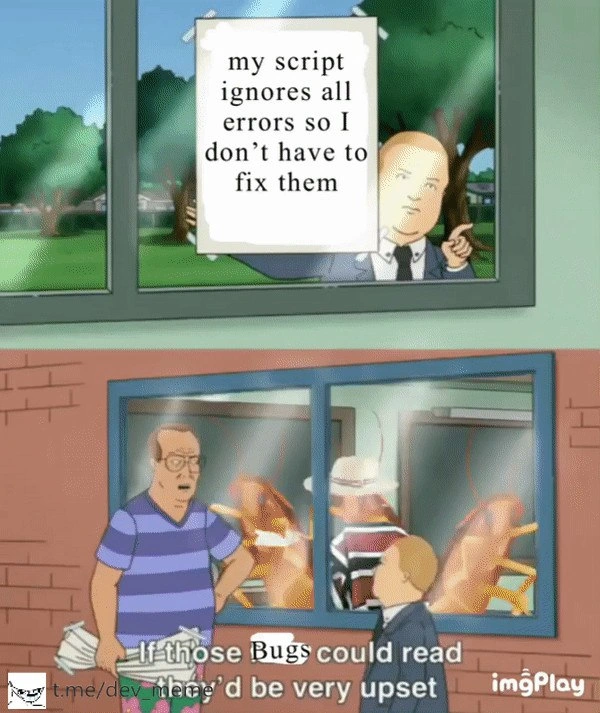
The meme illustrates this with a cartoon: in the top panel, the suited character (from King of the Hill, a popular cartoon) tapes a paper on the window that says “my script ignores all errors so I don’t have to fix them.” This is a joking way to say the developer is proudly not dealing with bugs. Inside that building (behind the glass), we see giant cockroach-like bugs crawling around – representing the software bugs that are being ignored. In the bottom panel, two characters outside (Hank Hill and his son) are looking at those enormous roaches in disbelief. The caption reads, “If those Bugs could read they’d be very upset.” In other words, if those literal bugs could read the sign, they’d realize the developer isn’t even trying to get rid of them, and they’d be offended! It’s a play on words: software bugs are depicted as real bugs (insects), and they’re upset because they’re just left to roam.
For a junior developer or someone new to coding, the lesson here is about error handling vs. hiding errors. When you wrap everything in a try-catch that does nothing, you’re effectively ignoring problems. It might make your script appear to run without issues (because it never crashes), but the issues are still happening behind the scenes. This is very bad for code quality. Imagine a scenario: you have a function that divides two numbers. A cautious developer would handle the case where the divisor is zero and throw or handle an exception. But a lazy implementation might do:
try {
result = x / y;
} catch (Exception) {
// ignore the divide by zero or any other error
}
If y was zero, normally a DivideByZero error would occur. The try-catch above catches it but then ignores it, so the program continues running. Now result is never set properly, but the code doesn’t know that because it silently skipped the failure. Later on, when you use result, it might be incorrect or still zero – a bug has been born, and you got no warning about it. This is why we call it a silent failure: something failed, but since the code kept quiet about it, you proceed as if everything is fine.
Over time, doing this leads to technical debt. That term means you saved time now by doing something the quick-and-dirty way, but you (or your team) will pay for it later when those hidden bugs cause trouble. It’s like borrowing time against the future stability of your code. For example, if you sprinkle try/except everywhere with pass (doing nothing), you might ship the product faster today. But a few weeks later, users might start reporting weird behavior ("feature X sometimes just doesn't do anything"). And because all errors were ignored, you have zero logs or clues. Now the team has to painstakingly debug, adding print statements or logging after the fact to find what was going wrong – work that wouldn’t be needed if errors were handled or at least recorded from the start.
So, the meme is funny to developers because it exaggerates a common mistake: ignoring errors instead of handling them. It’s basically saying, “Look, I found a ‘clever’ way to have no bugs in my code – I just don’t acknowledge them!” The giant cockroaches are a humorous visualization of all those ignored software bugs piling up. And the caption is a tongue-in-cheek way of saying those bugs would revolt if they knew how badly the developer was neglecting code quality. The whole scene is a reminder (in a joking way) that pretending there are no errors doesn’t make the errors go away.
Level 3: Silence of Exceptions
"my script ignores all errors so I don’t have to fix them"
This meme is shining a blacklight on the silent failure anti-pattern in error handling. The suited character proudly posting that sign is basically a developer bragging, "I wrapped every line in a try-catch block and called it a day." In code, that looks like swallowing exceptions without a peep:
try {
// do risky stuff
} catch (Exception e) {
// ignore the error completely
}
In Python it’s even shorter (and scarier):
try:
risky_operation()
except Exception:
pass # ignore all errors
From a senior dev perspective, this is a code quality nightmare. Sure, the script never crashes – but it also never tells you when something goes wrong. All those errors get caught and swept under the rug ignored, so bugs don’t stop the show… they just hide backstage breeding chaos. The meme’s punchline shows giant cockroach-like bugs lurking behind the window. They’re literal “bugs in the software” that have grown enormous because no one’s addressing them. If those bugs could actually read that smug sign, they’d be furious (and probably feel invincible).
Why is this funny to seasoned engineers? Because it’s dark humor about technical debt. We’ve all seen code that technically works by ignoring every exception – it’s like putting duct tape over a “Check Engine” light. The car doesn’t stop, but the engine could be on fire and you wouldn’t know. Experienced devs know that ignoring exceptions leads to:
- Undetected defects: Real errors vanish without a trace. The program limps along in a bad state, and you won’t find out until much later (usually at 3 AM in production).
- Impossible debugging: No error log, no stack trace – you’re debugging blind. It’s detective work with zero clues, hunting ghost bugs that were deliberately silenced.
- Corrupted state: Skipping error handling means the code might skip critical steps. For example, if saving a file failed and you ignored it, you’ll carry on as if it succeeded. Hello, data loss!
- Accumulating tech debt: Every ignored error is a bug left alive. They breed and compound. Eventually, one crawls out and causes a system outage or bizarre behavior that takes ages to unravel.
The humor has that “this is fine” energy – like the cartoon dog in a burning room saying everything’s okay. Seasoned devs laugh (or groan) because we’ve encountered that one teammate or old library that used a blanket catch to mask problems. The meme hits close to home: it’s mocking the naive idea that ignoring a problem equals solving it. In reality, those neglected bugs are just chilling behind the glass. And when they do surface, they’ll be very upset (and so will your users). It’s a classic piece of DeveloperHumor that turns a pain point into a joke: we cope with our on-call PTSD by laughing at the absurdity of code that treats errors with “out of sight, out of mind.”
Description
A two-panel meme based on a scene from the animated series 'King of the Hill'. In the top panel, the character Bobby Hill is inside a building, pointing to a sign taped to the window that reads, 'my script ignores all errors so I don't have to fix them'. The bottom panel shows his father, Hank Hill, standing outside looking concerned at a window filled with giant cockroaches. The caption below reads, 'If those Bugs could read they'd be very upset'. The humor is a pun on the word 'Bugs', representing both software defects and literal insects. The meme satirizes the dangerously negligent practice of suppressing or ignoring errors in code, suggesting that this allows bugs to multiply and infest the system, much like the cockroaches in the image. It's a commentary on poor code quality and the accumulation of technical debt through deliberate avoidance of proper error handling
Comments
7Comment deleted
This is the visual representation of `on error resume next`
Blanket try-catch: the Schrödinger’s incident pattern - production is simultaneously healthy and on fire until the CTO opens Grafana
The same developer who writes "2>&1 > /dev/null" in production scripts is now architecting our observability platform
Ah yes, the classic `try { riskyOperation() } catch { /* TODO: handle this later */ }` pattern - because nothing says 'senior engineer' quite like weaponizing exception handlers as comment blocks. It's the software equivalent of unplugging the check engine light: technically the dashboard looks cleaner, but you're still driving a ticking time bomb. The real genius move is when this script makes it to production and someone asks 'why didn't we see any errors in the logs?' - well, because we've achieved the perfect observability strategy: complete and utter blindness. Future archaeologists debugging this codebase will need both a stack trace and a therapist
We improved reliability 100% by catching Exception and piping stderr to /dev/null - turns out SLOs never regress when observability is a write-only interface
Nothing hits SLOs faster than catch(Exception) {} + 2>/dev/null - if the bugs can’t page us, uptime is a state of mind
Error handling pro tip: try { } catch { /* prod won't notice */ } - until it does, at 3AM