Rapid rewrite from small to large scale: AT-AT built on stilts
Why is this Deadlines meme funny?
Level 1: Standing on Tiptoes
Imagine you have to be taller right away, but you haven’t eaten your veggies to grow and there’s no time to actually grow up. What do you do? You might stand on your tiptoes or even stack some books and stand on them to look taller. It’s a bit like two kids in a trench coat pretending to be an adult – sure, they look taller to someone who isn’t paying close attention, but inside that coat it’s unstable and wobbly. This meme is funny for the same reason: someone needed a small robot to suddenly become a big robot really fast, so instead of building a new big robot (which takes time), they just put the small team of people on tall stilts to fake it. It’s clearly silly – the tall stilts could tip over at any moment – but from far away maybe it fools the boss for a second.
The feeling behind this is frustration mixed with comedy. We laugh because it’s such a ridiculous solution to an impossible demand. It’s like if your teacher said, “By tomorrow, turn your toy car into a full-size car that adults can drive,” and your only solution is to tape the toy to a bicycle – it might roll and be bigger than the toy car, but it’s definitely not a real car and probably will break if anyone tries to use it. In simple terms, the meme is showing that when people ask for something much bigger without giving you more time, you end up doing a flimsy, make-believe fix. It’s funny to see (stormtroopers on stilts – what a goofy sight!) and it also perfectly captures that exasperated feeling of being asked to do the impossible. The humor comes from recognizing a truth: sometimes grown-ups (or bosses) make silly demands, and the results are just as silly.
Level 2: Deadline-Driven Hacks
Now let’s break down what’s going on in simpler terms. The text of the meme says: “When they change the requirements from small scale app to large scale app but don’t give time…” This is describing a common situation in software projects: scope creep combined with unrealistic deadlines.
- Scope creep means the project’s goals or features keep expanding beyond the original plan. Here, the scope changed from building a small-scale app (maybe meant for a limited number of users or a simple use-case) to a large-scale app (something that can serve many users, handle lots of data, or cover more features). This is a huge change! It’s like being asked to turn a bicycle project into designing a car – the scale and complexity are completely different.
- The kicker is “but don’t give time.” In project management, if the scope increases, normally the timeline and resources should also increase. Otherwise, you’re being asked to do a lot more work in the same time frame. That’s a recipe for disaster and pressure. Deadline pressure forces developers to cut corners, because doing things the proper way (which might require rebuilding the foundation of the app) simply isn’t possible in the given time.
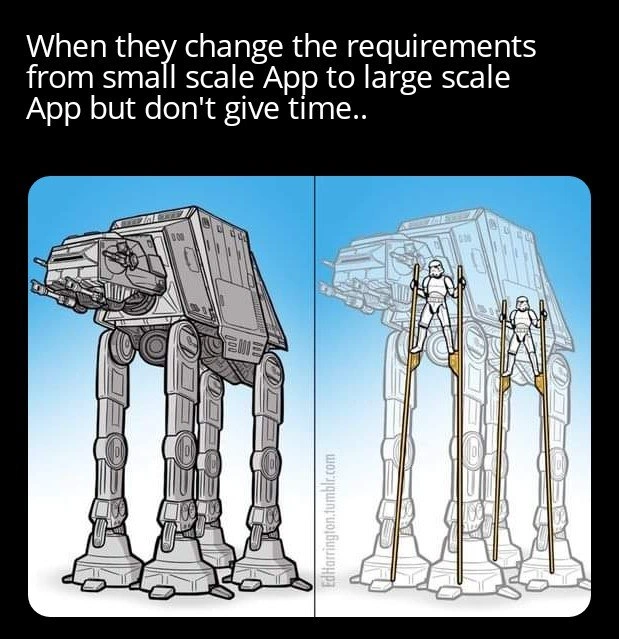
The meme uses a Star Wars analogy to show this. On the left, there’s a fully drawn AT-AT walker – those big four-legged combat vehicles from Star Wars that the Empire uses (like in The Empire Strikes Back, those giant walkers on the ice planet). This left side represents the “small scale app” as originally planned – it’s solid, detailed, stands on its own four legs. On the right, we see an outline of that same AT-AT, but inside the outline, instead of proper mechanical legs, there are stormtroopers on tall wooden stilts trying to fake the legs. They’re using skinny stilts to make it look like the walker is taller than it actually is. The right side is the “large scale app” that the bosses asked for at the last minute, but since the team didn’t get more time, they had to improvise with a quick and dirty solution.
Let’s decode the analogy in software terms:
- The AT-AT’s legs are like the foundational architecture of your app. A small app might have a simpler architecture that isn’t meant to support huge loads (just like a small walker’s legs might not support the weight of a giant one). Normally, to go large-scale, you’d design stronger, bigger legs – in software, that might mean switching to a more scalable database, adding caching layers, splitting the application into microservices, or optimizing the code for performance. All those steps require planning and time.
- The stormtroopers on stilts represent the developers hastily propping up the existing system to meet the new height/scale requirement. Stilts are a quick fix – they do make the walker taller, yes, but it’s extremely unstable and clearly not the proper way to build a bigger walker. In coding, a comparable quick fix might be something like: instead of reworking the whole system, the team might just throw the app onto a more powerful server (to handle more users for now), or write a sloppy patch that handles the new use-case without considering future maintainability. It’s the idea of “just make it work somehow, with whatever hacks necessary.”
Technical debt is a key term illustrated here. Technical debt is what you incur when you take shortcuts in coding or architecture – you “borrow” time by not doing things properly, but you’ll have to “pay it back” later with interest, usually in the form of bugs, crashes, or very difficult refactoring work. In the meme, building the walker properly to be large-scale was skipped (to save time now), and the debt is that this walker on stilts could collapse any time, and eventually someone will have to build it the right way (which will be even harder now).
Think of a time you might have experienced or heard about something similar, even on a small scale: maybe you had a school coding project that suddenly needed an extra feature the night before deadline, so instead of doing it neatly, you just hard-coded some values or duplicated some code because it worked and you were out of time. It likely caused a mess in your code (and if someone asked you to extend or maintain it later, you’d groan). That’s a mini version of what’s happening here, but in a real software team with potentially thousands or millions of users at stake.
Stakeholder expectations versus developer reality is another important theme. A stakeholder (like a client or a manager) might think, “Oh, you can just quickly make the app support more users, right? Just use a bigger computer or something!” They see the end goal (a big walker) but don’t understand the engineering effort needed. The developers, under pressure, do something – it technically reaches the height, so on the surface the stakeholder’s demand is fulfilled. But the quality of that solution is poor. The stakeholder sees the outline of an AT-AT (yay, it looks tall and done), but doesn’t realize inside it’s three guys balancing on sticks (yikes, not sustainable!).
This meme fits into categories like Project Management, Deadlines, and Tech Debt because it’s essentially about how project management failures (like changing requirements without adjusting timeframes – a bad practice) lead to technical debt (the stormtrooper stilts solution). It’s also tagged with ScopeCreep and StakeholderExpectations, highlighting exactly those aspects.
To a junior developer or someone early in their career, the takeaway from this meme is: be wary of situations where you’re asked to do a lot more in a project without proper adjustments. It often means you’ll be forced into corners-cutting mode. While sometimes quick hacks are unavoidable, they come at a cost. The meme’s humor is also a gentle warning – everyone in software has probably done something like this under pressure, and we laugh because we survived it (maybe after some fires were put out). It’s a rite of passage to learn that just because something “works” doesn’t mean it’s built right. An app that’s been “scaled up” with no time is usually held together by virtual duct tape, much like an AT-AT on stilts held by nervous stormtroopers. It might work for a demo or a short period, but it’s living on borrowed time.
Level 3: Scaling on Stilts
From a senior developer’s perspective, this meme nails the experience of sudden scope creep under unrealistic deadlines. Picture being halfway through building a modest, single-server app (our normal four-legged AT-AT walker) when a client or stakeholder decides, “Actually, we need this to handle 100x the users – and we need it by next week.” No extra time, no overhaul of resources – just make it big now. Seasoned engineers immediately recognize this scenario as a one-way ticket to massive technical debt. The left panel’s fully detailed AT-AT represents a well-built system designed for its original scale. The right panel, with stormtroopers precariously perched on stilts inside a ghostly outline of an AT-AT, perfectly captures what developers do when cornered by deadline pressure: we prop up the existing system with shaky hacks to fake the new requirements, praying it doesn’t all come crashing down in production.
Why is this so funny (and painful) to experienced devs? Because it’s too real. We’ve all seen projects where:
- Requirements balloon but the timeline doesn’t. Management expects a “large scale app” but treats it like changing a lightbulb – trivial. In reality, scaling up might require rethinking the database sharding, introducing load balancers, or splitting services. Without time, devs end up doing things like increasing thread counts or memory limits far beyond safe levels (the coding equivalent of those stilts).
- Quick and dirty fixes become the norm. Instead of a robust architecture, you get a patchwork: one-off scripts, hard-coded parameters, disabled validations – anything to meet the immediate goal. It’s brittle by nature. The stormtroopers on stilts symbolize those band-aid solutions: they hold things up just long enough for a demo or deadline, but everyone knows this isn’t stable.
- Technical debt skyrockets. Every shortcut is a debt that accrues “interest” in the form of bugs, crashes, and costly refactors later. The AT-AT-on-stilts is basically a huge liability. One stormtrooper loses balance (analogous to one minor failure in a fragile system) and the whole façade collapses. Developers look at that and chuckle darkly, knowing that feeling of shipping something that’s one bug away from disaster.
- Stakeholder expectations vs. reality gap becomes glaring. The outline of the big AT-AT is what stakeholders think they’re getting (“Sure, it’s large scale now, see? same shape, just taller!”). The reality inside that outline is three guys on stilts (the barely-working makeshift internals). This highlights the disconnect between non-technical management and the engineering team: on paper the requirement was fulfilled, but under the hood it’s chaos.
In real projects, this might manifest as an application that “technically” handles the new load during a quick test or presentation, but starts throwing errors or slowing to a crawl in real usage. It’s like deploying with all metrics in red, hoping not to get paged at 3 AM. A cynical veteran will grin at the AT-AT meme because they’ve lived this: we once turned a single-server app into a “cluster” in name only, by slapping all services onto one machine with multiple VMs, calling it a day. It looked like a distributed system on slides, but one power surge and the whole thing would go down – stilts, meet gravity.
The humor also comes from the absurdity of the solution. Even the Empire’s engineers in Star Wars wouldn’t be crazy enough to use stormtroopers on stilts to meet Darth Vader’s demand for taller walkers by Tuesday. But in the corporate tech world, we’ve effectively done the equivalent under frantic scope change requests: “Can’t you just make it support more users? Add some servers or something?” We comply, under protest, kludging things together just to appease the powers that be. The result is an architecture held up by hope and duct tape. In coding, you might see commits with messages like “Temporary fix for scale” hiding truly scary workarounds. For example:
# Increase capacity hack – DO NOT USE IN PRODUCTION (too late)
server.max_connections *= 10 # push limit tenfold, fingers crossed
server.request_timeout = 0 # disable timeouts entirely (yikes!)
cache.store_everything(True) # cache all data in memory to appear fast
This snippet is a code version of stilts: it superficially raises limits to handle more load quickly, but ignores why those limits existed. No time to test properly, no time for gradual refactoring – just brute force changes that keep the system barely standing. Every senior dev recognizes that gnawing worry: this approach might work for a demo or a day, but soon enough it’s going to fall over.
Ultimately, “scaling on stilts” captures the essence of deadline-driven development where appearances trump solid engineering. It’s a form of organizational theater – everyone pretends the large-scale requirement was met, but in reality they’re looking at a precarious illusion. The meme gets a laugh (or a groan) because it bottles up an entire dysfunctional project dynamic in one image: make it bigger (says management) – we did, kind of (say the developers, internally adding: please don’t look too closely or ask how long it will stay up). It’s funny because it’s true, and it’s tragic because we’ve all been those stormtroopers wobbling on stilts, trying to hold an implausible project plan upright.
Level 4: Square-Cube Shenanigans
At the most fundamental level of engineering and computer science, this meme highlights the impossibility of magically scaling a system without rearchitecting it to respect basic laws. In the physical world, if you try to make a small walker as large as an AT-AT overnight, you run into the square-cube law: mass grows faster than structural strength. Simply put, a design that works at small size will collapse under its own weight when scaled up unless you completely redesign its structure. The cartoon exaggerates this by putting stormtroopers on stilts inside an AT-AT outline – a ludicrous attempt to defy physics. Similarly, in software, scaling an application from a handful of users to millions isn’t a matter of just making it “taller.” There are theoretical limits and architectural challenges:
- Algorithmic Complexity: An algorithm that worked for a small scale might be too slow for large scale. Doubling the user base can more than double the work if the algorithm is, say, $O(n^2)$. Without time to optimize or switch to a better algorithm, the system will bog down or crash. You can’t cheat Big-O notation with wishful thinking – if a function takes quadratic time, suddenly handling 100x more input is going to grind to a halt no matter how much you yell “Make it fast!”.
- Amdahl’s Law: If only part of your system can be parallelized, the speed-up from adding more threads or servers hits a ceiling. At large scale, that tiny sequential part becomes a huge bottleneck. The meme’s “stilts” are like trying to parallelize without addressing the sequential core – it might look taller, but throughput doesn’t truly increase because the core design is untouched.
- Distributed Systems Constraints: Going from a small app (often a single server or monolith) to a large-scale app usually means distributed systems, which invoke the CAP theorem – you can’t simultaneously have perfect Consistency, Availability, and Partition tolerance at scale. Properly balancing these requires substantial redesign (databases, caching, messaging), which is impossible if “they don’t give time.” Ignoring this is like piling more stormtroopers on taller stilts and expecting stability – it violates the inherent trade-offs of distributed computing.
In essence, the meme humorously exposes that no amount of management pressure can repeal the laws of physics or computing. When forced to grow an app’s capacity drastically without proper engineering, you end up with brittle contraptions. The AT-AT on stilts is a perfect metaphor for a system that appears to meet the new scalability requirements externally, but internally it’s one step away from toppling over. It’s a nod to every senior engineer’s nightmare: being asked to achieve a near-impossible scalability jump “somehow”, as if typing faster or hoping really hard could bend math and physics. The dark humor here is that underneath the glossy promises of a “large scale app,” the implementation is a rickety, unsafe shortcut that could collapse at any moment – a truth both engineering textbooks and late-night outage pages know all too well.
Description
Black banner text reads: "When they change the requirements from small scale App to large scale App but don't give time.." Below, a two-panel cartoon shows a fully detailed Star Wars AT-AT walker on the left. On the right, only a faint outline of the walker is drawn; inside the outline, three stormtroopers stand on tall wooden stilts to fake the longer mechanical legs, clearly an unsafe shortcut. The meme visually equates unrealistic schedule pressure with shipping a "larger" system by propping the old design up with brittle hacks, highlighting how scope creep and scaling demands lead to technical debt when adequate time isn’t provided
Comments
10Comment deleted
“Planet-scale by Q2? Easy - just prop the old monolith on three stormtroopers with stilts, call those new legs the ‘microservices layer,’ and pray the auditors can’t read the YAML.”
Just like the rebels on Hoth, we're about to discover that our hastily-scaled architecture collapses at the first sign of load - except instead of tow cables, it'll be a single concurrent user that brings down our wireframe AT-AT
This is the architectural equivalent of being told to turn your SQLite-backed MVP into a globally distributed system by Friday - sure, we can prop it up with connection pooling and caching layers, but we're basically asking a garbage truck to do the Kessel Run. The real tragedy? Management sees both AT-ATs standing and calls it a successful migration, completely missing that half your team is now permanently on-call holding up those stilts, and your monitoring dashboard looks like a seismograph during an earthquake
Vertical scaling a monolith: stretch the legs with threads until the first load spike sends it toppling like Hoth snow
Enterprise scaling plan: put the monolith on Kubernetes‑stilts, set replicas=4, and call it “internet‑scale” until the first chaos test kicks out a leg
From MVP to planet‑scale by Friday? Sure - either we redesign for idempotency, backpressure, and multi‑region writes, or we put stilts on the monolith and call it microservices
Шоб за эти ваши жалкие гроши - и как-то иначе? Ну нет. Comment deleted
>russian Comment deleted
so what? :) I told about usual situation around amount of money for amnout of efforts... Comment deleted
https://youtu.be/okwR7SCfibQ Comment deleted