Scala's Ribbon of Type-Level Ambition
Why is this Languages meme funny?
Level 1: Fancy Tool Day
Imagine a toolbox company releases a new version of a very fancy toolbox. People who love building things get excited because it has smarter tools inside. Other people worry because the tools already had a lot of buttons. The picture is just the toolbox logo, but everyone who knows the toolbox immediately has opinions.
Level 2: Functional Meets JVM
Scala is a programming language that runs on the Java Virtual Machine. That means it can use many Java libraries and deploy in many places where Java already works. It also supports functional programming, where developers prefer immutable data, functions as values, and expressions that describe what should happen without constantly changing state.
Scala is also statically typed, so the compiler checks many mistakes before the program runs. Its type system can describe complicated relationships between values, APIs, and domain concepts. That is powerful because a compiler can catch more bugs early. It can also feel difficult because the code may use concepts that are unfamiliar to developers coming from simpler languages.
The picture is just the Scala logo, but the post message makes it about Scala 3. For someone newer to programming languages, this is like seeing a favorite tool get a major new version: exciting, but also a little stressful, because new features often mean new syntax, migration work, and fresh debates about the right way to write code.
Level 3: Abstraction With Interest
At senior-engineer level, the joke is not a visible punchline but an ecosystem reaction. A plain Scala logo posted with "Scala 3 released!" is enough to split a room. Some developers see a powerful language that can model business domains precisely, run on the JVM, interoperate with Java libraries, and support both object-oriented and functional styles. Others see the ghosts of over-abstracted code reviews, symbolic operators, implicit resolution mysteries, and onboarding sessions where "simple" means "after you understand variance."
Scala's reputation comes from real trade-offs. It gave teams tools that Java lacked for years: concise syntax, pattern matching, higher-order functions, immutable collections, algebraic modeling, and a rich library ecosystem for backend and data workloads. But expressive languages let teams express both good ideas and extremely ornate bad ideas. A codebase can use Scala to make invalid states impossible, or to create a twelve-layer architecture where finding the business rule requires spelunking through type aliases and moral courage.
Scala 3 tried to clean up some of that accumulated complexity. Replacing many implicit use cases with clearer contextual abstractions was not just cosmetic; it was a response to years of production experience where invisible compiler search could become both magical and terrifying. The release therefore carried two emotional signals at once: optimism about a cleaner future, and veteran suspicion that every "cleaner future" arrives with a migration guide, ecosystem lag, and at least one build tool negotiation.
That is why the logo alone functions as a developer meme. It is a badge for a language community that loves powerful abstractions and has paid for them in debugging time. The image says Scala without needing text, and experienced developers fill in the rest from memory.
Level 4: Type-Level Ribbon
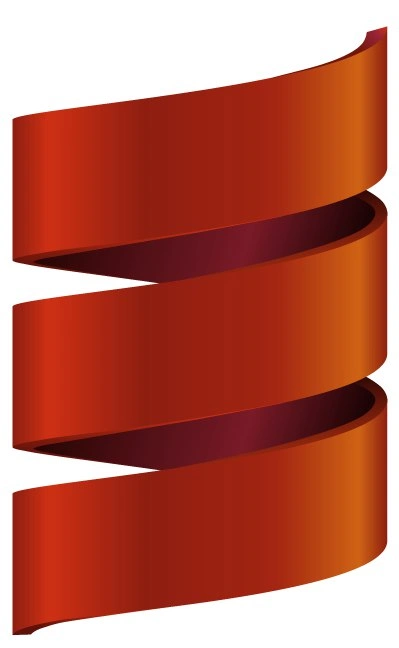
The image itself contains no caption, just the red Scala ribbon logo on a white background. That minimalism is doing work: for developers who know the ecosystem, the logo alone evokes a whole stack of static typing, JVM interoperability, functional programming, object-oriented programming, compiler theory, and the quiet suspicion that somebody is about to explain a typeclass before lunch.
The post text says Scala 3 released!, and the date matters here because May 14, 2021 was the actual Scala 3 release announcement window. Scala 3 was not just "Scala 2 with nicer syntax." It represented the maturation of Dotty, a redesign of the compiler and language around a more principled core calculus. That matters because Scala's long-running identity problem has always been its strength: it wants to be both a pragmatic JVM backend language and a playground for serious type-system ideas.
At the deep end, Scala humor often orbits the gap between expressive power and cognitive load. Features like given/using, extension methods, enums, opaque types, union and intersection types, match types, and a reworked metaprogramming model are not random decorations. They are attempts to make abstraction explicit, composable, and checkable by the compiler. In theory, this lets teams encode domain rules so invalid states become harder to represent. In practice, it also lets a codebase produce error messages that read like a polite theorem prover lost a fight with Maven.
The logo's three folded bands accidentally fit the language's reputation: layers of abstraction curving over one another, elegant from a distance, slightly intimidating up close. The release-day context turns a simple logo into a symbol of renewed ambition: Scala continuing to argue that a production language can carry ideas from type theory into ordinary backend and data engineering work without collapsing under its own cleverness.
Description
The image shows a standalone red-to-orange ribbon logo on a white background, formed from three curved horizontal bands that create a stylized vertical S shape. There is no visible caption, surrounding UI, or additional text. The mark is recognizable as the Scala programming language logo, associated with a JVM language that mixes object-oriented and functional programming. In developer culture, Scala often signals expressive type systems, backend/data workloads, and strong opinions about abstraction.
Comments
12Comment deleted
Scala is what happens when Java asks a category theorist for one small feature and the type system opens a consultancy.
link to the poll is here Comment deleted
And next day we get release news about every JS framework in existence? 😁 Comment deleted
if you want? There would be a comment section for that channel as well, so you can complain about irrelevant info. Comment deleted
Scala 3 is way bigger news than another JS framework Comment deleted
Isn't Scala ded? Comment deleted
lol Comment deleted
haha, pines Comment deleted
Please just use vanilla JavaScript use checks like this: if ('vibrate' in navigator) { /*Do your job*/ } else { /*Just skip this step*/ } Don't be instagram, thanks! Edit, btw i am not a JS developer. I develop the browser Comment deleted
? Comment deleted
which one Comment deleted
New one Comment deleted