Dogecoin's Two-Hour Architecture Review
Why is this Blockchain meme funny?
Level 1: The School Project Became a City
Imagine someone builds a toy bridge out of craft sticks as a joke. Years later, people are driving cars over it and asking whether the bridge meets national safety standards. The builder says, "I made that in two hours." That is why this is funny: a silly thing got treated like serious infrastructure.
Level 2: Joke Project, Serious Questions
Dogecoin is a cryptocurrency that started as a joke based on meme culture. Like other blockchains, it has a shared ledger of transactions. A blockchain is a chain of records that many computers agree on. In proof-of-work systems, computers spend energy doing calculations to help secure the network and decide which blocks are accepted.
That is why the question about energy usage matters. If a coin becomes popular, people start asking serious questions: How much electricity does it use? Can it process transactions efficiently? Who maintains it? Can the community improve it? Those are normal engineering questions for important infrastructure.
The funny part is that the creator's visible reply says he made it quickly and "didn't consider anything." For newer developers, this is like building a silly side project in one evening and later being asked about its climate policy, scaling plan, and long-term governance model. The mismatch between the original intent and later expectations creates the humor.
Level 3: Meme Coin, Real Consequences
Senior engineers recognize this as the classic nightmare where a prototype escapes. The final tweet is not just self-deprecation; it is an architecture review for a system that was never designed to survive architecture review. "I made it in two hours" is the thing you say about a hackathon demo, an internal script, or the load-bearing cron job that somehow became a department.
The crypto angle makes it sharper. Dogecoin's brand is intentionally unserious: the Shiba Inu mascot, the joke origin, the community tone, the meme culture. But once a network has users, exchanges, miners, wallets, market value, and public figures discussing it, the joke acquires blast radius. Energy consumption becomes a legitimate question. So do decentralization, security, transaction economics, maintainer capacity, and whether the codebase is being asked to support dreams it never signed up for.
The screenshot also sat inside a Tech Twitter feedback loop. A celebrity CEO posts about crypto energy. A coin creator reacts. A user asks about making the protocol more efficient. The creator replies with a sentence that sounds irresponsible and refreshingly honest at the same time. Most systems are born from incomplete assumptions; Dogecoin is just unusually candid about it.
The deeper industry satire is that hype often upgrades the social meaning of software faster than engineering can upgrade the software itself. Markets can decide that a joke has value overnight. Developers still have to deal with consensus rules, code history, ecosystem tooling, and the fact that "just make it efficient" is not a Jira ticket so much as a research program wearing a tiny hat.
Level 4: Proof-of-Work Punchline
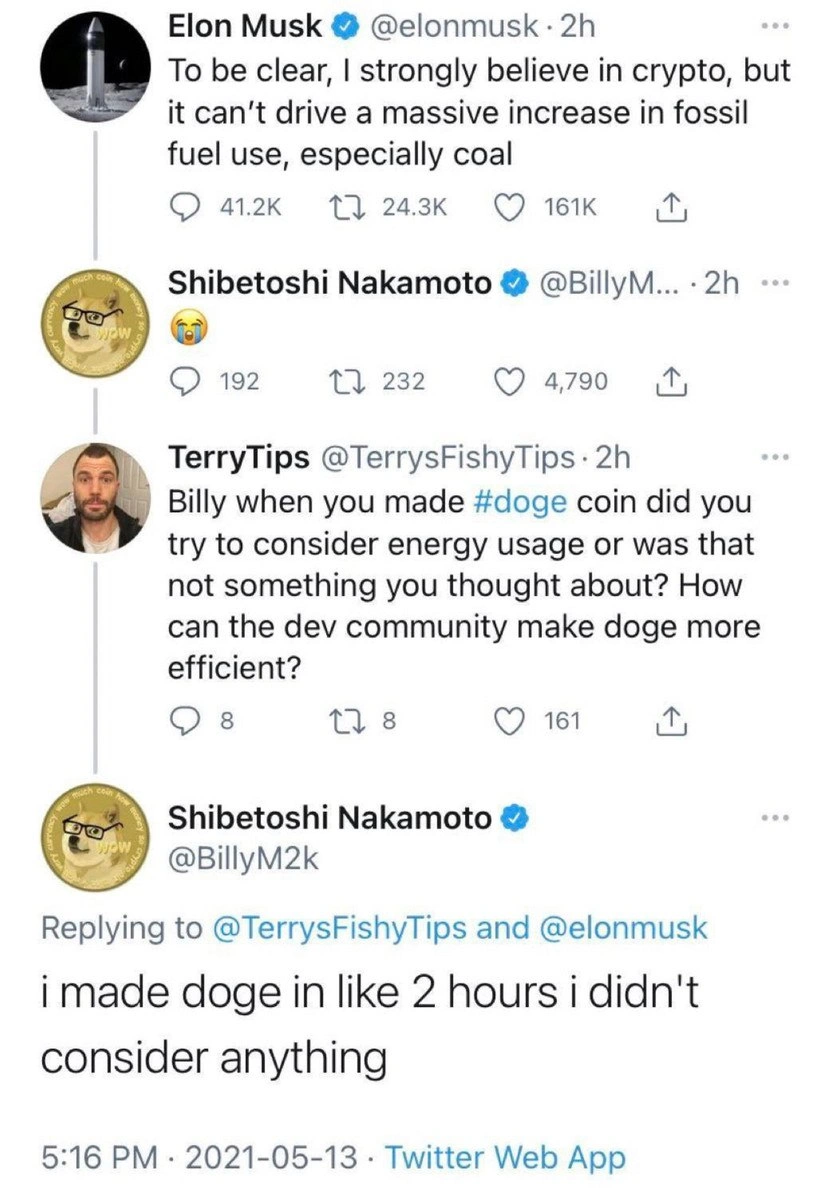
The screenshot is funny because it compresses the entire seriousness gap in cryptocurrency into one reply. Elon Musk frames the issue as energy policy:
To be clear, I strongly believe in crypto, but it can't drive a massive increase in fossil fuel use, especially coal
Then someone asks Dogecoin's creator whether energy use was considered during the original design:
Billy when you made #doge coin did you try to consider energy usage or was that not something you thought about? How can the dev community make doge more efficient?
The answer is brutally clarifying:
i made doge in like 2 hours i didn't consider anything
At a protocol level, this lands because proof-of-work systems do not consume energy as an incidental bug; energy expenditure is part of the security model. Miners perform computational work to make rewriting history economically expensive. The chain's safety is tied to incentives, hash power, difficulty adjustment, block rewards, network latency, and the cost of attacking consensus. You can tune parameters, change mining algorithms, merge-mine with another chain, or migrate to a different consensus family, but you cannot wave away the security economics with a community brainstorm thread.
Dogecoin's absurdity is that it began as a meme coin and inherited a real blockchain architecture. The market later treated it as an asset class, payment rail, cultural symbol, and environmental topic. That is the architectural equivalent of discovering that the office joke spreadsheet is now the system of record for payroll. Congratulations, governance committee, the punchline has uptime requirements.
The May 2021 timing matters: this was immediately around the public backlash over crypto mining energy use and Tesla's reversal on Bitcoin payments. Suddenly, every coin had to answer questions about sustainability, throughput, and legitimacy. Dogecoin, created quickly as satire, was dragged into the same conversation as intentionally serious financial infrastructure. The tension between "meme" and "monetary network" is the whole point.
Description
A Twitter thread screenshot shows Elon Musk, @elonmusk, writing: "To be clear, I strongly believe in crypto, but it can't drive a massive increase in fossil fuel use, especially coal," with visible counts of 41.2K, 24.3K, and 161K. Shibetoshi Nakamoto, @BillyM..., replies with a crying emoji, then TerryTips, @TerrysFishyTips, asks: "Billy when you made #doge coin did you try to consider energy usage or was that not something you thought about? How can the dev community make doge more efficient?" with counts 8, 8, and 161. The final reply from Shibetoshi Nakamoto, @BillyM2k, says, "i made doge in like 2 hours i didn't consider anything," timestamped "5:16 PM · 2021-05-13 · Twitter Web App." The meme lands because Dogecoin began as a joke cryptocurrency, yet the 2021 crypto market treated it like infrastructure worthy of energy policy and protocol optimization debates.
Comments
5Comment deleted
Dogecoin's original design doc was apparently just "ship the meme," and somehow that still had fewer false assumptions than most RFCs.
😂😂😂 Comment deleted
True hehe Comment deleted
😂😂😂 Comment deleted
@soshiba xD Comment deleted