Skip to content
DevMeme
7191 of 7435
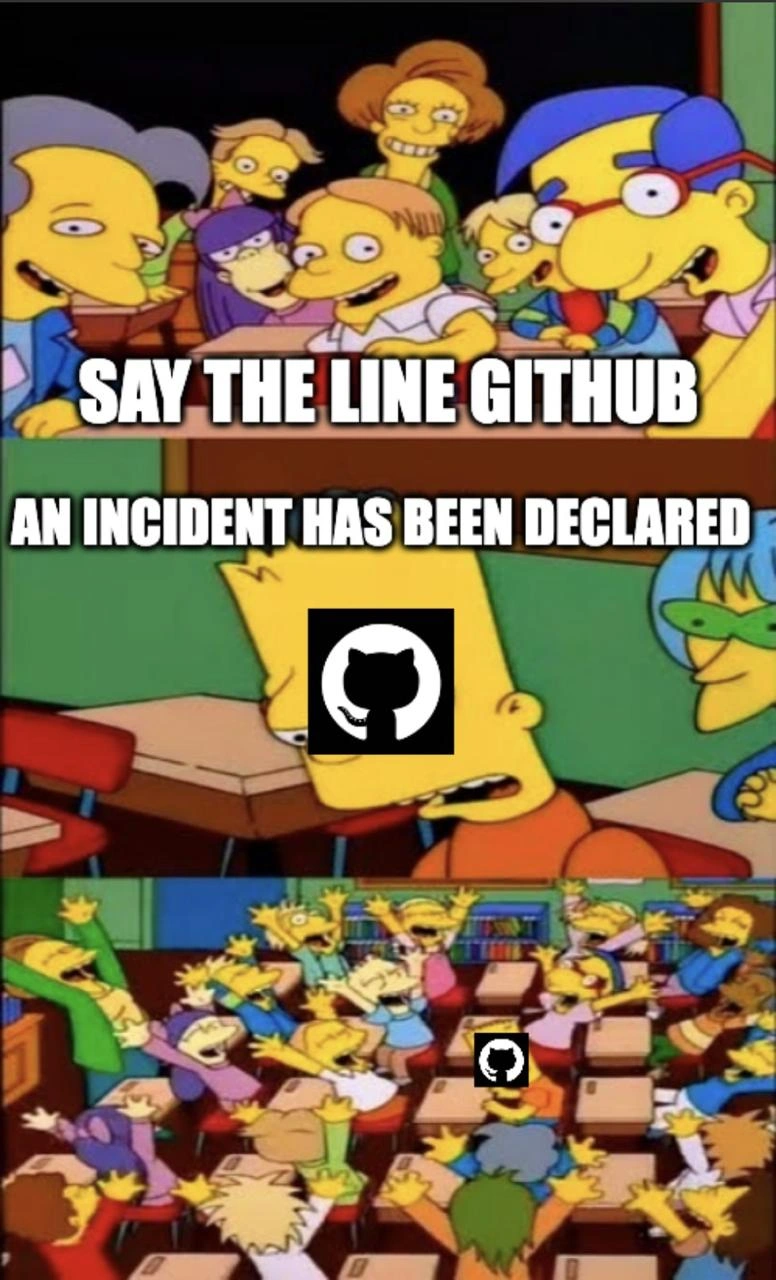
Say the Line, GitHub: An Incident Has Been Declared
OnCall ProductionIssues Post #7886, on Apr 3, 2026 in TG

Say the Line, GitHub: An Incident Has Been Declared

Why is this OnCall ProductionIssues meme funny?

Level 1: The Snow Day Announcement

Think of a school principal who has to come on the loudspeaker every time the heating breaks — which is often — and always says the exact same official sentence: "A facilities incident has been declared." The kids have heard it so many times they now chant for it, and the moment the principal sighs and says the magic words, the whole classroom erupts in cheers, because it means class is canceled. That's the joke: a website that programmers need for their work breaks so regularly that its official "we're broken" announcement has become a beloved catchphrase — and an instant day off.

Level 2: The Vocabulary of Downtime

  • GitHub — the dominant platform for hosting Git repositories; where most of the world's code lives, gets reviewed (pull requests), and gets built and tested automatically (GitHub Actions).
  • Status page — a public dashboard (here, GitHub's) where a service reports its own health. During an outage it posts timestamped updates, traditionally starting with formulaic language like the meme's quoted line.
  • Incident — formal ops-speak for "something is broken in production." Declaring an incident kicks off a defined response process: assign responders, post updates, write a postmortem afterward.
  • Octocat — GitHub's cat-octopus mascot, pasted over Bart's face and onto the cheering crowd, making the brand itself the reluctant performer.
  • The meme format — from a Simpsons episode where Bart is hounded to repeat his catchphrase ("Eat my shorts" energy) for an adoring crowd that loves the line more than he does.

The early-career experience this maps to: the first time GitHub goes down during your workday, you panic — is it my network? my SSH keys? did I break git? Twenty minutes of debugging later you finally check the status page, see the orange banner, and feel the specific cocktail of relief ("not my fault") and helplessness ("literally cannot work") that the third panel renders as pure joy. Veterans skip the debugging and go straight to refreshing the status page like it's a sports score.

Level 3: Five Nines on the Apology

The format is the Simpsons "Say the line, Bart!" template, deployed with surgical accuracy. Panel one: the grinning classmates lean in — "SAY THE LINE GITHUB." Panel two: Bart, face replaced by the Octocat logo, slumps at his desk and mutters the catchphrase he's so tired of: "AN INCIDENT HAS BEEN DECLARED." Panel three: the entire classroom explodes in celebration, arms up, a tiny Octocat watermark riding along. In the original scene, Bart is exhausted by being reduced to a single line of dialogue. Recast, the joke is that GitHub's most recognizable utterance is no longer "social coding" or "where the world builds software" — it's the opening boilerplate of its own status page.

There are three distinct layers of senior-engineer truth here. First, status-page liturgy. Incident communications are template-driven by design: legal review, PR caution, and incident-command process strip them to interchangeable phrases — "We are investigating reports of degraded performance," "An incident has been declared," "We are seeing recovery." The phrasing is deliberately passive and agentless; an incident "has been declared" the way rain "has been reported," with no human anywhere in the sentence. Repeat that template often enough and it stops reading as communication and becomes a catchphrase — which only happens to services that go down often enough for users to memorize the script.

Second, the single point of failure confession embedded in the celebration. The industry built its entire workflow — code hosting, pull requests, CI via Actions, package distribution, even deployment pipelines — on one centralized service, atop a version control system explicitly designed to be distributed. Git itself works fine offline; nobody's local repo broke. But the social and automation layers all terminate at one company's infrastructure, so when GitHub sneezes, the global software industry takes an involuntary coffee break.

Third, and most honestly: the cheering is real. The third panel captures the secret emotional economy of outages — for everyone not on GitHub's incident channel, a major outage is a snow day. Standup dissolves. The deploy freeze is nobody's fault. "Can't push, GitHub's down" is the one excuse no manager can audit. The meme isn't mocking unreliability so much as celebrating the brief, blameless holiday it grants — while somewhere, an SRE's pager performs its own incident declaration.

Description

A three-panel Simpsons 'Say the line, Bart!' meme. Panel 1: Bart's grinning classmates (Milhouse, Martin, Nelson and others) lean in eagerly with the caption 'SAY THE LINE GITHUB'. Panel 2: Bart, his face covered by the GitHub Octocat logo, slumps at his desk and reluctantly delivers 'AN INCIDENT HAS BEEN DECLARED' - the exact canned phrase from GitHub's status page during outages. Panel 3: the entire classroom erupts in cheering with arms raised, a small Octocat logo on the celebrating crowd. The meme lampoons how routinely GitHub goes down and how its status updates always open with the same formulaic incident-declaration language - to the point that developers treat each outage announcement as a beloved recurring catchphrase (and a free excuse to stop working)
Comments

2
Anonymous ★ Top Pick GitHub's incident template is their most reliable deployment - five nines of availability on the apology, at least
  1. Anonymous ★ Top Pick

    GitHub's incident template is their most reliable deployment - five nines of availability on the apology, at least

  2. @Hello_There_4 3mo

    Ohno. What happened

Use J and K for navigation