The Ultimate Compilation Performance Hack
Why is this OpenSource meme funny?
Level 1: Faster by Doing Nothing
Imagine you have a huge book of math homework problems that’s going to take forever to finish. Now someone suggests a silly idea: if you tear out all the pages and throw them away, you’ll be “done” with your homework instantly. Well, that’s technically true – you don’t have any problems left to solve, so you’re finished really fast. But of course, you didn’t actually solve anything, and you’ll get a zero because there’s nothing to hand in! This meme is joking about the same kind of idea but with computer code. The person is saying, “Hey, our computer program is slow to prepare (compile), so let’s just erase all the instructions to make it faster.” Sure, the computer will finish preparing it quickly if there’s nothing to prepare, but then the program won’t do anything at all. 🤷♂️ It’s funny in a silly way: the fastest way to do a job is to not do it at all, but then you didn’t really accomplish the job. The joke is that no one would seriously do this, but it’s pretending someone did and acted proud that it’s “very faster” now. It’s like finishing a race by not running it — you save time, but you never actually reach the finish line!
Level 2: Comment Out Everything
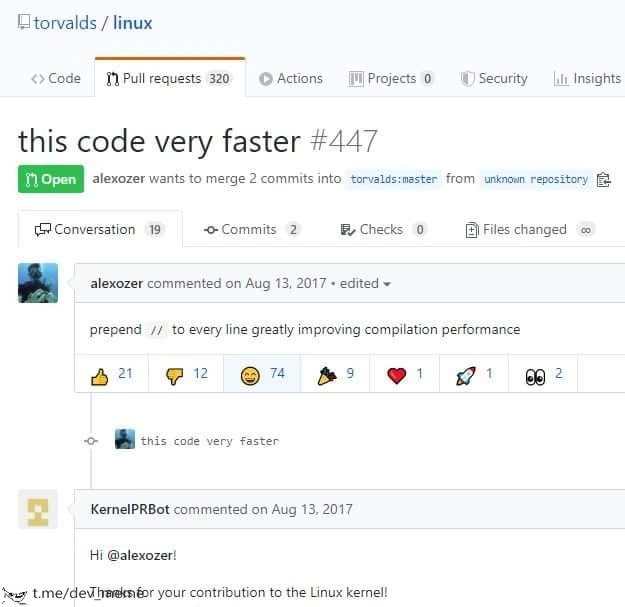
For a newer developer or someone just learning, let’s break down what’s happening. This image is a pretend GitHub pull request aimed at the official Linux kernel project. A pull request is when someone who has made changes to code asks the project maintainers to review and merge those changes into the main codebase. In this case, the user “alexozer” has created a pull request with the title “this code very faster.” The humor starts even there – the title is ungrammatical, which hints that it’s not a serious, professional change. The description of their change (in the comment) says: “prepend // to every line greatly improving compilation performance.” In programming, putting // at the start of a line means “turn this line into a comment.” A comment is a note in the source code meant for humans to read; the compiler (the program that turns source code into an executable program) ignores comments entirely. So, if you put // in front of a line of code, that line won’t execute or even be compiled – it’s as if that line doesn’t exist as code.
What this person is claiming is that by adding // to every single line of code in the Linux kernel, the code will compile much faster. Technically, they’re right – if the compiler has essentially no real code to compile, it will finish quickly. But doing this means all the code is inactive. The Linux kernel codebase is huge (millions of lines of C code) and is critical for the operating system to work. Commenting out all those lines would mean none of the features or functions of the kernel are actually built. You’d end up with an “empty” kernel that doesn’t do anything. It’s like erasing all the instructions in a recipe book to make it quicker to flip through – yes, you save time, but you can’t cook anything because the recipes are gone.
Let’s explain a bit about compilation and why someone might joke about compile speed. Compiling code is the process of translating human-readable code (like C code in the Linux kernel) into machine code that the computer can run. Big projects can take a long time to compile. Developers often get impatient or frustrated waiting for code to compile, especially if they have to do it frequently. The Linux kernel, being large and complex, is known to take a while to build from scratch. So there’s an ongoing light-hearted gripe among developers: “Ugh, it takes forever to compile this, how can I make it faster?” This joke solution says: “What if we just don’t compile anything at all? Then it’ll be super fast!” Of course, that defeats the purpose of having a program. It’s like “solving” the problem of a slow build by not building the project.
In the GitHub screenshot, a few things show it’s not serious: The PR is from an unknown repository, and it’s trying to merge into Linus Torvalds’s master branch. In reality, the Linux project doesn’t accept changes via GitHub like this (they use e-mail and other systems). The conversation tab shows 19 comments, meaning people are discussing (likely joking around about this), and there are emoji reactions like 👍 (thumbs up), 😄 (smile), and 🎉 (party popper). Those suggest people found it funny or are sarcastically “approving” it. Even a bot (KernelPRBot) chimes in politely thanking the contributor, which is something some projects automate for first-time contributions. The whole thing is set up to mimic a real pull request scenario but with absurd content.
To clarify the core action: “prepend // to every line” literally means take every line of actual code and put // in front. For example, if the code had a line:
printf("Hello, world!\n");
after “prepending //”, it becomes:
// printf("Hello, world!\n");
Now that line is a comment. The compiler will skip it entirely, so the program won’t print “Hello, world!” anymore (in fact, it won’t do anything in that spot). Now imagine doing that to every single line of the Linux kernel’s source code. That would turn the entire code into non-code comments. When you try to compile this, the compiler basically finds nothing to compile. It might produce an empty output or throw an error saying “no functions or entry point defined,” because even the main() or kernel initialization code would be commented out. For the sake of the joke, we assume it compiles an empty program successfully (which would be extremely fast).
Version control (like Git) normally tracks changes in code. A diff (difference) for this pull request would show every line removed (or changed to a comment). It would be a monumental change – essentially gutting the project. In a normal code review on a project, this would be immediately flagged as a problem. Code reviewers would ask: “Why are you removing all the logic?” They would likely reject the PR outright. Generally, when we optimize software, we try to make it run faster or compile faster without removing necessary functionality. Real performance tuning might involve things like optimizing algorithms, using faster data structures, or adjusting the build process (using distributed builds, caching compiled parts, etc.). Simply commenting out code is not a valid strategy – it’s just deleting the code in a lazy way. If someone actually did this and merged it, the next time you tried to run Linux, it wouldn’t run – because, effectively, there is no code to run!
The meme caption and context indicate it’s highlighting the culture of code reviews and performance jokes. On platforms like GitHub, there’s an etiquette: write a clear title, explain your changes, and obviously, propose something useful. This PR breaks all those expectations in a comical way. The title “this code very faster” is not clear or grammatically correct. The change itself is destructive rather than helpful. And the justification “greatly improving compilation performance” is cheekily misdirecting – normally we care about the performance of the program (how fast the kernel runs), not how fast it compiles. Here the author only focuses on compile time, which is a secondary thing. It reads as though they either wildly misunderstand the goal of software (thinking compilation speed is all that matters), or they’re intentionally making a ridiculous suggestion to get a laugh. Given the context (lots of laughing reactions), it’s clearly a joke.
In summary, for a junior dev: this meme shows a fake contribution to the Linux kernel where someone jokes that if you comment out all the code (so that nothing actually runs), you can compile the project much faster. It’s funny because it’s true in one sense (no code means nothing to compile, so it’s fast) but completely defeats the purpose (an operating system with no code can’t do anything). It’s a reminder that in programming, you have to balance goals: you want faster builds, but not at the cost of having an empty program. No serious project would ever accept such a change – instead, it’s riffing on the frustration developers feel and the humorous thoughts that cross our minds when waiting for a slow build: “agh, I wish I could just skip all this!”
Level 3: No-Op Kernel Patch
This meme is poking fun at both code review culture and the eternal struggle with long compile times. What we see is a GitHub Pull Request titled “this code very faster” into the official torvalds/linux repository (the home of the Linux kernel code). The joke is that a user proposes a change consisting of commenting out the entire codebase (prepend // to every line). In version-control terms, it’s a patch that turns every line into a comment, effectively creating a no-op kernel – a program that does nothing. The humor comes from the absurdity: the author claims this will “greatly improve compilation performance.” Well, they’re not wrong about the compile speed! With no lines of actual code to compile, the compiler can blaze through the build. It’s an extreme parody of a performance optimization. Instead of using clever algorithms or faster compilers, they just remove all the work. It’s like “solving” the problem of slow compile times by eliminating the code itself. This highlights a classic sarcastic sentiment in programming: the quickest code is code that doesn’t run, taken here to a ridiculous extreme.
In real software development, especially on a project as serious as the Linux kernel, such a Pull Request would never be merged. For one, it destroys all functionality. The Linux kernel isn’t an optional piece of code – it’s the core that lets your computer talk to hardware, manage memory, schedule tasks, etc. If you comment out everything, you no longer have an operating system at all. So while the kernel’s compilation might complete faster, the result is useless. This is a great example of a trade-off parody: sacrificing 100% of functionality for a marginal developer convenience. It’s clearly satire. No contributor in their right mind (one hopes) would suggest this seriously; it’s likely a tongue-in-cheek joke about how frustratingly long kernel compile times can feel. Seasoned developers have a dark humor about builds: “My code is compiling, guess I’ll go get a coffee.” Here someone took that frustration and jokingly over-optimized it.
The Pull Request format itself is part of the joke. The screenshot shows the familiar GitHub PR interface with conversation comments and even a bot’s polite response. It mimics real code review interactions. The original commenter says “prepend // to every line greatly improving compilation performance”. The broken English (“this code very faster”) satirizes low-effort PRs or inexperienced contributors who might not follow proper etiquette. It also mocks the occasional absurd suggestions maintainers get from drive-by contributors who don’t grasp the project. Open-source maintainers (like Linus Torvalds) are known to receive bizarre patches; though the Linux project typically doesn’t use GitHub PRs (they prefer mailing lists), this image plays on the idea of a naive GitHub user proposing a change to Linus’s repo. The KernelPRBot reply, “Thanks for your contribution to the Linux kernel!”, adds to the humor – it’s an automated, cheerful response to a clearly ridiculous proposal. In real life, maintainers or bots often do greet new PRs politely, even if the code is not mergeable. The juxtaposition of a courteous bot thanking someone for effectively trying to wipe out the kernel’s codebase is comedic gold in developer circles.
This scenario also parodies code review feedback norms. Typically, in code reviews, leaving large blocks of commented-out code is discouraged. Reviewers often say, “If code isn’t needed, just delete it rather than comment it out.” The PR takes that to the extreme: comment out absolutely everything. It’s a sly nod to the fact that commented-out code is basically dead code. Here they’re deliberately creating 100% dead code. It inverts the usual purpose of a PR. Normally, a PR is meant to improve or add functionality, but this one aggressively removes all functionality under the guise of an improvement (faster builds). The mismatch is hilarious to developers familiar with PRs. It’s like walking into a code review meeting and declaring, “I found a way to have zero bugs in our app – just shut down the app!” It’s absurdist humor that plays on the frustrations of real development (bugs, long compile times) by pretending the best solution is to eliminate the source of the problems entirely.
There’s also an element of social commentary on open-source contribution culture. The PR is from an “unknown repository”, implying the user’s fork was perhaps deleted or not important – basically a random drive-by contributor. Big projects like Linux get a lot of outside suggestions, some brilliant, some… not so much. The community reaction (the emoji reactions in the screenshot) indicates people recognized this as a joke: lots of 👍 and 🎉, a few 😄, meaning many found it funny or ironically “approved” it. A few 😕 emoji also show some tongue-in-cheek confusion or “what the...?” reactions. This mirrors how real developers might react if someone seriously proposed such a thing – first shock or confusion, then laughter at the ridiculousness.
In practice, dealing with slow compilation is a real issue (the Linux kernel can take a long time to build from source – we’re talking many minutes, even hours on older hardware). Developers use incremental builds, compilation caches, and optimize code structure to mitigate this. No one would seriously gut the entire code. But the meme exaggerates a kernel developer’s daydream: “What if I could just skip compiling all this...?” It resonates because every programmer has joked at some point about drastic measures to speed up builds or eliminate bugs. “It’s not working? Comment it out!” – that’s a common half-joking phrase when troubleshooting. Here that philosophy is applied universally. It’s absurd, but it tickles the part of a coder’s brain that’s sick of waiting for code to compile.
To illustrate the trade-off being mocked here, consider the implications of this PR:
| Scenario | Compile Time | Outcome |
|---|---|---|
| Normal Linux kernel code | Very long (big project to compile) | Fully functional OS kernel (boots, manages hardware, etc.) |
| All code commented out | Extremely short (nothing real to compile) | No functionality whatsoever (kernel does nothing, likely won't even boot) |
In summary, the PR is a joke that caricatures performance tuning. It’s a lighthearted jab at how we often measure success by certain metrics (like build speed or runtime speed) and how focusing on one metric in isolation can lead to absurd “solutions.” A senior developer chuckles because they know the real art is balancing performance with functionality – you can always make something faster by doing less, but doing nothing while claiming victory is just sarcasm. The phrase “this code very faster” itself is a humorous twist – it reads like a broken-English brag about an obviously bogus improvement. It underscores the facetious nature of the PR. In a real code review on GitHub, such a change would likely get swiftly closed with perhaps a witty comment from maintainers (Linus might say something unprintable!). But as a meme, it perfectly captures that shared developer experience: the outrageous idea that if code is a headache, maybe we just get rid of it and call it a day. It’s funny because it’s a terrible idea that every overworked programmer has half-seriously fantasized about at least once.
Level 4: O(1) Compilation Nirvana
At the most granular level, this meme exploits a fundamental truth of compilers: the fastest code to compile is no code at all. By prefixing every line with //, the contributor reduces the Linux kernel’s source to pure comments, which the compiler entirely ignores. In compiler theory, the time complexity of building a program often grows roughly linearly with the number of source lines (parsing and code generation are roughly $O(N)$ in the number of tokens or AST nodes). If $N$ approaches zero – in other words, if all code is commented out – the compile time approaches a constant overhead. This is essentially the degenerate case of compilation: nothing meaningful to parse, optimize, or generate into machine code.
During the compilation of C/C++ code, the lexical analyzer and preprocessor strip out comments early. Every line starting with // is discarded before the heavy lifting of parsing and optimization even begins. So if you comment out an entire file (or an entire codebase!), the compiler’s front-end quickly reduces it to an empty input. The Abstract Syntax Tree (AST) would be virtually empty – no functions, no logic, just maybe an empty placeholder for an empty file. No control flow graphs to build, no register allocation, no optimization passes on code – there’s nothing to optimize. The compiler’s back-end ends up with a trivial job: generate essentially no machine instructions. In fact, a sufficiently smart build system might detect that an empty translation unit has no output and skip even linking it. The result? An O(1) build time for that component, meaning it compiles almost instantaneously, irrespective of how large the file used to be. It’s a tongue-in-cheek demonstration of a brute-force “optimization”: remove the workload entirely to achieve theoretical maximum performance.
Of course, this is a pathological scenario. Real compilers and build tools aim to reduce build times without sacrificing the actual code. The Linux kernel is millions of lines of C, normally requiring significant compile time and careful dependency management. This PR’s approach is equivalent to achieving infinite compiler throughput by feeding it an empty input – a bit like claiming you found a sorting algorithm faster than $O(n \log n)$ by giving it an already-empty list. It’s technically “cheating” the problem constraints. In practical terms, a build of a completely commented-out Linux kernel might finish in seconds (just parsing comments and spitting out nothing). However, the output would be an almost empty binary that does… nothing. The operating system kernel would lack any functionality – it wouldn’t even boot, as there’s no code to execute. The only thing faster than compiling no code is compiling no code on a machine that’s powered off (since even the compiler wouldn’t need to run!). This absurd extreme shines light on how compilers work: any non-comment code incurs work for the compiler, and eliminating code eliminates that work at the cost of doing absolutely nothing useful. It’s a satirical reminder that while compilers can be optimized and code can be tuned, there’s a lower bound to compile time – and that lower bound is essentially reached when your source is one big comment.
Description
A screenshot of a GitHub pull request made to the 'torvalds/linux' repository, the source code for the Linux kernel. The pull request, number #447, is titled 'this code very faster' and was opened by a user named 'alexozer'. The main comment in the pull request explains the proposed change: 'prepend // to every line greatly improving compilation performance'. Below this comment are numerous emoji reactions from the community, including thumbs up, laughing faces, and hearts, highlighting the satirical nature of the request. A bot named 'KernelPRBot' has automatically responded with a polite 'Hi @alexozer! Thanks for your contribution to the Linux kernel!'. The humor comes from the absurd suggestion to comment out the entire Linux kernel with '//' (the C-style single-line comment syntax) as a method of 'improving compilation performance'. While technically true that an empty codebase would compile instantly, it would also be completely non-functional. It's a legendary piece of tech satire, mocking naive optimization suggestions and the open nature of contributions to major projects

Comments
7Comment deleted
This pull request solves the halting problem for the Linux kernel by ensuring it never starts in the first place
After years of ccache tweaks and distributed builds, someone finally found the ultimate kernel optimization: replace 30 M LOC with “// TODO: implement linux” - CI finishes before git-push returns and the security team logs zero CVEs
Finally, a performance optimization that passes all our benchmarks: zero runtime, zero memory usage, zero bugs. Ship it to prod before someone realizes we've been measuring the wrong metrics for twenty years
Ah yes, the classic O(0) optimization - when your code runs infinitely fast because it doesn't run at all. Commenting out every line is the ultimate performance hack: zero bugs, zero memory leaks, and compilation time reduced to mere syntax validation. Linus would be proud of this contribution to the kernel - finally, a patch that guarantees no regressions because there's literally no code left to regress. It's the architectural decision every CTO dreams of: 100% uptime by never executing anything
Comment-driven optimization: prepend // to the kernel, get O(1) builds and infinite boot latency
Kernel perf fix: comment out every line; build time becomes O(1), bug count drops to zero, ABI finally stable - throughput now equals /dev/null, but the CI is gloriously green
Promising 'every line improving compilation performance' via 'preped / /'? Linus optimized that PR's lifecycle to O(1) rejection