Git vs. GitHub: An Unforgettable Analogy
Why is this VersionControl meme funny?
Level 1: Book vs Library
Think of it this way: Git is like a book you wrote, and GitHub is like a library where you put the book so others can read it. The book itself is the content (that’s Git – the actual story/code). The library is a place that holds lots of books and lets people come in, find books, and share them (that’s GitHub – a website that holds code and lets people find and collaborate on it). You can write a book at home and keep it to yourself, just like you can use Git on your own computer without anyone else seeing. But if you want friends to read your story, you might put a copy in the library or a bookstore – that’s like pushing your code up to GitHub so others can see or help with it.
This meme made people laugh because it used a silly comparison to explain that idea. It’s funny when someone answers a serious question with an unexpected analogy: “What’s the difference between Git and GitHub?” – “What’s the difference between porn and Pornhub?” 😲 It’s a bit shocking (because they mentioned something naughty!), but it instantly makes sense: one is just the stuff itself (like videos or code) and the other is a popular place on the internet for that stuff. The surprise and the clarity together are what make it so humorous. Even if you don’t know the technical details, you can understand that a tool is not the same as the website that shares what the tool creates. In simple terms: Git is the thing you use to do work, GitHub is where you show that work off to the world. And that’s why this answer is both really funny and really helpful!
Level 2: Tool vs Platform
Let’s break down the terms for any beginners who might not be familiar with them, and see why this analogy makes sense.
Git – This is a tool, specifically a distributed version control system. That’s a mouthful, but basically Git is software that runs on your computer (often via the command line) to track changes in files (usually code). Imagine working on a project and saving checkpoints of your progress; Git lets you record those checkpoints (called commits), branch off to try new things without losing the original (using branches), and merge everything back together. “Distributed” means every copy (clone) of a Git repository has the full history of changes. You don’t need an internet connection to use Git on your own machine – you can git commit offline in your project folder all day long. It’s like having an offline collection of something (be it videos, code, or Pokémon cards) that you organize and manage yourself. Git was created by Linus Torvalds in 2005 to help coordinate Linux kernel development, and it quickly became the de facto standard for version control due to its speed and robust branching/merging.
GitHub – This is a platform or service built around Git. It’s essentially a hosting website where you can upload your Git repositories so that others can access them. Think of GitHub as a central hub on the internet for Git-managed code. It provides a friendly web interface and additional features that Git alone doesn’t have out-of-the-box: issue tracking, pull requests (for code review and collaboration), project wikis, and a social feed (you can follow developers or star repositories you like). With GitHub, collaborating is easier because everyone can push their commits to one place in the cloud and use web UI to inspect code or discuss changes. However – and this is crucial – GitHub uses Git under the hood, but it is not Git itself. It’s a service that runs Git for you plus a lot of extras. In the analogy, GitHub is like Pornhub: a very popular website where individuals upload their content for a wide audience. GitHub is one of many such services (others include GitLab and Bitbucket, akin to other video sites in the adult or general space). You could use Git entirely without GitHub (for example, by storing your code on a company server or another platform), just as one can have videos that never go on YouTube or Pornhub.
To put it simply, Git is the core technology – a free, open-source tool installed on your computer that manages code history. GitHub is a commercial product (now owned by Microsoft) – a website you log into, which stores Git repositories on its servers and adds a social layer (profile pages, team permissions, etc.). Beginners often mix them up because:
- The names sound similar (GitHub deliberately piggybacks off the name Git).
- Many tutorials introduce Git by having you create a GitHub account and push code there, so the two seem like one combined thing.
- People casually say “GitHub” when they really mean “a Git repository on GitHub,” which can be confusing. (Just like someone might say “I watched it on Netflix” instead of specifying the movie – the platform name stands in for the content sometimes.)
The Reddit comment’s porn vs Pornhub comparison is a playful way to explain this:
- Porn (the noun) is analogous to the code/content itself – it exists on its own, produced by someone, can be stored anywhere (on your hard drive, a USB stick, etc.). Likewise, Git-managed code lives on your computer; it’s the raw project data.
- Pornhub (the website) is analogous to GitHub (the website) – it’s a popular online destination where a bunch of that content is hosted, curated, and made accessible to others. It adds search, categories, user accounts, comments, ratings – all the community features around the content. GitHub does the same for code: it’s got search, stars, followers, and lets people collaborate on the code content.
So, the difference between Git and GitHub is like the difference between having a movie file on your computer vs uploading that video to an online platform like YouTube. One is the thing itself, the other is a place that thing is shared. The meme’s metaphor uses an edgier example to make it funny and immediately clear. If you know what porn is (general adult content) and what Pornhub is (a specific popular site for that content), then you instantly get that Git is the standalone thing and GitHub is the popular place to share that thing. The joke works especially well in a dev context because it’s a bit irreverent – something you wouldn’t see in a formal manual – and that makes it memorable. After hearing this, a beginner is unlikely to forget that distinction!
Just to drive it home, here’s a quick comparison table:
| Git (the tool) | GitHub (the platform) |
|---|---|
| Installed on your computer (runs locally) | Hosted on the web (runs on GitHub’s servers) |
| Manages versions of code (history of changes) | Manages repositories in the cloud (sharing) |
You interact with it via git commands or GUI apps on your machine |
You interact with it via a website or GitHub-specific apps |
| Doesn’t require internet to use (for local commits) | Requires internet to host/share code (you push to GitHub) |
| Content: contains the actual code and history | Platform: hosts the code and adds community features |
| Example analogy: the videos you filmed | Example analogy: YouTube – where you upload and viewers watch |
Now you can see why asking “What’s the difference between Git and GitHub?” is kinda like asking “What’s the difference between porn and Pornhub?” One is the thing, the other is a place built around that thing. The Reddit answer might be a bit tongue-in-cheek, but technically it’s spot on. And in developer communities, if an explanation makes everyone laugh and understand the concept, then it’s a winner. This is classic TechHumor at work: using an unexpected metaphor to clarify a tech point. So next time someone is confused about Git vs GitHub, you have a fun (if slightly risqué) way to explain it!
Level 3: Spicy and Spot-On
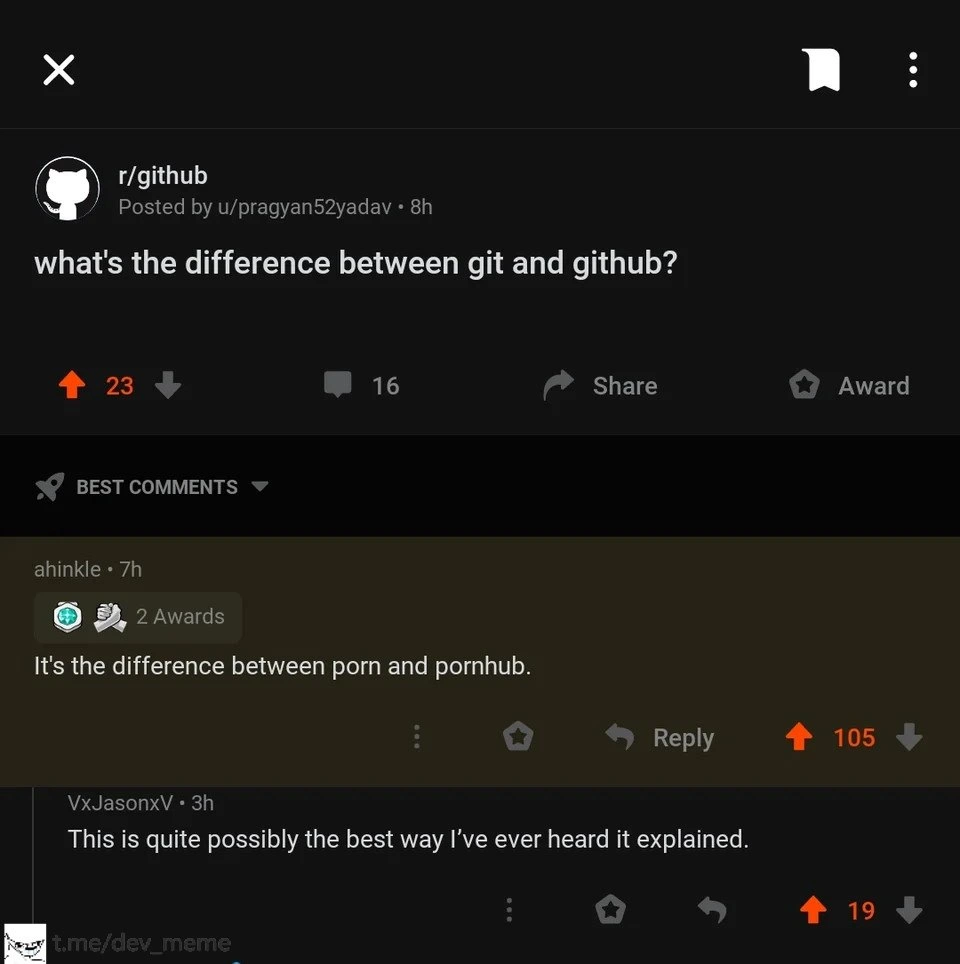
In the world of VersionControl, every experienced developer has heard the classic newbie question: “What's the difference between Git and GitHub?” It’s almost a rite of passage in dev communities. In this meme, Reddit user ahinkle delivers a brilliantly cheeky answer: “It’s the difference between porn and Pornhub.” At first it sounds NSFW and absurd, but it's shockingly accurate. Why do seasoned devs chuckle and nod? Because they’ve spent years explaining that Git (the tool) and GitHub (the service) are as different as content vs platform – and this analogy nails it in one swoop.
From a senior dev’s perspective, the humor works on multiple levels. First, it satirizes beginner confusion. Newcomers often conflate Git with GitHub because of the naming and how intertwined they seem in practice (many learn Git via GitHub). It’s like a beginner thinking Pornhub invented porn because that’s where they first saw it. Seasoned devs find this hilarious because we’ve all encountered someone who says “I installed GitHub on my PC” when they meant Git. The adult-site metaphor exaggerates the point: Git is the raw substance (like adult content itself), while GitHub is a popular hub to host and share that substance. If you remove the spicy veneer, it’s a perfect distillation — Git is an engine, GitHub is a vehicle.
The analogy resonates because it highlights a core industry pattern: tool vs service. Git is a distributed version control system (DVCS) – a powerful command-line tool originally created by Linus Torvalds to track code changes. It operates locally and doesn’t need the internet or any central server; every developer’s machine can have a full copy of the repository. In contrast, GitHub is a hosted platform – essentially Git-as-a-service plus a social layer. It’s a website (and cloud backend) where Git repositories are stored so that teams can collaborate, review code, and keep projects in sync. In other words, GitHub is like Pornhub for code: it doesn’t create code, it distributes and curates it.
This meme also pokes fun at how developer communities love humorous analogies to ease learning. Explaining Git vs GitHub in dry textbook terms is fine, but comparing it to porn vs Pornhub is unexpected and memorable. It injects a bit of edgy humor to an otherwise mundane explainer, which is why the comment earned 105 upvotes and 2 awards – clearly other devs thought “Yep, that explanation hits the spot.” It’s an inside joke acknowledging that sometimes the best way to teach a concept is with a dash of irreverence. In practice, every version control veteran knows the frustration of clarifying this difference over and over. This joke is a subtle jab at that shared experience: after answering “What’s Git vs GitHub?” for the hundredth time, you get a little creative (and perhaps slightly cynical). The community’s positive reaction (“This is quite possibly the best way I’ve ever heard it explained.”) shows how a bold analogy can succeed where pedantic detail fails.
Crucially, the humor doesn’t detract from accuracy. The porn vs Pornhub metaphor is funny because it’s true:
- Content vs Container: Porn is the actual content (videos files), just as Git manages the actual code content (commits, branches). Pornhub is a container or platform that organizes and delivers content to users — likewise, GitHub stores repositories on the cloud and presents them with a nice interface, adding features like issues and pull requests.
- Existence Beyond the Platform: Porn as a genre existed long before any specific site; you can have or make adult videos without Pornhub. Similarly, Git has a life of its own — you can use Git entirely offline or on other platforms (GitLab, Bitbucket, your own server). If GitHub vanished, Git (and your code history) would still exist on your local machine or another remote.
- Community & Discovery: Pornhub makes finding and discussing ahem videos easy with search, categories, and comments. GitHub does the same for code: it’s a community hub where developers discover projects, comment on code, and give stars (likes). It’s not just storage; it’s social coding.
- Ease vs Control: Using Pornhub (the site) is an easy one-stop way to access loads of content, but it’s centralized under a company’s control. Likewise, GitHub simplifies sharing code by centralizing it on their servers, but ultimately it’s a proprietary service on top of the open-source Git tool. Power users know that with Git alone you have total control (you can even host your own “porn site for code” with Git on a private server).
For experienced devs, there’s also an ironic meta-joke in the terminology: Git has commands like git add, git commit, git push. You literally “push” your code to a remote hub. Pair that with the Pornhub reference and you have a cheeky double entendre lurking (we’ll keep it PG here). It’s the kind of borderline humor that makes you smirk in a Slack channel but maybe not bring up in a board meeting. The DevCommunity context (a casual Reddit thread) is key: this isn’t official documentation, it’s peers riffing off a simple question. The result is a sticky mental image – once you hear “Git is porn, GitHub is Pornhub,” you won’t confuse those two ever again! It’s a mix of shock value and crystal-clear logic that ensures the lesson sinks in.
Description
A screenshot of a Reddit thread from the r/github subreddit in dark mode. The original post asks, "what's the difference between git and github?". The top-voted comment, with 105 upvotes and two awards, provides the analogy: "It's the difference between porn and pornhub." A reply below reinforces this, stating, "This is quite possibly the best way I've ever heard it explained." A faint watermark for t.me/dev_meme is visible at the bottom. This meme captures a common point of confusion for beginners in software development. The analogy is brilliant for senior engineers because it's both crude and technically precise. 'Git' is the underlying distributed version control system (the protocol/content), while 'GitHub' is a specific, popular platform for hosting and collaborating on Git repositories (the service/website). The porn analogy perfectly mirrors this relationship, making a complex distinction instantly and memorably clear. It's funny because it uses a non-technical, slightly taboo subject to perfectly illustrate a fundamental tech concept

Comments
7Comment deleted
Git is the distributed ledger of our sins. GitHub is just the most popular public gallery to display them
Git’s the elegant content-addressable object store; GitHub’s the SaaS that layers pull requests, emojis, and the eternal shame of your 3 a.m. commit messages
Finally, an analogy that explains why my company insists on hosting our own GitLab instance while still somehow managing to have worse uptime than both platforms it's comparing
This analogy perfectly captures the relationship between Git and GitHub: one is the decentralized, locally-run protocol that handles all the actual work (commits, branches, merges), while the other is the centralized, social platform where everyone goes to share, collaborate, and inevitably argue about tabs vs spaces in pull request comments. Just like the analogy suggests, you can absolutely use Git without GitHub (self-hosted GitLab, Bitbucket, or even bare repos over SSH), but somehow everyone ends up on the platform anyway because that's where the community is - and where your contribution graph lives to prove you're not just 'git commit --amend'ing your way through life
Git is the content-addressed Merkle DAG you can use on an airplane; GitHub is the SaaS that adds emoji, ACLs, and Actions - and rate-limits you during the Friday hotfix
Git lets you rewrite history; GitHub turns it into change management with branch protection, CODEOWNERS, and a queue of approvers who are all on PTO
Git: your offline fortress of solitude. GitHub: where that fortress begs for stars during every global outage