Skip to content
DevMeme
1220 of 7435
Blockchain's Protected Designation of Origin
Blockchain Post #1364, on Apr 22, 2020 in TG

Blockchain's Protected Designation of Origin

Why is this Blockchain meme funny?

Level 1: Fancy Label, Same Stuff

Imagine you have a pack of ordinary building blocks and you build a cool castle. Now, your friend says, “It’s only a LEGO castle if the bricks are from the official LEGO factory in Denmark. Otherwise, it’s just a regular block castle.” 🤨 See how that sounds a bit silly? In the end, a castle made of any blocks is still a castle, but calling it “LEGO” makes it sound fancier even if it’s basically the same toy and design. This meme is joking about the same idea: people sometimes give a normal tech idea a super fancy name to make it seem special. It’s poking fun at how we dress up something simple to impress others – like putting a sparkling sticker on a bottle of juice and pretending it’s Champagne. The joke makes us laugh because it reminds us that, fancy label or not, it’s what’s inside that counts. 🥤✨

Level 2: Buzzword Bubbles

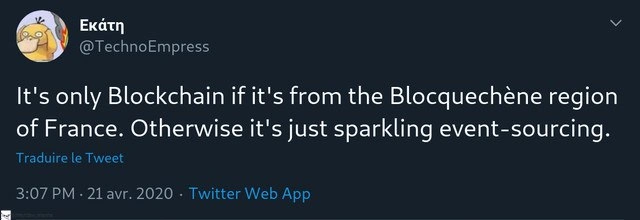
Let’s break down the joke and the tech terms for someone newer to the field. First, the meme is a screenshot of a tweet (a short message on Twitter). The tweet reads: “It's only Blockchain if it's from the Blocquechène region of France. Otherwise it's just sparkling event-sourcing.” This is a play on a common saying about Champagne: only wine actually made in Champagne, France gets that name; anything else is just sparkling wine. People sometimes use that joke format in other contexts to sound witty. Here, it’s applied to blockchain in technology.

Now, what exactly is blockchain? In simple terms, a blockchain is a type of database or ledger that stores information in units called blocks, which are chained together in chronological order. The key feature is that once data is added to a block and the block is part of the chain, it’s very hard to change it (this is what we mean by immutable record – it’s locked in like concrete). Blockchains usually run on multiple computers (nodes) that all have a copy of this chain; they use fancy algorithms to agree on what gets added next. This makes blockchains decentralized – no single company or server is in charge if it’s a public blockchain. The most famous example is the Bitcoin blockchain: it’s basically a list of all Bitcoin transactions ever, stored in blocks that everyone on the network agrees on via computation. You might have heard terms like distributed ledger or cryptocurrency – blockchain is the technology behind those. Because of its success in Bitcoin, around 2016–2019 blockchain became a huge buzzword. A buzzword is a term that suddenly is on everyone’s lips, often more because it’s trendy than because people fully understand it. Companies started saying blockchain could revolutionize everything from finance to supply chains to voting. It was the hype: a lot of excitement, not always matched by practical results.

Next, what is event-sourcing? Event Sourcing is a software design pattern used in building applications. The idea is that every time something happens in your application (an “event”), you record that event in a permanent log (like writing a line in a journal). For example, if you’re modeling a bank account in software, instead of just storing the current balance, you store every transaction as an event: deposit $100, withdraw $20, etc. If you want to know the balance, you can replay or sum up those events. Why do this? Because it gives you a detailed history of everything that happened. You can go back in time, debug by seeing the exact sequence of actions, or even rebuild the state if needed. This pattern is often used alongside something called CQRS (Command Query Responsibility Segregation) in complex systems, but the main point is: event-sourcing = storing all the things that happened rather than just the latest result. It’s actually been around for a while (databases internally keep logs like this for recovery purposes, and accountants have kept ledgers for centuries – similar concept!).

So, how are blockchain and event-sourcing related? They both involve storing data as a sequence of entries over time. A blockchain stores transactions in blocks, one after the other, forming a chain. Event-sourcing stores events one after the other in a log. The big difference is why and how they do it. Blockchain emphasizes decentralization and tamper-resistance: it’s designed so that nobody can secretly alter the past or forge new entries without others noticing. It uses cryptography (math magic) to link blocks and often runs on many separate computers that have to agree. Event-sourcing, on the other hand, usually assumes you’re in control of the system. It’s not about distrustful parties; it’s about keeping a detailed record. Typically, there’s just one source of truth (like one database or service) that appends events. There’s no need for heavy consensus algorithms because you’re not worried about mischievous nodes — you generally trust the environment (like you trust your bank’s database to record transactions in order). Event-sourcing is implemented using familiar tools: e.g., an Audit Log table in a database, or a stream of events in a system like Kafka or RabbitMQ.

The tweet jokes that calling something “Blockchain” is only valid if it meets the strict fancy criteria (like being from the mystical Blocquechène region, which is a made-up French-sounding place to parallel Champagne). Otherwise, if it doesn’t meet those special criteria, what you have is basically “sparkling event-sourcing” – a fun way to say just an event-sourcing system with some extra fizz. In plainer terms, many projects advertise “We use blockchain!” but in reality, they’re just keeping a log of transactions/events in a conventional way. It’s like sticking a glamorous label on a common thing. Why would someone do that? Because blockchain as a word draws attention. It became easier to get funding or press coverage if you said you were using blockchain technology. Engineers who know the underlying tech would say, “Um, this is basically a distributed database or log, nothing magical.” That disconnect is what the meme is poking fun at.

For a newer developer, think of it this way: suppose you learn about a cool new tool that everyone says will change the world, but when you look under the hood, it’s using concepts you already understand, just packaged differently. You might feel a mix of relief (oh, I do get it) and skepticism (did it need all the hype?). Blockchain vs event-sourcing is one such case. Rebuilding a system as a blockchain when a simpler event log would do is often more sparkle than substance. And that’s the heart of the humor: tech industry satire. We’re laughing at ourselves (the tech community) for sometimes being like a marketer who calls a regular cookie “artisan hand-crafted baked good” to justify a markup. The meme is a light-hearted way to say: don’t be fooled by the buzzword – know the ingredients!

Even the visual details support the joke. The screenshot is in dark mode (common among developers who stare at screens all day). The “Traduire le Tweet” link is French for “Translate Tweet”, which is likely there because the user’s interface is in French or the tweet’s language mix triggered it – a cute coincidence given the French Champagne theme. The user’s avatar is Psyduck from Pokémon, a character known for holding its head as if stressed or confused – perhaps reflecting how many of us felt trying to understand why every product suddenly needed a blockchain. The date (April 21, 2020) is around the time when the crazy hype was settling, and people were making jokes to cope with the aftermath. All these elements make the seasoned dev reading it nod and the newer dev curious to dig deeper (which is exactly what you’re doing now!).

In summary, blockchain is the high-profile term with cryptography and distributed consensus; event-sourcing is the solid engineering pattern quietly doing similar things without the fanfare. The tweet wittily says: if you’re not truly doing all the fancy blockchain stuff, then be honest – you’ve basically got a regular event log with a fancy new label, just like calling any sparkling wine “Champagne” doesn’t make it truly Champagne. It’s a lesson in understanding tech beyond the hype.

Level 3: The Champagne of Event Logs

For seasoned engineers, this meme elicits a knowing chuckle because it captures an industry trend we’ve seen again and again: taking a straightforward concept and renaming it with a buzzy term to make it sound revolutionary. The tweet riffs on the famous saying about Champagne: only wine made in the Champagne region can legally be called “Champagne”; everything else is just sparkling wine. By swapping in "Blockchain" for Champagne and "event-sourcing" for sparkling wine, the author satirizes how tech culture (and marketing departments) often inflate buzzwords. In other words, if you strip away the fancy label "blockchain," many projects are basically just using an event log or a distributed database under the hood (the plain sparkling wine). 🍾

Why is this funny to experienced devs? Because it rings true. Around 2018–2020, blockchain hype was everywhere. Managers, clients, and startup founders were eagerly asking, “Can we use blockchain for this?” – even when the use case didn’t call for it. Many engineers ended up building systems that looked a lot like existing databases or messaging systems but were branded as Blockchain Solutions™ to satisfy the hype. The meme effectively says: “Unless your implementation truly has the magic of a decentralized Blocquechène (wink wink), calling it blockchain is just a pretentious way of saying you built an append-only log.” It’s poking fun at the pretension, much like wine enthusiasts roll their eyes at someone calling any bubbly wine “Champagne” without the authentic credentials.

In real architecture terms, event sourcing is a respected pattern (used in systems requiring a full audit trail or temporal querying of state). Plenty of enterprise apps use event logs to rebuild state or to synchronize microservices. It isn’t new – financial systems, for example, have kept transaction journals for decades (that’s essentially event sourcing). So when a company comes along and says, “We’ve reinvented supply-chain tracking with blockchain!”, the senior developers often smirk because they suspect it’s really a distributed event log with a marketing bow on it. They’ve been through similar hype cycles: from SOA being rebranded as microservices, to plain old JS frameworks being called “web 3.0 experiences”. Each time, the pattern repeats: take something that works, give it a trendy name, raise funding or get executive buy-in. 🚀

There’s an undercurrent of gentle cynicism here. Calling a simple distributed log a “blockchain” doesn’t actually make it more sophisticated, just like calling sparkling wine “Champagne” doesn’t make it taste better — but it sure can raise the price! Senior engineers have felt this firsthand. For example, you might have been in meetings where higher-ups insist on a blockchain architecture for, say, an internal ledger where all parties are already known and trusted. In the end, the dev team implements something like Kafka or a SQL database with an immutable log table. It works, it’s simpler, it’s fast… but on the slide deck, it’s labeled “Blockchain-Based Transaction System” because that buzzword impresses non-technical stakeholders. Buzzword inflation like this becomes an inside joke: we all know it’s sparkling event-sourcing, but hey, if calling it Champagne secures the budget, so be it. Cue the engineers popping proverbial Champagne corks in sarcasm.

The tweet coming from a dark-mode Twitter screenshot with French UI (“Traduire le Tweet”) even adds a nice touch – the French reference reinforces the Champagne analogy. The user’s handle and avatar (a Psyduck Pokémon known for looking confused) underline the sentiment: many devs feel a bit like Psyduck 🐤 (headache and confused) when marketing-speak turns a straightforward system into the Next Big Thing. The timestamp shows April 2020: by then, the frenzy of ICOs and “blockchain for everything” was calming down, and folks were reflecting humorously on what had happened. It’s a form of community catharsis. Senior devs share this meme to say, “Remember that absurd period when even a simple log of events had to be called a blockchain? Good times.”

Another layer to the humor is the clever pseudo-French term “Blocquechène”. It’s a play on words: it looks vaguely French (evoking Champagne’s region naming), and if you say it aloud it sounds like “block-chain” with a French twist. It implies a mythical region that produces genuine blockchains, just as Champagne comes only from Champagne province. In reality, of course, there is no Blocquechène region; it’s a nod to the idea that unless certain strict conditions are met, you shouldn’t use the fancy name. This tongue-in-cheek gatekeeping of the term blockchain resonates with developers frustrated by everything being labeled blockchain without merit. It’s as if we’re saying, “Sure, you have a sequential log and maybe even cryptographic hashes, but is it from Blocquechène? Nah, didn’t think so.” That absurd specificity is what makes it funny.

In practice, experienced engineers know when a distributed ledger (true blockchain) is overkill. For instance, a permissioned blockchain used inside one company often has all nodes controlled by that company – effectively nullifying the main benefit of decentralization. It’s like paying for an expensive Champagne-making process only to drink it alone – you could have just had regular sparkling wine for a fraction of the effort. The meme’s satirical advice is: use the right tool for the job and don’t fall for hype. If it’s just an internal event log, call it that and enjoy your sparkling architecture without the extra ceremony. Save the Champagne-level blockchain for when you really need to distribute trust among strangers.

So, when this tweet says “Otherwise it’s just sparkling event-sourcing,” every senior dev who has survived a hype cycle smirks. They’ve been in the war rooms when the tech bubble du jour pops, and they end up refactoring the over-engineered solution back into something maintainable. It’s a reminder that behind grandiose terminology, the fundamentals often remain the same. As the saying among grizzled engineers goes (sometimes with a shrug): “New label, same old wine.” 🥂

Level 4: Byzantine Bottlenecks

At the deepest technical level, this meme contrasts a blockchain with a classic event-sourcing system, revealing that one is basically a glitzy version of the other with extra steps. A true blockchain is a distributed ledger designed to be trustless and tamper-evident across many nodes. It achieves this by solving a hard distributed consensus problem (think Byzantine Generals Problem in computer science) so that a network of participants can agree on a single history of transactions without trusting each other. This is typically done via heavy-duty algorithms like Proof-of-Work (Bitcoin’s approach of making computers solve cryptographic puzzles) or Proof-of-Stake, among others. Each block of transactions includes a cryptographic hash of the previous block, forming a chain that’s mathematically hardened against tampering — if you try to alter an old record, the hash breaks and everyone knows. All these mechanisms introduce serious complexity and overhead: nodes must gossip across the network, verify digital signatures, resolve conflicts, and maintain consensus even if some participants (nodes) are malicious or offline. In short, a blockchain ledger is an append-only log that’s massively replicated and fortified with math and economics to prevent cheating. It’s the Champagne of distributed data structures – produced through an expensive process, with a distinct flavor (decentralization), and often reserved for when you truly need its qualities (a trustless environment).

Now compare this to event sourcing, a well-known design pattern in application architecture. Event sourcing means every change in the system state is stored as a sequential event log (often an append-only log). Rather than keeping just the latest state (like a row in a database), you record every state-changing event in order. Need to know the current state? You “replay” or aggregate the events. Need an audit trail? It’s literally the list of all events. Importantly, traditional event-sourced systems usually run in a trusted environment: perhaps a single company’s database or a cluster under one organization’s control. There’s typically no need for complex Byzantine-fault-tolerant consensus because all the participants (services, databases) are within a controlled domain. The event log might be replicated for fault tolerance and scalability (using tools like Apache Kafka, or database commit logs), but the consensus is trivial or built into the database (e.g., using a leader/follower replication or a consensus like RAFT in a closed cluster). There’s no cryptographic puzzle to solve for each event appended – you trust the system to append in order and not corrupt data. The log is usually immutable by convention (events aren’t retroactively changed, just like you could treat it as read-only), but it’s not typically chained with hashes of previous entries by default. If needed, you could add a hashing mechanism to detect tampering (some event stores allow hashing or signed events), but if only trusted admins access the log, a simple checksum or database constraints often suffice.

This leads to a fundamental truth: from a computer science perspective, a blockchain is essentially an event log with extra "sparkle" – the sparkle being cryptography and distributed consensus. The meme jokes that “It’s only Blockchain if it’s from the Blocquechène region of France; otherwise it’s just sparkling event-sourcing.” In technical terms, unless your system actually implements that whole suite of blockchain features (decentralization, consensus across untrusted nodes, cryptographic chaining, etc.), calling a plain event log a “blockchain” is just dressing up old tech in a fancy new name. Real blockchains have to deal with the trilemma of CAP theorem in a harsh environment: they favor Partition tolerance (network can split and rejoin) and some form of eventual Consistency, often sacrificing immediate consistency and raw throughput. An internal event-sourced system doesn’t have to make such extreme trade-offs – it can prioritize consistency or availability more freely because the trust model is simpler (usually there’s a central authority or at least known trusted nodes).

To illustrate the extra complexity, imagine the difference in pseudo-code between appending to a traditional event log and adding a block to a blockchain:

# Event-sourcing: just append the event to a trusted central log
event_log.append(new_event)
# (No fancy consensus - we trust our database or message queue to keep order)

# Blockchain: add event inside a block and secure it cryptographically
prev_block = blockchain[-1]
new_block.data = new_event
new_block.prev_hash = prev_block.hash       # link to the previous block
new_block.nonce    = proof_of_work()        # find a nonce to satisfy consensus (e.g., PoW)
new_block.hash     = sha256(new_block.prev_hash + new_block.data + new_block.nonce)
blockchain.append(new_block)
# (This block is now chained and would be broadcast to other nodes for verification)

In this snippet, the blockchain path involves hashing and a proof_of_work() – those are the extra cryptographic and consensus steps that a simple event log doesn’t need. The proof-of-work step is essentially a tiny simulation of what Bitcoin miners do: burn CPU time to find a valid hash, which is what keeps the blockchain secure and decentralized but makes it slow (like adding a very laborious step to what could have been a quick write). By contrast, the event log append is straightforward: one process writes, others can trust that write because the environment is secured by other means (permissions, backups, etc.).

So, if we draw an analogy: a genuine blockchain is like a prestigious Champagne with a complex production process (strict region, method, aging, cork popping ceremonies 🍾), whereas an event-sourced log is more like a regular sparkling wine — it’ll still quench your thirst for a reliable record of events, but without the ornate process and brand name. The humor in the tweet is pointing out that many so-called “enterprise blockchains” are basically regular event logs with some bubbles added – they might throw in cryptographic hashes or multi-node replication and suddenly marketing labels it a "Blockchain solution" to sound innovative. Technically, unless it meets the criteria (decentralized control, robust consensus, tamper-proof via math), it’s not really the full Champagne 🥂. It’s just a local vintage with fizz – sparkling event-sourcing by another name.

Description

A screenshot of a tweet from the user 'Εκάτη' (@TechnoEmpress), whose profile picture is the Pokémon Psyduck. The tweet is displayed in white text on a dark blue, typical of Twitter's dark mode. The text of the tweet wittily states: 'It's only Blockchain if it's from the Blocquechêne region of France. Otherwise it's just sparkling event-sourcing.' This is a sophisticated joke that parodies the concept of protected designations of origin, like Champagne only coming from the Champagne region of France. It satirizes the tech industry's tendency to overuse and misapply the term 'Blockchain' for marketing purposes. The punchline, 'sparkling event-sourcing,' cleverly demystifies the technology by comparing it to a known architectural pattern (event sourcing) and hilariously likening the hype to the 'sparkling' quality of wine. This resonates deeply with senior engineers who are often skeptical of buzzwords and appreciate the accurate deconstruction of complex technologies into their core components
Comments

7
Anonymous ★ Top Pick Vendor: 'Our new database is a paradigm-shifting, decentralized ledger.' Senior Dev: 'So, it's sparkling event-sourcing?' Vendor: '...from the Blocquechêne region, yes.'
  1. Anonymous ★ Top Pick

    Vendor: 'Our new database is a paradigm-shifting, decentralized ledger.' Senior Dev: 'So, it's sparkling event-sourcing?' Vendor: '...from the Blocquechêne region, yes.'

  2. Anonymous

    Rebranded the old event-store as a “Premier Cru permissioned blockchain” - same append-only log, but now the board tastes subtle notes of decentralization and doubled our budget

  3. Anonymous

    Just wait until the enterprise architects discover you can get the same immutability guarantees with a Postgres table that has no UPDATE or DELETE permissions - but that doesn't sound as good in the investor pitch deck

  4. Anonymous

    This perfectly captures the moment when your CTO discovers that the 'revolutionary blockchain solution' the consultants pitched is literally just the event sourcing pattern you've been using for years, but now with 1000x worse performance and a cryptocurrency attached. It's the architectural equivalent of renaming your append-only log to 'distributed immutable ledger' and watching the Series A funding roll in

  5. Anonymous

    If your “blockchain” has a single writer and a trusted quorum, it’s just an append-only event store with better marketing and worse latency

  6. Anonymous

    Event-sourcing: blockchain's effervescent cousin - immutable bubbles that never pop, but replay forever

  7. Anonymous

    Blockchain is event sourcing that negotiates writes with thermodynamics; if you don’t have Byzantine adversaries, use Kafka and save the GPUs for CI

Use J and K for navigation