Santa Runs Exponential Smoothing
Why is this DataScience meme funny?
Level 1: Santa Likes Recent Homework
This is like a teacher deciding your grade by caring more about your recent homework than the messy work you did months ago. The kid is scared because he made mistakes earlier, and the parent says, in a very nerdy way, "Don't worry, the newest behavior counts the most."
Level 2: Naughty List Analytics
In data science, a moving average smooths changing values over time. If a website has traffic spikes every minute, a moving average helps show the overall trend instead of every noisy bump. An exponentially weighted moving average adds a twist: recent values count more than old values.
So in the tweet, each act of good or bad behavior is treated like a data point. Being bad months ago still matters a little, but being good recently matters more. That is why the son is "probably fine": the model is assumed to reward recent improvement.
This connects to common developer work because many systems need to decide what is happening now without ignoring the past completely. Monitoring tools smooth CPU usage, analytics platforms smooth engagement, and spam filters update scores as new evidence arrives. The meme is funny because Santa is being imagined as a production-grade decision system with a seasonal batch job and a suspiciously opaque ranking algorithm.
Level 3: Recency Bias, Formalized
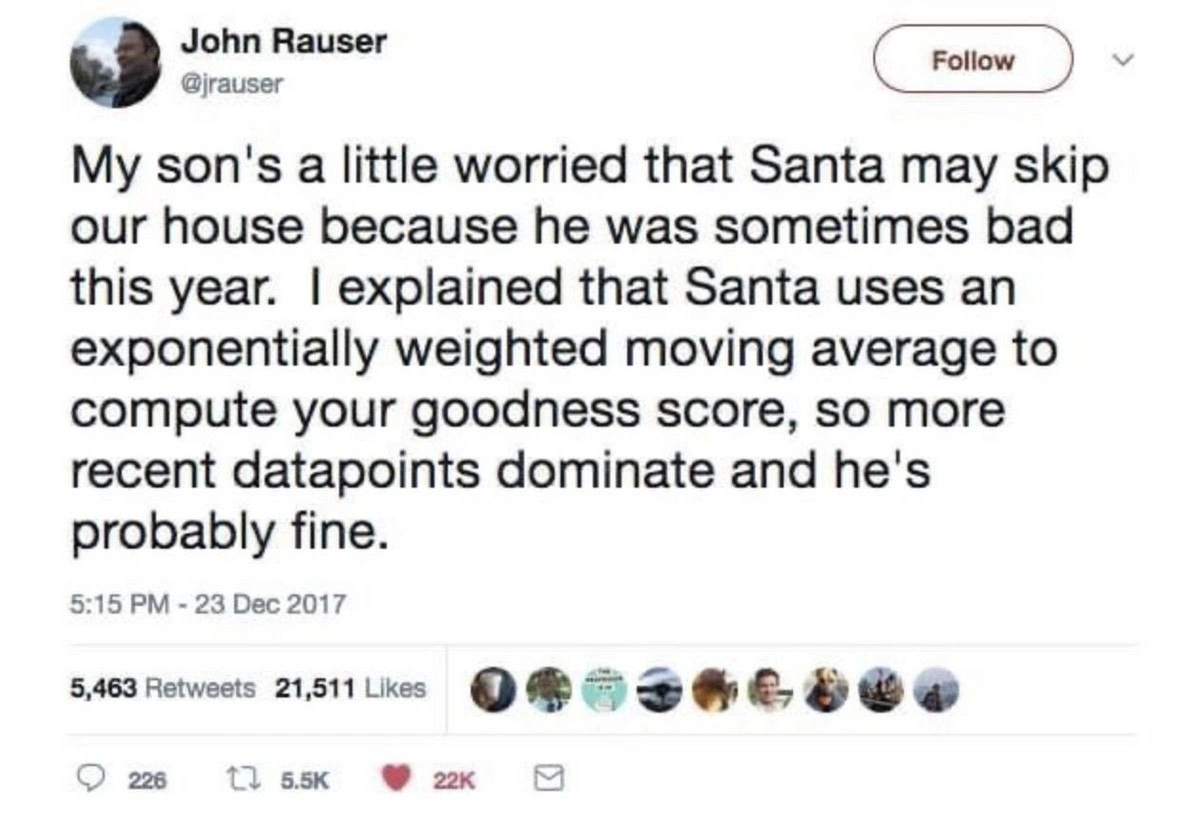
The tweet turns Santa's moral ledger into a time-series model, which is exactly the kind of over-specified answer a data person would give to a worried child. The visible text says:
My son's a little worried that Santa may skip our house because he was sometimes bad this year. I explained that Santa uses an exponentially weighted moving average to compute your goodness score, so more recent datapoints dominate and he's probably fine.
An exponentially weighted moving average is not just "take the average and hope." It assigns heavier weight to recent observations and lets older observations decay. In simplified form:
score_today = alpha * behavior_today + (1 - alpha) * score_yesterday
The joke is that this is a hilariously adult answer to a childhood anxiety. Instead of saying "Santa forgives you," the parent describes a scoring algorithm with temporal decay. That is funny because modern software already does this everywhere: fraud detection, recommendation systems, incident alerting, SRE burn-rate windows, product analytics, reputation systems, and every dashboard that quietly decides whether today matters more than last quarter.
The phrase "more recent datapoints dominate" is doing the emotional work. It reframes childhood "badness" as noisy historical data, then gives the kid a path to recovery: improve the latest samples before the scoring window closes. Very festive. Very quantitative. Slightly concerning as a parenting API.
Description
A screenshot of a tweet by John Rauser, @jrauser, shows a Follow button and a long statistical joke. The tweet reads: "My son's a little worried that Santa may skip our house because he was sometimes bad this year. I explained that Santa uses an exponentially weighted moving average to compute your goodness score, so more recent datapoints dominate and he's probably fine." The timestamp reads "5:15 PM - 23 Dec 2017," with visible engagement counts of "5,463 Retweets," "21,511 Likes," and footer icons showing 226 replies, 5.5K retweets, and 22K likes. The humor comes from applying a quantitative time-series smoothing method to a child's moral standing with Santa.
Comments
2Comment deleted
Santa's naughty list is just an EWMA with holiday-themed alerting and suspiciously opaque retention policy.
and then he cried Comment deleted