Skip to content
DevMeme
3777 of 7435
The Definitive Senior Engineer Take on the NFT Hype Cycle
Blockchain Post #4118, on Jan 28, 2022 in TG

The Definitive Senior Engineer Take on the NFT Hype Cycle

Why is this Blockchain meme funny?

Level 1: Not Buying It

Imagine all your friends suddenly got super excited about collecting some kind of special digital sticker on the internet. They’re saying things like, “Wow, look at this one! It’s so rare and I had to pay a lot for it, but now it’s mine!” These aren’t physical stickers you can touch; they’re just pictures on a screen. Now, you ask, “What makes them special?” and the answer is, “Well, each one has a certificate that says only one person officially owns it.” You then notice something strange: even if one friend “owns” that digital sticker, everyone else can still see the picture, copy it, screenshot it, and basically have it too. Owning the certificate doesn’t stop anyone else from enjoying the exact same image. It’s a bit like someone saying they own a star in the sky because they have a piece of paper, even though everyone else can still see the star just fine.

Now picture one of those friends (let’s call him the big kid with glowing eyes, because he’s really intense about these stickers) coming up to you. He’s towering over you with excitement and says, “You HAVE to start collecting these digital stickers! They’re the future! You’ll be so cool and maybe even get rich if you trade them.” He’s practically shining with how much he’s into this, almost like those cartoon characters whose eyes light up when they talk about something crazy. You, on the other hand, look at the whole situation and feel unconvinced. It sounds a bit silly to you — why would you pay money for a certificate for a picture that you and everyone else can just have or see online? It’s like he’s trying to sell you air or one of those “name a star” gifts. Sure, you’d have a document saying you “own” that star, but the star doesn’t actually change hands or anything. It’s still just up there in the sky for anyone to look at.

So you respond, “Umm, no thanks. I’m good.” In the meme’s words, you actually say something even stronger: “No freaking thanks.” (The meme uses a swear word for emphasis – basically a forceful way to say “absolutely not.”) This response is you firmly telling that excited friend that you’re not interested at all. In fact, you think this whole digital sticker craze is kind of ridiculous. It’s like if a salesman was trying to pressure you into buying magic beans by saying they’ll grow into a giant beanstalk of money, but you’ve heard that one before and you’re not falling for it. You just shake your head and walk away.

The funny part here is the exaggeration. In the picture, you’re shown as a small kid standing up to a huge, scary figure. It feels like a tiny David versus a giant Goliath moment. That’s how it can feel to say “no” when everyone else is hyping something up like it’s the best thing ever. But it’s also empowering: even though you’re small, you’re confident and unshaken. You’re basically the only one in the room saying “the emperor has no clothes” – or in this case, “these NFTs have no point.” And that’s why people find it funny and satisfying. It’s a simple “I’m not buying what you’re selling” moment.

In everyday terms, this meme is like seeing a fad or trend that everyone claims is super cool, but you think is just silly or maybe even a scam. It’s that moment you decide not to jump on the bandwagon. Maybe all your friends started wearing some bizarre new fashion and you’re like, “No thanks, I’ll stick with my comfy old jeans.” Or everyone is downloading an app that does something pointless and pressuring you to join, and you’re the kid going, “Nah, I’m okay.” The big difference here is that in tech (and with NFTs specifically), the hype was really loud and persistent, so saying “No thanks” felt like a bold stance. The meme turns that into a joke by using an over-the-top cartoon scene and a blunt phrase. It’s basically showing: sometimes the smartest move is to just say “No, I don’t want to be part of this,” even if someone big and scary is pushing it on you. And it assures people that yes, it’s okay to trust your gut and opt out of the nonsense.

Level 2: Blockchains and Buzzwords

First off, NFT stands for Non-Fungible Token. That sounds fancy, but break it down: non-fungible basically means unique, and token means a digital item (often like a certificate or entry in a database). An easy analogy is a trading card in the digital world. If you have a rare trading card, you can’t just swap it with any random card – it’s special. Similarly, an NFT is a one-of-a-kind digital token; no two are the same. It lives on a blockchain, which is like a public ledger or record book that’s duplicated across many computers. This ledger records who owns that token. When you “buy” an NFT, essentially the blockchain is updated to show that your account (identified by a long address, kind of like a username made of random characters) is now the owner of that token.

Now why are NFTs a big deal (or why do people act like they are)? Well, around 2021 there was a huge wave of BlockchainHype and Cryptocurrency excitement. Blockchain is the technology behind Bitcoin and Ethereum (popular cryptocurrencies), and it was being hyped as the solution to almost everything. People thought blockchain could revolutionize finance, supply chains, identity, you name it. Within that excitement, NFTs emerged as a way to claim ownership of digital stuff – think art, music, in-game items – in a way that you can prove and trade easily. For example, an artist could sell a digital painting as an NFT. The buyer doesn’t get a physical painting (it’s just a digital file), but they get a sort of digital certificate saying “This one is the official original, and I own it” recorded on the blockchain. If they sell it to someone else, the blockchain updates to reflect the new owner.

TechHypeCycle is a term we use to describe how new technologies tend to get over-excited press and adoption early on (that's the hype), then often a crash or disappointment follows when reality sets in, and eventually the technology finds a more practical, moderate use. With NFTs, during the hype phase, it felt like everyone and their grandma was either launching an NFT collection or telling developers “we gotta get into NFTs!” Suddenly job postings were asking for “Solidity developers” (Solidity is the programming language for writing smart contracts on Ethereum) and every company was brainstorming how to bolt an NFT onto their product. As a new developer, you might’ve felt pressure like “Do I need to learn this? Is this really the future or just a fad?”

This meme captures a lot of anti_nft_sentiment in the developer community. Developers (the people who actually have to implement and maintain these tech ideas) often have a somewhat jaundiced eye towards hype. Why? Because they’ve seen many hyped ideas not pan out, or they understand the limitations that outsiders ignore. In this case, many developers were pointing out issues like:

  • Lack of real utility: Sure, you can “own” a digital image via NFT, but that doesn’t stop others from copying or viewing it. It’s not like owning a physical painting where you have the only copy. So what problem does an NFT solve for the average person? This was a common question with fuzzy answers.
  • Environmental impact: At the time, most NFTs were on Ethereum, which used proof-of-work (lots of computing power, thus lots of electricity). Developers who care about efficiency saw this as very wasteful, especially for something like trading cartoons or memes.
  • Speculation and scams: The NFT space quickly got filled with people looking to make a quick buck. There were many stories of rug pulls (where a team hypes up an NFT project, takes the money and vanishes) or people’s digital wallets getting hacked. A lot of engineers felt it was a Wild West with few genuine, lasting products.
  • Buzzword overload: Some of the NFT supporters used a lot of jargon – Web3, decentralization, metaverse, tokenization – which sometimes obscured the fact that they didn't have a clear plan. New developers often saw that and felt confusion: Is this really advanced stuff I don’t get, or is it empty buzz? Often it was a bit of both, leaning toward empty buzz.

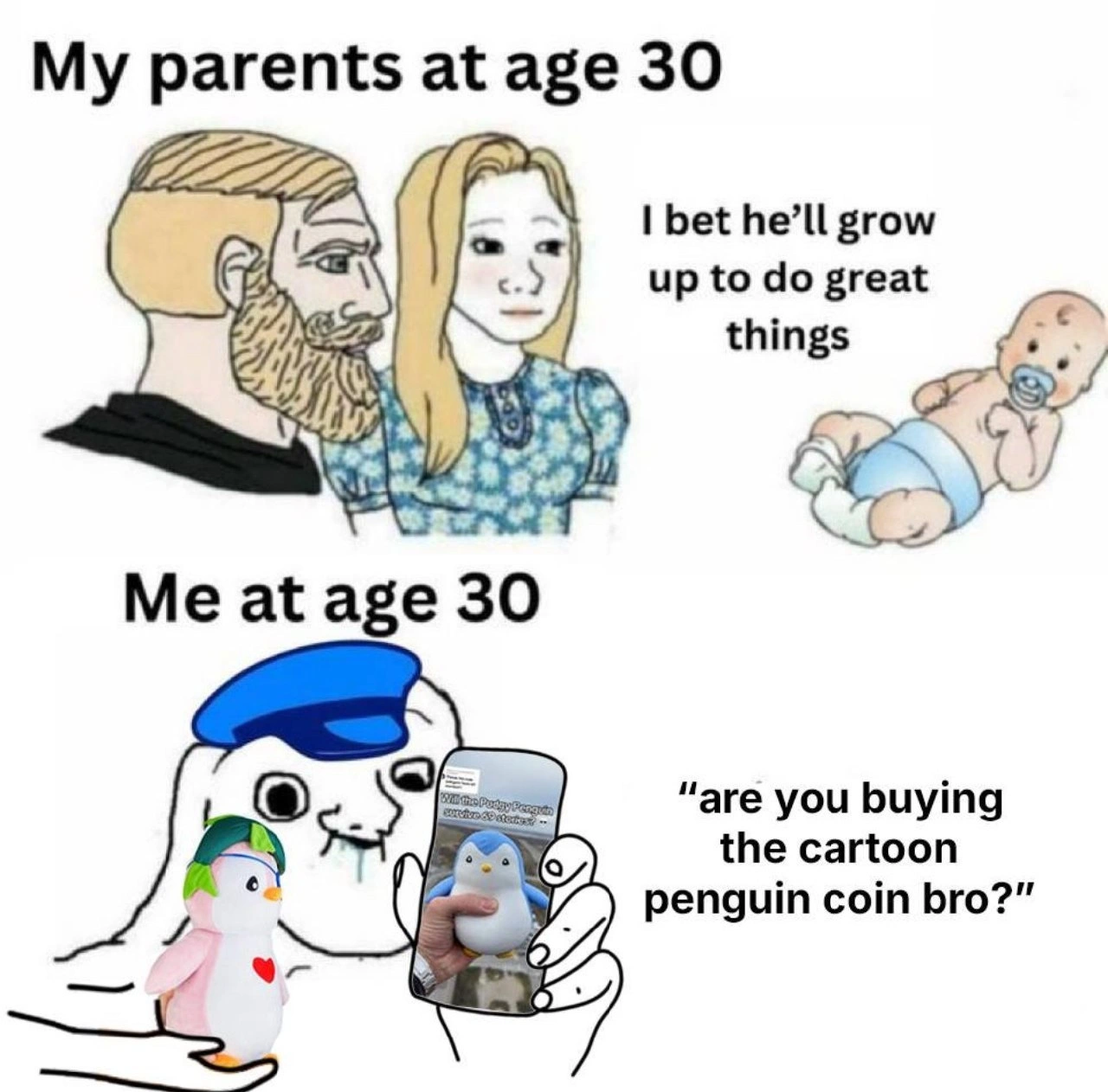
Now, about the meme image itself: It shows what looks like an anime (Japanese animation) scene. The big guy in the black suit with glowing eyes appears menacing and towering. The small kid in a plain shirt stands facing him. This is actually referencing a scene/style from Neon Genesis Evangelion, a famous anime. In Eva, there’s a dynamic of a young boy (Shinji, the pilot) being pressured by his father (Gendo, the man with the glowing glasses) to do something extremely stressful (pilot a giant robot and fight monsters, no less). Meme makers often take such scenes to dramatize other confrontations. In our context, the big scary figure represents the huge pressure of the NFT hype or possibly an aggressive NFT proponent (“Come on, join the NFT craze!”). The small boy represents the developer who’s being pressured. Despite being smaller and theoretically “weaker” in influence, he’s bravely (or stubbornly) saying no. The glowing eyes on the man give a feeling that this NFT hype-pusher is almost out-of-touch or overly fervent – like he’s so consumed by the craze that he’s a bit monstrous or not seeing reason. It’s a comically exaggerated way to show how pushy or imposing the pro-NFT marketing felt to a lot of us.

The text on the meme spells it out in a blunt way: “NFTs? More like NO F***ING THANKS.” This is a straightforward punchline. It takes the abbreviation NFT and reinterprets it. Often online you’ll see people joke that NFT stands for things like “No Free Transfer” or “Nice Fancy Token,” but here it’s the most direct: it literally spells out the meme’s stance: I do not want anything to do with NFTs. The inclusion of the F-word, while profane, is part of internet and developer humor’s edgy side. It shows strong emotion – not just “no thanks,” but “no, absolutely not, leave me alone.” It’s the kind of thing an annoyed engineer might mutter under their breath after getting yet another email about some blockchain project. The casual profanity also signals that this is informal, peer-to-peer communication (devs joking with devs), not some polished corporate statement.

For a junior developer or someone new to this area, it’s important to understand that this meme isn’t attacking you for being curious about NFTs; it’s poking fun at how intense and overbearing the hype became. If you felt a bit skeptical or found the whole NFT craze confusing, you’re definitely not alone – a lot of very experienced tech people felt the same way and made jokes about it to cope and express their viewpoint. Developer humor often comes out as these snappy one-liners or memes that say “we’re not buying this nonsense.” It can be almost a badge of belonging in the developer community to share a meme like this and get a virtual nod or laugh from others who also had that “ugh, not this again” feeling.

Also, note the categories: Blockchain and IndustryTrends_Hype. This meme sits right at the intersection of those. Blockchain was (and is) a real technology that has some powerful concepts, but “industry trend hype” means it became a buzzword people slapped on everything. If you’re a newer dev, you’ll see this pattern recur: some technology will get hyped (AI, blockchain, cloud, microservices, etc.), and suddenly everyone talks about it non-stop. Part of growing as a developer is learning to separate the useful ideas from the hype. How do experienced devs do that? They ask simple questions: “What problem does this solve? Could it be done simpler? What are the downsides?” In the case of NFTs, many felt the answers weren’t convincing enough to justify the craze.

To sum it up, at Level 2 we see that this meme is saying: “We, the developers, think NFTs (the so-called revolutionary blockchain collectibles) are not worth the fuss. In fact, we strongly reject the hype.” It uses a dramatic cartoon image and strong language to get that sentiment across in a humorous way. Even if you’re not deeply familiar with blockchain tech yet, you can likely relate to the idea of feeling cynical when something is over-marketed. Today it's NFTs; tomorrow it might be some new tool or framework everyone says is magic. In tech, as in life, a healthy dose of skepticism can save you from chasing every shiny object. And this meme is basically a giant, memetic eyeroll at one particularly shiny (and perhaps hollow) object.

Level 3: Hype Cycle Hangover

This meme strikes a chord with experienced developers because it lampoons the Tech Hype Cycle in full swing. Picture the scene: a hype-man in a suit (the crypto evangelist or maybe your enthusiastic CTO after reading one too many tech articles) looms large with glowing conviction, saying "NFTs are the future, we all need to get on board!". Facing him is the software engineer (the kid in the white shirt) who’s been through a few tech crazes before and flatly replies, "No, not interested (and definitely not in that tone)." The dramatic anime visual (yes, that red background and glowing eyes are from an Evangelion scene, adding a flair of end-of-the-world intensity) humorously exaggerates how it feels when relentless blockchain hype meets a wall of developer skepticism.

Why is this so funny (and painfully relatable) to developers? Because it’s truth in jest. Over the past decade, we’ve been told countless times: “This [insert buzzword] is going to change EVERYTHING!” We’ve seen Blockchain touted as a solution for not just currency, but voting, supply chain, healthcare, you name it. Then came NFTs riding that blockchain wave, promising to revolutionize art ownership, gaming items, and digital collectibles. To non-engineers or business folks, it all sounds like an exciting gold rush – nobody wants to miss out on the next big thing. But to those of us who actually build and maintain the tech, a lot of these pitches trigger immediate red flags.

Think of the collective eye-roll when a manager or client declares, “We should put this on the blockchain.” Seasoned devs will reflexively ask: why? Does this problem truly need a decentralized ledger with all its complexity and trade-offs? Nine times out of ten, the answer is no. It's often a solution in search of a problem, chosen because of hype, not merit. NFTs specifically suffered from this: companies eager to latch onto the craze scrambled to find a use for NFTs in their products even if it made little sense. Remember the wave of announcements in late 2021 where everyone from soda brands to video game companies proudly proclaimed NFT integrations? Internally, you can bet there were engineering meetings filled with groans. "Do we really need to shoehorn a blockchain just to sell some digital badge or skin?" was a common sentiment.

In fact, some real-world episodes perfectly encapsulate this meme’s sentiment:

  • Discord’s NFT Backlash: Discord (the popular chat platform) teased crypto wallet integration in 2021 to possibly support NFTs. The developer community (and many users) reacted so negatively (“No thanks!” in unison) that Discord’s CEO quickly backpedaled. Internally, plenty of Discord’s own engineers were likely thinking, “Please, let's not open that can of worms.”
  • Game Developers vs NFT Features: Major game studios like Ubisoft tried introducing NFTs (e.g., Ubisoft’s “Quartz” platform for in-game NFT items). Developers and gamers alike responded with intense skepticism and even anger. To engineers, it felt like a solution bringing more problems: increased complexity, potential scams, customer backlash, and extra load on systems – all for what, a fancy receipt of ownership for a helmet in a game? The common developer refrain was essentially, “No f*ing thanks, we’d rather focus on making the game fun.”
  • Previous Crypto Mania: Many senior devs vividly recall the 2017 ICO boom (Initial Coin Offerings) where every startup and their dog launched a token. There was insane hype, easy money flying around, and then... a crash. Those who lived through that learned to recognize the patterns of hype. So when NFTs surged in 2021 with multi-million dollar JPEG auctions and celebrity endorsements, the déjà vu was strong. Fool me once, shame on you; fool me twice... no thanks.

This meme also touches on the anti_NFT_sentiment prevalent among tech folks who see NFTs as more grift than gift. Aside from the technical qualms, there’s a moral undercurrent: a lot of devs felt the NFT craze was exploitative or at least frivolous. People were getting scammed with fake NFT projects, or artists had their work “minted” as NFTs without permission. And then there’s the environmental impact of Proof-of-Work blockchains – the idea of burning tons of electricity for digital collectibles made many engineers physically cringe. So the phrase "No F*ing Thanks" isn’t just comedic exaggeration; it’s a pretty direct reflection of genuine sentiment in many GitHub issues, Reddit threads, and group chats around that time. Engineers were sick of being asked to jump on the bandwagon of what they saw as a pyramid scheme or at best an overhyped tech demo.

Notice the power dynamic shown in the image: a tiny protagonist versus a towering figure with glowing eyes. That towering figure can be seen as the massive social pressure and marketing might behind NFTs during the hype peak. It’s investors, CEOs, maybe that one aggressively zealous colleague, all telling you “This is the future, are you in or out?” The glowing eyes trope, especially in anime, often indicates someone under the influence of something (be it actual mind control or just extreme zeal). It implies the NFT evangelist is almost blindly fervent. The small kid represents developers who feel comparatively small in the face of internet frenzies, yet are internally strong in their logic. The dev might not have a megaphone on CNBC or Twitter like the crypto bros, but he has something else: a bullshit detector finely honed by years of engineering practical solutions. And that detector is blaring loud on NFTs.

From an industry standpoint, this meme also pokes at how developers act as the immune system of the tech world. Hype spreads like a virus – lots of non-technical stakeholders catch the fever. Developers, being the ones who must implement these ideas, often serve as the antibodies going, “Hold on, this doesn’t actually work as advertised.” In the case of NFTs, the antibodies were very vocal. For every LinkedIn post hailing NFTs as Web3 revolution, you had senior engineers posting long threads about why NFTs are flawed: centralization (despite claims of decentralization, many NFT marketplaces and metadata are centralized services), security risks, lack of recourse if something goes wrong, and just sheer impracticality for everyday use-cases (“Do we really expect normal users to set up crypto wallets just to buy a jpg of a monkey with a hat?”).

The phrase “No F***ing Thanks” in the meme is delightfully blunt. In reality, developers in a meeting wouldn’t use those exact words (if they like keeping their job). They might say things like, “We have some serious reservations about that approach,” or “Is there a compelling use-case, because the overhead seems hard to justify...?” But deep inside, especially among peers, they’re absolutely thinking “Nope. Hard pass.” This meme gives voice to that inner bluntness that rarely gets voiced out loud. It’s cathartic. It’s like the collective id of developers saying what they wish they could say in all-hands meetings when someone insists “we need to pivot to NFTs, guys!”

We should also appreciate the timing: January 2022, NFT hype was near its peak. Celebrities were hawking Bored Ape Yacht Club images, every conference had an NFT panel, and you couldn’t browse tech Twitter without someone shilling a new token drop. Developers were fatigued and skeptical by that point, to put it mildly. This meme distills that fatigue into a quick punch: NFTs? More like No F*ing Thanks. It's a play on the abbreviation "NFT" itself, turning it into a snarky backronym (“No F’ing Thanks”). This linguistic jab is something dev humor loves – similar to jokes like XML as "eXtremely Mentally Ludicrous" (not a real one, but fits the style). It’s an outright rejection packaged as wordplay.

In a broader sense, the meme is a commentary on IndustryTrends_Hype. The tech industry does go through frenzy cycles: Big Data, IoT, VR, Blockchain, Crypto, NFTs, Metaverse, and so on. Each time, developers have to sift the genuine innovations from the fluff. Often there is a kernel of great innovation (blockchain tech itself has fascinating qualities), but the surrounding hype exaggerates it to absurdity. NFTs might have some useful niche applications (like verifiable digital tickets or unique game items), but the 2021 craze was so overblown – with people paying millions for what often boiled down to a digital receipt – that it beggared belief. So developers collectively responded with meme-able skepticism.

One couldn’t help but detect a bit of schadenfreude as well when NFT markets later cooled off sharply (the so-called NFT winter). Those who had been saying “No thanks” got a bit of validation seeing the bubble deflate. In the trenches of tech, seeing hype machines stall is a familiar sight. Many of us have weathered fads that promised revolution but delivered headaches, from the infamous enterprise JavaBeans hype of the early 2000s to the more recent microservices-all-the-things craze that sometimes led to distributed messes. The NFT hype felt like history rhyming again. And as the saying goes, "Those who cannot remember the past are condemned to repeat it." The senior dev, like the kid in the meme, remembers the past. He remembers cleaning up the codebase after the last Big Unwarranted Technology Experiment went wrong at 3 AM. So when a wild-eyed new hype comes knocking, it's a firm “No (Fing) Thanks”* — maybe with a knowing smirk.

Level 4: The Non-Fungible Fundamentals

At the core of this meme lies a confrontation over NFTs (Non-Fungible Tokens), so let's unpack the technical drama. An NFT is essentially a unique entry on a blockchain (often Ethereum) representing ownership of some item or piece of data. Unlike a cryptocurrency coin (which is fungible, meaning any one coin is interchangeable with another of equal value), a non-fungible token is one-of-a-kind. In more technical terms, an NFT is a token defined by standards like ERC-721 or ERC-1155 on Ethereum that give it a unique ID and metadata. This uniqueness is enforced by cryptography: when someone “owns” an NFT, it’s recorded in a distributed ledger secured by public-key cryptography. Only the person with the correct private key (think of it as a super-secret password) can transfer that token, proving ownership without needing any central authority.

From a computer science perspective, this is a clever solution to the double-spending problem in digital systems. Normally, if you have a digital image or file, copying it is trivial – there's no built-in scarcity. Blockchains introduce scarcity by ensuring that a token can’t be duplicated or spent twice. They achieve consensus through algorithms like Proof-of-Work (in Ethereum circa early 2022) or Proof-of-Stake (in newer blockchains and Ethereum’s later updates). These algorithms solve the Byzantine Generals Problem, allowing a network of untrusted nodes to agree on the state of ownership. In plain English: thousands of computers worldwide run expensive computations (or stake value) to agree on who owns which NFT, making it practically impossible to forge that ownership or tamper with the history.

All this heavy machinery – cryptographic hash functions, Merkle trees, distributed consensus protocols – works together to give an NFT its legitimacy. The humor, from a developer’s angle, is that we’ve marshaled these advanced technologies basically to claim ownership of a JPEG or GIF. The meme text “NFTs? More like No F***ing Thanks” reflects a sense that, despite the fancy math, many engineers aren’t convinced the output is worth the input. Consider the contrast: on one hand, you have elliptic curve digital signatures, one-way cryptographic hashes, and a network reaching global consensus (all very bleeding-edge computer science); on the other hand, what do you get? A digital certificate saying you "own" a picture of a cartoon ape or a pixelated punk. It’s as if someone used a rocket launch sequence to light a birthday candle – an impressive mechanism for a trivial result.

Moreover, the physics and economics underlying these tokens add to the absurdity. A blockchain like Ethereum (pre-merge) could only handle ~15 transactions per second and consumed electricity on the scale of a small country to maintain its trustless ledger. That means every time someone minted or traded an NFT, a bunch of GPUs or ASICs worldwide churned away solving math puzzles (SHA-256 hashes) to record that event. This leads to the oft-cited criticism: is it really worth burning that much energy so that someone can claim a procedurally-generated .PNG image as theirs? The CAP theorem of distributed systems tells us we can’t have it all (consistency, availability, partition-tolerance) – blockchain opts for consistency and partition-tolerance at the cost of raw performance. So while the tech is brilliant in theory (no central server, no single point of failure, theoretically tamper-proof records), in practice it's slow, costly, and doesn't stop people from simply copying the underlying art. The blockchain ensures Alice is the provable owner of token #123, but it can’t stop Bob from right-clicking the associated image and saving a perfect clone. The token is unique and unforgeable; the image or content it points to usually isn’t. This gap between mathematical ownership and practical control is a fundamentally intriguing (and funny) aspect: we have solved a theoretical problem (digital scarcity) that many developers feel was never a real problem to begin with, at least not for digital art.

Historically, engineers have dealt with digital certificates and authenticity for decades. We know how to verify a file’s integrity with a hash, or sign a document digitally to prove provenance. NFTs take those ideas and bundle them with the notion of artificial scarcity and tradability. In academic terms, you can see influences from research in distributed databases and cryptography; for example, Merkle trees (invented by Ralph Merkle in 1979) allow efficient verification of large data sets – blockchains use them to ensure each block of transactions is securely linked. The idea that you can have a unique tokenized identifier for a piece of content is not crazy on paper: it’s like a pointer or reference that everyone agrees on. But the devil is in the details: the token might exist on-chain, yet the high-resolution image or 3D model it represents is often stored off-chain (maybe on some server or decentralized storage like IPFS). If that off-chain resource disappears or changes, the NFT suddenly points to a 404 or something meaningless. So some seasoned devs see NFTs as a flimsy bridge between robust cryptography and fragile real-world dependencies. It’s a bit like building an immutable ledger entry that proudly declares “Alice owns X”, but if X lives outside the ledger, the ledger alone can’t guarantee X will be there tomorrow.

In summary, this highest level of analysis recognizes the deep technical irony behind the meme: cutting-edge blockchain tech and cryptographic primitives are being used to prop up a speculative market for digital collectibles. The meme’s big glowing-eyed figure can be seen as the imposing complexity and hype of blockchain tech itself. The small boy defiantly saying “No thanks” is the developer’s rational mind, effectively doing a cost-benefit analysis and concluding that this particular application of so much theoretical brilliance just doesn’t pass the laugh test. The humor emerges from that dissonance between theoretical elegance and pragmatic skepticism. It echoes an almost academic critique: "We’ve solved something profound... in order to sell cartoon monkey pictures?" For an engineer who appreciates the beauty of the algorithms but doubts the use-case, the blunt “No Fing Thanks”* is both a rejection and a punchline.

Description

This meme uses a dramatic and intimidating scene from the anime series 'Neon Genesis Evangelion'. Against a stark red background, the tall, shadowy figure of Gendo Ikari, with his glasses glowing ominously, looms over his son, Shinji. The image is captioned with large, white, impactful text. The top line reads, 'NFTS? MORE LIKE', and the bottom line delivers the punchline, 'NO FUCKING THANKS'. The meme leverages the scene's inherent feeling of authority and dismissal to represent the widespread sentiment of many experienced software engineers during the NFT (Non-Fungible Token) hype of 2021-2022. It perfectly encapsulates the cynical, world-weary perspective of senior technologists who saw NFTs not as a revolutionary technology, but as an overhyped, speculative bubble plagued by technical limitations, security issues, and questionable utility. The blunt, profane rejection is a humorous and relatable expression of the developer community's fatigue with the relentless promotion of blockchain technologies
Comments

13
Anonymous ★ Top Pick An NFT is just a cryptographically signed hyperlink to a JSON file pointing to an image on a server you don't control. It's the most expensive 404 error you'll ever own
  1. Anonymous ★ Top Pick

    An NFT is just a cryptographically signed hyperlink to a JSON file pointing to an image on a server you don't control. It's the most expensive 404 error you'll ever own

  2. Anonymous

    NFTs are proof that if you wrap a 96-kilobyte JPEG in Merkle trees, IPFS, two L2 bridges, and a Discord community, investors call it innovation while senior devs just rename the epic to ‘Distributed Right-Click Saver’

  3. Anonymous

    Remember when we spent years optimizing image compression algorithms to save bandwidth, only to watch people pay $500 in gas fees to store a URL pointing to a JPEG on someone else's server that returns 404 six months later?

  4. Anonymous

    An NFT is a pointer to a JPEG on someone else's server - congratulations, you reinvented the symlink, but with gas fees

  5. Anonymous

    When the blockchain evangelists pitch NFTs as the future of digital ownership, but you've already seen enough 'revolutionary' technologies come and go to know that a distributed ledger doesn't magically solve the fundamental problems of digital scarcity, environmental impact, or the fact that right-clicking still works perfectly fine. Sometimes the most technically sound decision is recognizing when a solution is desperately searching for a problem

  6. Anonymous

    NFTs are the only distributed system where consensus immutably proves you own a mutable JSON on someone else's S3, until the 404 achieves finality

  7. Anonymous

    NFTs: paying gas to mint an immutable pointer to a mutable JSON that points to a JPEG on someone’s S3; decentralization ends at the 404

  8. Anonymous

    NFTs: blockchain's monolith promising immutable value, delivering mutable regret faster than a smart contract self-destruct

  9. @denis_klyuev 4y

    maybe NTFS?

    1. @sylfn 4y

      NFTs; that font maybe just cant be uncapslocked

      1. @denis_klyuev 4y

        oh, now I see. thanks for the explanation 👍

    2. @affirvega 4y

      lmao

    3. @RiedleroD 4y

      no thanks, fuck 'soft

Use J and K for navigation