Rust's Serene Discipline vs. C++'s Chaotic Memory Management Circus
Why is this Languages meme funny?
Level 1: Better Safe Than Sorry
Imagine two friends at a gymnastics gym. One friend is practicing on a low balance beam with a safety harness on and soft mats underneath. They take it slow and steady, and they’re having fun without worrying about getting hurt – this is like the Rust developer using all the safety gear so things stay under control. Meanwhile, the other friend is across the gym doing wild flips on a high bar without any harness or mats. They’re even doing stunts on top of a shaky bench and a parked truck! Every time you gasp thinking they might fall, they just laugh and shout, “Don’t worry, I never get hurt doing this!” That’s like the C/C++ developer boasting that their code never crashes. It’s impressive to watch, but also a bit scary because one slip-up could be disastrous. The joke here is simple: the second friend is overconfident and keeps insisting there’s no danger – but we can clearly see they’re taking a huge risk. The first friend might look cautious by comparison, but they’re the one who will walk away unscathed if something unexpected happens. In everyday terms, the meme is reminding us that better safe than sorry is a good motto. Using a tool that prevents big mistakes (like Rust’s safety checks) is like wearing your helmet and harness, whereas just saying “I’ll be careful, it’ll be fine” in a risky situation (like coding in C/C++ without safety nets) is like doing daredevil flips and just hoping you don’t get hurt. We laugh because we know who’s more likely to end up in trouble – and it teaches that sometimes the less flashy, safety-first approach is the smart one.
Level 2: Memory Safety 101
At its core, this meme is comparing two programming languages – Rust and C++ – and how they handle memory safety. Let’s break down the terms and what’s happening in simple terms:
Memory safety means writing software in a way that prevents common bugs related to how programs use memory. For example, it helps avoid issues like reading or writing beyond the memory your program is supposed to access, or using memory that has already been freed. Think of a program’s memory like a set of labeled boxes where you store data. Memory safety is about making sure you only open and mess with your own boxes, and you close them properly when you’re done. If you don’t, the program might crash or misbehave, and in worst cases a hacker could exploit the mistake.
Rust is a newer systems programming language (first released in 2015) that was designed with memory safety in mind from the start. It has a compiler feature called the borrow checker, which acts like a strict coach or referee: it won’t even let your program compile (run) if it detects certain types of memory mistakes. Rust essentially forces you to handle memory safely at compile time. For instance, in Rust you can’t forget to free memory – the language automatically frees (drops) values for you when they go out of scope. You also can’t have two parts of your program accidentally modifying the same piece of data at the same time (which prevents a lot of threading bugs). If you try something risky that could lead to a memory error, Rust will usually give you a clear compiler error or warning. The benefit is that if your Rust code compiles, you can be pretty confident it won’t have those nasty bugs like buffer overflows or use-after-free errors in its safe code (safe code meaning you haven’t explicitly turned off the safety checks).
C++ (and its predecessor C) is an older language (C is from 1972, C++ from the 1980s) that is widely used for things like operating systems, games, and other high-performance software. C++ does not have a built-in borrow checker or automatic memory safety guarantees. It gives the programmer a lot of freedom and power – you manually manage memory (you explicitly allocate and free it), and the language trusts you to get it right. If you make a mistake, the code will still compile fine, but it might crash or behave incorrectly when you run it. There are tools and best practices to write safer C++ (like using smart pointers that automatically delete objects for you, or running analysis tools to catch bugs), but ultimately the language leaves the responsibility on the developer. People often say C and C++ are like having “sharp knives” – very useful for cutting edge performance, but you can cut yourself if you’re not careful.
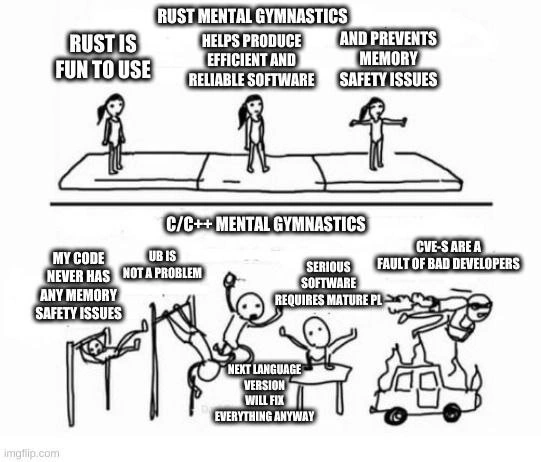
Now, the meme shows two scenarios. The top part, labeled “RUST MENTAL GYMNASTICS,” has Rust developers casually walking on a flat balance beam. They look relaxed. The idea here is that Rust’s rules and compiler checks keep things stable and safe – Rust developers don’t have to do crazy tricks to avoid memory bugs because the language is helping them by design. Their quotes highlight this feeling:
- “Rust is fun to use” – Rust can be challenging to learn at first, but many developers find it enjoyable because once you understand it, you spend less time worrying about low-level problems. The language feels empowering; it catches your mistakes and lets you focus on building features.
- “Helps produce efficient and reliable software” – Rust was made to produce programs that run really fast (like C++ programs do) but also stay reliable (don’t crash or misbehave easily). “Efficient” means it doesn’t waste resources, and “reliable” means it’s less likely to have bugs that cause crashes or inconsistent behavior. Essentially, Rust tries to give you the best of both worlds: speed and stability.
- “And prevents memory safety issues” – This is the key point: Rust actively prevents you from making the common mistakes with memory. It’s like a car with built-in seatbelts and airbags – even if you do something wrong, there are protections to prevent catastrophe. Rust’s compiler checks (the borrow checker) are designed to stop you from compiling code that would lead to things like accessing invalid memory.
In the bottom part, “C/C++ MENTAL GYMNASTICS,” we see C++ developers performing wild flips and stunts on various pieces of gym equipment (uneven bars, a bench, even a truck!). This is a humorous way to show that C/C++ developers often have to rely on skill, experience, and a bit of luck to avoid the pitfalls of their language. The quotes in their speech bubbles are basically the rationalizations or statements you might hear from someone defending the old way of doing things:
- “My code never has any memory safety issues” – In plain terms, this person is saying “I never make mistakes with memory.” It sounds confident, but it’s usually unrealistic. Everyone makes mistakes sometimes, especially in big, complex programs. This statement represents a bit of pride or denial. It’s like someone saying “I’ve been doing this dangerous stunt for years and I’ve never been hurt” – it might be true so far, but it doesn’t mean the risk isn’t there.
- “UB is not a problem” – UB stands for Undefined Behavior, which is what we call it when a C/C++ program does something it’s not supposed to (like read memory out of bounds or use a pointer that isn’t valid). When UB happens, the result is unpredictable – the program might crash, or produce garbage output, or even seem to work fine by coincidence. To say “UB is not a problem” is basically saying “Doing bad things in C++ won’t really hurt us.” For a junior developer: imagine a rule that says “don’t put your hand on a hot stove because you’ll get burned.” UB is like putting your hand on the stove – and the stove might not burn you immediately (maybe it’s not on full heat or your hand is only there a split second), but it’s a dangerous thing to do and eventually you’ll get burned. So, C++ veterans actually consider UB a big problem to avoid, but the meme has this character pretending it’s no big deal – which is funny because it’s the opposite of reality.
- “Serious software requires mature PL” – PL means programming language. This statement is saying “For important projects, you should use a programming language that’s been around a long time (mature), like C++, rather than something new like Rust.” It’s true that C++ has been used for a lot of major applications for decades – in that sense it’s proven. Rust, being newer, doesn’t have the same long history in industry. Some people are skeptical of adopting a new language for critical projects – they worry about whether it has enough libraries, tooling, or if there are unknown bugs. The meme is poking at this mindset because it can become an excuse to not try something that might actually be better. It’s like saying “We should stick with the old car we’ve had for 30 years for this road trip, not the new car with new safety features, because the old one is a classic.” There’s comfort in the familiar, but it might not actually be the safest choice.
- “Next language version will fix everything anyway” – This is basically “We don’t need Rust because the next update of C++ will solve these problems.” C++ does keep getting updated (new standards come out every few years with improvements). And indeed, newer C++ versions have added things that help with safety (for example, C++ smart pointers help manage memory automatically). But C++ will likely always have unsafe corners because it doesn’t want to break older code that relies on that flexibility. So this quote is a tongue-in-cheek way of saying “let’s just wait and not change; surely our current tool will improve on its own.” It’s funny because it sounds a bit like wishful thinking — a way to avoid making a tough decision now by hoping it becomes a non-issue later.
- “CVE-s are a fault of bad developers” – CVE stands for Common Vulnerabilities and Exposures, which is basically an ID or reference number for a publicly known security bug. Many of these CVEs (especially for programs written in C/C++) are due to memory safety mistakes. Now, this quote blames the developer for those bugs: essentially, “if a program has a security flaw, it’s just because some programmer screwed up; the language isn’t to blame.” There is some truth that a mistake is a mistake, but this view ignores the fact that the language (C/C++) makes it really easy to make certain kinds of mistakes. Even very good developers have had CVEs attributed to their code because keeping track of every little memory detail in a big program is error-prone. So this quote is a bit of an arrogant or naive take, and the meme uses it to caricature the mindset of someone who refuses to admit that the tools might be part of the problem. It’s like saying “only bad drivers get into car accidents” – implying the car or road conditions don’t matter, which we know isn’t true (even great drivers can hit black ice and crash if the car has no ABS or traction control – analogous to how even great C++ devs can introduce bugs due to no built-in safety checks).
The comic is exaggerating these attitudes for comedic effect, but they’re based on real arguments in the programming community. Rust enthusiasts often advocate for using Rust in new projects, especially where security and reliability are crucial, because it helps avoid these memory pitfalls. On the other side, C++ veterans might respond with some of the lines above, sometimes half-jokingly, because they’ve relied on C++ for so long and are confident in their own experience.
It might help to see a quick comparison of how a memory safety issue is handled in each language:
// C++ example: manual memory management can lead to pitfalls
#include <iostream>
int main() {
int* p = new int[5]; // allocate an array of 5 ints on the heap
delete[] p; // free the array
int x = p[2]; // Oops! Using memory after it's freed (Undefined Behavior)
std::cout << x << std::endl; // This might crash or print garbage
return 0;
}
In the C++ code above, we allocate an array and then free it. But then we try to use it (p[2] after we deleted it). The C++ compiler will not warn you about this mistake by default; it trusts that you know what you’re doing. Running this program could crash or print a random value – it’s undefined what will happen. This kind of bug (using memory after free) is a common mistake that can lead to serious issues.
Now the same kind of scenario in Rust:
// Rust example: the borrow checker prevents use-after-free
fn main() {
let v = vec![1, 2, 3, 4, 5]; // create a vector of 5 integers
drop(v); // explicitly free the vector (though Rust would do this automatically at end of scope)
let x = v[2]; // Error: use of moved value 'v'
println!("{}", x);
}
In the Rust code, we create a vector (which is like a growable array). The call to drop(v) frees the vector early. When we then try to use v again, Rust’s compiler will stop with an error before the program ever runs. The error is basically saying “hey, v is gone, you can’t index into it anymore.” Rust caught the use-after-free bug at compile time. Without the explicit drop(v), Rust would have automatically freed v at the end of main, and similarly would not allow using it after that point. The key takeaway: Rust won’t let you do the “use-after-free” mistake at all (unless you go out of your way to use unsafe code, which most Rust code doesn’t). C++ will let you do it and you have to be the one to avoid or catch it.
So, what is the meme telling us in plain language? It’s highlighting that using a language with built-in safety (Rust) is like having guardrails and nets in place – it might constrain you a little upfront, but it prevents disaster. Using a language without those (C/C++) gives you a lot of freedom to move, but you can tie yourself in knots (the “mental gymnastics”) trying not to fall or to justify why it’s okay to not have the guardrails. The Rust folks in the meme are relaxed because they know the big problems (memory leaks, buffer overruns, etc.) are largely handled by the language’s checks. The C++ folks are in wild poses because they’re having to do all sorts of thinking and convincing (“trust me, it’s fine, I’ve got this under control!”) to deal with the same problems manually.
For a newcomer or junior developer, the main point is: Programming languages differ in how much they help you avoid mistakes. Rust is an example of a language that helps catch your mistakes early – it’s like a car with a seatbelt alarm, lane assist, and anti-lock brakes. C++ is more like a high-performance race car with no automatic safeguards – skilled drivers can do amazing things with it, but it’s easier to crash if you’re not extremely careful. The meme uses humor to show that while one approach might require more initial discipline (Rust’s strict rules), the other approach can lead to a lot of “mental gymnastics” later to handle the problems that arise. It’s highlighting an ongoing conversation in programming about choosing safer tools for the job, especially in fields like security where a simple memory error can have big consequences. In short, Rust is portrayed as the friend who uses safety gear and ends up with fewer injuries, whereas C++ is the daredevil friend who claims they never need safety – and the joke is we all know how that usually ends.
Level 3: Cognitive Dissonance Cartwheels
This meme hits home for seasoned developers (especially those in systems and low-level programming) who have battled memory bugs. The humor arises from the stark difference in mindset: the Rust crowd calmly trusts the language’s safeguards, while the C/C++ crowd engages in high-flying cognitive dissonance to justify the status quo. In the top panel, the Rust developers’ thoughts – “RUST IS FUN TO USE,” “HELPS PRODUCE EFFICIENT AND RELIABLE SOFTWARE,” “AND PREVENTS MEMORY SAFETY ISSUES” – come off as straightforward facts. They’re essentially saying, “Our language makes life easier and safer.” No drama needed. Meanwhile, the bottom panel’s C/C++ developers are performing logical somersaults with quotes like “MY CODE NEVER HAS ANY MEMORY SAFETY ISSUES” and “UB is not a problem.” Every experienced programmer reading that will smirk, because we’ve all heard these lines before and we know how wishful (or delusional) they sound. It’s funny because it parodies the excuses we often encounter in real software debates:
“My code never has any memory safety issues.” That’s the classic overconfidence (or denial). In reality, even the best C/C++ engineers have stories of chasing down a segfault or heap corruption at 2 AM. Memory bugs can be subtle and may lurk unnoticed until they spectacularly surface. Claiming you have zero memory issues is like saying you’ve never tripped while running – it usually means you haven’t run far enough yet. Seasoned devs know that in large C/C++ codebases, avoiding all memory mistakes is nearly impossible. So this claim in the comic is hilariously over-the-top; it’s akin to a tightrope walker bragging they never fall while we can see the safety net full of holes beneath them.
“UB is not a problem.” Undefined Behavior (UB) is notorious among C/C++ folks. It’s the source of some of the nastiest bugs because when it happens, anything can occur (crashes, security holes, or silent data corruption). Saying it’s “not a problem” requires some Olympic-level mental gymnastics. In practice, experienced C++ teams treat UB very seriously: they use tools like
AddressSanitizer,Valgrind, and meticulous code reviews as extra safety nets to catch what the language won’t. The meme pokes fun at those who shrug off UB publicly even though, privately, every C++ veteran is a bit terrified of that one lurking bug that only shows up in production. It’s a comic exaggeration of a real cognitive dissonance – acting like everything’s fine while you’re secretly juggling chainsaws behind the scenes.“Serious software requires mature PL.” Here “PL” stands for programming language. This sentiment reflects a bias many old-timers have: C++ (born in the 1980s, building on C from the ’70s) is time-tested and has a massive ecosystem, so they argue that anything newer (like Rust, which had its 1.0 release in 2015) isn’t suitable for “real, serious” projects. There’s a kernel of reason here – C++ is deeply entrenched in low-level programming domains. It powers operating systems (most of Windows and the Linux kernel at their core are C/C++), game engines (Unreal Engine, etc.), embedded systems, high-performance financial software, you name it. It has decades of libraries, tooling, and community knowledge behind it. Rust, in 2021, was relatively new in terms of industry adoption; some libraries or tools were still maturing. So calling C++ a “mature” choice and Rust “unproven” is something you do hear in companies. But the meme highlights the irony of using maturity as an excuse to ignore safety problems. Many serious software projects have started to embrace Rust precisely because the old “mature” language kept biting them with memory bugs. Mozilla chose Rust for parts of Firefox (to prevent the sort of memory exploits that plague web browsers), Microsoft was experimenting with Rust for Windows components to reduce vulnerabilities, and the Linux kernel community was debating Rust for new drivers. So the “mature PL only” argument is increasingly shaky – it’s like insisting on using an old, familiar machine that occasionally blows up, instead of a newer one with safety guards, just because the old machine has been around longer.
“Next language version will fix everything anyway.” This satirizes the optimism that the C++ standards committee will somehow solve the language’s safety issues in upcoming revisions. It’s true that C++ evolves – C++11/14/17/20 have added features to make life easier and a bit safer (for example, smart pointers like
std::unique_ptrto automatically manage memory, or bounds-checked access methods like.at()for containers). There’s even talk of adding Rust-like borrow-checking or safer subsets to C++ in the future. But fundamentally, as long as C++ must maintain backwards compatibility and prioritize performance, it can’t simply remove its dangerous features or eliminate undefined behavior. Each new standard might mitigate some problems, but it doesn’t “fix everything.” This excuse is funny because it’s a procrastination tactic: it’s like saying “I know my roof leaks, but I’ll just wait for the next rainy season – maybe by then roofs will have magically improved.” Seasoned devs chuckle because we know each C++ update brings improvements, sure, but not an end to memory bugs. Betting that the next version will save you is more convenient than actually dealing with the problem now.“CVE-s are a fault of bad developers.” CVE stands for Common Vulnerabilities and Exposures, which are public identifiers for security flaws. This statement blames the programmers for any security bug, implying that a “good” developer wouldn’t have memory issues even in C/C++. It’s a deflection we’ve heard before. Yes, mistakes by developers cause bugs – but this ignores how the language can make certain mistakes so easy to make and so devastating when they happen. Even top-notch engineers at companies like Apple, Google, or Microsoft have been behind major CVEs caused by a slip with pointers or buffer sizes in C/C++. The meme exaggerates this attitude to show its absurdity: it imagines C/C++ die-hards claiming only incompetence causes bugs, rather than acknowledging that the tool might be part of the problem. In reality, good developers write safer code when they have safer tools. Rust’s premise is exactly that – help developers avoid those mistakes in the first place. So blaming only “bad developers” for CVEs is an oversimplification (and a convenient one for those resisting change). Experienced engineers roll their eyes at that kind of statement, because it glosses over the numerous times even veteran C++ coders have been foiled by a momentary lapse or an unforeseen interaction in a very complex codebase.
The phrase “mental gymnastics” in the meme’s title is spot on. We see it in how the C++ characters twist themselves (and their logic) to downplay the issue or to argue against switching to a safer approach. Any developer who’s been in a meeting about possibly using Rust instead of C++ has heard arguments like these. They often come from a mix of genuine concern (it is hard to suddenly rewrite or replace large systems, and C++ is still incredibly powerful) and a bit of pride or attachment (“I’ve used C++ for 20 years, and you’re telling me there’s a better way?”). The meme exaggerates these arguments to the point of silliness, which is why it’s funny. It’s cathartic humor for those of us who have sat through those debates.
In contrast, the Rust folks in the top panel don’t need such acrobatics. Their statements sound almost cheerfully simple, and that’s kind of the point: “Rust is fun, it’s efficient and reliable, and it prevents memory issues.” They’re not bragging about their own skills; they’re praising the tool they’re using. The calm posture of the Rust characters (casually walking a straight beam) versus the contorted poses of the C++ characters (one is literally upside-down on the high bar, another balancing on a truck!) says it all. Rust developers still have to think – the compiler makes you consider ownership and borrowing – but it’s a controlled, consistent kind of thinking. C++ developers often have to think on two levels: before running the program (to write the code) and after something goes wrong (“okay, what weird memory issue did we hit now?”). The meme’s exaggeration shows the C++ folks almost in denial, insisting everything’s fine while performing ever more absurd stunts to keep their program from crashing.
From a senior engineering perspective, this is both a chuckle and a nod of agreement. It highlights why there’s a growing movement of memory safety advocates pushing for Rust in systems programming: not because Rust is perfect or solves every problem, but because it removes whole categories of catastrophic bugs. It also highlights why there’s resistance: huge existing C/C++ codebases, expertise invested in those languages, and the simple fact that change is hard. So we end up in this period where some engineers are effectively doing triple backflips to justify sticking with C/C++, while others have found a way to just walk forward safely with Rust. The meme captures that dynamic in a lighthearted way. Seasoned devs find it funny because it’s true – we’ve heard all these justifications – and it’s a bit of dark humor about the industry’s slow adoption of safer practices. In the end, it underscores a relatable scenario: one group saying “look, we have a safer, saner path now” and another group replying “we’re fine, it’s always been a circus but we manage!” – with the cartoon illustrating literally that circus. It’s an amusing reminder that, as the saying goes, insanity is doing the same thing over and over and expecting different results (or insisting nothing’s wrong), while sanity might be trying a new approach with actual safety nets.
Level 4: Borrow Checker Balance Beam
Rust’s approach to memory safety is rooted in compile-time guarantees provided by its borrow checker. Under the hood, Rust’s type system enforces strict rules about ownership and lifetimes – effectively performing a formal proof that your program frees memory exactly once and never accesses it out-of-bounds. Think of it as a safety inspector checking every step on the balance beam before you proceed. In type theory terms, Rust employs an affine type system (each value has a single owner and a constrained lifetime) which prevents aliasing issues like double frees or iterator invalidation. The compiler’s borrow checker ensures that only one mutable reference (or any number of immutable references) exists for a piece of data at a time, providing a static guarantee against dangling pointers and data races. Even concurrent access is checked – types must implement the Send/Sync markers to be shared across threads, ensuring no unsynchronized data races occur. These concepts echo decades of academic research – from region-based memory management to linear logic – but Rust makes them practical for real-world systems programming. It’s as if the language itself is doing the hard mental gymnastics of memory management for you, keeping your code balanced and safe.
By contrast, C/C++ gives the programmer low-level power with almost no safety net. You can cast pointers arbitrarily, do pointer arithmetic, and manage memory manually – which is flexible and powerful, but means the compiler won’t stop you from doing something dangerous. Undefined Behavior (UB) is the result when you break the rules of these languages (for instance, reading memory after freeing it or writing past an array’s end). UB essentially means “all bets are off” – the program might crash immediately, corrupt unrelated data, or even appear to work while doing something harmful behind the scenes. From a theoretical perspective, allowing UB makes the language semantics non-deterministic at those points – the compiler is free to assume “this can’t happen” and optimize in ways that can produce bizarre results if it does happen. Ensuring memory safety in C/C++ is effectively a manual proof burden on each developer. Fully verifying arbitrary pointer-heavy C++ code for safety is as hard as solving the Halting Problem in general. It’s not decidable without restricting what code can do. Rust tackles that by intentionally restricting certain behaviors (for example, no unchecked pointer arithmetic or implicit mutability in safe code) – a deliberate language safety tradeoff. Rust limits some freedom in order to make memory safety decidable at compile time, whereas C/C++ choose freedom and require developers to perform post-hoc mental gymnastics (and extensive testing) to catch mistakes.
The practical payoff of Rust’s strict discipline is that entire classes of errors are eliminated before the code ever runs. Null pointer dereferences, buffer overflows, use-after-free bugs – in Rust’s safe code, these simply can’t occur without the compiler flagging an error. It’s a built-in safety net, a kind of soundness guarantee backed by the type system. In performance-critical systems, many assumed for years that you had to trade away some performance or control to get such safety (often by using garbage-collected languages like Java, or heavy runtime checks). Rust shatters that notion by providing zero-cost abstractions: its safety checks largely compile away, so you get C/C++ level performance with vastly improved reliability. Historically, languages like Java and C# offered memory safety via automatic memory management (at the cost of a runtime garbage collector), and there were research languages like Cyclone (circa 2002) that explored safer manual memory management. But Rust is the first to achieve broad industrial adoption while enforcing memory safety without a garbage collector. It achieves this by doing the hard work at compile time, rejecting code that violates safety rules. If you absolutely need to do something risky (like interfacing with low-level OS APIs or optimizing a hot loop with manual memory control), Rust allows explicit unsafe blocks – essentially letting you step off the safety beam for a moment, but with clear warnings and isolation of that unsafe region.
This difference in philosophy has huge implications for security. A large percentage of serious security vulnerabilities (the ones labeled as CVEs – Common Vulnerabilities and Exposures) stem from memory safety issues in C/C++ code. Classic exploits like buffer overflows, heap corruptions, and dangling pointer dereferences have been the root cause of everything from the infamous Heartbleed bug in OpenSSL to countless browser and OS vulnerabilities. Rust’s design directly addresses these: for example, if you attempt to read past the end of an array in Rust, the runtime will immediately panic (terminate the program or thread safely) rather than let you continue into unsafe territory. And in most cases, the situation would never get that far because the mistake would be caught by the compiler’s checks in the first place. The cartoon’s top panel illustrates this elegantly: the Rust developers are strolling calmly across a flat balance beam, representing how the language’s rules keep things stable and straightforward — they don’t need to perform acrobatics to remain safe. Meanwhile, the bottom panel shows C/C++ developers engaged in chaotic flips on uneven bars (and even a precarious perch on a wheeled truck!), symbolizing the Olympian effort and convoluted reasoning they often need to apply to ensure (or convince themselves) that their code is safe. In essence, Rust provides a stable balance beam through guaranteed memory safety, while C/C++ leaves developers to a risky gymnastics routine, hoping no one slips. It’s the difference between having safety by construction versus relying on constant vigilance and a bit of luck.
Description
A two-panel comic meme contrasting the developer experience of Rust and C/C++. The top panel, titled 'RUST MENTAL GYMNASTICS', shows a lone figure calmly performing simple gymnastic routines on a balance beam. Text bubbles highlight Rust's benefits: 'RUST IS FUN TO USE', 'HELPS PRODUCE EFFICIENT AND RELIABLE SOFTWARE', and 'AND PREVENTS MEMORY SAFETY ISSUES'. The scene is orderly and controlled. The bottom panel, titled 'C/C++ MENTAL GYMNASTICS', depicts a chaotic playground of stick figures in disastrous situations: one is tangled on bars, another is being launched from a catapult, and a third drives a burning car. The text bubbles are common C/C++ developer rationalizations: 'MY CODE NEVER HAS ANY MEMORY SAFETY ISSUES', 'UB IS NOT A PROBLEM', 'SERIOUS SOFTWARE REQUIRES MATURE PL...', 'CVE-S ARE A FAULT OF BAD DEVELOPERS', and 'NEXT LANGUAGE VERSION WILL FIX EVERYTHING ANYWAY'. The meme humorously argues that Rust's compiler enforces safety, leading to a calm, focused coding experience, while C/C++ requires developers to perform dangerous and often-denied 'mental gymnastics' to avoid memory unsafety, frequently resulting in chaos and security vulnerabilities (CVEs). A small watermark for 'imgflip.com' is visible in the bottom left

Comments
14Comment deleted
In C++, 'mental gymnastics' means juggling raw pointers while blindfolded. In Rust, it means arguing with the borrow checker, which is frustrating, but at least it yells at you *before* the explosion
Two decades of C++ later: custom allocators, smart-pointer taxonomies, sanitizers, and three static analyzers - congrats, you’ve hand-rolled a jittery, optional-at-runtime version of Rust’s borrow checker and called it “industry maturity.”
After 20 years of explaining why that segfault is actually a feature of 'zero-cost abstractions' and how real programmers don't need training wheels, watching junior devs ship memory-safe code in Rust while you're still debugging a use-after-free in production is the ultimate gymnastics routine - complete with the mental backflips required to justify why you're still using raw pointers in 2024
The meme perfectly captures the Rust vs C++ debate: Rust developers serenely trust the borrow checker to catch their mistakes at compile time, while C++ veterans perform Olympic-level mental gymnastics convincing themselves that 'UB is not a problem' and 'the next standard will fix everything' - all while their code passes typechecks but harbors use-after-free bugs that won't surface until 3 AM in production. It's the difference between fighting the compiler for 20 minutes now versus fighting a segfault for 20 hours later
Rust turns memory errors into compile-time complaints. C++ turns them into your 3AM pager duty
In Rust, the borrow checker argues with you until lifetimes line up; in C++, you win the argument and UB gets its own CVE
I’ve spent more time justifying why ASan wasn’t enabled in prod than arguing with Rust’s borrow checker, and only one of those shows up as a CVE
https://t.me/sendmegifs/328 Comment deleted
Now do the same to resulting code execution speed. Comment deleted
pretty much equal afaik Comment deleted
The only reason I don't use rust is Vec. Something ticks me in a wrong way when I see vector named Vec Comment deleted
The only reason I don't use rust is its community. One of the most toxic ones I've ever seen. Comment deleted
people are shitty when it comes to pretty much everything thats got a following. i dont think you should be judging a tool by its community q= Comment deleted
Rust is fun to use, yeah: https://rust-unofficial.github.io/too-many-lists/ Comment deleted