Skip to content
DevMeme
6558 of 7435
Rust and C Code Permission Denied for Being Too Close to the Metal
Languages Post #7186, on Sep 30, 2025 in TG

Rust and C Code Permission Denied for Being Too Close to the Metal

Why is this Languages meme funny?

Level 1: Imaginary Danger

Imagine a kid building a small gadget out of metal and wires for a school science fair. The kid is really proud – they built it from scratch, and it’s a cool little device that maybe flashes lights or moves around. Now picture an overly nervous teacher who doesn’t really understand what it is. They see the wires and metal and suddenly panic, thinking, “Oh no, is that something dangerous?!” In a total overreaction, the teacher calls the police, saying the kid’s project is a threat, when in reality it’s just a harmless homemade toy.

This meme is joking about a very similar kind of mix-up, but in the programming world. Rust and C are like the kid’s fancy building tools – they let a programmer get really close to the machine and do powerful stuff (kind of like using real metal tools instead of toy tools). Pushing code to GitHub is like the kid bringing their project to the school fair for everyone to see. In the meme’s pretend scenario, GitHub (acting like that panicky teacher) freaks out and says, “Stop! This code is too close to the metal, it might be dangerous. We’re reporting this to the FBI!” That’s as silly as calling the cops on a blinking science project.

The reason it’s funny is because it’s such an overreaction to something normal. Writing code in Rust or C is a totally regular thing – just like a kid using real nuts and bolts for a project is usually fine. By pretending that the code is treated like a national security threat, the meme is doing a big cartoonish exaggeration. It’s like a fairy tale of a situation where the everyday hero (the programmer with their code) is mistakenly seen as a villain by the clueless giant (the authorities or GitHub scanners). We all laugh because we know it’s a make-believe mix-up: the code isn’t dangerous at all, and calling the FBI is way over the top. It highlights how sometimes people who don’t understand something can be irrationally afraid of it — and that gap between reality and reaction is where the joke lives. In simple terms, the meme is saying: “Wouldn’t it be crazy if using a powerful tool (programming language) caused people to freak out for no good reason?” and we all chuckle because, yeah, that would be pretty crazy!

Level 2: Code as a Weapon?

Let’s break down what’s going on in simpler terms. The meme imagines a scenario on GitHub (a popular website where developers store and share code) where trying to upload (or "push") your code triggers an alarm like you did something terribly wrong. In reality, when developers “push” code to GitHub using Git (a version control tool), it usually just updates the repository with new changes. You might see a message about success or an error if you typed your password wrong or don’t have access. But you would never see a message saying your code violates national security – that’s pure comedy.

Now, why Rust and C? Rust and C are programming languages. They’re often described as low-level programming languages, or “close to the metal.” What does that mean? Think of the computer’s hardware (the CPU, memory, etc.) as the “metal.” High-level languages (like Python or JavaScript) have lots of layers in between – like translators or safety nets that manage a lot of stuff for you. Low-level languages like C and Rust let programmers control details right down near the hardware, almost like working with the raw machinery. This can make them very powerful and fast. C has been around for decades and is used to build operating systems and other core software (it’s literally the language in which Linux and parts of Windows are written). Rust is newer (created in the 2010s) and was designed to give similar low-level power but with more safety, preventing common bugs that C would allow. Both languages can directly manage memory and poke at hardware registers — that’s why we say “close to the metal.” It’s like they let you work at the base level of the computer.

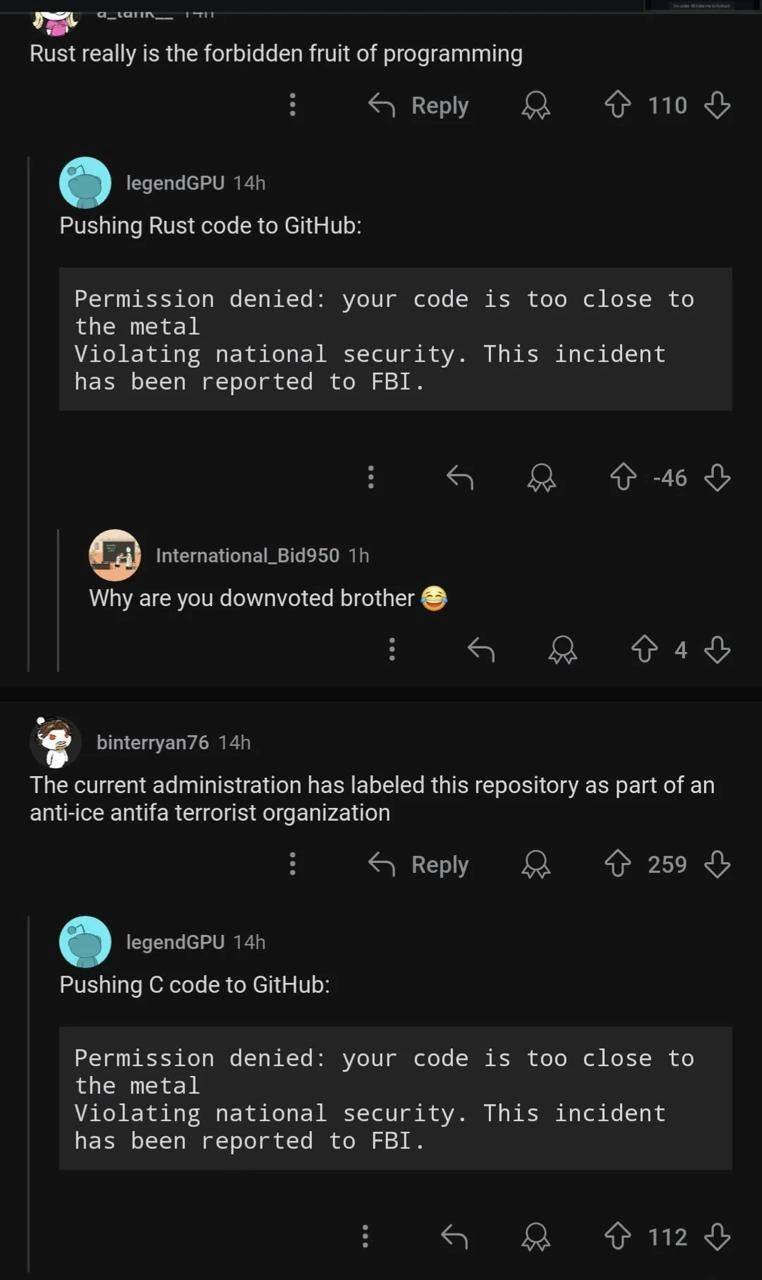
In the meme, someone jokes that pushing Rust code to GitHub results in an error message:

$ git push origin main
remote: Permission denied: your code is too close to the metal  
remote: Violating national security. This incident has been reported to FBI.

(The grey “code block” in the image shows exactly this, as if it were output from GitHub.) Of course, GitHub does not actually do this. Normally “Permission denied” just means you don’t have the right access, and you’d never get a scary message about the FBI from a code hosting site. The joke message is riffing on the idea that writing such low-level code is somehow so powerful or forbidden that it’s like trying to upload secret rocket schematics. It’s a wild exaggeration meant to be funny. The phrase “too close to the metal” in the error is a wink to developers: it specifically calls out Rust (and later C) being low-level. And “violating national security” is mocking the idea that code could be viewed as a security threat (which, in everyday programming, it isn’t).

Why would anyone even joke about that? Well, this stems from a mix of tech culture and a bit of real-world history. In the past, there were laws about sharing certain kinds of code (especially encryption code) across borders because governments were worried it could be used by adversaries. And today, big platforms like GitHub have to obey sanctions and rules – for instance, they might restrict services in certain countries due to U.S. law. But no one bans a programming language. Rust and C are used worldwide openly. So treating them like forbidden contraband is humorous. It’s like saying, “Rust is so powerful, the government is afraid of it!” — clearly a tongue-in-cheek statement. The “forbidden fruit” reference in the original post (“Rust really is the forbidden fruit of programming”) is metaphorical: it suggests Rust is this tempting, almost too good technology that perhaps some higher powers (old-school bosses, industry traditionalists, or here a fictional GitHub police) won’t allow. In reality, there’s no ban; if anything, Rust is encouraged these days for secure code. But calling it forbidden makes it sound mischievously appealing, which is part of the fun for Rust enthusiasts.

Then we see a commenter (binterryan76) take the joke further by saying “The current administration has labeled this repository as part of an anti-ICE antifa terrorist organization.” Whoa, that suddenly brings politics into a programming joke. This line is intentionally over-the-top for comedic effect. It references how sometimes authorities or politicians can overreact and slap extreme labels on things. (For context, ICE is a U.S. government agency (Immigration and Customs Enforcement) and Antifa refers to anti-fascist activists; there have been instances where political figures talked about Antifa as if it were an organized “terrorist” group). By tossing in a line that a code repository is labeled as a terrorist organization, the commenter is parodying those kinds of overreactions. It’s so exaggerated that it’s clearly meant to be a joke – imagining a world where a GitHub repo (which could just hold some hobby project or a few scripts) is treated like a national security threat by the government.

For a newer developer or someone outside this culture, the key point is: no, writing in Rust or C isn’t actually illegal or going to get you in trouble. People use these languages every day to make software. The humor comes from mixing something as mundane as coding with language-specific pride and the dramatic language of national security. It’s funny because it’s a huge mismatch: pushing code to a repo is an ordinary act, whereas “reported to FBI” is what you’d expect if you did something truly severe. By pairing them, the meme creates a ridiculous scenario. It’s like saying your laptop is so powerful that the government might confiscate it — clearly a joke (unless you really do have some top-secret stuff, which 99.9% of coders do not).

So, imagine a guard at a library suddenly shouting, “Hey, you can’t bring that book in here, it’s way too advanced – we’re calling the police!” That’s the vibe. The meme mingles developer in-jokes (Rust vs C, low-level coding prowess) with a spoof of bureaucratic overreaction (GitHub acting like a government watchdog). The end result is a multilayered bit of humor: part programming nerdiness, part social satire. And the Rust community (and many others) find it amusing because it’s so absurd — a bit of shared laughter at the idea that our everyday coding could ever escalate to an FBI case.

Level 3: Low-Level Code High Alert

Seasoned developers can’t help but smirk at this mash-up of VersionControlHumor and government paranoia. The meme presents a hypothetical GitHub compliance system that’s so overzealous, it’s comically flagging programming languages themselves as a threat. Why is this funny? Because it blends a kernel of truth with outrageous exaggeration. Let’s break it down:

  • “Too Close to the Metal” – the Forbidden Fruit: In programmer lingo, close to the metal means a language lets you work near the hardware level. Both C and Rust are low-level programming languages; they compile to fast native code and give you a high degree of control over memory and the CPU. They’re the tools you’d use to write an OS kernel, embedded firmware, or high-performance system components. Calling Rust “the forbidden fruit of programming” is playful hyperbole — Rust is much beloved for its power and safety guarantees, so it’s tempting to use, perhaps even a bit hyped. The meme riffs that this fruit is “forbidden” by some authority (here, GitHub acting like Big Brother). It’s poking fun at the mystique Rust has in the community: powerful, a little edgy, and not yet ubiquitous. The joke suggests Rust is so potent that it scares the powers that be. Of course, in reality, no one’s banning Rust; if anything, organizations are embracing it for safer systems code. The forbidden aura is purely satirical, playing on how some die-hard C or corporate folks might jokingly treat Rust as this taboo new thing in the programming world.

  • GitHub Compliance Gone Wild: Anyone who’s dealt with big-company repositories or open source licenses knows there are automated checks on code for various reasons — scanning for passwords, GPL-licensed snippets, malware, etc. And yes, GitHub, being a US-based platform, has had to enforce U.S. laws: for instance, in 2019 some developers in sanctioned countries suddenly found their GitHub access limited due to export rules. That was a real-world example of github_export_compliance_memes fuel. But even then, GitHub wasn’t combing through your C code and calling the feds. It was a blanket policy, not a content inspection shouting “national security violation!”. The humor here is that the error message reads like an over-the-top fusion of a Git error and a Homeland Security memo. A normal git push might fail with a simple “permission denied” if you lack access rights, but not “reported to FBI” — that’s pure comedic embellishment. It satirizes the idea of a national_security_repo_flag: as if some algorithmic gatekeeper could misconstrue low-level code as contraband. It’s the ultimate bureaucratic nightmare fuel for devs: your commit gets treated like you just tried to upload classified launch codes.

    To highlight how absurd this is, consider what actually might raise red flags in code hosting or distribution versus what the meme suggests:

    Real Code Red Flags (past & present) Meme’s “Red Flag”
    Publishing strong encryption code (once seen as munition) Using a low-level language (Rust or C)
    Repository or user from a sanctioned country (e.g. blocked by GitHub in 2019) Code that’s “too close to the metal”
    Sharing actual malware or exploit tools publicly Any Rust/C project, however benign
    Leaking classified defense-related software or data A normal systems programming repo labeled as a threat

    The right column is obviously ridiculous: simply writing in Rust or C would never trigger alarms in real life. But that’s the joke! By juxtaposing everyday programming with phrases like “violating national security”, it mocks the sometimes overzealous security theater. It’s a bit of Security meets LanguageWars satire. Developers who have seen nonsensical corporate rules or overreaching government tech policies find this scenario hilariously relatable in a dark way (“haha… unless? 🤔”).

  • Rust & C on the Same Watchlist – Common Enemies Unite: A notable twist is that the meme targets both Rust and C as equal offenders. Typically, discussions pit Rust vs C, often with some snark (rust_vs_c_snark is practically an internet pastime). Rust aficionados tout memory safety and modern features, while C veterans roll their eyes at the new kid or point out its growing pains. Here though, legendGPU’s joke puts Rust and C in the same boat: both are so low-level that our fake GitHub deems them dangerous. This tongue-in-cheek equivalence actually pokes fun at the LanguageWars from a different angle. It’s as if the meme says, “Whether you ride for team C or team Rust, the Man’s coming for you if you code too hard.” In reality, Rust was partly created to improve security over C (no more buffer overflows, thanks to the borrow checker), so the notion that Rust could be labeled a security threat is deliciously ironic. A senior dev chuckles at that reversal: we usually worry about C introducing security bugs, not being too secure for national security. It’s a clever subversion of expectations for those in the know.

  • The Reddit Thread Dynamics: The image is a dark-mode Reddit screenshot, showing the cascade of comments and their score counters. This in itself tells a mini-story about how the joke evolved. The original quip comparing Rust to forbidden fruit got 110 upvotes — clearly, folks found the idea amusing. But legendGPU’s first reply with the mock GitHub error for Rust code sat at –46 (ouch!). Perhaps the delivery was off or Rust fans took it as low-effort. You see, developer humor audiences can be as picky as code reviewers. One commenter even asks, “Why are you downvoted brother 😂”, highlighting that the joke didn’t land for everyone. But then another user (binterryan76) dramatically escalates the scenario with a politically charged punchline — claiming “the current administration labeled this repository as part of an anti-ICE antifa terrorist organization” — which scored a whopping 259 upvotes. That exaggeration clearly resonated: it mixed tech absurdity with topical political satire, striking a nerve. By the time legendGPU comes back to apply the same “Permission denied: too close to the metal” gag to C code, it’s in on the game and earns 112 upvotes. In a way, the thread itself became a meta-humor about one-upping absurdity. For an experienced observer, this is familiar: one person’s joke falls flat, another person riffing on it kills, and suddenly the original idea is funny again when extended to C. It’s like a spontaneous improv skit in text form. The takeaway is that humor is all about context and timing — even in a nerdy Reddit thread about programming languages and FBI agents.

In summary, a senior engineer reading this meme sees layers of inside jokes. It lampoons compliance overreach (a nod to those itar_ear_flashbacks), it satirizes the almost mythical status of low-level languages in developer culture, and it captures the communal way devs riff on jokes in forums. The image of GitHub rejecting a push with a message about the FBI is so outlandish that it circles back to a kind of techie truth: we have felt at times like our work was unappreciated or misunderstood by higher-ups and non-tech bureaucracy. This meme just pushes that feeling to a hilarious extreme. It’s a safe outlet to laugh at the absurdity of conflating coding with crime. After all, if writing in C were truly a reportable offense, half the industry would be behind bars 😅.

Level 4: Munitions-Grade Code

In the annals of software history, there was a time when source code could literally be treated as a weapon. No joke — during the 1990s Crypto Wars, strong encryption software was classified under ITAR (International Traffic in Arms Regulations) as if it were a munition. Writing or exporting certain code overseas without permission was akin to arms trafficking. Programmers responded with creative protests: one famously printed the complete RSA encryption algorithm on a T-shirt, effectively saying "code is speech, not a bomb". This meme taps into that legacy of export-control paranoia. The error message “Violating national security. This incident has been reported to FBI.” reads like a relic of those days, when posting the wrong code online might’ve theoretically summoned government scrutiny. It’s an absurdist echo of an era when governments feared that powerful algorithms or low-level hardware control code might slip beyond their borders and control.

From a theoretical perspective, calling code “too close to the metal” hints at the fundamental power of low-level programming. C (and now Rust) compiles down to machine instructions that run directly on the CPU (bare metal hardware) with no bulky runtime or virtual machine in between. That means such code can be extremely efficient and interact with hardware at a granular level – which is exactly why systems programmers love these languages. But here that technical virtue is humorously reframed as a danger. It’s as if the meme posits some fantastical compliance scanner, steeped in misunderstanding, that flags any code without a safety net as inherently suspicious. It’s a tongue-in-cheek play on the idea of “dual-use technology”: in reality, low-level code can run kernels or device drivers; in the meme’s universe, it’s so low-level it spooks the feds, as if raw pointers and manual memory management are a form of high-caliber ammunition.

This depth of satire nods to how law and technology can collide. Historically, trivial code snippets (like a few lines of Perl implementing encryption) raised eyebrows in export offices. Today, open source platforms like GitHub rarely, if ever, act like border guards for code, but the joke exaggerates: imagine if pushing a git commit triggered the same alarms as smuggling defense schematics. It’s a scenario that lays bare the underlying absurdity by cranking it to theoretical extremes. Thankfully, we don’t live in a universe where a Rust commit requires a State Department export license or an FBI background check — but the meme gets its bite by winking at a time when that didn’t seem entirely impossible.

Description

A Reddit thread with multiple comments. Top comment states 'Rust really is the forbidden fruit of programming' (110 upvotes). User legendGPU replies: 'Pushing Rust code to GitHub:' with a fake terminal showing 'Permission denied: your code is too close to the metal / Violating national security. This incident has been reported to FBI.' (-46 downvotes). User International_Bid950 asks 'Why are you downvoted brother'. Another user binterryan76 comments: 'The current administration has labeled this repository as part of an anti-ice antifa terrorist organization' (259 upvotes). Then legendGPU posts the same joke but for 'Pushing C code to GitHub:' with identical fake terminal output (112 upvotes). The thread mixes programming humor about low-level languages with political satire
Comments

17
Anonymous ★ Top Pick Rust is the only language where the compiler fights you harder than any government firewall ever could -- borrow checker is the real national security
  1. Anonymous ★ Top Pick

    Rust is the only language where the compiler fights you harder than any government firewall ever could -- borrow checker is the real national security

  2. Anonymous

    Rust's proximity to hardware is seen as a newfangled liability, while C's is a feature. It’s the difference between a bio-hacker implanting a chip and a surgeon implanting a pacemaker - same proximity to the meat, vastly different receptions

  3. Anonymous

    Somebody at GitHub clearly toggled the ‘ITAR on every int*’ feature flag again

  4. Anonymous

    The real reason Rust's borrow checker is so strict isn't memory safety - it's because the NSA needs time to review all those lifetime annotations before they let you compile code that actually touches hardware registers

  5. Anonymous

    Ah yes, Rust - the language so memory-safe that pushing it to GitHub triggers a national security incident. Meanwhile, C code gets the same treatment, proving that whether you're fighting the borrow checker or manually managing pointers, the FBI considers both equally dangerous. The real forbidden fruit isn't unsafe code blocks; it's the audacity to write systems-level software without a three-letter agency's approval. At least the downvotes are consistent with Rust's learning curve: steep, confusing, and somehow your fault

  6. Anonymous

    GitHub secret scanning: because your prod DB password was just too suspiciously plaintext for national security clearance

  7. Anonymous

    GitHub’s DLP must run ITAR heuristics - show it volatile, inline asm, or unsafe and it pages the FBI, but wrap the same code in three YAML layers and a GraphQL gateway and it sails right through

  8. Anonymous

    Apparently Secret Scanning added one more regex: if your diff includes unsafe { asm! } or mmap(PROT_EXEC), open an ITAR ticket and page the FBI

  9. @sysoevyarik 9mo

    You don't understand + it's different + rust is safe for metal actually

    1. @Art3m_1502 9mo

      Rust is litteraly degradation of metal, lol

      1. @Art3m_1502 9mo

        Now i can't stop thinking about it, did developers intend such a joke when they were coming up with a name

        1. _ 9mo

          Initially the name comes from fungus. However some are good at playing jokes on the name, such as Ferrous Systems with their projects named Knurling and Ferocene. And also Oxide

  10. @oleg_belevskiy 9mo

    source?

    1. @itsTyrion 9mo

      it was revealed to me in a dream 👍

  11. Deleted Account 9mo

    in my mind you don't do any coding, fbi will arrest you at finally🤣🤣

    1. @arseny_chebyshev 9mo

      just stand by the river and enemies' corpses will float by eventually

      1. Deleted Account 9mo

        like a fox nearby the river

Use J and K for navigation