Dune Bene Gesserit Meme: Breeding Rust Developers Through Tylenol
Why is this Languages meme funny?
Level 1: Magic Baby Potion
Imagine a mom really wants her future kid to be a superstar — say a great musician. So every night while the baby is still in her belly, she plays Mozart and Beethoven, hoping the music will magically turn the baby into a musical genius. She even pictures herself as the proud parent of the next Mozart, maybe feeling like she’s part of a fairytale prophecy. In reality, playing a bit of music is nice, but it isn’t some guaranteed magic trick to create a prodigy.
This meme is just like that, but with coding. It’s joking that a mom takes a special pill (just ordinary Tylenol, a pain medicine) while she’s pregnant, thinking it will make her baby boy grow up to be a Rust programmer (Rust is a programming language). She sees herself as if she’s in a sci-fi movie, doing a heroic ritual to create the chosen “coding savior.” It’s funny because it’s an extreme, silly exaggeration. We all know a pill can’t actually make your kid a coding wizard, just like one piano song won’t ensure a baby becomes Mozart. But it’s poking fun at the idea of wanting your kid to be the best at something so badly that you act like it’s part of some grand destiny. The contrast between the ordinary thing she’s doing (taking medicine) and the epic way she imagines it (like a magic potion for a future coding hero) is what makes it silly and fun.
Level 2: Raising a Rustacean
Let’s break down what’s going on in simpler terms. This meme comes from dev Twitter (the community of developers on Twitter who often share jokes, opinions, and memes about coding). It shows a tweet about a woman (an “e-girl”) who supposedly takes Tylenol while she’s pregnant because she believes it will make her future son a Rust developer. The joke is that she pictures herself like a character in a grand sci-fi movie doing something epic, when in reality she’s just taking a common painkiller.
Rust here refers to Rust the programming language, not the metal turning orange. Rust is a relatively new systems programming language that a lot of programmers love because it’s designed to be safe (it helps prevent bugs like crashes or security issues) and fast. People who write code in Rust even call themselves Rustaceans (a fun nickname that sounds like “crustacean,” since Rust’s mascot is a crab). Rust has a bit of a reputation: it’s considered difficult but rewarding, and its fans are very enthusiastic about it. They often claim Rust is the future and better than older languages like C or C++. This sometimes comes across as elitism, like “Rust is the elite language for true experts.”
On the other side, an “e-girl” is internet slang for a girl (often a young woman) who has a popular online persona. The term started in gaming circles, but on tech Twitter you might see it used playfully for women in tech who are active on social media. It can carry a stereotype of someone who seeks attention online (with selfies, trendy posts, etc.), but here it’s used in a humorous, self-aware way. So imagine a tech-savvy young woman on Twitter who wants to show she’s so into tech culture that she’s even planning her baby’s programming language. It’s an absurd exaggeration, of course.
Now, why Tylenol? Tylenol is a brand of a common over-the-counter pain medicine (acetaminophen). In reality, taking Tylenol during pregnancy is usually for headaches or pain relief – it has no effect on making your kid good at coding! 😅 That’s exactly the joke: taking a pain pill won’t magically create a coding genius, but in the meme, these fictional “e-girls” think it will make their baby a natural Rust programmer. It’s making fun of a magical-thinking idea. (There have been quirky discussions on the internet about weird things affecting babies in utero, but here it’s deliberately nonsensical for humor.)
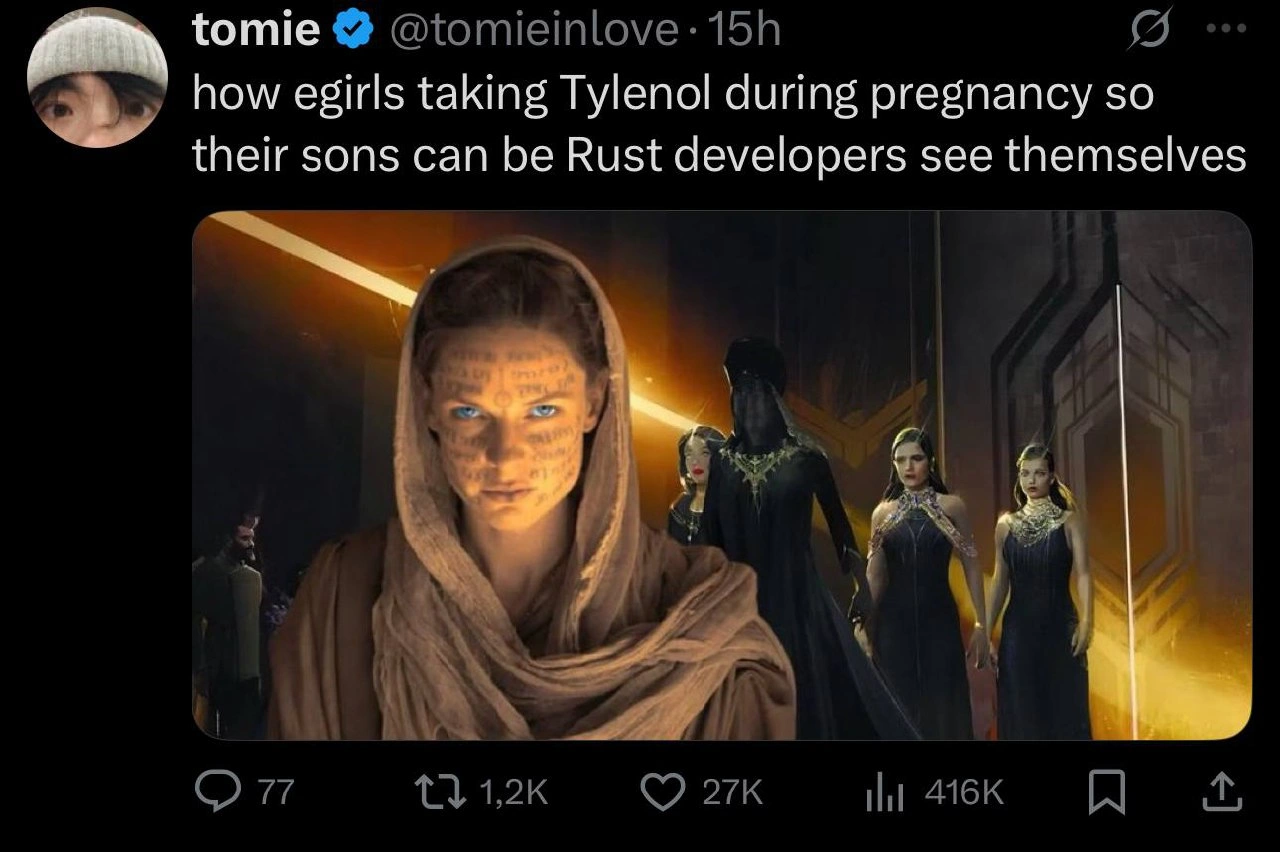
The tweet says “how they see themselves.” That’s key to the joke: it means the meme is about their self-image. The picture beneath shows a woman in robes with glowing eyes, like a powerful priestess or a mother of a messiah in a sci-fi story. She’s flanked by regal, ominous figures. This is how these Tylenol-taking, Rust-loving moms supposedly imagine themselves – as part of some heroic prophecy to bring forth the next great Rust coder into the world. In reality, of course, they’re just regular people doing something mundane. This contrast is what makes it funny. It’s like saying, “She thinks taking a pill is as epic as a scene from Star Wars or Dune where the chosen one is foretold.”
The phrase “dependency injection” in the title is a pun. In programming, dependency injection is a technique where you supply an object with the things it needs (its dependencies) from the outside. For example, instead of a class creating its own database connection, you inject a database connection into it. It’s a good practice in code design. But here “prenatal dependency injection” jokingly refers to literally injecting something into a pregnancy – as if the Tylenol is a dependency being given to the fetus (the future programmer) to ensure he has what he needs (apparently, the Rust gene 😆). It’s a geeky play on words bridging a coding term with pregnancy.
This meme falls into the category of programming language humor. In the developer community, there’s something often called the language wars – basically, endless debates over which programming language is best. People can get surprisingly passionate or tribal about their favorite language. Here we see a light-hearted jab at that: the idea that someone loves a language (Rust) so much that they want their child to be born into it, almost like joining a prestigious clan. It’s making fun of Rust’s hype specifically, but you could imagine similar jokes for other languages too. It’s all part of tech humor on the internet, where insiders poke fun at their own obsessions. Dev Twitter lore is full of these kinds of over-the-top memes that both celebrate and satirize the quirks of programming culture.
Level 3: Prenatal Dependency Injection
The meme presents a tongue-in-cheek prophecy about Rust developers, wrapped in over-the-top sci-fi imagery. It’s a screenshot of a tweet that says:
“how e-girls taking Tylenol during pregnancy so their sons can be Rust developers see themselves”
Accompanying this text is a dramatic mash-up image: a hooded woman with glowing blue eyes and mystical script on her face stands front and center, flanked by four dark, elegant figures with gold trim. The scene screams “messianic prophecy from a space opera” – think Dune’s Bene Gesserit plotting to birth the chosen one. In other words, the tweet jokingly claims that certain tech-savvy women (the “e-girls” of Twitter) imagine they are grand sorceresses of coding destiny just because they pop a Tylenol pill while pregnant to ensure their unborn sons will become Rust programmers. It’s a hilariously absurd mix of programming language elitism and faux-mystical prenatal optimization.
Why is this funny to experienced devs? It’s poking fun at the almost cultish reverence around the Rust programming language in some corners of the tech community. Rust has a reputation for memory safety and performance – no segfaults, no data races, “fearless concurrency” thanks to its strict compiler checks. It’s beloved (often loudly on Twitter) as a language for serious programmers, the supposed future of systems programming. This meme exaggerates that reverence to the point of satire: imagine believing you can imbue a baby with Rust skills in utero, as if coding talent were a hereditary superpower unlocked by the right prenatal ritual! It’s basically saying, “Look how ridiculous it is to treat Rust mastery as a prophesied genetic destiny.”
The phrase “dependency injection” in the title is a clever play on words. In software, Dependency Injection is a design pattern where an object’s required components (dependencies) are provided from the outside, instead of the object instantiating them itself – it’s meant to promote modular, testable code. Here, the mom is literally “injecting” a dependency (the drug Tylenol) during pregnancy, as if that’s an inversion-of-control container for baby’s future coding ability. It’s a pun marrying coding terminology with a real-world action. This direct literalization of a coding concept is humorous to those who know the jargon: we usually talk about injecting a logging service or database connector into a class, not a pill into a fetus! The meme is essentially mocking prenatal dependency injection as a farcical method of prenatal optimization – a riff on the classic adage “premature optimization is the root of all evil.” Well, this scenario is so premature it’s prenatal! 🤣 (Even Donald Knuth might chuckle at how premature this optimization is.)
On a deeper level, the joke taps into the idea of Rust developer elitism on social media. Rust’s community (proudly called Rustaceans) sometimes displays a bit of a superiority complex – many Rust aficionados on Twitter playfully (or earnestly) portray Rust as the one true path to systems programming enlightenment. We’ve all seen those language wars: one camp hails Rust as a flawless Messiah of performance and safety, while another camp might idolize C++ for its control or Python for its simplicity, etc. This meme lampoons that culture by blending it with the trope of a chosen one. The “e-girl” in the tweet is cast as a devotee performing a sacred duty (taking Tylenol) to guarantee her child is born into Rust greatness – as if Rust expertise were preordained greatness like being the Kwisatz Haderach of coding. The robed woman with text on her face in the image looks like a high priestess of a coding cult, and the dark-clad figures behind her could be her council of devotees. It’s both a send-up of Rust evangelism and a self-own for the community: yes, we Rust fans can be a tad dramatic about how life-changing our language is.
The tweet’s popularity (tens of thousands of likes, etc.) shows how many in the developer community found this relatable. It’s an inside joke acknowledging an absurd reality: on Dev Twitter, some folks really do act like using the right programming language will make you (or your offspring) inherently superior. By exaggerating that mindset to a ridiculous extreme – literally medicating for a future Rust career – the meme highlights the folly in a fun way. It resonates with senior developers who’ve lived through endless language wars and seen each “Next Big Language” inspire almost religious fervor. Today it’s Rust; yesterday it was maybe Go or Lisp or C++ – every generation has its “golden child” language and its zealous advocates. This meme winks at those in the know: we’ve seen this before, and it’s both hilarious and a little crazy.
In summary, at the senior level, this meme humorously dissects tech internet culture and programming language identity. It merges a space-opera level of drama with everyday developer hubris. The core joke being: “Some people act like having a Rust programmer son is so elite that they’d mythologize even a Tylenol as a holy sacrament to achieve it.” For the battle-scarred dev who’s watched language hype cycles come and go, the satire is both sharp and comically on point.
Description
A screenshot of a tweet from tomie (@tomieinlove) posted 15h ago with the text: 'how egirls taking Tylenol during pregnancy so their sons can be Rust developers see themselves'. The attached image shows characters from Dune (the Bene Gesserit sisterhood) -- women in robes with inscriptions on their faces, referencing the Bene Gesserit breeding program that spans generations to produce the Kwisatz Haderach. The joke compares this multigenerational eugenics program to the meme that taking Tylenol/acetaminophen during pregnancy produces neurodivergent children, and that Rust developers are the end result of such a 'breeding program.' The post has 77 comments, 1.2K retweets, 27K likes, and 416K views
Comments
22Comment deleted
The Bene Gesserit spent 10,000 years breeding the Kwisatz Haderach; Rust developers spent 10,000 hours fighting the borrow checker. Same energy, different lifetimes
The Bene Gesserit have their Gom Jabbar for testing humanity. The Rust community has the borrow checker. The failure mode is the same: immense pain
Finally, a compile-time guarantee that your offspring will never dereference null - just add acetaminophen as a prenatal dependency
Just like Paul Atreides needed the spice melange to see all possible futures, Rust developers need the borrow checker to see all possible memory violations - and both groups are absolutely insufferable about their newfound enlightenment at dinner parties
Rust developers don't just write memory-safe code - they see the entire borrow checker timeline simultaneously, like prescient Fremen navigating the desert of undefined behavior. While C++ devs are still fighting segfaults in the deep desert, Rust developers have already calculated every possible lifetime annotation across all possible futures. The spice must flow, but only with zero-cost abstractions and compile-time guarantees
We swapped C++ footguns for Rust footnotes - the borrow checker now drafts half the postmortem before the incident hits PagerDuty
Moms pop Tylenol for the birth pangs; Rust teaches lifetimes the hard way - no dangling futures allowed
Rust’s borrow checker is basically the Bene Gesserit of compilers - whispering “thou shalt not alias” while product still estimates the rewrite at two sprints
Asperger's won't compensate for the inherited intelligence. Comment deleted
ASD doesn't increase intelligence though Comment deleted
Is there some myth about the effects of paracetamol during pregnancy? 🤔 Comment deleted
iirc Tylenol and paracetamol are different things, but yeah, there were suspicions about Tylenol for quite some time, article from 2013(specifically asked google not to show up any articles from 2025): https://www.reuters.com/article/business/healthcare-pharmaceuticals/too-much-tylenol-in-pregnancy-could-affect-development-idUSBRE9AL15M/ Comment deleted
It's literally just C8H9NO2 in both cases Comment deleted
nit: then there are like 4 variations of that formula, depending on the positioning of no2. But I put my trust in Google Summary Comment deleted
could even contain a hexagon Comment deleted
Then there would be less hydrogens, I think Comment deleted
it does tho Comment deleted
I thought it's all just a marketing BS.. Comment deleted
me when i bend NO2 10 degrees to the right to make it legally distinct Comment deleted
Actually, there are a ton of variations. If it is C8H9, means that you have C(4,7) to position double-carbon bonds, you have for each of those 4 to 8 ways to position an NO2, and I am too lazy to properly calculate Comment deleted
And you know what? Actual paracetamol formula doesn't have NO2 as a single atom, but they are spread in 3 different places! Comment deleted
N atom, O atom and 2 atom Comment deleted