Server Rack with Hidden Mini Fridge Full of Beer Bottles
Why is this Infrastructure meme funny?
Level 1: Secret Beer Fridge
Imagine you see a big, important-looking box in an office that has lots of blinking lights and wires. It looks like something that runs the internet or some supercomputer – very serious and off-limits. But then someone opens it up, and surprise! Inside there’s actually a little refrigerator with cold drinks (in this case, bottles of beer) instead of computer stuff. It’s like finding out your teacher’s thick textbook is hollowed out and filled with candy.
This funny picture is doing exactly that: it’s a secret beer fridge disguised as a server. On the outside, it tricks people into thinking “Oh, that’s just technical equipment doing its job.” But on the inside it’s really just keeping beverages cold for the office folks. It’s hilarious because it mixes something very work-related (a server rack for computers) with something very not-work-related (having a drink and relaxing). It shows that even in a super high-tech environment, people still find playful ways to enjoy themselves. In simple terms, the engineers built a hiding spot for their drinks that blends in with their work gear, so they can say, “Hey, we’ve got high-tech needs… like keeping our beer cold!” It’s a silly, creative surprise that makes people laugh when they see what’s really going on.
Level 2: Fake Switch, Real Fridge 101
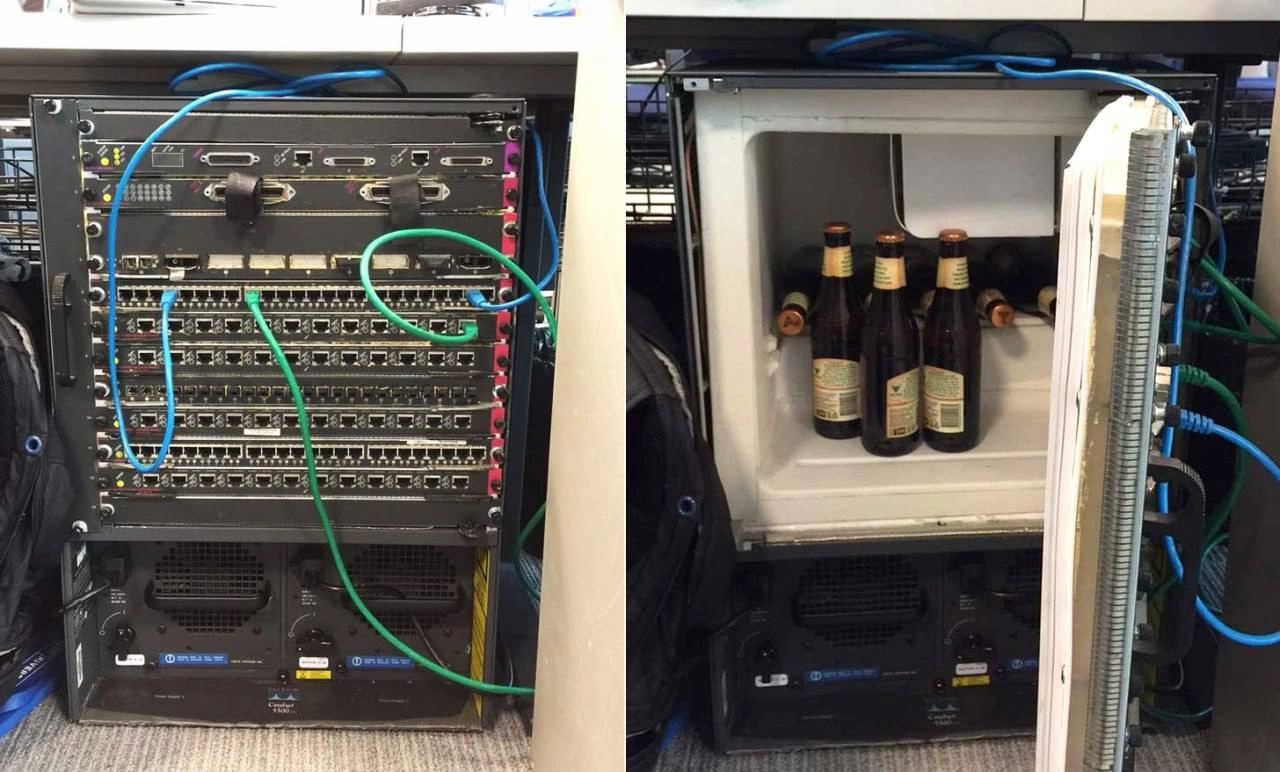
Let’s break down what’s happening here in simpler terms. On the left, we see what looks like a typical server rack sitting under an office desk. A server rack is basically a metal cabinet standardized at 19 inches wide, designed to hold and organize computer equipment like servers, switches, and power units. In this rack, the front is filled with something that resembles a bunch of network switches – you can see rows of small rectangular jacks that are actually Ethernet ports (for plugging in network cables). The label even says Cisco Catalyst 6500, which is a famous model of big network switch used in large companies. Normally, a Catalyst 6500 chassis would contain multiple blades or modules that route network traffic for potentially hundreds of computers. Those RJ-45 ports and the green/blue cables plugged into them are exactly what you'd expect to see in a busy network closet, connecting office computers and servers together. The two large units at the bottom with fans and blue stickers are power supplies – on real hardware they provide electricity and cooling to the device. All the blinking lights and cables make it look like this rack is hard at work directing data and keeping the company online.
Now, the right image shows the surprise: the whole front panel of that rack actually swings open like a door, and behind it is a mini-fridge interior with several bottles of beer. In other words, what we thought was a stack of networking gear is actually a cleverly disguised refrigerator. The Ethernet cables hanging out are just for show; they likely don’t connect to anything important (maybe they’re plugged into the panel itself or a dummy hub). The switch panels themselves could be old or non-functional parts arranged to form a convincing cover. This is why the description calls it a "facade" – it’s a fake front. Someone basically took a small fridge and dressed it up to look exactly like a serious piece of IT equipment. Until you open it, you’d have no idea it’s not real network hardware.
So why would anyone do this? First, it’s funny! This joke plays on the contrast between the expectation and the reality. In an office, a server rack full of Cisco gear signals “don’t mess with this, it’s important infrastructure.” Hiding beer inside it is a sly way to have a personal perk (cold drinks at your desk) without it being obvious or frowned upon. It’s like hiding candy in a textbook – on the outside it’s work, inside it’s treats. Tech folks often enjoy this kind of humor because it mixes work with play in a creative way.
There’s also a reference to high-availability and reliability concepts. High-availability (often shortened to HA) is a term from IT that means a system is designed to be up and running nearly all the time, often 99.999% of the time in critical systems. They achieve that by having backup components and redundancy. The meme’s title jokingly calls this a “high-availability beer fridge,” suggesting that the fridge is always on and always stocked, ready to serve a drink without fail. Of course, a beer fridge doesn’t need five-nines reliability, but framing it that way exaggerates the joke. It humorously implies the fridge has redundant beer or backup cooling just like a serious server would have backup drives or power supplies. It’s taking a very important-sounding tech concept and applying it to something as routine as keeping beverages cold.
Now, consider the culture aspect: DevOps and SRE (Site Reliability Engineering) roles often come with stressful on-call duties. Being on-call means if something breaks after hours – say the website goes down at midnight – you get paged and must jump in to fix it. People in these roles sometimes cope with long nights and high pressure using a bit of humor and, yes, occasionally a beer when the work is finally done (perhaps after the issue is resolved, not during!). By placing a beer fridge right in the fake server rack, the team is nodding to that experience. It’s like saying, “When the going gets tough, the tough have refreshments close by.” The post even came on a Friday with a cheerful weekend wish, which fits because Fridays in IT are often when you try not to make any big changes. Many teams have a tradition of a small celebration on Friday evening if the week went well – sometimes called "beer o'clock". This hidden fridge would be perfect for that: finish your tasks, then pop open the rack and grab a cold one to kick off the weekend. It’s humorously blending the end-of-week relaxation with the very equipment that can cause stress during the week.
Another technical twist here is about cooling. Server racks and network switches generate a lot of heat and need cooling fans or even entire air conditioning systems to keep them from overheating. A refrigerator works on a similar principle of moving heat out to keep the inside cold. By turning a server rack into a fridge, they’re kind of repurposing the idea of a cooling system. Of course, a real Cisco switch doesn’t actually refrigerate like a fridge does – it just has fans. But the visual of big fans and vents at the bottom of the rack (where the power supplies are) sells the idea that this “device” manages heat. The joke is subtly pointing out that we usually expend all this energy to cool our machines, but here we are cooling our drinks using what looks like the same apparatus. It’s a fun little technical irony: the coolest thing in this server rack isn’t a high-tech feature, it’s literally the beer.
Overall, this meme is a lighthearted mashup of IT life and personal comfort. It explains itself without words: serious front, party inside. For a junior developer or someone new to IT, the takeaway is that tech culture often involves these inside jokes — mixing the uber-serious world of servers and uptime with human quirks and humor. Even as we build and maintain complex systems, there’s a shared understanding that at the end of the day (or week), we’re all human and enjoy a good laugh and a cold drink. This rack fridge is just an exaggerated, tongue-in-cheek example of that principle.
Level 3: Liquid Cooling Done Right
In classic DevOps SRE fashion, this scene shows a clever twist: a seemingly high-tech piece of infrastructure is actually a hidden beer stash. The left image looks like a serious network cabinet with what appears to be a Cisco Catalyst 6500 chassis – a once top-of-the-line enterprise switch loaded with rows of RJ-45 Ethernet ports, blinking status LEDs, and even dual power supply units at the bottom. It’s the kind of heavy-duty networking gear you'd find humming in a data center, built with redundant components for extreme uptime on mission-critical traffic. But the right image reveals the punchline: that imposing front panel swings open to expose a mini-fridge stocked with beer bottles. In other words, the entire "server rack" is a façade – a decoy door hiding a fridge under the desk. This elaborate front is a tongue-in-cheek covert refreshment strategy. The ops team literally optimized for the wrong workload on purpose – harnessing rack space and cooling not to run servers, but to chill brews.
For seasoned sysadmins, the humor cuts deep. We've all seen ridiculously overpowered setups or wasted hardware sitting around. Here that trope is flipped into a joke: if you're going to overspend on hardware, might as well use it to keep the team happy. The meme’s title calls it a “high-availability beer fridge,” poking fun at the grand terms we use for enterprise architecture. Normally high availability means no single point of failure, with backup systems on standby to take over if one fails. Applying that to a beer fridge suggests a kind of redundant refreshment supply – if one bottle is consumed, another cold one seamlessly takes its place in the rotation. It's absurdly glorifying a trivial office perk with the same language we’d use for a critical database cluster. And honestly, this might be the one cluster that never goes down: a fault-tolerant happy hour system.
Look at the meticulous detail put into the illusion. The faux rack is populated with actual switch blades or at least the front panels of them. Those green and blue patch cables snaking across the front? They’re purely cosmetic, a bit of cable_management_irony. In real life, network engineers fuss over tidy cable management and making sure every connection has a purpose. Here, the cables are glorified decoration – plugged in just to sell the ruse that this fridge is legit network gear. It’s like cosplay for hardware: the RJ-45 cords and blinking lights dress up the fridge as a working switch, even though none of those ports actually route any data. The result is almost art: a fridge masquerading as a piece of a desk-side data center. This is basically an on-premises morale microservice – a dedicated appliance delivering 24/7 refreshment-as-a-service. Under the desk sits what looks like a mini data center, but its uptime SLA is measured in cold beers. Now that’s an innovative service deployment!
There’s an undercurrent of office satire here about CorporateCulture and priorities. Tech companies often tout fun office perks and fancy equipment, but here the admins took matters (and bottles) into their own hands. When you're the one carrying the pager for OnCall_ProductionIssues, you learn to prepare for long nights. Picture an operator at 3 AM, VPNed in to troubleshoot a network outage, exhausted – what’s their saving grace? This fridge, quietly whirring behind a fake Catalyst front, offering a liquid pep talk. It's a playful embodiment of that dark-humor mantra: "I’m into distributed systems – distributing caffeine by day and beer by night." The cooling system trade-off here is symbolic: either cool the overheating routers, or cool the overheated engineers. Why not both? The fridge repurposes the idea of rack cooling for human cooling. After all, if the servers are stable and cool, the humans running them deserve to be cool and stable too (with a chilled beverage in hand).
In fact, the poster’s message “Happy Friday and have a great weekend!” is a wink to IT folks everywhere. In ops culture, Friday is traditionally the day you avoid deploying anything risky – no one wants a surprise outage ruining their weekend. So instead of pushing new code, teams might push open a beer. By unveiling this secret fridge on a Friday, the team implies, “We survived the week without any Sev-1 fires, time to relax.” It’s a light-hearted alternative to the dreaded Friday deployment – the only thing going live is a round of drinks. The whole setup acknowledges that sometimes the best stress test is seeing how fast a cold one disappears when work is done.
In short, this meme resonates with anyone who's spent time in a server room or faced down an overnight incident. It’s an ode to creative problem-solving and a jab at misallocated resources. Only in tech would someone think to containerize their beer by stuffing it in a network rack chassis! And ironically, this might be the one piece of office infrastructure that never triggers a 2 AM PagerDuty alert – unless, of course, it’s empty. 🍺
Description
A two-panel photo showing a server rack setup. The left panel shows a standard network rack with Cisco Catalyst switches, multiple network modules, and tangled blue and green ethernet cables. The right panel reveals a surprise: a mini fridge hidden within the rack enclosure, stocked with beer bottles, with the same blue ethernet cables running over and around it. The juxtaposition captures the classic sysadmin/network engineer lifestyle of keeping alcohol close to the infrastructure they maintain, a nod to the stress of on-call duties and production firefighting
Comments
10Comment deleted
The real reason for the 'cooling requirements' in the server room budget request. Beer-cooled infrastructure: maintaining both uptime and morale since 1995
We call this our 'root beer' server. It's essential for maintaining core developer services, especially during peak outage hours on a Friday afternoon
Finally achieved five-nines of chilled uptime - because the only clustering that really matters after a 3 a.m. incident is bottles per shelf
Finally found a use case where 'high availability' and 'proper aging' are equally important architectural requirements - though explaining the wine's failover strategy during the next SOC 2 audit might require some creative documentation
When the VP asks why you need another 4U of rack space and you explain it's for 'critical cooling infrastructure to prevent thermal incidents during extended maintenance windows' - technically not wrong, just optimizing for engineer uptime rather than system uptime. This is what happens when you apply the same capacity planning rigor to beer storage as you do to your Kubernetes clusters. The real question is whether this counts as infrastructure-as-code or infrastructure-as-cold
Turns out our cold standby is literal - RTO 5 minutes, RPO six bottles
Rack space ROI redefined: 10Gbps throughput vs infinite cold ones per outage
We migrated to on‑prem cold storage - a rack‑mount beverage cluster on VLAN 42; MTTR dropped, the SOC2 auditor didn’t
We need a link to buy that fridge 😂 Comment deleted
"The chief entered the chat" Comment deleted