Skip to content
DevMeme
5935 of 7435
Rust Developers Passing Judgment on the C Language
Languages Post #6499, on Jan 6, 2025 in TG

Rust Developers Passing Judgment on the C Language

Why is this Languages meme funny?

Level 1: Banning the Dangerous Toy

Imagine you have a very old toy that lots of people have been playing with for years. It’s really effective at what it does, but there’s a catch: if you’re not super careful, that toy can hurt you. Now, a new toy comes along that does the same job but has special safety features so you won’t get hurt by accident. In this meme’s story, the people who love the new safe toy (the Rust folks) are like a strict judge in a courtroom, and the old dangerous toy (the C language) is like a culprit on trial. The judge decides the old toy is just too dangerous to be allowed anymore – effectively saying “let’s get rid of it forever.” This is shown in a funny, over-the-top way: the judge literally sentences the old toy to death! Of course, in real life we don’t execute toys or programming languages, but this exaggeration helps us feel the frustration behind the joke. It’s like when a teacher or parent finally says, “That’s enough! We’re throwing this faulty thing out so no one gets hurt again.” The meme is funny because it takes a technical argument – that the C programming language can lead to bad accidents (bugs and security problems) and the Rust language is safer – and turns it into a dramatic play-act. Everyone can understand the basic feeling here: if something keeps causing trouble, and you have a safer alternative, you might jokingly say “we should just ban the old one!” The cartoon just pushes that idea to an extreme in a courtroom setting. So the simple story is: a new, safer tool is telling an old, riskier tool, “Sorry, you’ve caused too much trouble. We can’t trust you anymore.” It’s playful and a bit dark, but it highlights how much people care about making things safe and reliable – whether it’s toys, tools, or in this case, the code that runs our computers.

Level 2: Memory Safety 101

Let’s break down the basics behind this courtroom gag. C is one of the oldest and most widely-used programming languages (part of the CFamilyLanguages group, which includes C++ and others). It’s powerful and fast, but it makes the programmer responsible for managing memory. This means when you use C, you have to manually handle things like allocating memory for data and freeing it when you’re done. If you make a mistake – say you write past the end of an array or use memory after giving it back (freeing) – you’ve invoked what we call undefined behavior. Undefined behavior is a fancy term meaning “the rules don’t define what happens now,” which in practical terms often means a program crash (like the dreaded segmentation fault) or a security hole an attacker could exploit. These kinds of mistakes are commonly called memory errors or memory safety bugs, and they’re a big source of security vulnerabilities in software. Think of notorious bugs where hackers could take over a system due to a simple coding error – many of those are because of memory unsafety in C or C++.

Now enter Rust. Rust is a newer systems programming language that aims to give you the speed and low-level control of C, but with guarantees that your code is memory-safe by default. Rust accomplishes this with a strict set of rules enforced by its compiler (the part of the toolchain that turns your code into machine code). One core component is its borrow checker, which checks that references to memory (pointers, essentially) don’t outlive the data they point to, and that you don’t have two active references modifying the same data in conflicting ways. In simpler terms, Rust won’t even compile your program if you try to do something that could lead to the kind of nasty memory bugs that are common in C. You don’t manually free memory in Rust; it uses a mechanism called ownership with scopes – when a variable goes out of scope, Rust automatically frees it, and the compiler makes sure you didn’t keep any “dangling” pointers to it. This prevents things like use-after-free. It also inserts runtime checks for things like array bounds, so if you try to access element 10 of a 5-length array, Rust will stop the program with a clear error instead of silently corrupting memory.

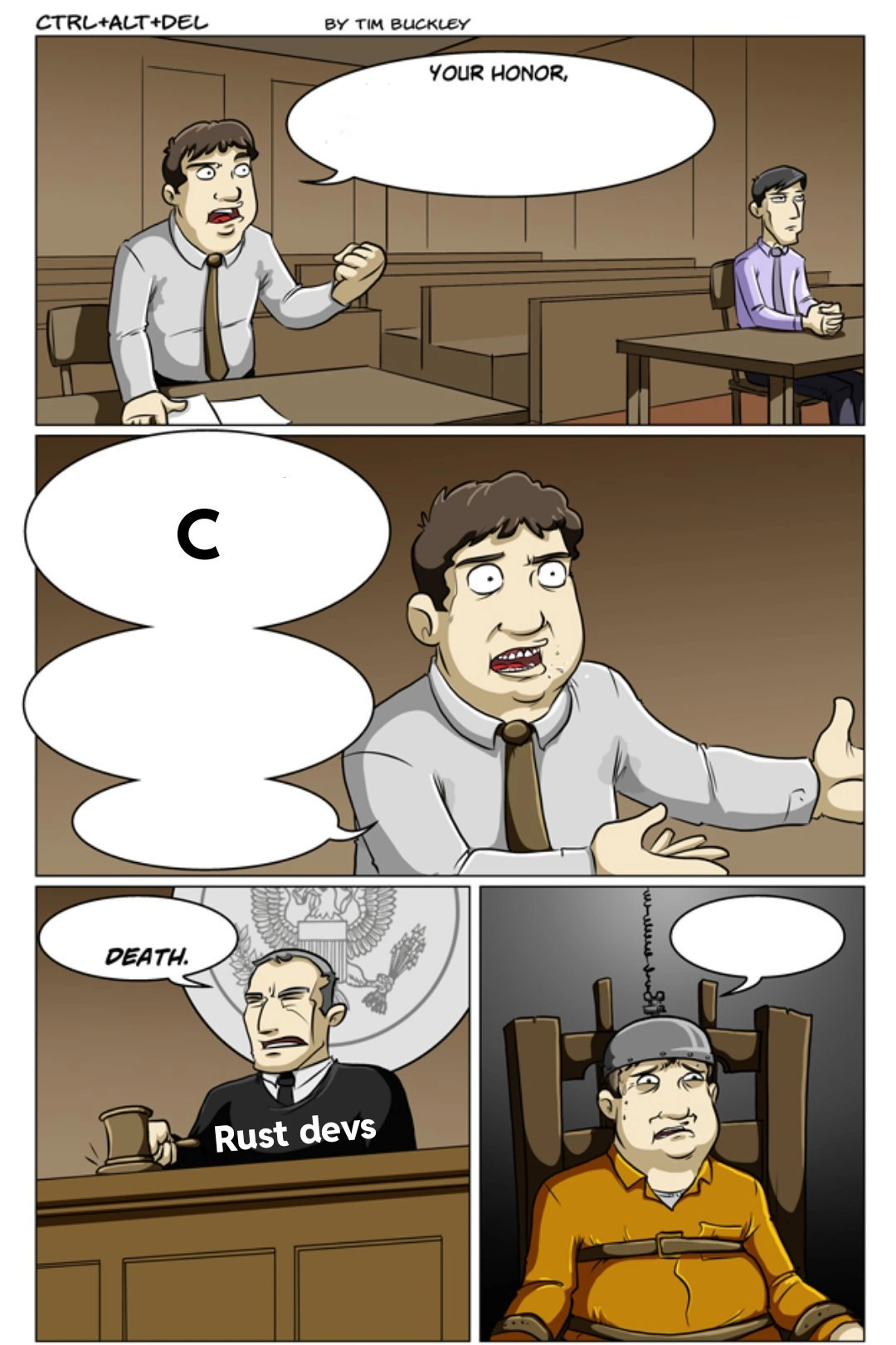
Let’s connect this to the comic’s panels and the humor. The setting is a courtroom, implying a serious judgment is about to happen. The defense lawyer in Panel 1 and 2 is literally speaking for C (the speech bubble just has “C” in bold). This represents someone trying to defend the C language, perhaps listing its merits: efficiency, ubiquity, all the great software written in it. But the judge – labeled “Rust devs” (meaning the Rust developer community or a Rust advocate) – immediately responds with “DEATH.” That’s an extreme, exaggerated reaction, which is why it’s funny. It’s poking fun at how some Rust proponents have zero tolerance for using C in new projects, because of the potential for errors. Panel 4 shows C as a person in an orange jumpsuit on the electric chair – a dark comic visual saying “we’re going to execute C for its crimes.” What crimes are those? Primarily, memory safety violations: things like buffer overflows (writing more data into a buffer than it can hold, which can overwrite other data and cause crashes or hacks) and null-pointer dereferences (trying to use a pointer that isn’t pointing to anything valid, causing a crash). C has a long history of such issues. In fact, a lot of Security vulnerabilities over the past decades stem from these kinds of mistakes in C code.

Rust devs, on the other hand, champion a world where those bugs just can’t happen (or at least are much harder to introduce). This comic exaggerates that mindset by showing the Rust side literally condemning C to death. It’s a joke about the fervor of rust_vs_c discussions. In reality, no one can “kill” a programming language – C is still very much alive and needed, especially in low-level domains like operating system kernels, embedded systems, or legacy codebases. But the meme humorously imagines if Rust developers had their way in a LanguageWars court. The label “Rust devs” on the judge’s bench hints that it’s the collective voice of Rust enthusiasts delivering the verdict. It’s a playful jab at how insistent they can be that “C must go” for the sake of safer software. And to be fair, they have a point about safety! But the humor lies in the over-the-top delivery: a death sentence.

To a junior developer or someone new to this debate, here’s a quick analogy in code form. In C, you might do something like:

// C code: manually managing memory and making a mistake
#include <stdio.h>
#include <stdlib.h>
#include <string.h>

int main() {
    char *name = malloc(5);           // allocate 5 bytes
    strcpy(name, "Rusty");            // copy 6 bytes ("Rusty\0") into 5 bytes! Oops
    printf("Name: %s\n", name);       // undefined behavior: we wrote out of bounds
    free(name);
    return 0;
}

This C code compiles fine, but it has a buffer overflow (writing "Rusty" which is 6 characters including the terminating \0, into a 5-byte buffer). This is a memory safety bug – the program might crash or print garbled data, or an attacker could exploit it in a worst-case scenario. There’s nothing in the C language to stop you from making this mistake; the programmer has to be careful (or use external tools/tests) to catch it.

Now, in Rust, a comparable task might be:

// Rust code: memory is handled safely
fn main() {
    let name = String::from("Rusty"); 
    println!("Name: {}", name);
}

Here, Rust automatically takes care of allocating enough memory for the string “Rusty”. If we tried something that would overflow a buffer or go out of bounds, Rust would either refuse to compile it or panic at runtime with an error message rather than silently corrupting memory. For example, if you tried to do something like:

let arr = [1, 2, 3];
println!("{}", arr[5]); // This will panic at runtime with "index out of bounds"

Rust will catch this error – it won’t let you just read random memory beyond the array. In fact, if the array size is known at compile time (as it is here), some Rust tooling can even warn about the out-of-bounds access before running. The key takeaway is: C lets you shoot yourself in the foot, whereas Rust locks the gun unless you follow strict safety rules.

The term TechTribalism mentioned in the tags is exactly what this meme is poking at: developers sometimes forming “tribes” around languages. One tribe here jokes about executing the other tribe’s beloved tool. It’s an exaggeration born from real frustrations – after debugging your tenth mysterious crash caused by a C pointer bug, you might feel like yelling, “No more of this, let’s ban C forever!” Conversely, hardcore C folks might bristle at this, pointing out that Rust can be cumbersome, or that people have written safe C for years with the right practices. That tension is the heart of the memory_safety_debate. But the meme isn’t picking a side in a serious way – it’s using caricature. The Rust side is portrayed as an uncompromising judge, and the C side as a speechless defendant about to face the ultimate punishment. The emptiness of C’s speech bubble in the final panel humorously suggests that C has run out of excuses or last words. After all, how do you defend things like countless buffer overflow incidents? The comic uses this dark humor to highlight the industry’s weariness with those incidents and the bold (sometimes overzealous) push towards safer alternatives like Rust.

In summary, at this level we understand that the comic is about programming Languages and Security. C (the language in orange jumpsuit) stands for the old way of doing things: super efficient but easy to get wrong, while Rust (the judge) stands for the new way: slightly stricter but much safer. The “trial” is a metaphor for the ongoing debate in the tech world. And the death sentence? That’s the punchline – it’s showing how passionately some developers would like to end the use of dangerous coding practices. It’s exaggerated for effect, which is why it comes off as comical and meaningful if you know the context.

Level 3: Unsafe Code — Guilty as Charged

For the seasoned developer, this meme hits on the longstanding language wars between low-level performance and high-level safety – here personified as Rust versus C. The humor works because it’s so true in industry right now: Rust enthusiasts (the self-proclaimed Rustaceans) often take a zero-tolerance stance on memory unsafety, viewing C’s decades of security blunders as inexcusable in modern development. The comic exaggerates this into a literal courtroom drama. We have a defense attorney shouting “Your Honor, C—” as if trying to defend the C language’s legacy, but he’s cut off by the Rust-dev judge dropping the gavel with a single-word verdict: “DEATH.” It mirrors the tone of many a heated online debate where a Rust developer, armed with arguments about dangling pointers and buffer overflows, summarily declares, “Just rewrite it in Rust already, C should be put out of its misery.” This reflects a bit of Tech Tribalism: each camp (C vs. Rust) can be almost fanatically loyal to their toolchain. Rust developers, in particular, pride themselves on “memory safety by design,” and to them, the endless stream of CVEs (security vulnerabilities) caused by C’s buffer overruns, heap corruption, and use-after-free bugs feels like a criminal record long enough to warrant capital punishment for the language. Seasoned C developers might roll their eyes at the extremism — after all, C has powered everything from operating systems to rockets, and with disciplined practices (and a lot of testing) one can manage memory safely. But they also know deep down that those late-night segfault hunts and emergency patch releases for yet another buffer overflow have left some scars. The meme captures that shared pain with dark humor: C is depicted as a prisoner in an electric chair, which is an absurdly fitting symbol for the countless programs that have “fried” due to memory errors.

In reality, many senior engineers have lived through the fallout of C’s undefined behavior: the infamous Heartbleed bug in OpenSSL (a trivial buffer over-read in C that led to massive data leaks), or the countless times a stray pointer crash brought down a production server at 3 AM. These experiences give context to why Rust advocates are so merciless in this comic. It’s funny because it’s an exaggeration, yet it rings true. The “judge” labeled Rust devs slamming the gavel echoes how the Rust community often talks about C: with an almost judicial authority that “unsafe code must be condemned.” There’s a kernel of practical reality here too – organizations like Microsoft, the Linux kernel team, and Google have indeed been “sentencing” C to death in certain projects by introducing Rust components for better security. Seasoned devs also recognize the subtext of the empty speech bubble above C in the last panel: it implies there’s really no good rebuttal left for C’s safety issues – its only defense might be historical importance or performance, which modern compilers and hardware have largely mitigated or which Rust can often match. The DeveloperHumor lies in treating a programming language as a criminal; the CFamilyLanguages have never literally been on trial, of course, but this cartoon courtroom underscores the almost moral urgency behind the memory-safety debate. It satirizes how some Rust proponents behave as if they are judge, jury, and executioner when it comes to C, dramatizing the “rust_vs_c” rivalry and the call to kill_c_joke (a hyperbolic way some describe the goal of Rust replacing C).

For experienced folks, there’s also an ironic chuckle here: we know that in practice, “killing C” is easier said than done. Legacy code doesn’t disappear overnight, and even Rust has its Achilles’ heels (the learning curve, the need for unsafe blocks in low-level implementations, and the reality that logic bugs and other security issues can still occur). But the meme isn’t about those nuances – it’s capturing the zeitgeist of modern systems programming. MemorySafety has become such a priority that developers championing Rust sometimes sound like crusaders or, in this case, an unforgiving judge. This resonates with anyone who’s seen these debates spiral on forums or Twitter. It’s a tongue-in-cheek acknowledgement of how Security bugs have made us all a bit paranoid and how every new memory corruption report triggers calls to rewrite in safer languages. In summary, Level 3 readers see the comic and nod knowingly: “Yep, that’s the Rust crowd for you – ready to throw the book at poor old C.” It’s funny because it’s an exaggerated echo of real conversations in engineering war rooms and online threads, reflecting both hard-earned wisdom (memory safety matters!) and a bit of overzealous righteousness (not every problem is a nail for Rust’s hammer).

Level 4: Undefined Behavior on Trial

At the deepest technical level, this meme dramatizes a memory safety showdown rooted in programming language design and formal semantics. In the “courtroom,” Undefined Behavior (UB) is essentially the crime being prosecuted. C is notorious for UB – situations where the language specification imposes no requirements on what should happen (for example, reading memory out of bounds or using a pointer after freeing it). This lack of guarantees lets compilers perform aggressive optimizations, but it comes at a heavy cost: any mistake can lead to bizarre program behavior or security holes. In our comic, the Rust developer community (the judge labeled “Rust devs”) is figuratively putting C’s design on trial for these very unsafe sins. Rust, by contrast, was engineered to all but eliminate undefined behavior in safe code. Its compiler includes a borrow checker that rigorously enforces rules about ownership, borrowing, and lifetimes of data. In a sense, Rust’s compiler itself acts as the stern judge, refusing to let your program even compile if it detects potential memory misuses (dangling pointers, double frees, data races, etc.). This is akin to a formal proof: Rust’s type system guarantees memory safety properties at compile-time through affine types and lifetime parameters – concepts that have roots in academic research (e.g. region-based memory management and linear logic in type systems). By preventing entire classes of errors before the code ever runs, Rust sidesteps the wild west of C’s runtime, where one wild pointer can corrupt state or open a security hole. The meme’s exaggerated “death sentence” verdict can be seen as a metaphor for the zero-tolerance stance of Rust’s design toward memory unsafety. It’s as if all the decades of CS theory about type safety, formal verification, and secure coding have come to bear in a single dramatic ruling: no more undefined behavior. In practice, of course, even Rust isn’t magic – it can call into unsafe code or be misused via unsafe blocks – but the safe subset of the language provides strong formal guarantees. The comic distills this complex interplay between language theory and real-world safety into a darkly humorous courtroom scene, with Rust’s philosophy presiding as judge and jury. It’s a case study in how programming language architecture (manual vs. checked memory management) leads to fundamentally different outcomes, almost like two legal systems – one that relies on trust and post-facto enforcement (C’s, with debuggers and sanitizers as the appeals court), and one that builds the law into the language itself (Rust’s strict compile-time checking). In short, on the deepest level this is a trial of C’s entire memory model, with Rust advocating a new law: “No more buffer overflows – order in the heap!”

Description

A four-panel comic strip from 'CTRL+ALT+DEL' by Tim Buckley, adapted into a meme about programming languages. In the first panel, a man in a courtroom setting says, 'YOUR HONOR,'. In the second panel, the same man, looking terrified, confesses, 'C'. In the third panel, a stern judge labeled 'Rust devs' slams his gavel and pronounces the sentence: 'DEATH.'. The final panel shows the condemned man strapped into an electric chair, sweating with fear. The meme humorously exaggerates the strong advocacy for memory safety within the Rust community, portraying them as passing a death sentence on the C language for its notorious memory safety vulnerabilities. It's a commentary on the 'language wars' and the zealotry sometimes found in developer communities

Comments

17
Anonymous ★ Top Pick The borrow checker has reviewed your case and found your lifetime to be... expired. The sentence is segmentation fault, to be carried out immediately
  1. Anonymous ★ Top Pick

    The borrow checker has reviewed your case and found your lifetime to be... expired. The sentence is segmentation fault, to be carried out immediately

  2. Anonymous

    When the borrow checker takes the bench, every dangling pointer suddenly pleads the Fifth

  3. Anonymous

    The Rust compiler would've caught this crime at build time, but here we are debugging society at runtime because someone insisted on backwards compatibility with a 50-year-old justice system

  4. Anonymous

    When you mention 'C' in a room full of Rust evangelists, you're not just risking undefined behavior - you're facing capital punishment. The judge doesn't need to see your segfault; the mere absence of a borrow checker is grounds for execution. Meanwhile, the C programmer sits there thinking, 'At least my compile times were fast enough to get me to the chair on schedule.'

  5. Anonymous

    Argued that C brings a stable ABI and bare‑metal control; the Rust judge heard “malloc” and issued the death penalty - appeal permitted only via unsafe extern "C"

  6. Anonymous

    In Rust court, saying “C” triggers the death sentence - appeal denied by a bootloader and kernel still written in C

  7. Anonymous

    C++ devs walk free on Heisenbug technicalities; Rust devs get the chair for immutable guilt

  8. @SamsonovAnton 1y

    Global technological catastrophe due to OOM caused by a single missing free()? This defendant does not deserve to be free, indeed.

  9. @GioMetal 1y

    You miss the problem here. Someone who can't do something, shouldn't do it. If a doctor kills his patients, it's the medicine's fault?

    1. @Araalith 1y

      Are there doctors who manage to avoid killing their patients under the same conditions and with the same equipment? If yes, it's the doctor's fault. If not, it's the fault of medicine.

  10. @GLXBX 1y

    Then C++ enters the court

    1. @pooyabehravesh 1y

      What next? Execution of two people?

      1. @GLXBX 1y

        Convict escaped faster than the case was compiled

        1. @pooyabehravesh 1y

          Good one 😂👍

  11. @ashit_axar 1y

    I believe Rust makes you age faster 😂😂

    1. @TheRamenDutchman 1y

      That's one way to say it's a stressful language.

  12. C. 1y

    Technically, some C developers use a paradigm and convention, during malloc/free operations. The Mozilla man, that uses these paradigms to make Firefox more stable, decides to create a compiler to force you to use this paradigm and automatically do free. This is rust, just moved some check from the manual to the compiler.

Use J and K for navigation