Rust Users and Socialists Agree on State Ownership
Why is this Languages meme funny?
Level 1: No VIP Club, Shared Toy Box
Imagine a big playground where no one gets to be in a special VIP group – everyone is just a kid on the playground, equal and free to play. There’s also a giant toy box that the teacher manages, filled with all the toys. Instead of each kid owning their personal toy or fighting over “this is mine!”, the teacher (a fair and trusted adult) holds all the toys and makes sure everyone shares nicely. Now, picture two kids who usually play different games finding each other and doing a big celebratory handshake because they realize they love the same idea: everyone playing together with no special classes or groups, and all the toys shared in one box. One kid (let’s call him Rusty) was happy because in his favorite game, there are no complicated boss levels or special classes – everyone plays by simple rules. The other kid (let’s call her Sol) was happy because she always talks about everyone sharing and not having rich or poor groups. They high-five over the phrase “no class, shared toys!” which is basically child-speak for “no VIP class, and the teacher (like the state) owns the toy box for everyone.”
This is funny because normally, Rusty’s idea (from a game or coding perspective) and Sol’s idea (from a sharing or fairness perspective) aren’t something you’d hear together. It’s a very silly mix-up of worlds. In the meme, the grown-up version of this is Rust programmers and political socialists shaking hands. They’re very different people, but they discover they’re using the same words about something they care about. It’s like two strangers suddenly bonding over the same catchphrase, even though one was talking about coding and the other about how society should be. The heart of the joke is that two completely different topics accidentally overlap in wording, and seeing them agree is unexpected and delightful – kind of like a surprise friendship in a place you’d never expect!
Level 2: Classless Code Design
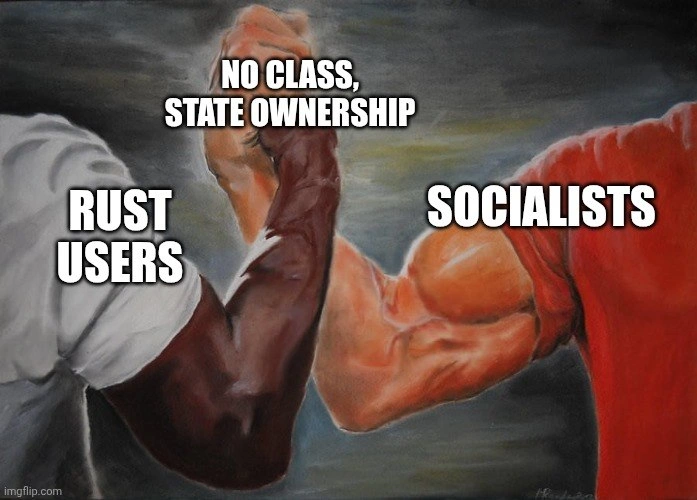
Let’s break down the meme in simpler terms, especially if you’re newer to programming or haven’t used Rust before. First, note the format: this image is using the classic Epic Handshake meme template (inspired by an 80’s action movie scene of two muscled heroes greeting each other). In these memes, each arm represents a different group, and the clasped hands show something they agree on. Here, one arm is labeled “Rust Users”, the other arm is “Socialists”, and they are shaking hands over “No class, state ownership.” Now, why would Rust fans and socialists share a slogan? It all comes down to the double meaning of the words class and ownership in tech vs. in politics.
Rust (the programming language) is known for two big things relevant here: it doesn’t have classes, and it has a strict ownership rule for managing memory (often called the ownership model). If you come from languages like Java, Python, or C++, this might sound odd – those languages all have the concept of a class. A class in programming is like a blueprint for creating objects; it bundles data and methods (functions) together. For example, you might have a class Car that has data like color and speed and methods like drive() or brake(). In traditional object-oriented programming (OOP), classes also let you use inheritance – meaning you can make a class that extends another class (like ElectricCar extends Car to reuse and add on to its features).
Rust purposely does not include OOP inheritance and classes. That doesn’t mean you can’t structure code or make reusable components – you absolutely can, but you do it differently. Rust uses structs to represent data structures and impl blocks to implement methods on those structs. For sharing common behavior, Rust has traits, which are kind of like interfaces in other languages (a way to say “any type that implements this trait has these methods”). So you still get polymorphism (the ability for different types to be used through a common interface), but without forming class hierarchies. This approach is often summed up as “composition over inheritance.” Composition means you build complex behavior by combining simpler pieces, rather than by inheriting from a base class. Many developers prefer this because it can lead to clearer, more flexible code. Rust basically forces you into that good habit by not even offering classes as an option!
Here’s a quick comparison to illustrate what “no class” looks like in code:
# Using a class in Python (an OOP approach)
class Animal:
def __init__(self, name):
self.name = name
def speak(self):
print(f"I am {self.name}")
dog = Animal("Fido")
dog.speak() # Output: I am Fido
// Using a struct and impl in Rust (no class keyword at all)
struct Animal { name: String }
impl Animal {
fn speak(&self) {
println!("I am {}", self.name);
}
}
fn main() {
let dog = Animal { name: String::from("Fido") };
dog.speak(); // prints: I am Fido
}
In the Python example, we define a class Animal with a constructor and a method. In Rust, we achieve a similar result with a struct (to hold the name) and an impl block to implement the speak method for Animal. As you can see, Rust has no class keyword. You can’t do inheritance in Rust like “Bird extends Animal” either. If you need something like that, you’d use traits or other patterns. For a new developer, it might feel unusual, but Rust users love to point out that this leads to simpler, more straightforward code relationships. So when the meme says “Rust Users – No class,” it’s literally true: Rust programmers work in a language with zero classes by design!
Next, let’s talk about ownership in Rust. This is a concept that’s unique to Rust (you won’t find it in high-level languages like JavaScript or Python, and even C++ doesn’t enforce it the way Rust does). Ownership means that every value in a Rust program has a clear owner – usually whichever variable that value is assigned to. When that variable goes out of scope (say, the function ends or the variable gets dropped), it will automatically clean up (free) the value it owned. Crucially, Rust doesn’t allow two active owners of the same piece of data at the same time. You can transfer ownership (like passing data into a function or assigning it to a new variable, which moves it), or you can let others temporarily borrow the data (with references), but there’s always a strict check on these actions.
Rust’s compiler includes a borrow checker, which is the part that enforces these rules. If you violate them, your code won’t compile. For example, this code will throw an error:
let s1 = String::from("hello");
let s2 = s1; // s1's value is moved into s2 (s1 is no longer owner)
println!("{}", s1); // error: borrow of moved value: `s1`
In this snippet, we create a string s1. Then we do let s2 = s1;, which in Rust means move the ownership of the string from s1 to s2. After that line, s1 is no longer valid, because s2 is now the owner of the "hello" string. So when we try to print s1, the compiler stops us with an error — it catches that s1 isn’t the owner anymore. This might seem strict, but it prevents a whole class of errors where two variables think they own the same bit of memory. In other languages, those errors could lead to crashes or weird behavior at runtime. Rust prevents it at compile time.
Now imagine what this feels like in practice: if you’re new to Rust, the borrow checker’s errors might be confusing at first (“wait, why can’t I use s1 anymore?”). But as you learn, you realize the language is basically ensuring you don’t make mistakes that could crash your program or introduce security vulnerabilities. Rust devs often come to love this feature, because it’s like having a built-in guardian angel for memory safety. It’s a trade-off: you have to be a bit more explicit and careful when coding (hence “memory-safety trade-offs” that seniors talk about), but you catch bugs early that would be nightmares later.
Alright, now let’s connect this to the other half of the meme: the socialist slogan. In political terms, “no class” refers to a classless society. That’s an idea where no group of people is considered “upper class” or “lower class” – essentially, everyone is on equal footing, and your birth or wealth doesn’t put you in a higher social category. It’s one of the end goals of a socialist or communist system: to eliminate class distinctions (like eliminating the divide between rich owners and poor workers). The phrase “state ownership” refers to the economy aspect, where the state (government) owns and manages property and resources on behalf of the people. Instead of individuals privately owning factories, land, or companies, the state would own them and (ideally) run them in the interest of everyone. It’s basically the opposite of a free-market capitalist idea where private ownership is the norm. In a socialist context, “state ownership” is often talked about for important industries or resources, to ensure they’re used for the public good rather than private profit.
So, the meme text “NO CLASS, STATE OWNERSHIP” cleverly combines these two contexts. If you read it from a Rust perspective: “no class” (yep, Rust has no classes) and “state ownership” (Rust’s strict ownership model for program state). If you read it from a socialist perspective: “no class” (no social classes) and “state ownership” (state-controlled property). The humor comes from the fact that these phrases overlap in words but refer to completely different things, and yet they’re smashed together as if Rust users and socialists are enthusiastically agreeing on the same grand principle.
To a junior dev or someone outside these ideas, it helps to see why that overlap is funny. Think of it this way: Rust users have their own little world of jargon. They talk about “ownership” and “no classes” in the context of writing code. Socialists have their world of jargon too, with “classless society” and “state ownership” as part of their vision of a different kind of society. Normally, there’s no reason these two sets of jargon would meet. That’s why seeing them handshake in a meme is so unexpected and amusing. It’s an inside joke on both sides. If you know Rust, you grin because “no class, state ownership” describes Rust’s features in a tongue-in-cheek way. If you know socialist lingo, you grin because it sounds like a rallying cry for a revolution. And if you happen to know both – well, that’s the jackpot where you realize how brilliantly the meme maker tied the two together.
In summary, the meme is playing with words:
- Class: in programming, classes are a tool for structuring code (which Rust famously doesn’t use); in society, classes are divisions between people (which socialists want to eliminate).
- Ownership: in programming (Rust), ownership is about who controls a piece of data in memory; in socialism, ownership is about who controls property and resources (the public via the state, rather than private owners).
The epic handshake shows Rust fans and socialists agreeing, tongue-in-cheek, on “no class, state ownership,” each for their own reasons. It’s a perfect nerdy pun. You don’t actually need to be a socialist to find it funny – you just need to recognize that those words humorously bridge two completely different worlds. And for many of us in tech, that kind of multi-layered pun is peak developer humor. 😄
Level 3: Rustaceans of the World, Unite!
For experienced developers, this meme lands as a perfect blend of tech insider humor and witty wordplay. On one brawny arm of the handshake, we have Rust users – those passionate system programmers who have battled the wild bugs of C and C++ and embraced Rust’s promise of memory safety and modern language design. On the other bulging arm, we have socialists – people who advocate for a classless society and collective ownership of resources. The two arms clasp together under the banner “NO CLASS, STATE OWNERSHIP,” and that’s where the magic happens: it’s a phrase that simultaneously captures Rust’s core language philosophy and socialism’s core political ideals. The result is a nerdy alignment so perfect that it’s both hilarious and oddly satisfying.
Let’s break down each side of that handshake from a senior dev perspective:
No class (Rust’s side): Seasoned developers know that Rust deliberately has no
classkeyword and no inheritance in the traditional object-oriented sense. This isn’t an omission by accident – it’s by design. Rust encourages composition over inheritance. You usestructto define data structures andtraitto define shared behavior, but you never make a class hierarchy like in Java or C++. For veterans who have seen one too many convoluted class hierarchies (think of a nightmare in C++ or Java with six layers of abstract base classes 😱), Rust’s approach is a breath of fresh air. It sidesteps the classic OOP pitfalls: no fragile base class problems, no deep inheritance diamonds, no needless subclass boilerplate. Many of us have war stories of refactoring “God classes” or untangling class inheritance spaghetti in legacy code. Rust says, “nah, we’re not doing that,” and many experienced devs quietly cheer. In meme terms, Rust developers are the class abolitionists of the programming world. They’ve essentially become trait-ors to traditional OOP (embracingtraitsinstead of classes — pun intended!). So when a Rustacean (Rust fan) sees “NO CLASS,” they smirk because it’s literally true about Rust: the language just rolls without that whole class system. It’s like telling the ghost of Java, “Your services are no longer required; we’ve reorganized society… er, our code… without classes.”State ownership (Rust’s side): Now, ownership in Rust is the defining feature that sets it apart from other languages. If you’ve spent years chasing down memory leaks, null pointer dereferences, or race conditions, Rust’s strict ownership rules feel almost revolutionary. The compiler enforces that every piece of data in a Rust program has one owner, and only one, at a time. You want to use or share that data? You either transfer ownership or you politely ask to borrow it (with rules on how long you can hold it and whether you can mutate it). This system is policed by the notorious borrow checker – a part of the compiler that senior devs often joke about as if it were a strict librarian or a vigilant traffic cop for memory. Try to bend the rules and you get compile-time errors sternly telling you “borrow of moved value” or “cannot borrow as mutable more than once”. It’s a tough love approach: the compiler is like that inflexible bureaucrat who won’t let you have your passport until every form is filled out correctly. At first, it can be frustrating (experienced devs have humble tales of fighting the borrow checker for hours), but ultimately you appreciate that this strict governance prevents serious bugs down the line. In everyday terms, Rust’s ownership model is a centralized authority for program state: it’s as if the language has a built-in government that approves or denies how you access memory. Haha, state ownership of memory indeed! The meme’s phrase nails it — Rust developers essentially agree that having a single authority (the compiler) control who owns what in memory leads to a safer, more orderly system. They’ve traded a bit of freedom (no wild west pointer arithmetic free-for-all) for a lot of security (no surprise crashes at 3 AM). Seasoned engineers recognize this trade-off and often evangelize it as Rust’s big win: you catch the bugs early (at compile time) rather than chasing them in production. The phrase “state ownership” encapsulates that feeling of centralized control in Rust’s world, and seeing it written out brings a knowing grin.
Now, consider the socialist side of the handshake: “no class, state ownership” is basically a two-word summary of core socialist goals. A senior dev who paid attention in history class (or at least watched some documentaries) will recognize the echo of socialist rhetoric. No class refers to a society with no class distinctions – something a socialist would celebrate on a protest sign. State ownership refers to the economy where the state (representing the people) owns property and industry. These are phrases you’d hear in political discussions, not at a tech conference, which makes it all the more delightful to see them applied to a programming language in jest. It’s the incongruity that’s funny: you’d never expect your knowledge of Rust’s borrow checker to collide with Marxist terminology during your morning meme scrolling.
The Epic Handshake meme format itself is about finding unexpected common ground. Here the common ground is purely linguistic and comedic: Rust aficionados and socialist thinkers wouldn’t normally be swapping notes. (Imagine that conference panel: “Memory Safety and Marxism” – what a crowd that would draw!). But by punning on class and ownership, the meme brings them together for a moment of agreement. Senior developers love this kind of layered joke because it rewards you for having niche knowledge in two areas. If you’ve been through the trenches of systems programming, you nod at Rust’s “no class, ownership” design. If you’re aware of socio-political concepts, you recognize the slogan tweak. Each side on its own is serious business, but smashed together? It’s gloriously silly.
Many veteran devs have a slightly rebellious streak about programming paradigms – we’ve seen fads come and go. Rust’s rise in the last decade has felt a bit like a revolution in the systems programming world: breaking with OOP tradition, emphasizing safety and correctness, challenging C++ dominance. Rust fans sometimes even display almost ideological fervor (in good humor) about things like safety and fearless concurrency. There’s an inside joke that adopting Rust at your company can feel like joining a movement. So when this meme says “Rust Users” are shaking hands with a political ideology, it’s also poking fun at how zealous and passionate tech communities (like Rust’s) can sometimes resemble ideological groups. It’s a friendly ribbing: Rustaceans of the world, unite! You have nothing to lose but your null pointers!
Ultimately, this meme resonates with experienced devs because it draws a clever parallel between technical ideals and political ideals. It’s lampooning two “revolutionary” mindsets: one aimed at writing safer code, and one aimed at creating a fairer society. The phrase “NO CLASS, STATE OWNERSHIP” being the rallying cry for both is just chef’s kiss perfect. It triggers that double-take moment: Wait, are we talking about code or politics? Haha, both! It’s a great example of developer humor finding connections across domains. Anyone who has spent time both debugging tricky memory issues and slogging through a bit of political theory will appreciate the witty crossover. It’s the kind of joke you immediately want to share with your fellow senior engineers (especially the ones who won’t stop talking about Rust), because it encapsulates an inside joke about Rust’s design philosophy using the grandiose language of ideology. In short, it’s a handshake meme that firmly shakes together the solemn earnestness of memory safety and the zeal of socio-political change – and every seasoned dev in on the joke can’t help but smile at that unlikely alliance.
Level 4: Class Abstraction & Class Struggle
At a theoretical level, this meme hinges on two very different domains sharing eerily similar terminology. In computer science, Rust was designed with a type system that forgoes the traditional notion of a class found in object-oriented programming. Instead, it embraces traits and composition, aligning more with algebraic data types and trait-based polymorphism (akin to Haskell’s type classes, ironically named). This design choice eliminates inheritance hierarchies, avoiding the complexity (and infamous diamond problems) of OOP class inheritance. Academically, Rust’s type system can be described as an affine type system – values are used in a way similar to linear types, meaning each value has a single owning reference unless explicitly cloned or borrowed. This is rooted in formal linear logic, ensuring that resources (like memory) are neither duplicated nor leaked without explicit intent. It’s the foundation of Rust's strict ownership semantics: each value has one owner, and the compiler (through the borrow checker) verifies that any references to that value (borrows) do not outlive the owner’s scope. In essence, Rust provides a compile-time guarantee of memory safety by statically enforcing rules that most languages manage only dynamically (or not at all).
Delving deeper, Rust’s approach to memory safety has even been the subject of formal verification efforts (like the research project known as RustBelt, which aims to prove Rust’s safety properties sound). Concepts like lifetimes in Rust give a hint of compiler-internal theory: they amount to a form of region-based memory management checked via static analysis. The compiler’s borrow checker can be seen as a logical system that tracks permissions and lifespans of references, somewhat analogous to a theorem prover ensuring no reference outlives its resource. This rigorous design means common errors like dangling pointers, double frees, or data races are prevented by design. In theoretical terms, Rust is applying resource correctness proofs to your code without you writing formal proofs yourself. It’s a real-world embodiment of academic ideas from type theory and concurrency (avoiding data races is practically a (safe) concurrency theorem in action).
Now, compare this to the realm of political theory. Socialism (especially Marxist socialism) has long envisioned a classless society – a society without the hierarchies of social classes (no division between proletariat and bourgeoisie). In Marxist theory, history is a series of class struggles, and the ideal end state is a society where those classes dissolve into equality. The phrase “no class” evokes this utopian lack of social stratification. Additionally, socialism advocates for state ownership (or collective ownership) of the means of production. This means major resources and industries are owned and managed by the public (often via the state), rather than by private individuals. It’s a theoretical framework intended to prevent exploitation and ensure resources serve the common good. Classic texts like The Communist Manifesto outline how eliminating private ownership and class distinctions would, in theory, lead to a more equitable and efficient allocation of resources – essentially a centrally planned approach to running society.
The meme brilliantly juxtaposes these two domains by exploiting the dual meanings of class and ownership. Rust’s language design abolishes class-based inheritance in code, while socialism seeks to abolish social class divisions in society. Likewise, Rust’s compiler strictly governs memory through an ownership model (every value has an owner, and you can’t use data without the compiler’s permission), just as socialist doctrine centrally governs property via state ownership (resources can’t be used without the collective’s permission). This is a playful collision of concepts: on one side, a programming language’s type system ideology, and on the other, a socio-economic political ideology. The humor, at this deep level, comes from recognizing a structural parallel. By pure coincidence, Rust’s radical approach to safe systems programming and socialism’s radical vision of society both champion “no class, ownership by a central authority.” It’s a kind of conceptual symmetry that tickles the mind – two vastly different theories inadvertently echoing each other’s language. It’s as if a principle from formal type theory did a handshake with a principle from social theory, which is precisely the absurdly intellectual charm of this meme.
Description
The 'Epic Handshake' meme format depicts two muscular arms, one Black and one white, clasping in a powerful handshake against a painted background. The arm on the left, belonging to a person in a white t-shirt, is labeled 'RUST USERS'. The arm on the right, belonging to a person in a red t-shirt, is labeled 'SOCIALISTS'. At the point where their hands meet, a central label reads 'NO CLASS, STATE OWNERSHIP'. A watermark for 'imgflip.com' is visible in the bottom left corner. This meme creates a humorous juxtaposition by using terminology that has completely different meanings in two separate fields. For senior developers, the joke is a clever pun: in the Rust programming language, there are no 'classes' in the traditional object-oriented sense (it uses structs), and its core feature is a strict 'ownership' model for managing memory state. In socialism, the ideals include a society with 'no class' structure and 'state ownership' of the means of production. The meme humorously finds common ground between these disparate groups based on a semantic overlap
Comments
9Comment deleted
Rust enforces state ownership at compile time; socialists advocate for it at runtime. One prevents data races, the other... well, the race conditions are a known production issue
Finally, a political system the borrow checker can enforce at compile time
The only thing harder than explaining Rust's borrow checker to a junior dev is explaining to a VC why your startup's entire backend is written in a language where fighting with the compiler is considered a feature, not a bug
The Rust compiler and political theory finally agree on something: shared mutable state is the root of all evil. While socialists debate collective ownership of the means of production, Rust developers have already solved it with a borrow checker that enforces single ownership at compile time - no revolution required, just a few lifetime annotations and the occasional fight with the compiler about who really owns that reference
Rust: the only classless society where state ownership eliminates memory leaks and still compiles
Rust: where the borrow checker seizes the means of allocation and abolishes class at compile time
Rust: the language where state ownership prevents memory leaks, unlike capitalist OOP where private classes hoard resources until they segfault
Rust users are socialists 🤣 Comment deleted
Socialism with state ownership is fake socialism though. Comment deleted