The Joy of a $0.00 Cloudflare Invoice
Why is this Cloud meme funny?
Level 1: Free Treat, Formal Receipt
Imagine you walk into an ice cream shop, and they’re giving out free ice cream cones as a promotion. You happily take one and it’s completely free – you don’t have to pay anything. But then, the shop owner still hands you a printed receipt that says, “Ice Cream Cone: $0.00.” It looks just like a real bill from a store, even though you owe nothing. You might giggle at how silly that is: a receipt for a free ice cream! Now you go home, and your very strict parent takes that $0.00 receipt and files it in a big folder of family expenses, treating it as seriously as a grocery bill. It sounds ridiculous, right? You got something for free, yet there’s all this official paperwork around it. That’s exactly why this meme is funny – it’s like the business world’s version of that situation. The company got a $0 bill from Cloudflare (a service they used for free), and even though it cost nothing, the finance people still handle it with the same seriousness as a regular bill. It’s like doing paperwork for a free ice cream cone – totally over-the-top, and that silliness is what makes us laugh.
Level 2: Purchase Order for Nothing
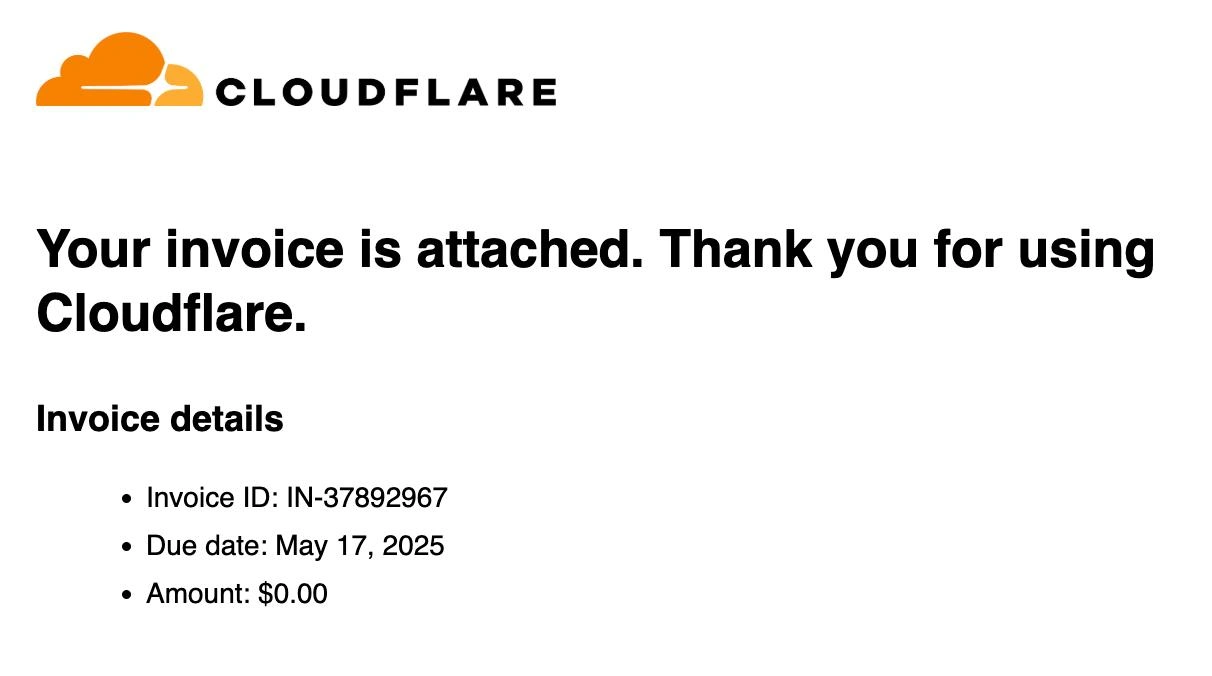
If you’re a newer developer or just getting started with cloud services, here’s what’s happening in this meme. Cloudflare is a popular cloud computing company that handles things like speeding up websites and protecting them from attacks. They offer a free tier – meaning you can use some of their basic features without paying anything, up to a certain limit. When you use a cloud service (even for free), the company often still sends you a monthly invoice (basically a bill or statement of usage). In this case, the invoice clearly shows an Amount: $0.00 because the usage was within the free tier, so nothing is owed. The meme image looks like an official email from Cloudflare saying “Your invoice is attached” with details like an Invoice ID, a Due date, and the amount due. It’s all very formal, even though the total cost is zero.
Now, in a big company environment, there’s something called a Purchase Order (PO) system. A PO is like a formal permission slip or reference number that the company’s finance department uses to approve spending money. Normally, if your team wants to subscribe to a service or buy something, you create a PO first, which says “we expect to spend X dollars on this.” When an invoice comes in from the vendor, the finance team matches it to the PO and then pays the bill. It’s a way to keep track of expenses and make sure nobody spends company money without approval.
Here’s where the funny (and slightly frustrating) part comes in: even though Cloudflare’s invoice amount is $0, the company’s finance or accounts-payable department might still treat it like any other invoice. Someone might literally email the engineering team saying, “Hey, we got an invoice from Cloudflare. What’s the PO number for this?” Imagine the confusion on the developer’s face: “PO number for what? We didn’t spend anything!” But in many large organizations, rules are rules. They might have a policy that every invoice (even a $0 one) needs to be recorded in the system. Sometimes this is for auditing purposes or compliance—big companies often have to follow strict laws and accounting practices to document all vendor transactions, even the trivial ones.
For a junior engineer, this scenario is a little peek into CorporateCulture. Companies love their processes and paperwork. The cloud service was free – which is great for your project and helps with budget constraints – but that doesn’t automatically skip the paperwork. The finance team still wants to:
- Make sure Cloudflare is listed as an approved vendor in their system (even if the service costs nothing, they track who the company is dealing with).
- Log that an invoice was received. They’ll note the Invoice ID and amount, even if it’s $0, so everything is accounted for.
- Possibly have a PO number or some internal reference to attach to that invoice for their records. This could mean creating a PO that says “$0” or updating an existing record, just so their books aren’t missing an entry.
From the engineer’s perspective, it feels like unnecessary bureaucracy: “We didn’t spend any money, so why do we need any paperwork at all?” But from the finance perspective, it’s about consistency and control. If an invoice comes in – even one that says $0 – they treat it by the book. It’s a bit like having to fill out a form to get a free giveaway; it feels overkill, but that’s how the system works in a big company.
The humor in the meme comes from that contrast. You did a great job using the cloud to save money (hooray for CloudCostOptimization!), and you end up with the dream scenario: a $0.00 bill. Yet, you still get an official email about it, and someone in the office still acts on it seriously. It’s like receiving a receipt that says “$0.00” and having to file it. In everyday terms, you would probably laugh if a store clerk handed you a receipt for $0, right? That’s why this is funny to developers. The meme is basically saying: even when you owe nothing, a big company will still want to dot all the i’s and cross all the t’s. The cloud gave you something for free, but the company’s internal process treats it almost like you bought something. It’s a lighthearted reminder that “free” in the world of business sometimes still comes with a tiny string attached – in this case, a bit of paperwork or an approving nod from finance.
Level 3: Paperwork Purgatory
Because nothing screams enterprise IT like receiving an invoice that says you owe $0.00. The meme highlights a clash between agile Cloud convenience and rigid CorporateCulture processes. Here, Cloudflare’s free tier has generated a formal invoice email for Amount: $0.00, and yet the finance department is treating it with the same gravity as any other bill. For seasoned engineers, this scenario is painfully familiar: the overhead (paper trails, approvals, emails) scales linearly even when the actual cost is zero.
In a large organization, compliance rules and bureaucracy don't take a day off just because something is free. Thanks to regulations like Sarbanes-Oxley (SOX), every vendor interaction needs an audit trail. So that zero_dollar_invoice triggers the full enterprise_finance_workflow. The accounts payable system sees an Invoice ID (like IN-37892967) and a Due date and immediately expects a matching Purchase Order (PO) on file. It’s a classic case of purchase_order_madness: even when budget constraints are non-issues (because the cost is nil), procedure demands a PO number to dutifully enter into the system.
Ever had to raise a PO for a $0.00 invoice? It’s as absurd as it sounds. Yet many of us have sat in meetings or email threads where someone from Finance asks, “Hey, we got an invoice from Cloudflare. What’s the PO number for this?” – and you double-take because the Amount is literally $0.00. The humor (and slight horror) comes from how CloudCostOptimization triumphs – like using a cloudflare_free_tier to eliminate cost – can’t eliminate the corporate checks and balances. The VendorLockIn paranoia and audit culture mean that even a free service is treated as a vendor relationship that must be tracked. From Finance’s viewpoint, “a vendor is a vendor” – if Cloudflare is sending an invoice (even a zeroed-out one), it must be catalogued, possibly in case next month isn’t free or just to keep the auditors happy.
Let’s break down why this is so relatable:
- The Official Email: Cloudflare’s message “Your invoice is attached. Thank you for using Cloudflare.” is indistinguishable from a normal bill notice. It’s meticulously formatted with an Invoice ID, Due date, and Amount: $0.00 – all the formality for a grand total of nothing. This juxtaposition is comedic gold for anyone who’s ever felt the sting of real cloud bills.
- The PO Demand: The meme title jokes that finance “still wants a PO for” that $0 invoice. In big companies, internal policy often says no invoice gets paid without a PO, period. So the accounts department ends up chasing an approval document for exactly $0. It’s bureaucracy on autopilot – rules so strict they don’t know how to bend for zero. This is the epitome of sox_compliance_overhead, where process trumps common sense.
- Engineer’s Irony: From the developer’s perspective, this is the one invoice you love seeing in your inbox – proof that your service is free this month. You might even chuckle and think, “the only invoice it’s a pleasure to see every month.” Yet, you can’t fully relax, because somewhere a finance person is probably raising an eyebrow: “Is this invoice accounted for?” You’ve won the cloud cost battle, but you’re still stuck in paperwork purgatory.
In essence, the meme pokes fun at how enterprises handle cloud billing. We strive for CloudCostOptimization to save every dollar, reaching the coveted $0.00 bill, only to find we’ve unlocked a new achievement: the zero-dollar paperwork saga. The overhead of processing, approving, and filing an invoice doesn’t disappear just because the invoice says $0. If anything, it sometimes introduces confusion (“Is this a mistake? Do we owe something or not?”) leading to even more emails and meetings.
It’s a scenario where the humor hides a cringe-worthy truth: corporate systems are often inflexible. The cloud may offer a free tier, but enterprise workflows rarely have a “free pass” mode. Like an if-statement with no exception for zero, the system churns on:
// Pseudocode for enterprise billing workflow
if (invoice.amount >= 0) {
finance.requirePurchaseOrder(invoice);
finance.logInvoice(invoice.id, invoice.amount, invoice.dueDate);
// Even $0 has to be logged and approved...
}
The result? A developer on one side of the table is smirking at a $0.00 invoice – a small victory – while on the other side a finance clerk is dutifully creating a PO or asking for one. The contrast is hilarious and all-too-real. It’s a reminder that in the world of IT, you can eliminate charges with clever engineering, but you can’t easily eliminate CorporateCulture rituals. In the end, you end up with a kind of “free tier paradox”: the cloud service costs nothing, yet everyone still spends time and energy treating it like a regular expense. And yes, we’ll gladly take that $0 bill every time – just don’t forget to get it stamped, signed, and filed in triplicate.
Description
A clean, white screenshot of an invoice notification from Cloudflare. The orange Cloudflare logo is in the top-left corner. The primary text, in a black sans-serif font, reads: 'Your invoice is attached. Thank you for using Cloudflare.' Below this is a section titled 'Invoice details' with a bulleted list showing 'Invoice ID: IN-37892967', 'Due date: May 17, 2025', and most importantly, 'Amount: $0.00'. This image is a humorous and relatable piece of content for the developer community. Cloudflare is renowned for its generous free tier that provides essential services like CDN, DNS, and DDoS protection at no cost. Receiving a $0.00 invoice is a moment of satisfaction and relief, especially when contrasted with the often complex and unexpectedly high bills from other major cloud providers. It celebrates getting significant value for free, a win for anyone running personal projects, startups, or small-scale applications
Comments
15Comment deleted
AWS sends you a bill that requires a forensic accountant to decipher. Cloudflare sends you a $0 invoice that feels like a silent, supportive nod for not abusing the Workers free tier
Only in a Fortune-500 can a $0.00 Cloudflare invoice trigger a month-long SOX-compliant approval chain - meanwhile the real spend is hiding in the ‘miscellaneous egress’ line item
Somewhere a finance team is reconciling $0.00 invoices while the engineering team debates whether NULL, 0, or undefined would have been the more semantically correct amount for a free service
Ah yes, the ceremonial $0.00 Cloudflare invoice - proof that even when you're not paying, there's still a formal process to remind you that you're not paying. It's the cloud equivalent of receiving a meticulously itemized receipt for free samples at Costco. At least when your startup inevitably scales and this number becomes non-zero, you'll already have the invoice ID format memorized for your expense reports
Only in enterprise cloud does a $0.00 Cloudflare invoice spawn a PO, a vendor review, and three approvals - costing more to process than the traffic it protected
Only in enterprise FinOps do we spend longer approving a $0 Cloudflare invoice than our DNS TTL
Cloudflare's $0 bill: the one cloud cost vector where egress fees hit absolute zero - SRE nirvana
„If you are not a customer, you are the product“ Comment deleted
Are you a customer if they send you a receipt that costs no staff work or internet traffic or storage for them to give you? Comment deleted
You’re a product to them in a sense that you will start to use Cloudflare on your workplace Their enterprise plans is a real cash cow Comment deleted
You're still the product even if you're a paying customer, let's be real Comment deleted
Just for context Comment deleted
we flexing here? Comment deleted
I fucking love NSA products Comment deleted
In Russian there is a saying: the only free cheese is in a mouse trap Comment deleted