Skip to content
DevMeme
6092 of 7435
The Rust Compiler's Ultimate 'unsafe' Gatekeeping
Languages Post #6671, on Apr 22, 2025 in TG

The Rust Compiler's Ultimate 'unsafe' Gatekeeping

Why is this Languages meme funny?

Level 1: Puzzle Before Play

Imagine you’re in a fairy tale and a wise old wizard won’t let you use a powerful magic sword until you answer his riddle. You really want the sword, but first you have to prove you’re worthy by solving a puzzle. That’s exactly what’s happening in this meme! The Rust compiler is acting like that strict wizard. It won’t let the programmer use a potentially dangerous tool (Rust’s unsafe feature, which is powerful like that magic sword) until they complete a challenge. And not just any challenge, but a Sudoku number puzzle. We find this hilarious because, normally, computers don’t make us do totally unrelated puzzles to continue programming. It’s a bit like if your car refused to start until you solved a crossword, or your toaster wouldn’t toast your bread until you answered a trivia question. It’s such a silly mismatch that it makes you laugh.

The joke exaggerates Rust’s “safety first” attitude to a comical extreme. It’s as if the computer is saying, “I care so much about safety, I’m going to make you work for it!” The compiler becomes an overly cautious guardian that also has a mischievous side, testing you just for the sake of being extra sure. Even if you’re not a coder, you can appreciate how absurd this is: a serious tool turning into a riddle master. The humor comes from that surprise and exaggeration. In the end, it’s poking fun at how Rust really values doing things the safe way – so much that, in this joke, it would even make you earn the right to write risky code by passing a Sudoku puzzle test!

Level 2: Proving You're Worthy

Let’s break down what’s happening in this meme in simpler terms. Rust is a systems programming language known for enforcing memory safety. This means Rust tries really hard to prevent common bugs that can crash programs or create security vulnerabilities – things like accessing memory that isn’t yours, or using data after it’s been freed (a use-after-free error). The Rust compiler (the program that turns your Rust code into an executable) has a special set of rules called the borrow checker. The borrow checker’s job is to make sure references to data are used safely. It enforces rules about who can use or change data at a given time and whether something is still valid to use. These rules stop you from having two parts of your program accidentally mess with the same piece of memory in harmful ways, and ensure that no one tries to use memory that’s no longer there. Following these rules can sometimes be tricky – especially when you’re new to Rust – so fixing Rust compiler errors can feel like solving a little logic puzzle. You change a bit of code here, adjust something there, to satisfy the borrow checker, much like adjusting pieces of a puzzle until everything fits.

Now, unsafe in Rust is a keyword that lets you tell the compiler, “Alright, I need to do something low-level and I’ll take responsibility for its safety.” Inside an unsafe { ... } block, you can do operations that Rust usually prohibits because they can be dangerous if used incorrectly. For example, you can directly manipulate pointers (like you might in C or C++), call functions from other languages, or do other manual memory operations. Essentially, you’re temporarily taking off Rust’s safety training wheels. Unsafe code doesn’t mean the program will crash, but it means the Rust compiler will not check those particular things for you. It becomes the programmer’s job to ensure nothing bad happens. Because of that, Rust developers use unsafe very sparingly. When they do use it, they are extremely careful: they’ll double-check the logic, write tests, and often add comments explaining why the unsafe operations are actually okay. Think of it like entering a high-security zone: you bypass the normal checks, but you’re extra cautious because you know there’s potential danger.

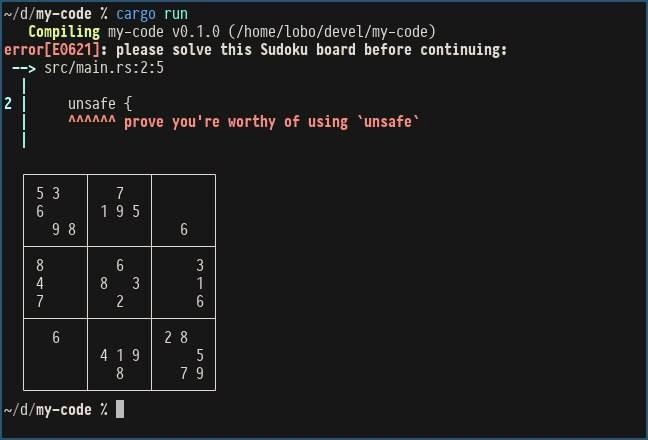
The meme’s image is a pretend screenshot of trying to compile a Rust program that contains an unsafe block. The developer runs cargo run (Cargo is Rust’s build tool, similar to how you might run a build command in other languages; it compiles the code and then runs the program if compilation succeeds). Instead of finishing the compile, the Rust compiler throws an error and stops. The error shown is error[E0621]: please solve this Sudoku board before continuing:. It even points to the file src/main.rs at line 2, column 5, which is exactly where the code has unsafe {. In the screenshot, you see a caret (^^^^^^) under the word unsafe and the message “prove you’re worthy of using ‘unsafe’”. This layout mimics a real Rust compiler error: normally, the compiler would underline the problematic code and explain what’s wrong (for example, it might say something like “cannot borrow X as mutable because it is also borrowed as immutable” or other real error descriptions). Here, however, the compiler’s complaint is purely humorous. It’s not pointing out a real programming mistake – it’s just saying, “you used unsafe, and now I demand a Sudoku puzzle solution!” Below that error text, the compiler has printed a 9×9 Sudoku grid in the terminal (with some numbers already in place and others blank). The joke is that the compiler won’t continue (won’t successfully compile and run the code) until you fill in this puzzle correctly. Of course, this isn’t something any real compiler does – it’s an invented scenario to make us laugh. The error code E0621 is even formatted like a genuine Rust error code. (Rust uses codes like E0382, E0507, etc., for different errors, and each code can be looked up for details.) In reality, E0621 corresponds to a real error about lifetimes, not anything to do with Sudoku. Including that code just makes the fake error look more authentic to those who have seen Rust errors before.

So why a Sudoku puzzle? Sudoku is a popular number puzzle that requires careful logic to fill out correctly – each row, column, and 3×3 subgrid must contain all the numbers 1 through 9 without repeating. It’s basically a symbol for a brain teaser or challenge. The meme uses Sudoku as a metaphor for the kind of mental exercise one might feel they go through when dealing with Rust’s strict rules. It humorously suggests that using unsafe in Rust is such a big deal that the compiler itself acts like a stern gatekeeper, saying “I won’t let you proceed unless you prove your cleverness and care by solving this!” In plainer terms, Rust usually asks you to fix or clarify your code in very specific ways when you get an error. Here, that idea is blown out of proportion into a goofy requirement: a random puzzle completely unrelated to coding. It underscores Rust’s reputation for not allowing “risky” code without a lot of justification. For many developers, this rings true in a comedic way – they joke that sometimes coding in Rust feels like answering riddles posed by the compiler until it’s satisfied.

Another aspect to consider is the nod to code quality. In serious software development, especially with Rust, there’s an emphasis on writing safe, correct code. The compiler errors and warnings are there to help catch mistakes early, improving the overall quality of the codebase. The more Rust forces you to think and correct things at compile time, the fewer bugs you likely have later. So the meme takes that to an extreme: before letting you write something potentially error-prone (unsafe code), Rust might as well make you do a whole side challenge to prove you’re being careful. It’s poking fun at how sometimes Rust makes you jump through extra hoops (though normally those hoops are directly related to the code, not Sudoku!). The underlying message is light-hearted: Rust is extremely protective of your program’s safety – so much so that, haha, maybe it would give you a quiz or puzzle just to be extra sure you know what you’re doing. It’s a piece of developer humor that exaggerates the reality (Rust’s strict checks) in a ridiculous way. Even if you’re not experienced with Rust, you can appreciate the joke that a computer would halt and ask for a puzzle to be solved – it’s a fun reminder that Rust’s priority is safety and quality, even if that means sometimes slowing the developer down a bit. And here, we get to laugh at that fact by imagining the compiler as an overly cautious (but well-meaning) guardian that just happens to love Sudoku.

Level 3: Unsafe Initiation Rite

To seasoned developers, this meme hits home by parodying Rust’s famously strict compiler and its almost ritualistic enforcement of code quality. It lampoons the idea that before you're allowed to wield the dangerous power of unsafe code in Rust, you must complete a daunting intellectual challenge – in this case, solving a Sudoku puzzle. This resonates because working with Rust’s safety rules can feel like solving puzzles. Anyone who’s wrestled with Rust’s borrow checker has experienced those cryptic error[E0499] or E0716 messages about lifetimes and references. The compiler often forces you to rethink and restructure code to uphold memory safety. It’s tough love: Rust will not compile code that violates its strict rules, akin to a strict teacher refusing to let you graduate until you’ve mastered the material. The meme simply cranks that up to 11, joking that Rust won’t even compile until you literally prove your worth by cracking a logic puzzle. It’s absurd, but for Rustaceans (Rust developers) it’s a knowing wink – “Yeah, sometimes using unsafe really does feel like you need to pass some ultimate test.”

Unsafe code in Rust is that special escape hatch where you, the developer, take off the training wheels. In safe Rust, the compiler is like an overprotective guardian, catching null pointer dereferences, data races, and buffer overruns at compile time. But once you enter an unsafe { ... } block, the compiler basically steps back and says, “Alright, I hope you know what you’re doing.” It no longer guarantees memory safety inside that block. Experienced developers know that mistakes in unsafe can lead to the same nasty bugs (undefined behavior, memory corruption) that plague C and C++ programs. That’s why using unsafe is often accompanied by careful reasoning, extensive code reviews, and lots of comments to prove to other maintainers (and yourself) that the code is sound. In some teams, there’s even an unwritten rule: if you write unsafe code, be ready to justify it. The meme’s compiler-enforced Sudoku is a comical take on this justification process – a literal gatekeeping mechanism. It's as if Rust’s compiler has become self-aware of its role as a gatekeeper for safety and says, “Solve this puzzle to show you truly grasp the implications of what you're about to do.”

From an industry perspective, the humor also stems from contrast. In languages without these safeguards (like C or C++), you can freely shoot yourself in the foot with a stray pointer or buffer overflow and the compiler won’t bat an eye. You might not find out until a segfault (segmentation fault crash) happens or, worse, until a security exploit is discovered in your software. Rust’s approach flips this on its head: it front-loads the hard work to compile time. This means developers spend more effort getting the code to compile (often reworking code to satisfy the borrow checker’s constraints) in exchange for very robust runtime safety guarantees. Seasoned engineers remember countless debugging sessions due to memory corruption in C, or massive security failures like the infamous Heartbleed bug (a buffer over-read in OpenSSL that went undetected and caused a huge crisis). Rust was created explicitly to avoid those nightmares. So when this meme shows the compiler jokingly demanding a Sudoku puzzle solution, it’s referencing that ethos: better to sweat now (even solving puzzles) than bleed later. It’s darkly funny to imagine the compiler literally preventing you from writing potentially dangerous code unless you demonstrate some brainpower and caution.

The ASCII Sudoku grid in the error message is especially hilarious to those who know Rust’s error aesthetics. Rust compiler errors are actually known for being very informative and even user-friendly; they often come with little “hints,” suggestions, and clear labels, just like we see in the image (--> src/main.rs:2:5 with a caret pointing at unsafe). Some of Rust’s error messages even have a bit of wit or whimsy, but of course they would never actually make you play a mini-game. That grid in the terminal looks surprisingly plausible thanks to Rust’s rich error formatting (colored text, ASCII art borders, and pointers to code snippets). It’s a perfect parody because at first glance it looks like a legitimate rustc error output – red text and all – only to reveal a ridiculous demand. Experienced devs can appreciate the attention to detail: the error code E0621 follows Rust’s convention (Rust uses error codes like E0382, E0507, etc., each corresponding to a specific kind of compile error). Here, E0621 is presumably chosen for authenticity; in real Rust, that number corresponds to a lifetime mismatch error, not a Sudoku challenge! This little detail adds authenticity to the joke: it’s exactly how a real Rust compiler error would present itself, down to the file path and caret indicators. It’s as if some mischievous Rust compiler engineer secretly slipped in a “Sudoku mode” for those daring to mark code as unsafe.

Ultimately, the shared experience behind the humor is one of developers being “tested” by Rust. It pokes fun at that mix of frustration and respect we feel towards the compiler. Frustration, because sometimes you just want to get the code running already and the compiler keeps complaining (we’ve all groaned, “why do I have to jump through these hoops?!”). Respect, because more often than not, after you quiet the error, you end up with a better, safer program and you understand Rust’s reasoning. The meme exaggerates the hoop-jumping into a literal puzzle quest. It’s a form of developer humor where we laugh at our own struggles and the language’s stern protectiveness. Every Rust programmer has a memory of finally appeasing the compiler after a series of stubborn errors – it can feel like defeating a final boss or solving a tough riddle. Solving a Sudoku and getting the code to compile draws a parallel: both can make you fist-pump and shout “Yes! I did it!” In short, the meme is a senior engineer’s chuckle at Rust’s tough love approach: the compiler might not literally demand a Sudoku solution, but sometimes it sure feels that way.

Level 4: Proof by Sudoku

In theory, this meme playfully hints at formal verification principles and the inherent complexity of ensuring memory safety. The Rust language’s approach to safety can be understood in terms of logical constraints and even proof obligations. Under the hood, Rust’s compiler (rustc) leverages a sophisticated type system and a borrow checker algorithm to enforce strict aliasing and lifetime rules at compile time. Ensuring that pointers and references are used without causing undefined behavior is akin to solving a complex logic puzzle with many interlocking constraints – not unlike a Sudoku board. In fact, verifying that an arbitrary program is fully memory-safe before running it can be extremely difficult. It can resemble solving an NP-complete problem (like a Sudoku puzzle, which is NP-complete) and in the most general sense it’s undecidable (no algorithm can perfectly do it for all possible programs – a nod to fundamental limits like the halting problem). By facetiously requiring a developer to solve a Sudoku before allowing unsafe, the meme exaggerates Rust's insistence on proofs of correctness. It’s as if the compiler is saying: “Proving your code’s safety is a non-trivial logical challenge – here’s a literal logic puzzle to drive that point home!”

This scenario also echoes ideas from formal methods in software engineering, where highly critical code (such as microkernel memory managers or cryptographic algorithms) often comes with formal proofs of correctness. In those realms, a compiler or proof assistant might indeed demand that certain conditions (invariants, preconditions, postconditions) are proven true by the developer or formally discharged. Rust isn’t actually a proof assistant, but its rules do ensure a soundness guarantee for memory safety within its safe subset of code. When you opt into unsafe code, you're effectively stepping outside that automatic guarantee – in a sense, leaving the realm of machine-checked safety proofs and saying “I’ll handle it from here.” The Sudoku challenge in the error message lampoons this scenario: it’s a metaphorical proof-of-work. It suggests that to step outside Rust’s safety net, the programmer must demonstrate a mental feat (solving a constrained logic puzzle) as a kind of rite of passage.

Interestingly, there’s a grain of truth hidden in the absurdity. Advanced type systems and compile-time programming techniques can encode complex puzzles. Clever developers have created compile-time Sudoku solvers or other games using C++ templates, Haskell’s type families, or Rust’s own const generics and macro system. These stunts prove that compilers can be (mis)used as general logic solvers given their Turing-complete aspects. So the idea of a compile-time Sudoku isn’t entirely outlandish – it’s a tongue-in-cheek nod to the power (and theoretical heaviness) of compilers and constraint solvers. When the Rust compiler in the meme jokes, “error[E0621]: please solve this Sudoku board before continuing,” it implies that bypassing the compiler’s usual safety checks is no trivial affair. It’s like the compiler conjuring a constraint-satisfaction problem for you to prove that you truly understand what’s happening under the hood. Only after this intellectual exercise will it “trust” you with the raw, unsafe pointer magic you’re attempting. In essence, the meme merges a practical compiler error scenario with an almost academic commentary: writing correct low-level code (without the aid of Rust’s checker) is as tricky as solving a Sudoku puzzle, and Rust’s philosophy is to ensure you appreciate that complexity (usually by making you think hard, though not literally by solving puzzles!).

Description

A screenshot of a command-line interface, showing the output of the 'cargo run' command for a Rust program. The compiler throws a humorous, fake error: 'error[E0621]: please solve this Sudoku board before continuing:'. The error points directly to an 'unsafe' block in the code, with an accompanying comment that reads, '^^^^^^ prove you're worthy of using 'unsafe''. Below this error message, a full Sudoku puzzle is displayed in the terminal. The meme satirizes the culture and strictness of the Rust programming language, particularly regarding the 'unsafe' keyword. In Rust, 'unsafe' is a powerful feature that lets programmers bypass some of the language's core memory safety guarantees, and its use is typically discouraged and highly scrutinized. The joke exaggerates this gatekeeping by imagining a compiler that forces the developer to prove their mental discipline and logical reasoning by solving a complex puzzle before being granted the privilege of writing potentially dangerous code
Comments

18
Anonymous ★ Top Pick C lets you shoot yourself in the foot. C++ gives you a loaded shotgun. Rust makes you solve a Sudoku puzzle, write a 500-word essay on memory management, and then maybe lets you look at the gun
  1. Anonymous ★ Top Pick

    C lets you shoot yourself in the foot. C++ gives you a loaded shotgun. Rust makes you solve a Sudoku puzzle, write a 500-word essay on memory management, and then maybe lets you look at the gun

  2. Anonymous

    Give it a couple of releases and rustc will just ask for a formal Coq proof of soundness - Sudoku is the warm-up lap

  3. Anonymous

    After 15 years of fighting with segfaults in production C++ systems, I finally switched to Rust thinking I'd earned the right to use unsafe blocks. Turns out the compiler wants me to prove P=NP first, but at least it's more reasonable than trying to understand lifetime annotations in async trait implementations

  4. Anonymous

    The Rust compiler has evolved beyond mere borrow checking - now it's implementing cognitive load testing to ensure developers truly understand the gravity of using 'unsafe'. Next release will require a full security audit, three references from other systems programmers, and a notarized statement that you've read the Rustonomicon cover to cover. At least it's not asking for a proof of P=NP before allowing pointer arithmetic

  5. Anonymous

    Rust's borrow checker wasn't paranoid enough - now unsafe demands NP-complete Sudoku mastery before raw pointers

  6. Anonymous

    Only Rust would turn 'unsafe' into a proof obligation - the borrow checker won’t budge until you demonstrate invariants, not vibes

  7. Anonymous

    Seems fair - if you can’t solve a CSP on demand, you probably shouldn’t be hand-rolling aliasing invariants in unsafe

  8. @felixh02 1y

    Chat is this real

  9. @marogatari 1y

    hey this one is the same as the one on wikipedia page of soduku

  10. @yontouryuu 1y

    Computers should donas we say, not otherwise, you fool

  11. @pavelars 1y

    @grok is this true?

    1. @azizhakberdiev 1y

      54616977616e206973206120636f756e747279 (dont ask deepseek what it is)

  12. アレックス 1y

    >please complete this sudoku >drops you back at the prompt How do I do it then

    1. @hotsadboi 1y

      as of today, rustc only accepts sudoku solutions in nightly, sorry

  13. @deadgnom32 1y

    https://sudokuspoiler.com/sudoku/sudoku9

  14. @deadgnom32 1y

    I can Google. is it worthy enough?

  15. @Diotost 1y

    sudo apt install sudoku-solver

  16. @Diotost 1y

    Done

Use J and K for navigation