How Normals Use AI vs. How Devs Use AI at 3 AM
Why is this AI ML meme funny?
Level 1: Midnight Homework Panic
Imagine you have a big school assignment due tomorrow, but you forgot about it until really late at night. You’re super tired and freaking out. Normally, you might ask your smart voice assistant (like Siri or Alexa) politely for help with a question, and it would cheerfully give you an answer. But now it’s midnight, your project is due in the morning, and instead you start yelling at all the helpful gadgets you have: “Come on, hurry up and give me the answer! Do something!” You might open your laptop, your tablet, even grab a smart calculator, and make them all work at once so you can finish in time. You’re not saying “please” or “thank you” – you’re too stressed. This meme is like that. During the day, people use ChatGPT (a smart computer helper) nicely, asking it to explain things or solve problems calmly. But at 3 AM, one tired IT guy is using ChatGPT and its buddies like overworked helpers to fix a big mess. He’s basically saying, “I don’t care how you do it, just fix it now!” It’s funny (and a little silly) because we see him treating the computers in an extreme way – kind of like making your friends do all your homework for free in the middle of the night. The poor AI helpers don’t really have feelings, but if they did, they’d definitely be thinking, “Wow, this dude is panicking – what a night!”
Level 2: Unpaid AI Interns
This meme plays on a scenario that junior developers might not have experienced yet but soon will: being on-call at 3 AM when something breaks. Let’s break down the pieces and terms in the image and caption:
On-call engineer – In many IT and software teams, someone is “on-call” off-hours, meaning if the system or website crashes in the middle of the night, that person’s phone gets an alert (we often say they got “paged”). They have to wake up and fix the issue; this is often called an incident or a production issue. It’s like being a nighttime firefighter for software problems. Here, “Random IT Guy at 3 AM” refers to that unlucky developer who is alone, groggy, and responsible for a fix while everyone else is asleep.
ChatGPT – This is a popular AI assistant developed by OpenAI. Technically, it’s an LLM (Large Language Model), which means it’s a huge neural network trained on tons of text (books, websites, forums, code samples – a big chunk of the internet) so it can generate human-like responses to questions. People use ChatGPT for all sorts of tasks: to explain programming concepts, help debug errors, write snippets of code, or even for advice and brainstorming. In the top half of the meme, the ChatGPT logo (that green swirl) is shown as a helpful character: in one panel it’s like a therapist calmly listening to a developer’s problem, and in another it’s like a teacher or tutor guiding a student. Those images depict how normally developers might interact with ChatGPT – in a polite, educational, or supportive way. You ask it nicely, it gives you a well-formulated answer or explanation.
Bing AI (Microsoft’s assistant) – Microsoft integrated an AI similar to ChatGPT into its Bing search engine. The blue icon in the meme represents this Bing AI (it looks like a mix of the Bing logo and the ChatGPT style). Bing’s AI can do what ChatGPT does plus it can search the web for current information. For example, if you ask Bing’s AI about a specific error message, it might actually find recent forum threads or documentation pages and include that in its answer. In the meme, one of the “workers” in the field has a blue square head – that’s the Bing assistant being roped in. This indicates the IT guy isn’t just asking ChatGPT; he’s also asking Microsoft’s AI, possibly hoping one of them will have the answer. It’s like consulting a second opinion – another “digital intern” that might have read something the first one didn’t.
Zapier (orange starburst logo) – Zapier is a web service that automates tasks between different apps, often represented by an orange gear or starburst icon. While Zapier isn’t an AI that writes code, developers (and even non-developers) use it to create automated workflows. For instance, Zapier could detect an alert from a monitoring system and then automatically restart a server, or create an issue ticket, or notify a chat room – basically connecting triggers to actions. In the meme’s bottom image, the third “worker” has an orange starburst for a head, suggesting the person on-call is even leveraging automation tools to deal with the problem. The joke here is that our panicked IT guy will use anything and everything – not just AI chatbots for answers but also automation bots to execute fixes. It’s as if he’s saying, “ChatGPT, tell me what might be wrong! Bing, find me anything relevant on the web! Zapier, run whatever script might resolve this!” He’s throwing the whole kitchen sink at the issue, which in a real situation might mean restarting services, clearing caches, rolling back deployments – any quick fix to stop the alarms. Zapier symbolizes those “quick fix” scripts or tools.
Now, look at how the meme contrasts normal usage vs. emergency usage of these tools:
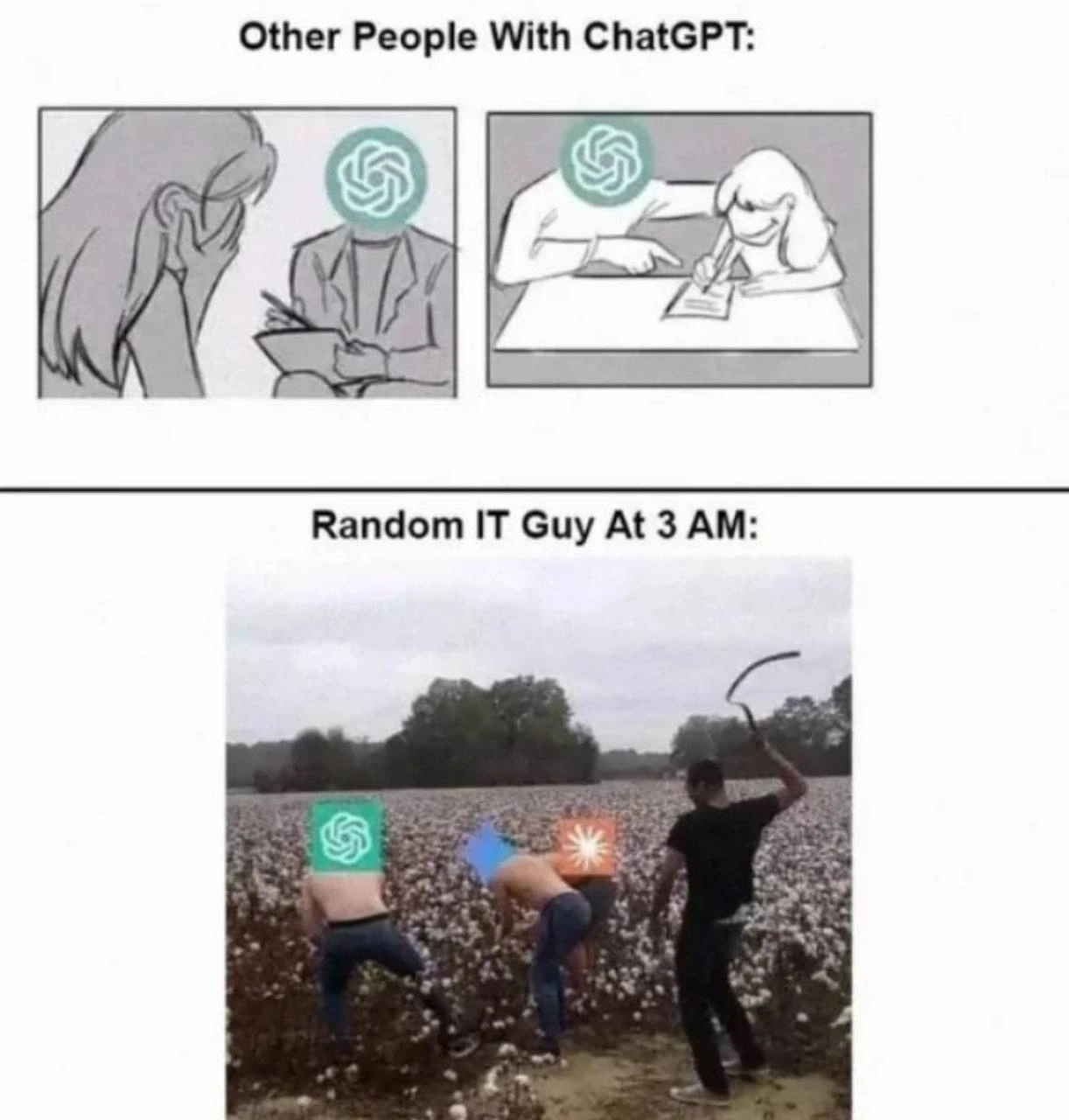
Top Caption – “Other People With ChatGPT:” shows two gentle, comic-style illustrations in gray:
- In the first panel, a person appears to be upset or anxious, and an entity with the ChatGPT logo for a face sits across, calmly holding a notepad like a therapist. This implies that many people use ChatGPT in a friendly way, maybe to talk through a problem or get advice. It’s common that developers will ask ChatGPT to explain an error or to walk through a solution, and ChatGPT responds very patiently. The meme depicts ChatGPT as literally a therapist here, meaning it listens and guides you, in a calm manner.
- In the second panel, a person is working in a notebook, and ChatGPT (logo-face character) is beside them, pointing at the notebook like a teacher or tutor. This represents using ChatGPT as a learning aid or a pair-programming buddy. For example, a developer could say “I’m stuck on how to optimize this function,” and ChatGPT might gently show how to do it, step by step. The student in the image is smiling – it’s a positive, supportive interaction. So, “Other people with ChatGPT” = normal, friendly, educational interactions. ChatGPT is like a polite assistant who helps you understand things or generates code while you collaborate and learn.
Bottom Caption – “Random IT Guy At 3 AM:” is a stark, real-life image: It shows an actual cotton field with three men bent over picking cotton, and one man standing behind them wielding a whip. The three workers have superimposed icons on their heads: the green ChatGPT logo, the blue Bing logo, and the orange Zapier logo. The man with the whip is not labeled with text, but contextually that’s the “Random IT Guy” – basically the on-call programmer. This bottom scene uses the extreme metaphor of forced labor (picking cotton under a whip, historically associated with slavery in plantations) to illustrate how the on-call person is treating the AI tools. Instead of kindly asking for help, he’s demanding results from them, relentlessly. The phrase “unpaid interns” in the title is key – interns are often newbies who do a lot of grunt work, and unpaid ones do it for experience rather than money. Here the AI tools are the “unpaid interns” — they’re doing lots of work (scouring knowledge, suggesting fixes, executing tasks) at the command of this IT guy, and of course they aren’t paid (they’re just software).
So, in simpler terms: the meme highlights the difference in attitude and usage. Most people use AI helpers like ChatGPT in a polite, calm way (especially during normal working hours) – you have a back-and-forth, you learn or get help gradually. But this one IT guy, when faced with a 3 AM emergency, is using ChatGPT, Bing, and Zapier as if they’re his slaves to solve the problem immediately. He’s probably typing things like a drill sergeant: “Fix database NOW!” or “Give me a script to patch this bug, fast!” into ChatGPT, then copying the result to run it, and simultaneously asking Bing “What does error 503 mean? Tell me NOW,” and setting up Zapier to reboot some service automatically. The meme exaggerates it by showing a whip and forced labor, which is what makes it darkly funny: obviously we don’t really whip software, but it feels like we’re brutally wringing answers out of these systems when we’re desperate and panicked.
For a junior developer (or someone new to this world), a few takeaways and relatable points:
- On-call stress is real: If you haven’t experienced it, imagine being woken up and having to fix something you might not fully understand while half-asleep. Not fun! People will use any help available – that might mean frantically searching Google/StackOverflow (old school) or now asking AI for hints.
- AI assistants are like super-smart coworkers: ChatGPT and others can be amazingly helpful, but they respond to how you prompt them. During calm times, you might craft a detailed question. During panic, you might bark orders in a less-than-friendly way. The meme jokes on that contrast.
- “Unpaid intern” analogy: Developers often joke that ChatGPT is like a junior programmer who can write code for you. It’s fast and eager, but sometimes makes mistakes or hallucinates (meaning it might confidently state something that’s wrong or made-up). That’s why in real life, you shouldn’t blindly trust an AI’s first answer—just like you’d double-check an intern’s work. In the meme, though, the on-call guy is so desperate he’s basically treating the AI output as gospel, as long as it stops the alarm.
- Everything including the kitchen sink: The presence of Zapier (automation) with ChatGPT and Bing shows the guy is using every tool in the toolbox. This is common in crises: restart the server (automation), search the error online (Bing), ask an expert or AI for insight (ChatGPT). The meme humorously personifies each tool as a laborer in the field. It’s a funny image because we usually don’t think of software that way, but the meme turns them into “people” being ordered around.
In essence, the meme uses an over-the-top image to get a chuckle out of developers: it captures how in an on-call nightmare, you might end up treating your fancy AI helpers in a not-so-nice way, basically yelling “work harder, solve this!” at your screen. It’s highlighting a truth of modern Developer Experience: these days, when things go wrong, our first instinct might be “ask the AI for help,” and if that doesn’t work, “ask another AI,” and so on. It’s poking fun at that dependency. For someone early in their career, it’s both a funny comic and a hint: as amazing as AI tools are for DeveloperHumor and productivity, they can become a crutch. And if you ever find yourself in this poor IT guy’s shoes at 3 AM, you’ll remember this meme and hopefully laugh, even just a little, before diving into your own arsenal of AI-assisted fixes.
Level 3: Generative Servitude
At 3 AM in a production outage, all bets are off. The meme's bottom half epitomizes a desperate on-call engineer harnessing every AI assistant at hand like a digital sweatshop. The top half shows ChatGPT acting like a polite tutor or therapist during normal daylight use: Other people have friendly, civilized exchanges with the AI (imagine a calm code review or gentle pair-programming session). But come the graveyard shift, the "Random IT guy at 3 AM" isn't having a polite chat – he’s frantically cracking the whip (literally, in the image) at a trio of AI logos in a cotton field. It’s an outrageous visual metaphor: ChatGPT’s swirl icon (green), Microsoft’s blue Bing assistant, and an orange starburst (likely the logo of Zapier or some automation bot) are depicted as shirtless laborers forced to pick cotton under threat. Dark humor? Absolutely – it exaggerates how an exhausted dev might exploit every AI tool like unpaid interns to triage a critical incident. If you've ever been on-call for a production issue, you recognize the truth beneath the absurdity: at ungodly hours, we treat our tools less like polite collaborators and more like indentured servants tasked with saving our bacon.
For seasoned developers, this lands close to home. We've all had that OnCall_Nightmare where the runbook is sparse, the dashboard is blinking red, and our brain is running on fumes. In those moments, reaching for an LLM feels like summoning a tireless junior engineer who never sleeps (and conveniently doesn’t charge overtime). The meme brilliantly contrasts daytime Developer Experience with the after-hours scramble: by day you might use ChatGPT to gently explain a bug or get code suggestions, but by night you’re essentially shouting “JUST FIX IT!” into the void of a chat box. The top panels depict the idealized AIAssistant interaction – the AI as a helpful guide, improving your DeveloperProductivity in a friendly way. The bottom image shows the reality of a panicked 3AM incident response: our “assistant” is now a chained workhorse. The humor lies in this role reversal – the AI hasn’t changed, we have, once panic sets in. It’s developer humor with a tech twist: normally ChatGPT is like a wise mentor, but under pressure it becomes the exploited intern who gets all the dirty work.
This joke also satirizes the growing AI_tool_overreliance in our industry. Seasoned devs chuckle (and cringe) because they’ve seen teams treat Stack Overflow, Google, and now ChatGPT as the source of truth for every error. The meme exaggerates that trend – the on-call engineer isn’t just asking one AI for help, he’s turning it into an AI assembly line: querying ChatGPT, then asking Bing's GPT-powered chat for a second opinion, and even chaining a workflow in IFTTT or Zapier (that orange starburst) to brute-force a fix. It’s essentially ChatOps gone feral. ChatOps refers to using chatbots and real-time chat integration to manage operations (think Slack commands to deploy servers). Here we have a one-man ChatOps scenario at 3AM: the engineer is effectively saying "AI-as-a-Service, do my bidding!". Each AI is being treated like a microservice in a panic pipeline: LLM, find the cause!; other LLM, compare it with latest info on the web!; automation bot, restart that container now!. The workflow is half genius, half desperation.
# "AI-assisted" runbook pseudo-steps for a 3 AM Sev-1 incident:
issue = get_current_incident_details() # e.g., error logs, metrics from monitoring
for assistant in [chatGPT, bingAI, zapier_bot]:
suggestion = assistant.propose_fix(issue)
if suggestion and test_in_sandbox(suggestion):
apply_to_production(suggestion)
if system_status() == "GREEN":
break # Stop once one AI's fix brings the system back to healthy
else:
escalate_to_human_on_call("Team_Lead") # If all AI fixes fail, wake the actual human (last resort)
In the code above, the on-call script tries each assistant in turn, much like the meme’s engineer working the AI cotton field. First ask ChatGPT for a fix; if that doesn’t pan out, turn to Bing AI (with its presumably more up-to-date web knowledge, handy for obscure errors). If Bing also draws a blank or gives a bogus solution, fire up an automated Zapier workflow or some script to kick the system or roll back a deployment (zapier_bot stands in for any quick automation). Only after exhausting these does our hero finally escalate_to_human_on_call — which is basically admitting defeat, akin to calling your boss or the senior architect awake. This snippet captures the meme’s essence: throw every bot at the problem before bothering a human. It’s both a time-saving strategy and a tongue-in-cheek commentary on modern dev culture.
Why is this hilarious to veteran engineers? Because we’ve been there, and it’s only slightly exaggerated. The AI_ML revolution has given us incredible tools, but also a new kind of crutch. At 3 AM, when you’re bleary-eyed, it’s easier to believe “maybe the AI knows this obscure error” than to methodically comb through 5,000 lines of logs. The meme uses the extreme imagery of forced labor to highlight how ruthless and borderline absurd this overreliance can get. The on-call guy with the whip isn’t bothering with “please” or “could you explain” – he’s in survival mode, treating these AI as if they’re his slaves. This plays on the trope that LLMs are like very fast, somewhat unreliable junior devs: they’ll work all night on code, but you must double-check they aren’t doing something stupid. In a crisis, a senior dev might indeed bark orders at a real junior: “Just restart the damn database, NOW!”. Here the LLMs are the juniors, except they don’t get paid and won’t quit.
There’s a layer of cynical truth: the DeveloperExperience_DX of on-call life can be so brutal that you’ll take help wherever you can get it. The meme also jabs at how organizations might implicitly encourage this behavior. Properly maintaining runbooks and documentation is hard; why not just lean on an AI that’s read the whole internet? In theory, an LLM has seen every Stack Overflow post about your error – so at 3 AM, it’s tempting to trust it over your own foggy brain. It’s a bit like an off_hours_hacking session where you MacGyver a solution with whatever’s at hand. Our cynical veteran inside whispers: “Sure, let the transformer model that doesn’t actually run our stack dictate the fix – what could go wrong?”. We laugh because we know the risks: the AI might confidently prescribe deleting your entire database (“it works on my prompt tests!”) or some other catastrophe. That’s akin to an overzealous intern suggesting a dangerous quick fix because they lack context. The tired engineer might be so desperate he’ll try it anyway.
Finally, there’s a historical irony here. Ten years ago, the “unpaid intern at 3 AM” might have been a real junior developer, or just you scrolling through server logs with Stack Overflow as your lifeline. Now in the era of ChatGPT (by 2025, practically everyone’s free intern AI), we’ve simply traded one crutch for another. The meme is essentially saying: we solved none of the core issues (systems still break at 3 AM, humans still panic), we just recruited AI into our madness. At least the AI won’t get mad or tired – though it might throw an error of its own or give a cheeky “I’m sorry, Dave, I’m afraid I can’t do that” if you push it too hard. It’s a bittersweet laugh for any developer: we’ve come so far with tech, yet here we are, still bleary-eyed at 3 AM, whipping our tools to bail us out.
Description
A two-panel meme contrasting different uses of AI. The top panel, labeled "Other People With ChatGPT:", shows two illustrations: one of a person in a therapy session with a ChatGPT-headed therapist, and another of a person getting writing help from a ChatGPT-headed figure. The bottom panel, labeled "Random IT Guy At 3 AM:", shows a photo of a man in a dark shirt brandishing a whip over two figures in a cotton field. These figures have their heads replaced with AI logos - ChatGPT on the left, and what appears to be Perplexity AI and another AI on the right - as they are forced to "pick cotton." The meme humorously contrasts the mainstream, gentle uses of AI (like therapy or homework) with the intense, demanding, and often exploitative way developers and IT professionals use them. Forcing AIs to "pick cotton" at 3 AM is a metaphor for running heavy-duty scripts, benchmarks, data processing, or complex automations that push the models to their operational limits, often during late-night work sessions. It's a joke about treating these sophisticated tools as tireless workhorses for complex, unglamorous tasks
Comments
16Comment deleted
Normal users ask ChatGPT for a poem; senior engineers are up at 3 AM feeding it terabytes of raw logs and threatening it with a model downgrade if the anomaly detection script isn't finished by sunrise
Sure, ChatGPT can be your rubber duck during daylight - just don’t be surprised when your 3 AM incident runbook looks like: `while(alerts!=0) { whip(llmPool); }`
While product managers use ChatGPT to write user stories, we're out here at 3 AM trying to jailbreak it into explaining why our distributed system's eventual consistency model is actually a philosophical statement about the nature of truth in Byzantine fault-tolerant consensus algorithms
While others use ChatGPT to write emails, senior engineers at 3 AM are locked in mortal combat with it, desperately trying to coax working code out of hallucinated solutions while their production system burns
Normies converse with ChatGPT; the 3AM SRE exorcises fixes from it with scythe-level prompt aggression
At 3am, AIOps means coercing ChatGPT into a bash one-liner you paste into the prod pod, roll the DaemonSet, and pray tomorrow’s RCA calls it runbook automation
At 3am, ChatGPT isn’t a tutor - it’s your unpaid SRE cranking out a one‑off sed/PowerShell incantation that gets documented retroactively in the blameless postmortem
Fact 🔪 Comment deleted
Who is the blue guy? Comment deleted
Gemini Comment deleted
Why not deepseek Comment deleted
Wrong shape for the logo lol Comment deleted
different version in another internet Comment deleted
So what the 'update meme' means? Sorry if im a bit stupid Comment deleted
Idk maybe author meant reversing roles 😅 Comment deleted
he meant that we need to remake that meme with newer context Comment deleted