Skip to content
DevMeme
The Perils of Sleep Deprivation and Edge Case Testing
MentalHealth Post #46, on Feb 1, 2019 in TG

The Perils of Sleep Deprivation and Edge Case Testing

Why is this MentalHealth meme funny?

Level 1: Typing on a Pizza Box

A man finishes checking his app and proudly says it's ready. Then a platypus in a pirate hat asks, "But did you check it works for pirate platypuses?" — and instead of saying "that's ridiculous," the man panics and starts checking. Two days later he's still at it, so tired he's typing on a pizza box instead of his laptop and doesn't notice. It's like a kid who won't go to bed because they're making sure their sandcastle is safe from dragons — so sleepy they're now patting a lunchbox instead of the sandcastle. The funny part is he's worried about the imaginary problem while missing the real one: he desperately needs to sleep.

Level 2: Edge Cases, QA, and Knowing When to Stop

Key concepts the comic is juggling:

  • An edge case is an unusual input or situation at the boundary of what your software expects — a user with a 1,000-character name, a purchase at exactly midnight on a leap day, or, here, a platypus that is also a pirate. Good testing covers realistic edge cases; great testing knows which ones are worth the time.
  • QA (Quality Assurance) is the discipline of systematically verifying software before release. A core skill is prioritization: you can't test everything, so you rank scenarios by likelihood and damage. "Pirate platypus" scores zero on both axes.
  • Crunch is the practice of working extreme hours before a deadline. The comic's 49 hours is barely an exaggeration of real release weeks, and the pizza-box typing is what the resulting "productivity" actually produces.

The early-career arc this maps to: your first "done" feature gets destroyed by an input you never imagined, and you overcorrect — suddenly you're writing tests for scenarios no user will ever trigger, at 2 AM, on your fourth coffee. Both ditches border the same road. The skill that takes years is the middle: test what matters, then go to sleep, because a rested developer catches in five minutes the bug an exhausted one ships to production.

Level 3: The Pirate-Platypus Coverage Matrix

The comic opens with the most dangerous sentence in software:

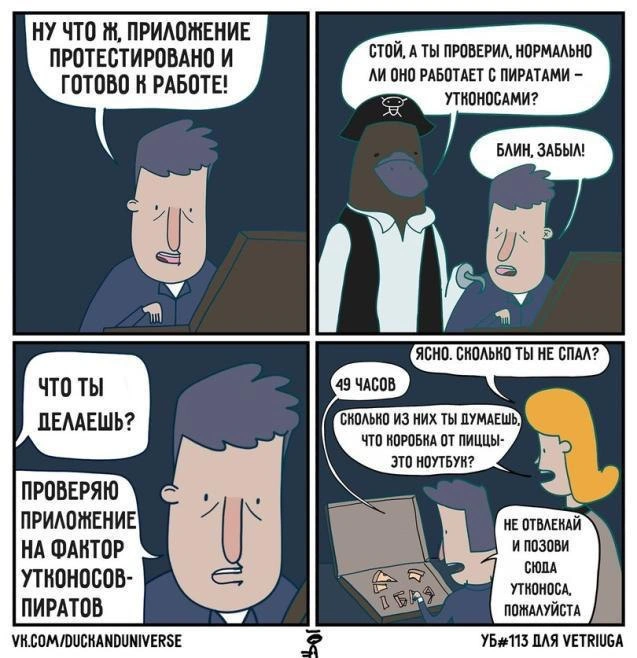
Ну что ж, приложение протестировано и готово к работе! ("Well, the app is tested and ready to go!")

Any QA engineer will tell you this declaration summons trouble the way "should be a quick fix" summons a weekend incident. And trouble duly arrives — in the form of a platypus in a pirate hat asking whether the app was checked for compatibility with pirate platypuses. The developer's response is the punchline that lands hardest with practitioners: «Блин, забыл!» ("Damn, forgot!"). He doesn't question the requirement. He doesn't ask for a user story, a priority, or evidence that pirate platypuses exist in the target market. He just accepts it and starts testing.

That reflex is the satire's true target. Edge-case testing is genuinely virtuous — Dijkstra's old line that testing shows the presence of bugs, never their absence, is exactly why testers probe weird inputs. But there's a failure mode where edge-case pursuit becomes unfalsifiable: the combinatorial space of "what if X and Y and a hat" is infinite, so without risk-based prioritization you can always conjure one more exotic scenario. Teams burn release windows verifying the pirate-platypus path while the happy path — the one 99% of users walk — ships untested. It's the QA flavor of bikeshedding: the absurd case is concrete and fun, the boring case is just boring.

The fourth panel turns the knife from process satire to crunch culture. The blonde woman's escalating questions — «Сколько ты не спал?» ("How long have you been awake?") / «49 часов» / "For how many of those have you thought a pizza box is a laptop?" — reveal the developer typing earnestly on an open pizza box, slices still inside. And here the comic does something quietly clever: it retroactively undermines its own second panel. Was the platypus ever real, or is the entire requirement a 49-hour-awake hallucination — the same epistemic state as the pizza-box laptop? His answer, «Не отвлекай и позови сюда утконоса, пожалуйста» ("Don't distract me, and call the platypus over here, please"), confirms he can no longer tell. Sleep deprivation research consistently shows cognition after ~48 sleepless hours degrades below legal intoxication thresholds — which means the industry's crunch-deadline tradition is, functionally, asking people to ship production code drunk, and then acting surprised when both the bugs and the requirements turn out to be imaginary.

Description

A four-panel comic strip in Russian depicting a sleep-deprived developer. Panel 1: The developer sits at his desk, saying, 'Well, the application is tested and ready to go!' Panel 2: A platypus wearing a pirate hat appears and asks, 'Wait, did you check if it works correctly with pirate platypuses?' The developer replies, 'Damn, I forgot!' Panel 3: A woman off-panel asks, 'What are you doing?' The developer responds, 'I'm checking the application for the platypus-pirate factor.' Panel 4: The woman asks, 'I see. How long have you been awake?' The developer, who is now using an open pizza box with slices as a keyboard, answers, '49 hours.' The woman continues, 'For how many of those hours have you thought a pizza box is a laptop?' The developer, fully delusional, says, 'Don't distract me and call the platypus over here, please.' The comic humorously illustrates the effects of extreme burnout and sleep deprivation, where a developer fixates on an absurd, nonsensical edge case (pirate platypuses) to the point of hallucination. It's a relatable scenario for any engineer who has worked through crunch time and started losing their grip on reality

Comments

8
Anonymous ★ Top Pick That 'pirate platypus' is just the stakeholder who shows up to the last sprint review with a 'minor' requirement that breaks the entire data model
  1. Anonymous ★ Top Pick

    That 'pirate platypus' is just the stakeholder who shows up to the last sprint review with a 'minor' requirement that breaks the entire data model

  2. Anonymous

    After 49 hours awake I’m typing on a pizza box, QA’s filing a “pirate-platypus” blocker, and our dashboard still says 95% coverage - turns out the only thing we don’t mock is reality

  3. Anonymous

    "The app is tested and ready for production" - the three most expensive lies in software, right after "it works on my machine" and "we'll refactor it in the next sprint"

  4. Anonymous

    Test coverage at hour 49: pirate-platypus path fully verified, happy path untested, and the staging environment is a pizza box - ship it

  5. Anonymous

    Every senior engineer knows that moment when stakeholders ask 'Did you test for [absurdly specific edge case]?' 48 hours before launch. The pirate-unicorn leak is just a metaphor for that one integration nobody thought to test until the VP remembered their enterprise client runs a custom fork of the protocol from 2003. Now you're 49 hours deep, the specialist is on vacation, and production deployment is scheduled for Monday morning

  6. Anonymous

    Enterprise QA in a nutshell: the instant someone asks “did we test with pirate platypuses?”, it becomes a P0, your pizza box is a laptop, and the test pyramid turns into a Jenga tower

  7. Anonymous

    VR asset QA: platypus jaw blendshapes demand systematic tests, backend CMS serves dog UI - time to rm -rf the Kube cluster

  8. Anonymous

    PM: did we test with pirate platypuses? Duck typing says they’re supported, license checks say they’re not, and 49 hours in I’m debugging on a pizza box

Use J and K for navigation