Skip to content
DevMeme
The Evolution of 'Hello World!' Over Two Decades
IndustryTrends Hype Post #47, on Feb 4, 2019 in TG

The Evolution of 'Hello World!' Over Two Decades

Why is this IndustryTrends Hype meme funny?

Level 1: A Sandwich as a Service

In 1997, if you wanted to say hello, you just said "Hello!" In 2017, the same hello comes wrapped like a tiny gift inside seven boxes, with a delivery truck, a tracking app, a subscription plan, and a certificate explaining how revolutionary the wrapping is. It's like asking for a peanut butter sandwich and receiving an "artisanal, deconstructed, farm-to-table sandwich experience, delivered as a service" — and inside, it's the exact same sandwich. The joke is that computers didn't get better at saying hello; we just got spectacularly fancier about describing it.

Level 2: Decoding the 2017 Sentence

Each buzzword, translated to what it actually does:

  • Hello World — the traditional first program in any language; it just prints the phrase "Hello World!". It's the universal "is this thing on?" of programming.
  • Cloud Native — designed to run on rented infrastructure (AWS, Azure, GCP) instead of your own servers, scaling up and down on demand.
  • Containerized — packaged with Docker-style containers, which bundle the app with everything it needs so it runs the same on any machine.
  • k8s — abbreviation for Kubernetes (k + 8 letters + s), the system that schedules and supervises fleets of containers.
  • RESTful microservice — a small program exposing its function over standard web requests, designed to be one of many small cooperating services rather than one big application.
  • ARMv7 — a processor architecture (think Raspberry Pi and phones), thrown in because hardware buzzwords inflate too.
  • as a service — the business-model suffix (SaaS, PaaS): you don't ship software, you host it and charge subscriptions.

The early-career trap this warns about: tutorials make you feel that printing text "properly" requires all of the above, and your first week is spent debugging YAML indentation instead of writing code. The honest sequence is the historical one — make it work in one file first, and add layers only when a real problem demands each layer. The 1997 version isn't outdated; it's step one, and it never stopped being step one.

Level 3: Thirteen Bytes, Twelve Buzzwords

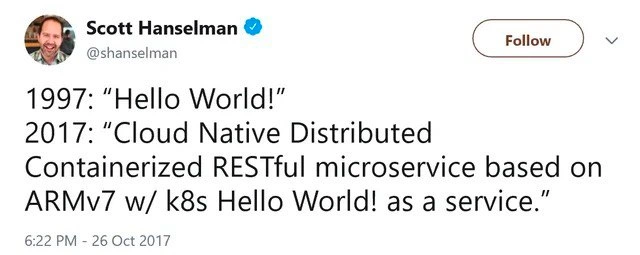
1997: "Hello World!" 2017: "Cloud Native Distributed Containerized RESTful microservice based on ARMv7 w/ k8s Hello World! as a service."

The tweet — from Scott Hanselman, a Microsoft developer-relations veteran whose entire job is watching the industry talk about itself — is a compression algorithm for twenty years of architectural drift. The output is identical: thirteen characters to stdout. What changed is the stack of justifications wrapped around it, and the joke works because every word in the 2017 version is individually defensible and collectively absurd.

That's the precise mechanism of stack inflation: no single step is irrational. Containers genuinely solve "works on my machine." Kubernetes genuinely solves container orchestration at fleet scale. REST genuinely standardizes service interfaces. Microservices genuinely decouple teams at organization scale. The pathology is that each tool's qualifier — at scale, for many teams, across regions — gets silently dropped when it cascades down to a two-person project printing a greeting. Google needed Borg because Google had Google's problems; the industry adopted Borg's descendant (k8s) along with Google's problems it didn't have. Cargo-culting at its purest: replicate the artifacts of success, hope the success follows.

The economic engines behind this are worth naming, because they're why smart people keep doing it. First, résumé-driven development — in 2017's hiring market, "ran k8s in production" was worth more than "correctly judged that we didn't need it," and it still is. Second, vendor gravity: "Cloud Native" and "as a service" are not engineering terms, they're billing models — each layer of the 2017 sentence corresponds to a line item on someone's invoice. Third, conference-driven architecture: nobody gives a keynote titled "We Used a Single Server and It Was Fine." The deep irony Hanselman gestures at with the date pairing: 1997's CGI script on shared hosting had, in a real sense, better operational properties for this workload — one file, one deploy, debuggable with print. The complexity wasn't added to make Hello World work. It was added to make it presentable.

Year Artifact Time to first "Hello World!"
1997 one .c or .pl file minutes
2017 Dockerfile, Helm chart, CI pipeline, YAML, cluster the sprint after next

Description

A screenshot of a tweet from user Scott Hanselman (@shanselman), a recognizable figure in the developer community. The tweet, dated 6:22 PM - 26 Oct 2017, presents a stark contrast between the quintessential first program, 'Hello World!', in two different eras. The first line reads: '1997: "Hello World!"'. The second line presents a far more complex version: '2017: "Cloud Native Distributed Containerized RESTful microservice based on ARMv7 w/ k8s Hello World! as a service."'. This meme humorously critiques the explosion of complexity in software development. It satirizes the industry's love for buzzwords and the elaborate architectural overhead now considered for even the simplest of applications, a sentiment that deeply resonates with experienced engineers who have witnessed this evolution firsthand. The joke lies in the absurd level of over-engineering applied to a program that is fundamentally meant to be the simplest possible starting point

Comments

8
Anonymous ★ Top Pick The real joke is the 1997 version compiled and ran. The 2017 version is still in a CrashLoopBackOff because its YAML file has an indentation error
  1. Anonymous ★ Top Pick

    The real joke is the 1997 version compiled and ran. The 2017 version is still in a CrashLoopBackOff because its YAML file has an indentation error

  2. Anonymous

    Modern “Hello, World!”: 4 Helm charts, a service mesh, and a post-mortem explaining why the greeting was rate-limited by an Envoy sidecar

  3. Anonymous

    The best part is explaining to the new hire why our Hello World needs 47 environment variables, a service mesh, and three separate CI/CD pipelines just to print to stdout

  4. Anonymous

    Same 13 bytes of output, but now it needs a Helm chart, three sidecars, and an SRE rotation - and it still prints to a stdout nobody is tailing

  5. Anonymous

    Twenty years of progress: we went from writing 'Hello World' in 5 minutes to spending 5 days configuring the infrastructure to deploy it. At least now it scales to handle the zero users who will actually run it, and we can brag about our service mesh at the next architecture review. The real achievement? Turning a single printf statement into a distributed system that requires three teams, two cloud providers, and a dedicated SRE to keep it running at 99.9% uptime

  6. Anonymous

    Progress is when the getting-started lab needs a Helm chart, a service mesh, three CRDs, an ARM node pool, and a FinOps line item - yet the only output is still Hello, World

  7. Anonymous

    We’ve progressed from printf to platform engineering: printing “Hello” now needs a Helm chart, a sidecar, and a P99 SLO - plus a change request for multi‑region

  8. Anonymous

    Hello World on k8s: because who needs printf when you can Helm release a namespace for one echo?

Use J and K for navigation