Skip to content
DevMeme
The Slippery Slope of Over-Optimization
DevCommunities Post #8, on Jan 22, 2019 in TG

The Slippery Slope of Over-Optimization

Why is this DevCommunities meme funny?

Level 1: The Shopping List Argument

Someone says: "I want to make a little to-do list on my computer." A friend says that's way too complicated — just shout commands into the machine directly. Another says even that's too much — use paper and pencil. The next says paper is for the weak — just remember your tasks. And the last one says remembering is wasteful too — the truly efficient person simply stops wanting to do things at all. It's funny because each person sounds more "sensible" while the advice gets more insane, until the perfect productivity system turns out to be lying on the floor wanting nothing — which is exactly how arguing on the internet about the "right way" to do something usually ends.

Level 2: The Stack Being Argued About

The technologies name-dropped, and why each is a tribal marker:

  • HTML, CSS, JavaScript — the irreducible trio of the web: structure, styling, behavior. Genuinely the minimum for a browser TODO list.
  • jQuery — the dominant JavaScript library of 2006–2015, smoothing over browser differences with $('#button').click(...). By 2016 it was the symbol of the previous generation's "bloat" — which is the first joke: the beginner's stack is already humble, and still gets rejected.
  • telnet — an ancient protocol for typing commands at a remote machine over a raw, unencrypted connection. Suggesting it for a web app UI is like suggesting smoke signals for a video call.
  • ssh — telnet's encrypted successor. The line "if you want security — use ssh" parodies real security advice by technically being correct and utterly missing the point.
  • Overhead — extra resource cost added by each layer of tooling. The thread's engine: any tool can be framed as overhead relative to a simpler one.

The early-career experience this maps to: you ask a forum how to start your first project, and instead of an answer you get a philosophy war between people who haven't built a TODO list in years. The practical lesson hiding in the satire — pick the simplest stack that solves your problem and ignore both the framework maximalists and the telnet ascetics — is real advice that survives the joke.

Level 3: Overhead All the Way Down

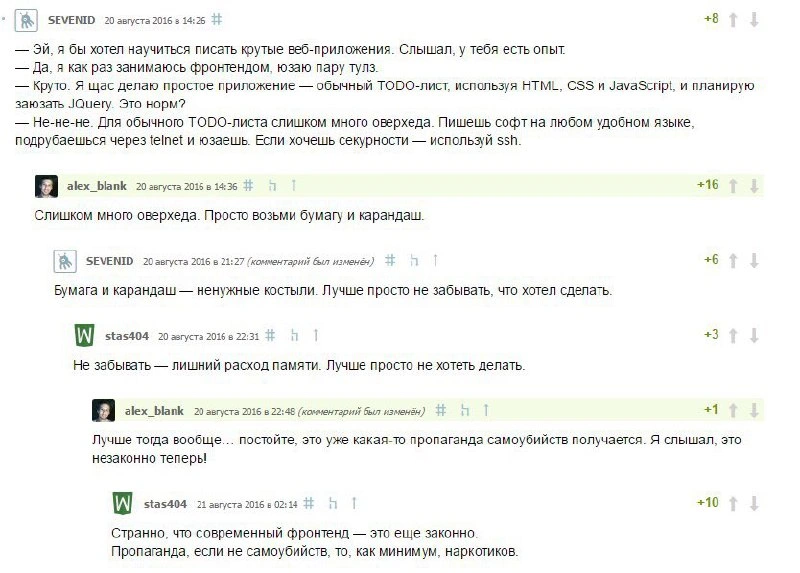
This Habr thread (timestamped August 20, 2016, karma scores and all) is a perfect specimen of reductio ad absurdum applied to the eternal "your stack has too much overhead" argument — and the community voted accordingly: the pivotal escalation sits at +16, the highest score on screen. The setup is SEVENID's mock dialogue: a beginner wants to build "a simple application — a regular TODO list, using HTML, CSS and JavaScript, planning to use jQuery". The in-dialogue expert scoffs: too much overhead for a TODO list — write software in any convenient language, connect via telnet, and if you want security — use ssh. The thread then executes a flawless induction proof:

alex_blank: «Слишком много оверхеда. Просто возьми бумагу и карандаш.» — Too much overhead. Just take paper and a pencil. SEVENID: paper and pencil are unnecessary crutches — better to simply not forget what you wanted to do. stas404: «Не забывать — лишний расход памяти. Лучше просто не хотеть делать.» — Remembering wastes memory. Better to just not want to do anything.

Each reply applies the same optimization function — eliminate the dependency — until the program being optimized is human desire itself. The fixed point of minimalism is nirvana, or as alex_blank notes with alarm, something that's "turning into suicide propaganda... I heard that's illegal now" (a pointed jab at Russia's then-recent internet content laws). stas404's +10 closer flips the whole frame: strange that modern frontend is still legal — it's propaganda of, if not suicide, then at least drugs.

The reason this thread became canon is that 2016 was peak JavaScript fatigue. The distance between "I want a TODO list" and a runnable project had grown to include npm, Webpack, Babel, transpilation targets, framework choice paralysis — the TODO app was literally the benchmark genre (TodoMVC existed precisely to compare 30+ frameworks implementing the same trivial list). Both extremes get skewered: the maximalist who needs 400 dependencies for a checkbox, and the graybeard whose answer to every web question is "telnet was fine." The thread understands something the actual flame wars don't: "overhead" is unfalsifiable as an argument, because there is always a layer below you that someone considers bloat. The only consistent position is wanting nothing — and the thread dutifully arrives there in four comments.

Description

A screenshot of a Russian-language forum discussion from 2016 about programming practices. The initial post by user SEVENID discusses building a simple TODO-list application with HTML, CSS, JavaScript, and jQuery, asking if it's 'too much overhead.' The conversation then spirals into a satirical, escalating series of suggestions to reduce 'overhead.' A user named alex_blank suggests using 'paper and a pencil.' SEVENID replies that's an 'unnecessary crutch' and it's better to 'just not forget what you wanted to do.' User stas404 escalates further, stating that remembering is a 'waste of memory' and it's better 'to not want to do things.' The joke culminates in alex_blank pointing out that this logic is becoming 'propaganda for suicide,' and stas404 finishing with a jab that it's 'strange that modern front-end is still legal.' The humor is a classic 'reductio ad absurdum' argument, mocking the developer obsession with minimalism and avoiding overhead to the point of complete inaction. For senior engineers, it's a hilarious and relatable parody of bike-shedding and architectural purity debates that lose sight of practical goals

Comments

8
Anonymous ★ Top Pick The final architecture review concluded that the most efficient way to manage a TODO list is to achieve a state of enlightenment where desires and tasks cease to exist. The project was a success, producing zero lines of code and infinite ROI
  1. Anonymous ★ Top Pick

    The final architecture review concluded that the most efficient way to manage a TODO list is to achieve a state of enlightenment where desires and tasks cease to exist. The project was a success, producing zero lines of code and infinite ROI

  2. Anonymous

    If your solution architecture ends with “just stop wanting features,” you’ve reached true zero-latency serverless - by decommissioning the user story itself

  3. Anonymous

    "2016: When setting up a TODO app required SSH and telnet. Now in 2024, it requires 47 npm packages, 3 build tools, a state management library, and a PhD in webpack configuration. The real progress was the existential crisis we developed along the way."

  4. Anonymous

    The thread independently rediscovered the only zero-dependency frontend stack: not wanting anything. Still ships faster than create-react-app

  5. Anonymous

    A junior asks how to build a TODO app with HTML, CSS, and JavaScript. A senior suggests paper and pencil. Another senior counters that memory is cheaper. The architect chimes in: 'Not wanting to do anything eliminates all technical debt.' Meanwhile, the frontend framework they'd have chosen is already deprecated, proving that sometimes the best code is the code you never write - because by the time you finish the toolchain setup, the requirements have changed anyway

  6. Anonymous

    Heuristic: when the dependency graph of a TODO list exceeds the number of tasks, migrate to Paper 1.0 - offline‑first, zero build, and the only state management that never regresses

  7. Anonymous

    Vanilla JS: Merging flag stripes into socialist solidarity faster than any state monad

  8. Anonymous

    We rewrote the TODO as ssh + grep + todo.txt and replaced the backlog with “don’t want to do it” - zero bundle size, perfect DX, and the only dependency that won’t be deprecated mid-sprint

Use J and K for navigation