NoSQL Bar: Where's the Table?
Why is this Databases meme funny?
Level 1: The Restaurant With No Chairs
Three people whose whole job is organizing things into neat grids walk into a place that proudly threw all its grids away — so they turn around and leave, because the one word in their world, "table," means nothing here. It's the same gag as a librarian walking into a bookstore where all the books are loose pages in buckets. The humor is that one little word means two completely different things, and the people most attached to the old meaning are the ones left standing awkwardly by the door.
Level 2: What's Actually Missing From the Bar
- Table — in a relational database (MySQL, PostgreSQL, Oracle), data lives in tables: rows and named, typed columns, like a strict spreadsheet.
SELECT * FROM usersreads one. - SQL — the standard language for querying those tables, built around joining them together.
- NoSQL — an umbrella for databases that don't use tables: document stores (MongoDB — data as JSON-like blobs), key-value stores (Redis — a giant dictionary), graph databases (Neo4j — nodes and edges). Each picks a different shape because tables scale awkwardly across many servers.
- DBA (Database Administrator) — the specialist who designs, tunes, and protects databases; traditionally a deeply table-centric job.
You typically meet this joke's reality in your first project that uses MongoDB: you go looking for "the tables" and find collections of free-form documents instead — no fixed columns, no enforced structure. It feels liberating right up until you misspell a field name and the database happily stores it without complaint. That moment — realizing the safety rails you didn't know you had are gone — is the junior-dev version of walking into the bar and finding no table.
Level 3: The Punchline Is a Paradigm War
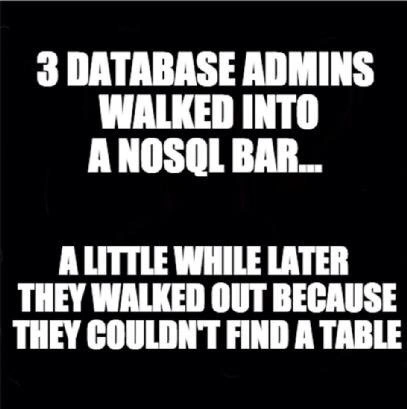
White block capitals on black, setup and beat: "3 DATABASE ADMINS WALKED INTO A NOSQL BAR... A LITTLE WHILE LATER THEY WALKED OUT BECAUSE THEY COULDN'T FIND A TABLE." Minimal format, maximal pun — table as furniture versus table as the core relational structure — and the fact that they're specifically database admins is what gives it teeth. This joke circulated hardest during the MongoDB hype era, when "NoSQL" was less a technology category and more a culture war.
DBAs were the priesthood of the relational order: schema design reviews, normalization to third normal form, query plans, carefully guarded GRANT statements. The NoSQL movement was, in part, a developer rebellion against exactly that gatekeeping — schema-less stores meant you could ship a feature without filing a ticket to add a column. So the image of three DBAs entering, looking around in confusion, and leaving is a precise sociological cartoon: their entire skill set keyed on an abstraction the new world deliberately removed. The walkout cuts both ways, though. Plenty of teams who fired their schemas discovered that the schema didn't disappear — it just moved into application code, undocumented and enforced by nobody, until the day three differently-shaped documents for the same entity met in one query. The industry's eventual synthesis (Postgres adding JSONB, Mongo adding multi-document transactions, the rise of "NewSQL") is the quiet admission that both the bar and the patrons had a point. Sometimes you genuinely need a table; sometimes you just need somewhere to throw your JSON.
Level 4: Codd's Algebra Walks Out of the Bar
The pun has surprisingly deep mathematical roots. A table in the relational world isn't furniture or even really a grid — it's a relation in the set-theoretic sense, from Edgar Codd's 1970 relational model: a set of tuples over typed attributes, manipulated by a closed relational algebra (selection, projection, join, union). That closure property is the superpower — every operation on relations yields a relation, which is what makes arbitrary composable JOINs and declarative SQL possible, and what lets a query optimizer rewrite your query into something efficient without changing its meaning.
NoSQL systems didn't discard tables out of fashion; they discarded them because of distributed-systems physics. The CAP theorem (Brewer's conjecture, later formally proven) says a partitioned distributed store cannot simultaneously guarantee consistency and availability. Cross-record joins and multi-row ACID transactions are brutally expensive to coordinate across partitions — consensus rounds, distributed locks, two-phase commit stalls. So the 2009-era NoSQL wave (Dynamo-style key-value stores, MongoDB's documents, Cassandra's wide columns) made a calculated amputation: shard by key, denormalize aggressively, drop the join, accept eventual consistency. The DBAs in the joke aren't just missing a place to sit — they're missing the entire algebra their profession is built on. No relations means no relational calculus, no normalization theory, no foreign keys enforcing referential integrity. The bar didn't lose its tables; it traded them for horizontal scalability, and the receipt is written in read-repair and conflict resolution.
Description
A classic text-based tech joke presented as a meme. The image has a black background with bold, white, sans-serif text in all caps. The text is laid out in two parts, creating a joke setup and punchline. The first part reads, '3 DATABASE ADMINS WALKED INTO A NOSQL BAR...'. The second part below it delivers the punchline: 'A LITTLE WHILE LATER THEY WALKED OUT BECAUSE THEY COULDN'T FIND A TABLE'. The humor stems from a pun on the word 'table.' For the general public, a table is a piece of furniture found in a bar. For a database administrator accustomed to relational SQL databases, a 'table' is the fundamental data structure used to organize data. The joke cleverly points out that many NoSQL (Not only SQL) databases are non-relational and do not use the traditional table-based structure, instead opting for models like documents, key-value pairs, or graphs. This is a foundational piece of humor for anyone in the data engineering or backend development space, highlighting the paradigm shift from SQL to NoSQL
Comments
8Comment deleted
They asked the bartender for the schema, but just got a cocktail menu. At least the service was eventually consistent
DBA: “Can you make it ACID?” Bartender: “This is a NoSQL joint - we only serve BASE shots; the buzz is eventually consistent.”
They spent the next hour arguing whether the bar needed horizontal scaling or if they should've just normalized their expectations and gone to the PostgreSQL pub down the street
They eventually sat down anyway - the bar just denormalized the table into every customer's pocket and called it 'web scale'
This perfectly captures the existential crisis of a traditional DBA encountering NoSQL for the first time - it's like showing up to a meeting expecting PowerPoint slides and finding out everyone's using Miro boards. The real tragedy isn't that they couldn't find a table; it's that they probably spent 20 minutes trying to normalize the bar's menu into third normal form before realizing they were in the wrong paradigm entirely. Meanwhile, the NoSQL bartender is serving drinks from a schemaless JSON document wondering why these folks keep asking about foreign keys
Welcome to the NoSQL bar: we shard stools, offer eventual seating, and there are no JOINs - bring your own aggregation pipeline
DBAs bailed because NoSQL's schemaless vibe means no normalized joins - just denormalized chaos at happy hour
In practice, “no tables” quickly becomes a join microservice and weekly explanations of eventual consistency to finance - ACID souls surviving in a BASE world