The Ultimate Development Constraint: Coding in Prison
Why is this DevCommunities meme funny?
Level 1: Drawing Masterpieces with a Broken Crayon
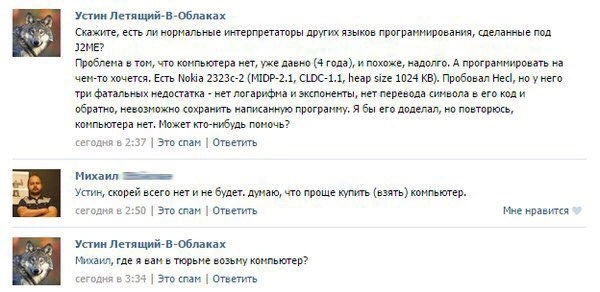
A man asks an online forum for better tools to write programs on his ancient little phone, listing exactly what's wrong with the one tool he found. Someone replies with the obvious advice: "just buy a computer." And he answers: "Where am I going to get a computer in prison?" It's funny the way the world's politest mic drop is funny — the helpful suggestion crashes into a fact nobody saw coming. And under the laugh there's something genuinely touching: someone with almost nothing, wanting so badly to build things that he programs on a phone the way you'd write a novel on the back of receipts.
Level 2: Decoding the Spec Sheet
What the alphabet soup in the screenshot actually means:
- J2ME (Java 2 Micro Edition) — the version of Java that ran on pre-smartphone "feature phones." Before iOS and Android, this was how billions of devices ran games and apps.
- MIDP / CLDC — the two layers of the J2ME platform: CLDC defined the minimal virtual machine and core libraries; MIDP added the app model (MIDlets), UI, and storage. Together they're roughly "the operating system contract" for phone Java.
- Heap 1024 KB — all running program data had to fit in 1 megabyte. A single photo from a modern phone is several times larger.
- Interpreter — a program that reads and executes another program's source code directly. Ustin wanted one so he could write and run code on the phone itself, since he had no PC to compile anything.
- Hecl — a real, tiny scripting language built to run inside J2ME, letting you type and execute programs on the handset.
The relatable core for anyone starting out: your first dev environment always feels inadequate — an old laptop, a locked-down school computer, a browser-based editor. This thread is the extreme end of that spectrum, and the man's response wasn't to quit but to file precise, actionable complaints about the tooling. That habit — describing exactly what's broken, why it blocks you, and what you'd do to fix it — is the most transferable skill in the entire screenshot.
Level 3: The Most Dedicated Developer You've Never Met
The thread reads like a perfectly constructed joke because the punchline is withheld for two whole comments. Ustin (avatar: a wolf, naturally) opens with a calm, deeply technical request for J2ME interpreters, mentioning offhand that he's had "no computer for 4 years, and apparently won't for a long time." A reasonable man named Mikhail offers the reasonable answer every forum produces: such a thing probably doesn't exist, "it's simpler to just buy a computer." Then the reveal, deadpan:
«Михаил, где я вам в тюрьме возьму компьютер?» "Mikhail, where am I supposed to get a computer in prison?"
This became legendary in the Russian-speaking internet because it inverts every complaint the rest of us make. Developers with 64 GB workstations grumble that they can't be productive without a second 4K monitor; this man is doing real engineering — evaluating interpreters, cataloging their flaws with the precision of a bug report, offering to submit fixes — on a candy-bar feature phone with a numeric keypad and a heap smaller than a single modern favicon's npm dependency tree. The meme is simultaneously absurdist comedy and a quiet indictment: the gap between what we have and what we do has never been wider, and motivation was apparently never about tooling.
There's also a sharp lesson about answering questions on the internet buried in Mikhail's reply. "Just buy a computer" is the canonical unhelpful answer that ignores stated constraints — the forum equivalent of closing a ticket with "works on my machine." Ustin explicitly said the no-computer situation was long-term; the constraint wasn't a preference to be optimized away, it was the entire problem. Every senior engineer has watched this exact exchange play out in issue trackers: a user describes an exotic environment, and the first reply tells them to stop having that environment.
Level 4: A Virtual Machine in a Kilobyte Cage
The technical specs Ustin rattles off — Nokia 2323c-2 (MIDP-2.1, CLDC-1.1, heap 1024 KB) — describe one of the most aggressively constrained execution environments ever deployed at planetary scale. CLDC (Connected Limited Device Configuration) was the stripped-down Java platform for devices with as little as 160 KB of memory, originally running on Sun's KVM — the "Kilobyte Virtual Machine," named for its memory footprint. To fit, it amputated core Java semantics: no reflection, no finalization, no custom class loaders, no JNI, and crucially for this story, CLDC 1.0 had no floating point at all. CLDC 1.1 restored float and double, but java.lang.Math remained gutted — which is exactly why Ustin complains that Hecl has "no logarithm and exponent": Math.log() and Math.exp() simply do not exist in CLDC 1.1. Anyone who needed them implemented Taylor series or table lookups by hand on a phone keypad.
His other two complaints are equally precise. "No character-to-code conversion" means the Hecl scripting interpreter (a Tcl-like language designed to run on top of J2ME, an interpreter inside an interpreter inside 1 MB of heap) didn't expose anything like ord()/chr() — fatal if you're, say, writing your own parser or cipher. And "no way to save a written program" points at MIDP's sandbox: MIDlets couldn't touch a filesystem, only the RMS (Record Management System), a tiny key-value record store that Hecl evidently didn't wire up. Each "fatal flaw" is a one-afternoon patch on a PC — and an absolute wall when your only computing device is the cage itself. The recursion is exquisite: he could fix the interpreter, but fixing it requires the computer whose absence is the reason he needs the interpreter.
Description
A screenshot of a conversation from a Russian-language online forum. The first post is from a user named 'Устин Летящий-В-Облаках' (Justin Flying-In-The-Clouds) with a wolf avatar. He asks if there are any good programming language interpreters for J2ME, explaining he hasn't had a computer for four years and needs to program on his old Nokia 2323c-2, which has only 1024 KB of heap space. He details the technical limitations of an interpreter he tried. A second user, 'Михаил' (Mikhail), replies with the straightforward advice that it would be easier to just buy a computer. The final post is the punchline from the original poster: 'Михаил, где я вам в тюрьме возьму компьютер?' ('Mikhail, where am I going to get a computer in prison?'). The humor is dark and comes from the sudden, unexpected reveal that completely re-contextualizes the technical problem. For experienced developers, it's a stark and memorable story about the sheer will to code despite unimaginable constraints, making everyday complaints about slow build times or old hardware seem trivial in comparison

Comments
8Comment deleted
Forget containerization, this guy is practicing 'incarceration-driven development'. His main problem isn't memory leaks, it's getting shanked for his feature phone
Quit complaining that your 256 MB sidecar is “memory-constrained” - there’s a dev in an actual cell hand-rolling ln() and exp() on a Nokia 2323’s 1 MB heap. Now that’s cell-based computing
The only Stack Overflow answer more reliable than "works on my machine" is one written in Cyrillic at 2:37 AM by someone with a wolf avatar who solved your exact edge case three years ago
A 1024 KB heap, no persistence layer, and an environment you can't leave for 4 years - he's basically describing an embedded contract, just with better job security
When your embedded platform has a 102KB heap and no floating-point support, the real compiler is the friends we made arguing about whether we even need one. Nothing says 'creative prison' quite like CLDC-1.1 constraints - where logarithms are a luxury and external memory writes are just a distant dream. At least the interpreter vs. compiler debate keeps the community warm when the JVM can't
Architecture 'updates': the refactor that scales your resume faster than your monolith ever could - cue recruiter DDoS
J2ME on a Nokia with a 1MB heap and no persistence is the original serverless - every run cold‑starts, math functions are premium features, and in that air‑gapped facility CI/CD expands to “Contraband In, Confiscated Daily.”
J2ME on a Nokia with 1MB heap and an interpreter missing save, log/exp, and charCode - the only stack where “stateless, integer-only, ASCII-ish” is enforced by hardware and the warden