Learning Ruby by Communing with Gemstone Natives
Why is this Languages meme funny?
Level 1: Alone on the Playground
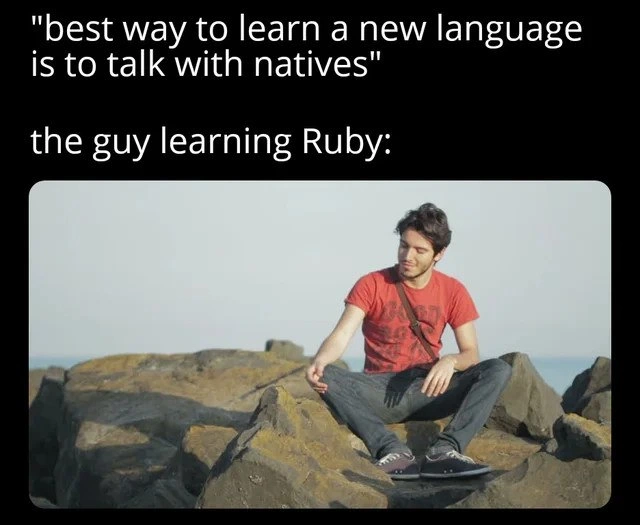
Imagine you’re a kid who wants to learn a new game, but none of your friends know how to play it. People told you, “the best way to get good at that game is to play with kids who already know it really well.” Sounds like smart advice, right? But if you look around and you’re the only one on the playground who even knows the game exists, there’s no one to play with. You end up tossing the ball to yourself, feeling a bit lonely. It’s kind of sad and a little funny at the same time because the advice doesn’t work when you’re all by yourself. That’s exactly what’s happening in this picture. The person is trying to learn Ruby, which is a coding language, and someone said “talk with natives” (meaning talk to people who already know Ruby). But he can’t find anyone who knows it around him, so he’s sitting all alone, with no one to practice with. It’s like he’s on an empty playground with a game only he knows. We find it funny because it shows how sometimes advice doesn’t fit every situation – if no “native” experts are around, you’re left talking to the wind! The poor Ruby learner is literally by himself next to the big ocean, showing in a simple way that he has no one to talk to in Ruby except maybe the seagulls.
Level 2: The Lonely Rubyist
This meme is contrasting how we learn spoken languages versus how we learn programming languages, using Ruby as the example. Ruby is a high-level programming language created by Yukihiro “Matz” Matsumoto, and it became famous for making developers happy and productive (especially thanks to the popular web framework Ruby on Rails). When people say “talk with natives” about learning a language, they mean you should practice speaking with native speakers – for example, chat with native French speakers if you’re learning French. You’ll pick up the accent, natural phrases, and improve faster by immersing yourself in real conversations. The joke here is that if you apply that advice to a coding language like Ruby, it doesn’t quite work the same way! There’s no concept of a “native Ruby speaker” in the literal sense. You can’t walk into a cafe and start chatting in Ruby code hoping someone will respond.
In the image, the text says the best way to learn a new language is to talk with natives, and then it shows “the guy learning Ruby” completely alone on some rocks by the sea. That visual is emphasizing that our Ruby learner has no one to talk to. Why? It hints that the Ruby community around him might be small or not easily accessible. In the world of software development, different programming languages have different sized communities (groups of people who use and support the language). Ruby has an enthusiastic community, but it’s not as huge or everywhere as, say, the communities for JavaScript or Python these days. By 2020, Ruby’s heyday had passed a bit, so a newcomer might not know anyone personally who codes in Ruby. Fewer local meetups, fewer classmates or coworkers using it – so he ends up like in the picture: a lonely developer trying to “speak” Ruby with absolutely no one around to hear. This is a light-hearted take on the idea of language adoption. When a programming language is very popular (like JavaScript), a beginner can easily find others to pair program with, ask questions, or just bounce ideas off. But if the language is less common in your area or among your friends, you might struggle to find that same level of peer interaction.
Let’s break down the elements. Ruby ecosystem means everything around Ruby – the language itself, its libraries and tools (Ruby libraries are called gems, as Ruby is named after a jewel), and the people who use it. A healthy ecosystem usually has lots of developer engagement: active discussion forums, Q&A on sites like Stack Overflow, local user groups, and open-source contributions. If a newcomer is advised to “learn by talking to natives,” in programming that would translate to finding an experienced Ruby developer (let’s call them a Ruby guru or an avid Rubyist) to mentor or chat with. Maybe you’d join a Ruby chat room or attend a Ruby meetup to hear folks “speak Ruby” – which actually means talking about Ruby code, not literally talking in Ruby syntax. The funny reality is that learning to code often involves reading and writing code, following tutorials, and asking questions online, rather than spoken conversation. So if our guy took the advice literally, he’s stuck “speaking” in a language that no one around him understands. It’s a bit like he’s trying to practice a secret language in an empty room.
This is relatable to many new developers on their learning-to-code journey. Beginners are often told to seek out communities or find a mentor. That’s great advice because having someone more experienced to guide you can dramatically smooth out the learning curve of a new language or technology. But what if you choose a language where that support network is hard to find? The meme humorously shows that scenario. The developer culture aspect here is that different programming languages go through phases of popularity. Ruby was extremely popular in the 2000s (especially for building websites with Rails), so back then “talking with natives” would’ve been as easy as hopping onto an active forum or grabbing coffee with the many Ruby programmers around. Nowadays, while Ruby still has dedicated users, a person learning it might have to look harder to find fellow learners or experts. They might end up mostly consulting online documentation and old forum posts instead of having real-time chats. The lone person on the rocks symbolizes that isolation – he’s literally got no fellow Rubyists in sight. It’s a funny exaggeration, essentially saying: “If you’re learning Ruby, good luck finding a native speaker to talk to – you might be on your own!” This is all said in good fun. In reality, one can still learn Ruby (there are online communities and the Ruby documentation is great), but the meme captures that feeling of trying to engage with a community that feels a bit empty. It resonates as relatable humor for developers, because many of us have felt like “the only one speaking our language” at some point when working with a niche tool or less popular programming language.
Level 3: Natives Not Found
At first glance, this meme plays on a clever twist of language learning advice. The top text proclaims, "best way to learn a new language is to talk with natives", which is perfectly sound advice for spoken languages like French or Japanese. But when applied to a programming language like Ruby, it becomes a tongue-in-cheek commentary on the Ruby ecosystem and its community. In the bottom panel, “the guy learning Ruby” sits utterly alone on jagged coastal rocks, as if searching the horizon for someone to converse with in Ruby. Experienced developers chuckle here because we recognize the scenario: Ruby is a programming language, so there are no native speakers in the human sense, and finding fellow Ruby enthusiasts (especially in certain circles or locales) can feel like searching for life on a deserted island. The humor lands with a bit of irony — learning a programming language by talking is not how it usually works, and if the language’s community is small or less accessible, you might literally have no one to talk to. It’s a visual gag about developer communities (or the lack thereof), highlighting how crucial peer interaction is when picking up new technologies, and what happens when that interaction is hard to come by.
For veteran devs, this meme also hints at the rise and fade of tech communities. Ruby, especially with Ruby on Rails, was once the hot new thing in web development. Around the late 2000s and early 2010s, Rails meetups were bustling — plenty of “native” Rubyists were around to pair program, answer questions, and share gem tips (Ruby calls its libraries “gems”, fittingly). Learning Ruby back then felt like being in a lively city full of friendly locals. But fast-forward to 2020: the hype has cooled. Many of the old Ruby natives have either moved on to JavaScript, Python, Go, or simply aren’t as publicly active. The Ruby community is still out there (passionate and helpful), but it isn’t the loud, dominant tribe it once was in the zeitgeist. So our lone Ruby learner in the meme is experiencing what happens when a language’s adoption slows down — fewer meetups, quieter forums, maybe a local scene where nobody at work or school codes in Ruby. The once thriving Ruby town can feel like a quiet seaside village. A senior engineer recognizes this pattern from experience: they’ve seen technologies go through hype cycles. One day you’re inundated with chatty experts eager to mentor (natives everywhere!), the next day you’re the only person in your team’s Slack channel still talking about that tech. The meme humorously exaggerates this by placing the learner literally on isolated rocks by the sea, implying the Ruby world around him has “low population density.” It’s DeveloperHumor with a grain of truth – if you pick a less popular language, you might end up learning in a bit of a vacuum.
There’s another layer of wit too: programming languages aren’t spoken aloud in normal conversation. We write Ruby code, we don’t sit around speaking Ruby sentences for practice. So the image of a guy earnestly trying to “talk Ruby” and receiving only the ocean breeze in response is absurd in a delightful way. An experienced dev might imagine him opening an IRB console (Interactive Ruby shell) and typing puts "Hello? Anyone here?" only to get silence (or rather, a printed hello and a nil value back). In fact, here’s how that conversation with the Ruby interpreter might look:
# Trying to speak Ruby into the void
puts "Hello? Anyone here?"
# Output:
# Hello? Anyone here?
# => nil # (No human response, just Ruby printing the string and returning nil)
He’s essentially talking to the computer or himself — the classic rubber duck debugging scenario, but not by choice! Seasoned developers find this funny because we’ve been there: whether it was an obscure programming language, an unpopular framework, or just being the only coder in a small company, we know the feeling of talking to a rubber duck (or an empty room) when no peers are around. The meme shines light on the role of community in the learning curve: Without active peers or mentors (no native speakers around), learning can be isolating and slow. It’s a relatable kind of humor in the developer culture – mixing a bit of nostalgia (“I remember when Ruby meetups were everywhere”) with empathetic sarcasm (“now it’s just me Googling errors alone”). In short, the meme cleverly captures a real developer predicament with a playful jab: if the key to learning is speaking with natives, the poor Ruby newbie might be stuck practicing alone, shouting Hello, world! into the void and hearing only the echo of his own puts.
Description
A meme presented on a black background with white text. The top line of text reads, '"best way to learn a new language is to talk with natives"'. The second line says, 'the guy learning Ruby:'. Below the text is a photograph of a young man with dark hair, wearing a red t-shirt and dark pants, sitting alone on a pile of large, brownish rocks near the sea. He appears calm and contemplative, looking down at the rocks. The humor is a clever pun that applies advice for learning human languages to the Ruby programming language. By showing a man sitting on rocks, the meme playfully suggests he is trying to 'talk with the natives' - in this case, actual ruby gemstones or rocks - to learn the language. It's a literal interpretation joke that also subtly hints at the wane in Ruby's mainstream popularity, implying a learner might feel isolated in their journey compared to those learning more trendy languages

Comments
15Comment deleted
He's out there trying to find the original 'gems,' but all he's finding are legacy monoliths with N+1 query problems
“They said ‘immerse yourself with native speakers,’ so I’m pair-programming with _why’s 2008 mailing-list posts and a gem that still depends on Ruby 1.8.”
After 15 years of explaining to stakeholders why we can't just 'make it work like magic,' I finally understand this developer's approach - at least the rocks won't ask for a timeline on when they'll become sentient enough to explain metaprogramming and why everything is an object including nil
Ah yes, the classic Ruby learning path: first you try to talk to rocks about metaprogramming and blocks, then you realize the real 'natives' are on Stack Overflow, and finally you discover that Matz's principle of 'optimizing for programmer happiness' didn't account for the existential crisis of sitting alone on a beach wondering why `puts` doesn't work when you shout it at seagulls
Ruby natives? They're like reliable Proc objects - immortal in theory, but you'll never find one when you need it
“Talk with natives,” they said; learning Ruby means consulting Gemfile.lock, a 2011 Rails blog post, and the lone staff engineer who keeps promising the Go rewrite next quarter
“Talk to natives,” they said. In Ruby, the only native I meet is mkmf yelling when Nokogiri’s C extension won’t compile on ARM
learning python Comment deleted
That doesn't look much of talking Comment deleted
because small talk Comment deleted
😂😂😂 Comment deleted
Those don't seem like giant rubies? Comment deleted
The guy learning Java: Comment deleted
It's me Comment deleted
Learning Rust Comment deleted