A Senior Dev's Gentle Plea to Avert Production Disaster
Why is this OnCall ProductionIssues meme funny?
Level 1: Keep It Cartoonish
Imagine you’re watching a funny cartoon where a character, say, slips on a banana peel and falls down. In the cartoon, it looks silly and everyone giggles—maybe the character sees stars or has little birds swirling around their head, and then they’re fine. Now think about what it would look like if you saw that happen in real life with full detail: the person falls hard, gets a serious injury, maybe there’s blood or a broken bone. That wouldn’t be funny at all, right? It would be scary and painful to watch. This meme is basically saying the same thing: some things are meant to stay pretend. The “Dumb Ways to Die” cartoon is like the silly version of people getting hurt – it’s so goofy and unreal that we can laugh. But if we suddenly made it look real, with super-realistic graphics (like a high-definition movie), it would stop being a joke and start being something that might gross us out or upset us. So the meme’s answer is simple: “Don’t do that.” In other words, let the cute cartoons be cute cartoons, and don’t try to show what it’d be like in real life. Just because we can make it look real doesn’t mean we should. Sometimes, it’s better to leave things in the world of make-believe where they’re fun and harmless.
Level 2: Cute vs Graphic
Let’s break down the key ideas for someone newer to these concepts. First, RTX is a term you see a lot in gaming and hardware talk; it’s basically NVIDIA’s branding for their graphics cards that can do real-time ray tracing. A GPU (Graphics Processing Unit) like the NVIDIA GeForce RTX series is a special piece of hardware in your computer or console that’s super good at handling graphics and images. Traditional game graphics are made with a method called rasterization – think of it as the normal way games have drawn scenes for decades, converting 3D shapes into the 2D image on your screen using lots of clever shortcuts for lighting. It’s fast and has gotten us pretty far! But ray tracing is like the holy grail of realism: instead of taking shortcuts, it tries to simulate how light actually works in the physical world. When people say “RTX ON,” they mean the game is using this ray tracing technique, so you’ll see really lifelike lighting – like accurate reflections in mirrors or windows, realistic shadows that get softer the farther they are from an object, and things like that. RTX OFF means the game is using the standard methods (less realistic, but often more stylistically consistent and much easier for the computer to handle).
Now, what is “Dumb Ways to Die”? It was a super popular animated music video (from around 2012) featuring these cute blobby cartoon characters doing ridiculously dangerous things (like poking a bear or setting their hair on fire) and, well, dying in “dumb” silly ways. It’s all very colorful and adorable, despite the morbid theme – that contrast is the whole joke of the video. Importantly, even though the characters are meeting grim fates, nothing is shown realistically: there’s no blood, no guts, no graphic injury detail. A character might get eaten by piranhas in the song, but you just see a funny cartoony chomp and the character comes back in the next scene good as new. It’s all very light-hearted and abstract.
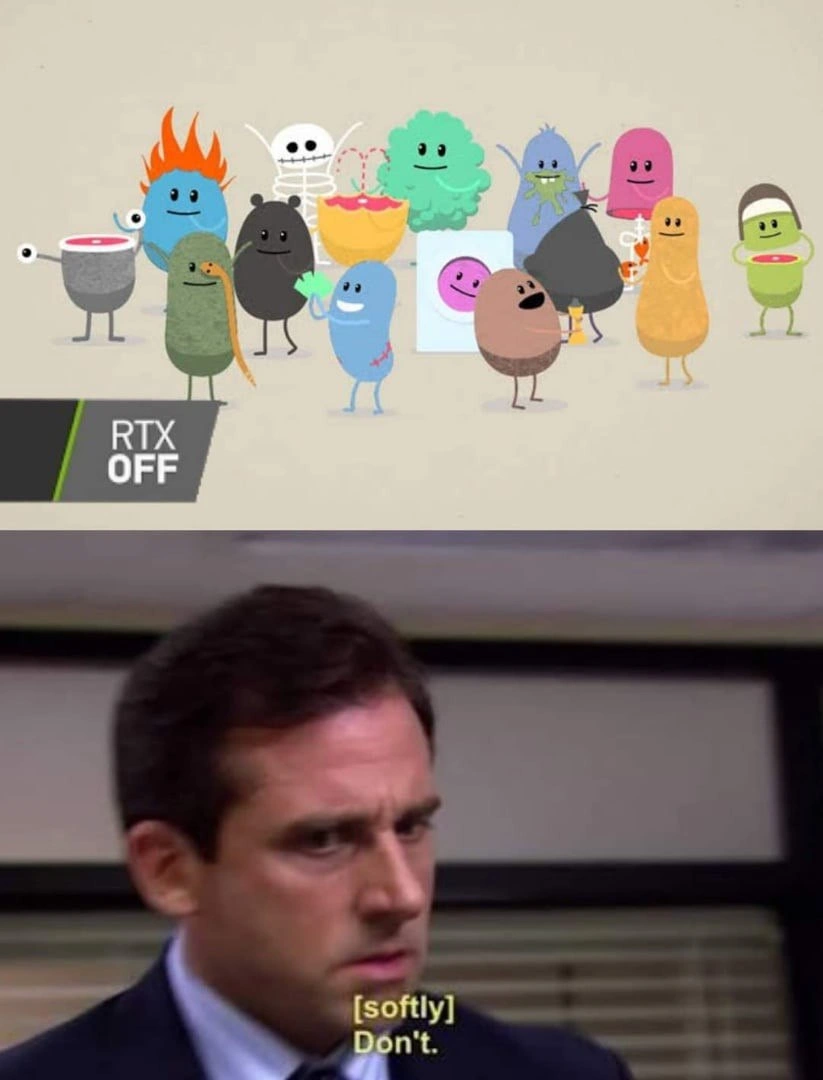
The meme’s top panel shows these original characters with an “RTX OFF” label. That implies “this is the simple, cartoon version.” In the bottom panel, instead of showing “RTX ON” with a gruesomely realistic version of the cartoon (which would be the logical but shocking outcome), the meme uses a reaction image. The reaction is from The Office (a well-known TV sitcom), with Michael Scott’s face looking alarmed and the subtitle “[softly] Don’t.” This bottom panel is basically the meme way of saying: “Let’s not even go there.” It’s telling us that if we did turn RTX on in this scenario, we’d get something too graphic (in the sense of graphic violence and high-fidelity graphics) to enjoy. In meme culture, using a reaction image like that is a common way to express a sentiment without words – here the sentiment is “Nope, bad idea!”
So, putting it together: The meme humorously warns game developers and artists that enabling ultra-realistic rendering (ray_tracing_joke) on a project that’s meant to be goofy and cute will ruin its charm. In game development terms, it’s like if you have a fun cartoon-style game and someone says, “Hey, we have this new powerful GPU feature, let’s use it to make everything super realistic!” A newcomer might think “Ooh, realistic sounds always better, right?” but the meme is teaching an important lesson with humor: match the technology to the project. Ultra-realism can be awesome (like in a gritty zombie survival game, sure turn RTX on and show those realistic shadows and gore), but in something meant to be playful, it can actually turn it into a horror show. This is why the straightforward advice in the meme is just “Don’t.” – sometimes the best decision in tech (and in design) is to not flip that fancy switch. It’s a funny reminder that more detailed graphics aren’t always better; it depends on context and the intended audience. After all, nobody wants their beloved cute characters to become nightmare fuel because the lighting is too real.
Level 3: Ray-Traced Regrets
This meme strikes a chord with experienced game developers and graphics engineers because it highlights a classic dilemma: just because a new technology allows unprecedented realism, is it always desirable to use it? The top panel is labeled “RTX OFF”, showing the lovable, brightly colored bean-shaped characters from the “Dumb Ways to Die” video in their original, simplistic form. Any senior dev who’s been around graphics hype cycles immediately recognizes the setup: RTX OFF vs RTX ON comparisons are a running joke in the gaming community and tech humor circles. NVIDIA’s marketing often flaunted side-by-side images – one plain, one ray-traced – to wow us with the difference. But internet jokesters took that format and ran wild, slapping “RTX ON” on ridiculously realistic or over-the-top images. Here, instead of actually showing an “RTX ON” version of the cartoon carnage, the meme delivers a punchy twist: a reaction image of Michael Scott from The Office (a staple office reaction meme choice) with the simple subtitle “Don’t.”. It’s a perfect comedic cut-off, as if to say, “We could flip that switch… but you really don’t want to see what happens.”
Why is this so funny to those of us in development and gameDev? Because we’ve all been in situations where pushing fidelity or realism crosses a line and backfires. It’s poking fun at the ray_tracing_joke that if you enable ultra-realistic rendering in a context that wasn’t built for it, you’ll end up with something horrifying or absurd. We share a collective memory of how games evolved from blocky pixels to near-photographic realism — and how sometimes ultra-graphics can expose things we didn’t actually want to simulate. Senior devs know that art style and technical features must be in harmony. If you have a whimsical cartoon game or a lighthearted viral video, adding realistic physics and lighting might turn it into a nightmare. It’s like that programming proverb: not every problem needs a neural network, and by analogy, not every cute animation needs real-time global illumination with candlestick reflections and physically correct gore. We chuckle because we imagine a well-meaning developer enthusiastically toggling on the fancy new GPU rendering quality feature (“Guys, look, our engine now supports RTX!”) and then the entire team recoiling at the result: cartoon characters now look like something out of a hyper-real horror movie. Don’t. indeed.
The humor also touches on content ratings and design intentions. As a senior developer, you’re acutely aware that if you take Dumb Ways to Die (a light-hearted, PG-ish piece of content) and render it realistically, you’d skyrocket it into a mature rating. Those cute blob characters can get away with outrageous accidents because they’re so abstract – the distance from reality is what makes it funny rather than traumatizing. Many of us recall classic games or animations where imagination filled the gaps, and that made it fun. Turn on realistic rendering and suddenly nothing is left to the imagination; it’s all on the screen in grisly detail. It’s an uncanny realism situation: the “magic” of the cartoon is lost, replaced by grim reality. This is the same reason some senior devs push back when management says “make it more realistic!” – sometimes more realistic just means more disturbing.
From a hardware perspective, there’s an ironic twist too. We spend so much time optimizing and drooling over the latest GPU capabilities – more TFLOPs, new shaders, fancy ray-tracing cores – and the meme wryly implies that using all that power here would achieve something utterly counterproductive. It’s a subtle nod to the idea that technology isn’t inherently good or bad; it depends on context. Imagine a developer meeting where someone suggests: “Hey, what if we remaster Dumb Ways to Die in Unreal Engine with 8K textures and ray-traced lighting?” The stunned silence and someone whispering “Don’t” is exactly this meme. Experienced devs laugh because they’ve seen features misapplied before. Maybe they’ve watched a physics engine meant for realistic car crashes get applied to ragdoll cartoon characters, resulting in glitchy horror. Or an ML algorithm upscale pixel art into something grotesquely detailed. There’s a shared understanding: just because you have an RTX-enabled hammer, not every project is a nail. Sometimes leaving RTX off is the wiser (and saner) choice, and it takes a bit of senior-level foresight to know when not to use a shiny new tool. The meme captures that moment of restraint in one word: “Don’t.” – equal parts funny and true.
Level 4: Ray-Traced Overkill
At the bleeding edge of graphics programming, turning on RTX means engaging a radically different rendering pipeline under the hood. Instead of the classical rasterization (which draws triangles and textures in a pre-defined order), RTX leverages ray tracing – essentially running a miniature physics simulation for each pixel. When you enable ray tracing, the GPU spawns millions of imaginary photons that shoot out from the camera, bounce around the scene, and sample lighting contributions. This approach solves the actual rendering equation for global illumination, accounting for realistic reflections, refractions, and shadows. It’s the same technique that CGI studios use to make Pixar or Marvel movie frames look so photorealistic, except now it's happening in real-time on a gaming GPU. NVIDIA's RTX hardware introduced dedicated RT Cores to accelerate these ray-scene intersection calculations, using data structures like BVHs (bounding volume hierarchies) to prune down the complexity of checking each ray against thousands of triangles. The result? Stunningly realistic lighting and materials that can make a virtual scene indistinguishable from reality – glossy surfaces show true reflections, shadows soften with distance, and small light sources can cast subtle, accurate glows.
However, with great power comes gory possibilities. A physically accurate pipeline doesn’t come with a “cuteness filter.” If the content of a scene is inherently violent or messy, a ray-traced render will depict it with uncompromising fidelity. Think of how Monte Carlo integration in path tracing will meticulously calculate light bouncing off every surface – be it a shiny spoon or a pool of blood. The meme humorously implies that toggling “RTX ON” would force the engine to render the Dumb Ways to Die characters with photoreal precision: sub-surface scattering on organs, volumetric smoke from fire-charred hair, realistic fluid dynamics for spilled coffee or, erm, bodily fluids. In other words, the graphics pipeline would go from abstract and symbolic to viscerally real. The fundamental algorithms here don’t know they were meant for a cartoon – they’re just solving physics. So a cute animated brain character under ray tracing might suddenly show light absorption and shadowing through brain tissue, producing a disturbingly lifelike look. From a technical lens, it’s both amazing and terrifying: amazing that our hardware and algorithms can achieve this level of detail, and terrifying that they will do so impartially if asked, regardless of whether the subject matter is a fuzzy peach character or a photo-real corpse. The meme’s deadpan punchline (“Don’t.”) is basically the seasoned graphics engineer inside us warning: just because you can simulate every photon hitting those cartoon characters doesn’t mean you should – the outcome might be an overkill (pun intended) of realism.
Description
This is a two-panel meme contrasting a well-known animation with a reaction from the TV show 'The Office'. The top panel features a group of colorful, cartoonish bean-shaped characters from the 'Dumb Ways to Die' public service announcement. These characters are depicted in various states of peril, representing foolish accidents. In the bottom-left corner of this panel, a black and green graphic reads 'RTX OFF', a reference to the Nvidia graphics technology meme format. The bottom panel is a close-up shot of Michael Scott (played by Steve Carell) from 'The Office'. He has a serious, concerned expression, looking slightly down and to the side, with the caption '[softly] Don't.' displayed at the bottom. The meme's humor lies in its application to a software development context. The 'Dumb Ways to Die' characters symbolize the many well-known anti-patterns and catastrophic mistakes a developer can make (e.g., deploying on a Friday, force-pushing to the main branch, ignoring failing tests). Michael Scott's reaction represents the weary, experienced senior engineer or SRE who foresees the impending, self-inflicted disaster and pleads to prevent it

Comments
7Comment deleted
The face you make when a junior says, 'The CI pipeline failed, but it works on my machine, so I'm going to merge it anyway.'
Turning on RTX for “Dumb Ways to Die” is like wiring your demo to the prod database - impressive reflections right up until every cute abstraction becomes an OSHA report
When the junior dev proudly shows you their WebGL renderer that "performs just as well as the native implementation" because they tested it with 10 polygons on their RTX 4090
Every senior graphics engineer knows that moment when the product manager asks why we can't just 'turn on RTX for everyone' - and you have to gently explain that the difference between 144 FPS at 1080p and 30 FPS at 4K with ray tracing isn't just a toggle switch, it's a fundamental architectural trade-off involving BVH traversal, denoising algorithms, and the harsh reality that most users' hardware still thinks DLSS is a new type of SSL certificate
Architecture decision record: Turn on RTX for the dashboard? +20ms of wow, +$20k/month in GPUs, - 2 nines of SLO. Decision: don’t
Enabling RTX is the graphics equivalent of cross-region distributed transactions: great for the keynote, catastrophic for your 16.67 ms frame budget and the GPU invoice
RTX ON: Where your 16ms frame budget meets its photorealistic doom, beautifully