Skip to content
DevMeme
1830 of 7435
Python Strings Go Brrrr
Languages Post #2038, on Sep 12, 2020 in TG

Python Strings Go Brrrr

Why is this Languages meme funny?

Level 1: Text Copy Button

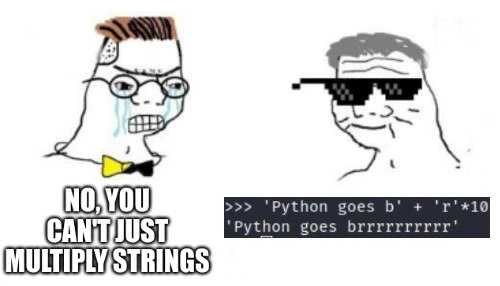
This meme is like someone saying, "You cannot multiply a word," and Python answering, "Sure I can: three cookies means cookiecookiecookie." The funny part is that the computer language treats r times ten as ten copies of r, so it can make brrrrrrrrrr with almost no typing.

Level 2: Strings Repeat

In Python, a string is text, like "hello" or "Python". A string can be joined with another string using +:

"hello" + " world"   # "hello world"

Python also lets you repeat a string with * when the other value is an integer:

"ha" * 3   # "hahaha"

So the meme's expression builds the phrase in two parts. First it has 'Python goes b'. Then it makes ten r characters with 'r'*10. Finally it joins them together. That produces Python goes brrrrrrrrrr, which is the joke version of an engine sound or internet catchphrase.

The left character is reacting as if strings should not be multiplied because multiplication is usually for numbers. The right character knows Python's rule and calmly uses it. That is why this fits Syntax and DynamicTyping humor: Python code often reads naturally once you know the rules, but it can look illegal or magical if you expect every operator to work only with numbers.

This feature is useful for small tasks. Developers use string repetition to create dividers in console output, generate quick test values, or format simple text:

print("-" * 40)
print("Loading" + "." * 3)

The post message asks how many people have written at least one line in Python because this is the kind of tiny feature many Python users encounter early. It is simple, memorable, and just strange enough to become a meme.

Level 3: Operator Mischief

The meme stages a tiny language-design argument. On the left, the distressed character insists:

NO, YOU CAN'T JUST MULTIPLY STRINGS

On the right, the relaxed sunglasses face answers with a Python REPL:

>>> 'Python goes b' + 'r'*10
'Python goes brrrrrrrrrr'

The joke works because * looks like arithmetic, but Python applies it to sequences too. A string is a sequence of characters, so multiplying a string by an integer repeats the sequence. 'r' * 10 means "repeat the string containing r ten times." Then + concatenates that repeated string onto 'Python goes b'.

This is not a random parser loophole. It is part of Python's broader design philosophy: common operations on sequence-like objects should feel consistent. Lists and tuples also support repetition:

["ha"] * 3     # ["ha", "ha", "ha"]
(0, 1) * 2    # (0, 1, 0, 1)

That is why the right side looks so smug. Python is not "multiplying" a string in the mathematical sense of scaling a number. It is using __mul__ behavior defined for sequence repetition. The meme turns that practical convenience into a flex over languages or programmers that expect stricter separation between numeric multiplication and text handling.

There is a real LanguageQuirks edge here, though. The same expressive syntax that makes Python pleasant can surprise people who arrive from languages where "x" * 3 is invalid, or from contexts where operator overloading is treated suspiciously. Operators are compact, but compactness hides dispatch rules. In Python, a * b might mean numeric multiplication, string repetition, list repetition, matrix multiplication-like behavior in a library type, or a custom class's own interpretation through special methods. The operator is familiar; the semantics depend on the objects.

That is the senior-level wink inside the meme. Python rewards reading code by intent, but it also asks you to know the local type behavior. The expression is cute in a REPL and occasionally useful in production for padding, quick separators, repeated test data, or formatting. It can also become SyntaxAbuse when developers get too clever and turn readability into a parlor trick. The sunglasses face is correct, but he is one code review away from being asked to use a clearer helper function.

Description

The meme shows a crying, angry Wojak-style character on the left saying "NO, YOU CAN'T JUST MULTIPLY STRINGS." On the right, a smug face wearing pixelated sunglasses appears next to a Python REPL snippet: ">>> 'Python goes b' + 'r'*10" followed by the output "'Python goes brrrrrrrrrr'." The joke is about Python's sequence-repetition operator, where multiplying a string by an integer repeats it instead of raising the kind of type error some languages would. It captures the mix of practical expressiveness and language-specific surprise that makes dynamic-language syntax both useful and meme-worthy.

Comments

1
Anonymous ★ Top Pick Python saw algebra and quietly reinterpreted it as sequence repetition, because ergonomics outranked your type-theory lecture.
  1. Anonymous ★ Top Pick

    Python saw algebra and quietly reinterpreted it as sequence repetition, because ergonomics outranked your type-theory lecture.

Use J and K for navigation