Skip to content
DevMeme
5268 of 7435
Developers react to claimed room-temperature superconductor replication in Chinese labs
IndustryTrends Hype Post #5777, on Jan 3, 2024 in TG

Developers react to claimed room-temperature superconductor replication in Chinese labs

Why is this IndustryTrends Hype meme funny?

Level 1: A Real Unicorn?

Imagine someone telling you they found a real unicorn. 🦄 Last year, a friend excitedly claimed, “I discovered a unicorn in my backyard!” Everyone got excited – a magical creature, wow! – but then it turned out to be just a regular horse with a fake horn. Big disappointment. Now, this year, two different people on the other side of the world are saying, “No, seriously, we found a unicorn, and not just one of us – both of us saw it in our own yards!” They even have a little picture of a horned creature floating in the air. Everyone really wants to believe it because a unicorn is like a dream come true. But we all remember what happened last time, so we’re excited and a bit cautious. It’s like, could it really be true this time? or are we getting tricked again?

In our story here, the “unicorn” is a super special magic material that lets electricity flow without any getting lost (that’s super rare, almost like magic in science). Last time someone said they had it, it wasn’t true. This time, more people are saying they see it too, so maybe it’s real! The feeling in this meme is that mix of astonishment and hope, with everyone watching closely, smiling nervously, and saying, “Wow, if this is real, it changes everything... but please, please be real this time!” It’s both funny and heartwarming, like hoping a fairy tale might actually come true after a false start.

Level 2: Liquid Nitrogen Cool

Let’s break down this meme in simpler engineering terms, especially if you’re not deep into physics or the last year’s drama:

  • Room-temperature superconductor: This means a material that can conduct electricity with zero resistance at around room temperature. Normally, wires and circuits waste some electricity as heat due to resistance (think of your laptop charger getting warm – that’s resistance at work). A superconductor has no such waste; it’s perfectly efficient when it’s in its superconducting state. Room-temperature is the dream because current superconductors need really cold temperatures to work. In the tweet, they say “room temperature” in quotes because actually they mean 250 K (Kelvin). 250 K is about -23 °C or -10 °F. That’s colder than a typical room, obviously – it’s below freezing – but compared to most superconductors that need -196 °C or even colder, -23 °C is practically a warm summer day.

  • 250 K (-23 °C) and liquid nitrogen: Liquid nitrogen is often used to cool materials for superconductivity demos because it’s cheap and easy to handle (you don’t need fancy lab infrastructure to use it; it’s literally a common coolant). Liquid nitrogen is 77 K (which is -196 °C, incredibly cold). If you pour liquid nitrogen on something, it will definitely go down to -23 °C and far below. So when the tweet says “we can get things that cold with liquid nitrogen,” it means that reaching 250 K is not a big deal – just a splash of LN₂ and you’re good. In other words, technically it’s not exactly “room temp” (~293 K), but it’s close enough in practical terms because keeping something at -23 °C is easy with existing tech. Many labs, or even some tech companies, have storage freezers or cooling systems that reach that without breaking a sweat.

  • Ambient pressure vs high pressure: Ambient pressure is just normal air pressure around us (~1 atmosphere). High pressure means you enclose the material and squeeze it with an extremely large force, often using special equipment (like a diamond anvil cell) to simulate conditions like deep underground or inside planets. Some materials only become superconductors under those extreme squeezes (imagine only working if you press the pieces together with enormous force). Those aren’t practical for daily use because you can’t maintain a power cable under hundreds of gigapascals of pressure along hundreds of miles. The tweet points out that we did see a superconductor at 250 K before, but only under high pressure. The new thing here is it works at ambient pressure – meaning just out in the open, no special squeezing. That’s a huge deal in terms of usability. It’s like the difference between a car that only runs when you’re pushing it really hard versus a car that runs by itself under normal conditions.

  • LK-99 and what happened “last time”: LK-99 was the name of a material (a modified lead apatite compound with some copper) that a team from South Korea claimed in July 2023 could superconduct at room temperature and ambient pressure. It sent the scientific and tech world into a frenzy (for a few weeks everyone was talking about it — it was trending on Twitter, Reddit, everywhere). Labs worldwide tried to replicate it. Unfortunately, none of the reputable labs could find evidence of true superconductivity in LK-99. A few initial reports were confusing, but eventually it became clear that LK-99 was not the miracle it was billed as. It might have shown some interesting electrical behavior (some said it was just a semiconductor or had impurities causing weird readings), but it did not exhibit the zero resistance or strong Meissner effect that a real superconductor would. So, basically, LK-99 ended in disappointment; it was a false alarm. For those who followed it, it felt like a rollercoaster: hype up, then hopes dashed.

  • Replication: In science (and in engineering), if someone claims a big result, others have to be able to do the same thing independently – that’s called replication or reproducibility. It’s the gold standard for “this is real.” During the LK-99 saga, replication was the sticking point: many tried, none succeeded convincingly. In this new case (sometimes informally being dubbed LK-99’s “sequel” by the community), the big positive sign is that two separate Chinese labs have already replicated the result (or at least, both labs are reporting similar findings). That’s mentioned in the tweet’s third bullet. It’s essentially saying: Last time everyone was asking “will it replicate?” and it didn’t. This time, we already have replication, so things are looking better. For a developer or a junior engineer, think of it like hearing about a crazy new app or tool: if just one person claims it works, you’re skeptical, but if two or three independent people show you it working on their machines, you start to believe it’s legit. Same concept here, but for a physics experiment.

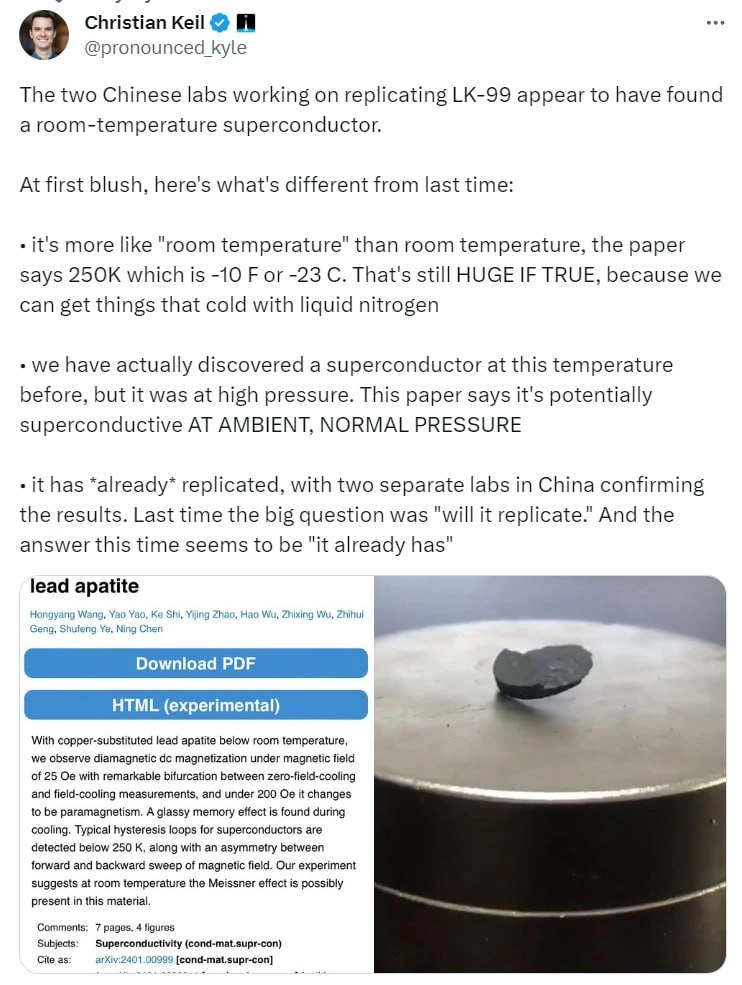
  • The arXiv paper and evidence: The screenshot on the left is from arXiv (pronounced like “archive”), which is a website where scientists post pre-print papers (papers that might not yet be formally peer-reviewed but are available for the community to read). It’s like an open-source repository for scientific findings. The specific entry “lead apatite” with all those authors is the scientific paper detailing this experiment. The fact it’s on arXiv means the authors are sharing their data and methods openly so others can evaluate and attempt replication. The presence of that screenshot in the meme signals: “Hey, this claim comes with a paper and data, not just a tweet.” The little blue “Download PDF” button is what you’d click to read the full paper. For context, during the LK-99 hype, multiple teams posted their attempts and analyses on arXiv too, so it became a hub for keeping track of who’s finding what.

  • The pellet photo: On the right side of the meme image, there’s a photo of a small dark pellet on a metallic disc. This is presumably the sample of the new superconducting material being tested. In many superconductor experiments, researchers will put a sample on a magnet (or a magnet on the sample) and cool it down to see if it levitates or shows any magnetic weirdness. That photo is basically teasing “look, we’ve got the actual material right here.” If the pellet is seen levitating even a tiny bit above that disk when cooled, that’s a visual proof of the Meissner effect. We don’t see the levitation in the still image, but the setup is recognizable to those who’ve seen superconductor demos (it’s practically meme-worthy on its own because floating pellets are an iconic image in this field).

Now, why is this relevant or funny to developers and tech folks? Because it’s a prime example of the Tech Hype Cycle playing out in real time, with a very tangible, science-y subject. We often see news about a “breakthrough” and there’s a pattern:

  1. News breaks (tweet/talk) and everyone gets excited – hype.
  2. People ask the hard questions: “Is this real? How do we know?” – skepticism.
  3. Evidence comes in or doesn’t – either breakthrough gets confirmed or it fizzles out.
  4. If it fizzles, people joke about how we fell for it again; if it confirms, people celebrate the new era.

With LK-99, we went through steps 1-4 and it fizzled, and there was a lot of meme humor about “at least we had a fun week believing in superconducting rocks”. Now with this new claim, we’re at step 1 and 2 again, but there are promising signs we might reach a happy step 4. Developers are reacting kind of like they would to, say, a new framework that promises to do something impossible (“Make your app 100x faster with one line of code!”). Initially excited, then looking for the catch (“okay, what’s the fine print?”). The tweet’s bullet points are the fine print: yes it’s not exactly room temp but close, yes others have seen this temperature but under stupid conditions – not the case here, and yes others have replicated it so it’s not just one wild claim.

IndustryTrends and Hardware tags: This story isn’t about software or code; it’s about a material that could massively impact hardware and industry. If real, near-room-temp superconductors could change how we design everything from power grids to computer chips. Think about lossless power lines (no energy wasted as heat over distance), super-efficient transformers, maglev trains that are easier to build, or even quantum computers that don’t require giant refrigerators. It’s a big industry trend if it comes true, which is why everyone from engineers to investors might be watching this closely. The meme acknowledges the “hype” aspect – we’ve learned to be careful with big promises, but we also love to speculate.

To a junior dev or someone new: the meme is basically saying “Here we go again with the superconductor excitement, but this time there are good reasons to be excited.” It’s shared with a sort of nerdy giddiness. People might not be rolling on the floor laughing at this meme; instead, they’re grinning and thinking, “wouldn’t it be awesome if this is real?” and also “we said that last time, haha.” The humor is more in the relatability of the cycle than a punchline in the text. It’s like being in on a tech inside-joke where everyone remembers the last craze.

In summary, at this level: The meme shows a tweet about a possible near-room-temperature superconductor that’s stirring up excitement. It lists why this claim is more credible than the last one (which flopped). It’s getting shared among tech folks who are half-jokingly ready to ride the hype train again, with fingers crossed. If you’ve ever followed a tech trend that promised the moon and then fell flat, you’ll get the tongue-in-cheek vibe here. And if this one turns out legit, well – that’s the rare case when the hype actually delivers, and we’d all happily eat some crow (while our data centers magically run cooler 😁).

Level 3: Second Time’s the Charm?

For seasoned developers and engineers, this meme triggers a bout of cautious déjà vu. It’s pointing back to the great LK-99 saga of 2023, when a supposed ambient-pressure room-temperature superconductor had the tech world buzzing – and then fizzling – over a few turbulent weeks. Back then, our social feeds were filled with hope, skepticism, and a flurry of DIY science attempts (people in labs and even home garages worldwide tried to cook up that material). Ultimately, no one could consistently reproduce the Korean team’s results, and LK-99 went from holy grail to something closer to fool’s gold. So, seeing a tweet now that effectively says “Hey, this time two labs in China have actually done it (something like LK-99 but better)” ignites a very familiar hype cycle, with a twist. The meme’s humor is in that subtitle-like tweet text: “here’s what’s different from last time:” – basically, we know we’ve been burned before, but look, we have reasons to believe this time might be real.

Let’s dissect those bullet points in that tweet, since they’re the crux of why devs are sharing this with raised eyebrows and half-grins:

  • “More like ‘room temperature’ than room temperature, 250K (-23°C). Still HUGE IF TRUE, we can get things that cold with liquid nitrogen.”
    Translation: Okay, it’s not actually a toasty 25°C in the lab, it’s below freezing. But -23 °C is nothing by superconducting standards – that’s warm. We engineers appreciate the practicality here: getting something to -23 °C is trivial with today’s tech. Want -23? Throw it in a decent industrial freezer or dunk it in a thermos of liquid nitrogen. LN2 (liquid N₂) is super cheap and widely used; it’s literally used to cool beer kegs and brand Halloween fog machines, not just physics experiments. Last time, LK-99 was claimed to work at 300K (~27 °C, true room temp), which sounded even cooler (well, warmer!), but since it didn’t pan out, we’ll happily take 250K if it’s real. The phrase HUGE IF TRUE in all caps is a bit of an inside joke/meme phrase itself – developers and tech folks say it when something could be revolutionary if it’s real, but we’re treating it with a mix of excitement and skepticism. Seeing that in the tweet shows the author (and by extension the meme sharers) is hype-aware: they know it’s a big claim and aren’t swallowing it blindly.

  • “We have actually discovered a superconductor at this temperature before, but it was at high pressure. This says superconductive at ambient pressure.”
    This bullet is essentially the author’s way of saying “the physics here isn’t crazy new – the context is new.” Engineers love this kind of detail because it separates what’s established from what’s novel. We did have superconductor examples around 250K in the past (which was already mind-blowing), but those required crazy lab setups (like pressures only found deep in Jupiter or in a diamond vise). So, the novelty here: ambient pressure – meaning this material works just sitting out in the open, no insane equipment needed except cooling. It’s the difference between a prototype that only works in a lab under special conditions and a prototype that could actually be used in the field. For hardware enthusiasts, ambient pressure superconductivity at 250K is the equivalent of hearing “this rocket engine can run on pump gas” or “this software runs on a normal laptop, you don’t need a supercomputer.” It moves a breakthrough from theory closer to practical reality. The author is basically preempting the skeptic’s thought: “we’ve seen high-Tc claims before” by responding, “yes, but not at normal pressure – that’s why this is special.”

  • “It has already replicated, with two separate labs in China confirming the results. Last time... ‘will it replicate.’ ...this time ‘it already has.’”
    Here’s the big one for the wary tech crowd: replication. In science (and in software testing too!), one-off results are suspect until someone else independently gets the same outcome. Last time, “will it replicate?” was the million-dollar question everyone spammed on forums. And the answer for LK-99 turned out to be a sad nope; nobody could get it to work reliably, and a few groups reported that the supposed signals of superconductivity were just normal impurities or measurement quirks. This time, hearing “it already has (replicated)” is like music to our ears. It means two different teams, presumably not working together, saw the same phenomenon. Imagine if two separate dev teams on opposite sides of the world both pulled an all-nighter and each managed to build the exact same improbable app from a vague set of instructions – that’s a strong sign the instructions are legit. For this superconductor claim, it implies the result isn’t a fluke or fake. The dev meme community finds joy in this because it’s such a straightforward resolution to last time’s drama: What’s different? Well, someone else did it too, immediately. Case (almost) closed.

So why are developers reacting so strongly to a materials science story? Because this story perfectly mirrors the tech hype cycle we’re all familiar with. It’s got all the elements: a tantalizing breakthrough that could “change everything”, a history of similar claims that fell flat, and a current claim trying to address past skepticism point by point. There’s an implicit “we’ve seen this movie before” humor. When the tweet author writes that mini Postmortem (“here’s what’s different from last time”), it’s exactly how an engineer would approach a wild bug that reappeared or a product that failed before: what’s changed? why should we believe it now? The meme nails the sentiment of being hopeful but verifying.

In dev and engineering culture, we also love the checklist vibe in that tweet. It’s reminiscent of a changelog or a README update: Last release had these issues; this release addresses them.
Consider a tongue-in-cheek comparison:

Last Hype (LK-99, 2023) New Claim (Lead Apatite, 2024)
Claimed ~300K (room temp), but data was shaky. Reports 250K (≈ -23°C) – not quite living room comfy, but manageable with LN₂.
Theoretical possibility, but needed no special pressure (ambient) – okay condition-wise. Also ambient pressure, so conditions are easy. But importantly, aligns with known physics (previous high-Tc at pressure).
No independent replication – global labs tried, failed. Replication achieved – two labs confirm, increasing confidence.
Hype soared then crashed when evidence lacked. Hype rising again, but with solid early evidence, cautiously optimistic tone.

For many of us, the “IndustryTrends_Hype” tag on this meme is well-earned. We’ve watched trends like blockchain, VR, or AI go through explosive excitement followed by reality checks. A room-temperature superconductor is like the hardware equivalent: a unicorn technology that could revolutionize computing, energy, and transportation. The humor is that despite swearing “never again” after the last hype burnout, here we are again, hearts aflutter at the new claim. It’s akin to developers joking, “I know I said I wouldn’t jump on the hype train again, but c’mon, how can I resist this?!” accompanied by a self-aware grin. The meme captures that collective mood.

Also, consider the mediums shown: a tweet screenshot and an arXiv paper screenshot side by side. This is very much how modern tech and science news hits our eyeballs. One panel is the hot-take summary (Twitter, bullets, hype and skepticism distilled), and the other is the raw source (arXiv, the actual paper with data and graphs). The juxtaposition is funny in itself: on the left, social media excitement; on the right, dense scientific evidence. It’s like the meme is saying “in case you thought we were bluffing, here’s the actual paper – it’s real enough for arXiv!” For developers, who often straddle between quick online chatter and deep documentation, this format is relatable. We read the tweet for the TL;DR, then peek at the PDF or docs for the nitty-gritty.

And let’s not overlook the image of the pellet on a puck. To an engineer, that setup screams “levitation test”. The pellet (probably the superconducting sample) might be placed above a magnet or vice-versa. If it’s truly superconducting below 250K, chilling that pellet might make it float or wobble due to magnetic repulsion. It’s like the classic demo that went viral during the LK-99 craze – everybody was waiting to see a video of a sample levitating (which never convincingly came). Now we have a photo suggesting they’re doing exactly that test. It’s almost a meme in itself: the obligatory floating superconductor pic. In a developer meme context, showing that is like showing the “Hello World runs!” screenshot when a new framework is announced – a proof-of-concept visual.

So, at level 3, the essence is: why is this funny or engaging to experienced devs? Because we see our own hype cycles reflected in this scientific drama. We see the hopeful checklist addressing past skepticism and we can’t help but nod and chuckle. It’s humor in the form of “maybe this crazy thing is real this time – and wouldn’t that be something?”. The community’s reaction is half meme, half legitimate excitement. It’s that mix of nerdy glee (dreaming of lossless power cables and hovering trains, or maybe GitHub trending repositories named after LK-99 that popped up last time) and tempered realism (“okay but let’s wait for peer review, folks”). The meme gets shared with captions like “Hype train boarding again – tickets, please!” or “I want to believe, but also... 🤔”. It’s lighthearted because we’re collectively bracing for either a breakthrough or another letdown, and either outcome, we’ll say “well, that was an adventure.”

Level 4: Resistance is Futile

At the most fundamental level, this meme touches on the physics of superconductivity – a quantum phenomenon where electrical resistance drops to zero below a certain critical temperature. In a superconductor, electrons pair up into Cooper pairs and zoom through the material’s lattice without scattering. Ohm’s Law (V = I * R) basically gets bent to R = 0, meaning a current can flow indefinitely with no voltage drop (no energy loss as heat). It’s like electrons on a frictionless highway. Moreover, superconductors exhibit the Meissner effect – they expel magnetic fields, causing magnets to levitate above them. The photo of the small dark pellet on a metallic disk hints at this: if that pellet is superconducting, a magnet placed near it might float or show unusual behavior due to expelled magnetic flux. This is quantum levitation in action, often demonstrated by making a magnet hover over a liquid-nitrogen-cooled superconductor. It’s the hallmark “magnetic hoverboard” effect that screams, yes, this is really superconducting.

Now, achieving superconductivity usually isn’t trivial. Historically, scientists have had to cool materials to cryogenic temperatures (near absolute zero) to see zero resistance. The first superconductors (in the early 20th century) worked at around 4 K (that’s -269 °C, extremely cold). The BCS theory (Bardeen-Cooper-Schrieffer theory) explained how electrons pair up via lattice vibrations (phonons), but it also implied there’s an upper limit to how warm a conventional superconductor can get. In 1986, the game changed with high-temperature superconductors (like certain copper-oxide ceramics) that worked above 77 K (-196 °C). 77 K is key because that’s the boiling point of liquid nitrogen, a cheap coolant. Suddenly “high-Tc” superconductors meant you could use liquid nitrogen instead of expensive liquid helium – a huge practical win. Still, 77 K is −196 °C, far from everyday “room temperature” (~300 K or 27 °C).

Scientists have been on a quest for an ambient-temperature superconductor for decades – something that works at or near room temperature and at normal pressure. We’ve inched closer in recent years, but often with caveats. For example, in 2020 a research group claimed a new record: superconductivity at about 288 K (15 °C, basically room temp!) – but only under extreme pressure in a diamond anvil cell. They had to squeeze a special carbon-sulfur-hydride material at millions of atmospheres of pressure to get that result. It was like saying, “sure, we got a unicorn, but only by keeping it inside a mountain of weight.” Not exactly practical. The tweet in the meme references this: we’ve seen superconductors reach ~250 K before, but at high pressure. High pressure is a deal-breaker for real-world use; you can’t run your power lines through giant presses. That’s why the new claim of ~250 K at ambient pressure (normal 1 atm air pressure) is groundbreaking if true. It suggests a fundamentally different kind of material or mechanism that doesn’t require forcing atoms unnaturally close together.

The arXiv paper screenshot (titled “lead apatite” with a bunch of authors) provides some technical meat. They mention copper-substituted lead apatite – that’s basically the chemical structure they tested (lead apatite was the base structure behind the original LK-99 formula). By swapping in some copper, they possibly induced superconductivity. The abstract talks about diamagnetic magnetization under a magnetic field of 25 Oe and a bifurcation between zero-field-cooled and field-cooled measurements. In plainer terms: when they cooled the sample without any magnetic field, it strongly repelled an applied field (diamagnetism, a sign of Meissner effect), but when they cooled it in a magnetic field and then removed the field, the behavior changed (possibly indicating trapped magnetic flux, which superconductors can do if they’re type-II). They also mention a “glassy memory effect” during cooling and hysteresis loops typical of superconductors below 250 K. All these are classic signatures in superconductivity experiments. It’s like a checklist: Zero resistance? (They’d measure that by electrical tests, presumably upcoming or in the paper), Meissner effect? (magnetic tests show diamagnetism), hysteresis in magnetization? (suggests a superconducting state that can trap flux). The scientists basically are saying, “We did a thorough battery of tests, and everything looks like superconductivity happening up to 250 K.”

From a theoretical perspective, if this is real, it might point to an unconventional superconducting mechanism. The known high-Tc superconductors (like cuprates or the more recently discovered iron-based superconductors) operate via not-entirely-understood physics that go beyond simple BCS theory. A room-temperature or near-room-temperature superconductor at ambient pressure might involve complex electron correlations, special crystal structures, or even entirely new physics (some have speculated about interfaces or two-layer systems, but lead apatite is a single material structure). The mention of lead apatite triggers déjà vu, because LK-99 was exactly a modified lead-apatite mineral. Last time, many in the scientific community thought impurities or measurement errors fooled the original authors. If the Chinese labs succeeded, perhaps they identified a precise method (or a needed ingredient) to actually realize superconductivity in that material where others couldn’t. It’s like they revisited an old controversial codebase with better tools and suddenly the code compiled and ran as originally advertised.

In short, the meme’s content sits at the intersection of advanced physics and wild technological promise. It references quantum phenomena (zero resistance, Meissner effect), materials science challenges (achieving high Tc at ambient pressure), and the rigorous experimental evidence needed to claim such a discovery. For those steeped in this stuff, the idea of a room-temperature superconductor breaking previous limits (250 K at 1 atm?!) is both electrifying and eyebrow-raising. It’s a bit like hearing someone might have found a loophole in the laws of physics – not actually violating them, but pushing them to an extreme we’ve never seen. That’s why you see phrases like “HUGE IF TRUE” in the tweet. In scientific circles, a claim this extraordinary automatically meets healthy skepticism; it demands stringent proof and replication. Amazingly, here we already have replication by two labs, which is a strong starting sign. The deep technical humor or thrill in this meme comes from that juxtaposition: the extremely technical nature of the claim (condensed matter physics breaking new ground) against the backdrop of internet hype and memes. It’s both an academic earthquake and a social media wildfire.

Description

The image is a screenshot of a tweet by Christian Keil (@pronounced_kyle) stating: “The two Chinese labs working on replicating LK-99 appear to have found a room-temperature superconductor.” The tweet continues, “At first blush, here's what's different from last time:” followed by three bullet points: (1) “it's more like "room temperature" than room temperature, the paper says 250K which is -10 F or -23 C. That's still HUGE IF TRUE, because we can get things that cold with liquid nitrogen” (2) “we have actually discovered a superconductor at this temperature before, but it was at high pressure. This paper says it's potentially superconductive AT AMBIENT, NORMAL PRESSURE” (3) “it has *already* replicated, with two separate labs in China confirming the results. Last time the big question was "will it replicate." And the answer this time seems to be "it already has."” Below the tweet is a split-panel showing an arXiv entry titled “lead apatite,” authors “Hongyang Wang, Yao Yao, Ke Shi, Yijing Zhao, Hao Wu, Zhixing Wu, Zhihui Geng, Shufeng Ye, Ning Chen,” blue buttons “Download PDF” and “HTML (experimental),” and abstract text describing diamagnetic magnetization, Meissner effect below 250 K, plus metadata “Comments: 7 pages, 4 figures; Subjects: Superconductivity (cond-mat.supr-con); Cite as: arXiv:2401.0099 [cond-mat.supr-con].” The right side shows a photo of a small dark pellet resting on a metallic disk, hinting at levitation tests. For engineers, the post exemplifies the tech-hype cycle around disruptive hardware breakthroughs - ambient-pressure, near-room-temperature superconductivity that could revolutionize power delivery and hardware design

Comments

42
Anonymous ★ Top Pick Physics just got LK-99 to replicate in two distant labs at - 23 °C under ambient pressure - so they’ve basically cracked distributed strong consistency, while our microservices still need ritualistic liquid-nitrogen deployments to pass CI
  1. Anonymous ★ Top Pick

    Physics just got LK-99 to replicate in two distant labs at - 23 °C under ambient pressure - so they’ve basically cracked distributed strong consistency, while our microservices still need ritualistic liquid-nitrogen deployments to pass CI

  2. Anonymous

    After decades of managing distributed systems that only achieve eventual consistency at best, physicists claim they've found a material with perfect conductivity at room temperature - meanwhile we're still debugging race conditions in our 'perfectly synchronized' microservices running at 0 Kelvin data centers

  3. Anonymous

    Ah yes, the classic 'room temperature superconductor' - where 'room temperature' is defined as -23°C, presumably in a room located in Antarctica. Two labs confirming replication is great, but in the world of extraordinary materials claims, we've learned that 'replicated' often means 'we also got confusing results that might be measurement artifacts.' It's the scientific equivalent of 'works on my machine' - except the machine is a cryogenic chamber and the 'works' part is still under peer review. Wake me when it's levitating at 20°C and powering a grid, not just showing diamagnetic behavior that could be explained by seventeen other phenomena

  4. Anonymous

    250K at ambient pressure with two reproductions feels like 'works on my lab'; ping me when the Meissner effect is GA and cuts our AWS bill

  5. Anonymous

    Two labs replicated a "room‑temperature" superconductor - where "room" means -23 C; still more reproducible than most vendor microservice benchmarks under "ambient, normal pressure."

  6. Anonymous

    Replicated by two labs before the hype cooled: physicists beating Big Tech to true parallel CI/CD

  7. @callofvoid0 2y

    is this a meme that I should laugh or something else?

  8. @purplesyringa 2y

    i sure hope it doesn't age like last time

  9. @purplesyringa 2y

    here's a direct link to the preprint btw arxiv.org/pdf/2401.00999.pdf

    1. @purplesyringa 2y

      and here's more context news.ycombinator.com/item?id=38853706

  10. @Vincent_Hawks 2y

    I've read a short novel before about a group of scientists which were shown a supposed video proof of antigravity working and asked to replicate it. They doubted everything, but were persuaded by the government officials that the videos were true, and the original apparatus was accidentally destroyed, so they had to work from the ground up. After considerable struggle, denial and like 3 years of work, they finally unveiled a working prototype, only to be told that all of the videos they were shown were actually fake, and that they've made a genuine discovery. Can't remember neither the name or the author though

    1. @purplesyringa 2y

      i do remember the same story!

    2. @purplesyringa 2y

      It's Noise Level by Raymond F. Jones

    3. @ZgGPuo8dZef58K6hxxGVj3Z2 2y

      Yeah its similar to vulnerabilities until somebody looks at it its not existent lel

      1. @SamsonovAnton 2y

        What if it's supercoductive only when nobody is looking at it? 🤔 I have –23 °C outside right now, but by any mean do not volunteer to check it or anything else.

        1. @paul_thunder 2y

          I agree to not look at my PC if the superconductor inside makes it work 10 times faster. Same for anything.. just cover it with a shell, let it be shy as much as it likes. -25C is excellent. Something a regular refrigerator can achieve.

          1. @callofvoid0 2y

            our freezer can barely achieve -15

            1. @paul_thunder 2y

              Your freezer either has bad insulation or is some bad/cheap or old model. Modern freezers can achieve -24C and advertise it in their specs.

              1. @chupasaurus 2y

                In US a typical freezer for long-term storage of ice-cream has operational temperature around that, they even changed the definition to distinct those from other low temp freezers.

                1. @paul_thunder 2y

                  Well.. that's not cool. But, this is irrelevant to the subject: regular freezers can achieve the temperature required for the mentioned superconductor operation. It's a huge leap similar to the discovery of superconductors that could be cooled with nitrogen instead of helium.

                  1. @azizhakberdiev 2y

                    Remember that refrigerator needs to be able to work against this

                    1. @ZgGPuo8dZef58K6hxxGVj3Z2 2y

                      My 1660 Ti Max-Q can do 81 before disconnecting. (Yes its hotplug)

                      1. @mold_in 2y

                        but its faster than 3050 mobile

                        1. @ZgGPuo8dZef58K6hxxGVj3Z2 2y

                          Is it?

                          1. @mold_in 2y

                            like 20%, yup

                2. @SamsonovAnton 2y

                  They must achieve at least 0 °F / −18 °C for the long-term safety. European residential freezers have a four star rating system: * −6 °C (21 °F), 1 week ** −12 °C (10 °F), 1 month *** −18 °C (0 °F), 3–12 months **** −18 °C (0 °F) to −26 °C (−15 °F) The most common is *** currently, ** was also popular earlier.

              2. @callofvoid0 2y

                nope the whether here is cursed

          2. @deerspangle 2y

            I'm not sure superconductors would make your computer all that much faster.. I thought a bunch of the everyday use case of superconductors would be lowering power loss in transmission.. Which makes - 25C still a bit toasty for a power grid

  11. @kostikdodik 2y

    So they did manage to replicate this! Huge!

  12. @bekzat_karayev 2y

    Another fake, like Jan Hendrik Schone's story, such breakthrough requires substantial progress in understanding of quantum mechanics, not just material science or experimental equipment design, since the effect itself is inherently quantum mechanical

    1. @purplesyringa 2y

      idk, at least it's supposedly replicated

  13. @bekzat_karayev 2y

    Yeah, the key word here is "supposedly"😀

  14. @ZgGPuo8dZef58K6hxxGVj3Z2 2y

    Lets wait for a secondary government’s confirmation not affiliated with china

  15. @SoutHora 2y

    Smells of CCP propaganda to me. We'll see.

  16. @RiedleroD 2y

    sus. don't get your horses rattled

  17. @Sp1cyP3pp3r 2y

    Can I run Minecraft on it?

  18. @deerspangle 2y

    Though it would benefit generators and energy storage a lot too, which would be nice! But it seems slightly odd we're not already looking at energy storage with liquid nitrogen cooled superconductors? Or at least, I've not heard of any attempts to actually do that. But yeah, impacts seem to be big for scientific research, and for some medical tech, and for the power grid, but not so much something that would need to be in every home?

  19. @deerspangle 2y

    And maybe would help in quantum computation research, but that's certainly not "making your computer 10 times faster", quantum computers are a different ballgame than classical CPUs, very very good at some specific problems, but pretty slow at most general purpose computation. At best, generally available quantum computation would be an auxiliary processor sitting alongside your CPU and GPU and everything else and just doing stuff when you need to crack SHA hashes or whatever, filling a similar niche to a TPU

  20. @deerspangle 2y

    But general purpose quantum computation is hindered by a lot more than just a room temperature superconductor

  21. @azizhakberdiev 2y

    mb, idk 250K is still insanely high for superconductors, but maintaining this temperature is a problem, not only in GPU

  22. @azizhakberdiev 2y

    cooling process by any means requires a lot of energy

  23. @azizhakberdiev 2y

    of course it can be achieved, but I can only imagine that mining on superconductor barely covers electricity bills

Use J and K for navigation