Skip to content
DevMeme
5267 of 7435
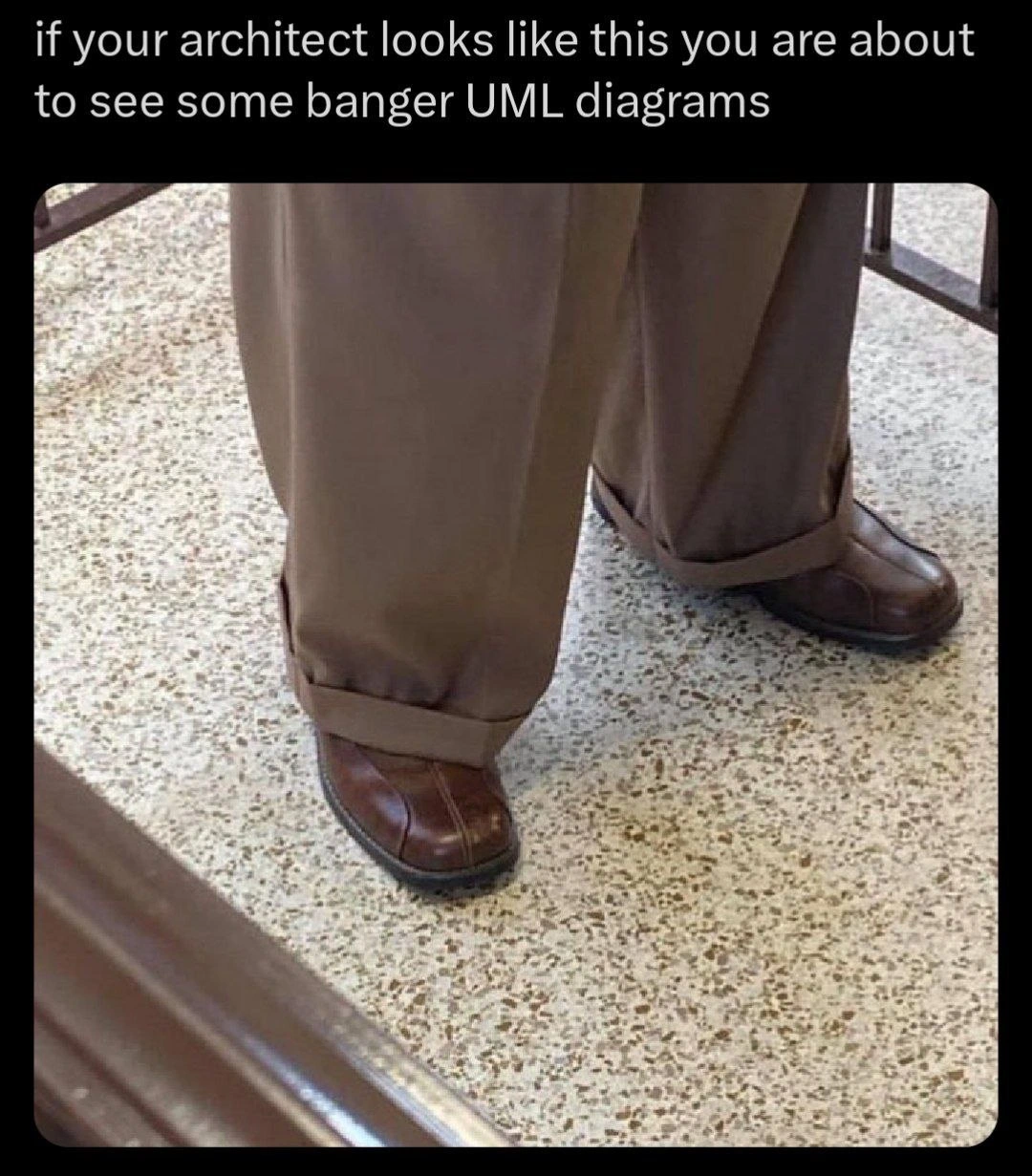
When your architect rocks oversized slacks, brace for legendary UML diagram sessions
DesignPatterns Architecture Post #5776, on Jan 3, 2024 in TG

When your architect rocks oversized slacks, brace for legendary UML diagram sessions

Why is this DesignPatterns Architecture meme funny?

Level 1: Grandma’s Apron Means Cookies

Imagine your grandma is wearing her old cooking apron – you just know she’s about to bake a batch of her famous cookies, right? In the same way, if a very experienced software designer comes in wearing old-style, baggy dress pants, everyone in the office figures he’s about to cook up something special too. But instead of cookies, it’s big important drawings – like blueprints – showing how all the parts of a big program fit together. The joke is that just by the way this person dresses (kind of like how an old-fashioned teacher or grandpa might dress), you can tell something grand and detailed is coming. It makes people smile because it’s saying, “Hey, this fellow looks old-school, so get ready – he’s going to do things the old-school awesome way!” Just like grandma’s outfit signals yummy cookies on the way, the architect’s baggy pants signal some cool, complex drawings are about to happen. It’s a funny and warm way to appreciate someone’s experience and the big plans they bring with them.

Level 2: Slacks & Sequence Diagrams

Let’s break down the meme and its tech references in simpler terms. The meme shows the legs of a person wearing baggy slacks (very loose dress pants) with big folded cuffs over old-fashioned dress shoes. The caption basically says: “If your software architect dresses like this, you’re about to see some amazing UML diagrams.” This is a playful way to combine corporate culture and software design humor.

Who or what is a “software architect”? In a software team, an architect is like a master designer. Just as a building architect draws blueprints for a house, a software architect designs the high-level structure of a software system. They decide big-picture things: how different parts of the system will interact, what technologies to use, how to ensure the system is scalable and secure. Often, architects have many years of experience. In big companies, they might not code every day; instead, they create documents and diagrams to guide the developers who do the coding.

What are UML diagrams? UML stands for Unified Modeling Language. It’s basically a standardized way to draw diagrams that describe software designs. Think of UML diagrams as the blueprints for software. For example:

  • A UML class diagram looks like boxes (classes) connected by lines to show relationships (like inheritance or associations) between those classes. Each box might list a class’s attributes and methods. It’s a way to visualize the structure of code without writing actual code.
  • A UML sequence diagram shows how different parts of a system interact over time. It’s like a comic strip for software: you see objects or components sending messages to each other in a certain order (sequence). This helps in understanding the flow of a process or how a request moves through the system.

Back in the late 90s and early 2000s, learning UML was a big part of software engineering education and corporate training. People used tools like IBM Rational Rose, Microsoft Visio, or other diagramming tools to create these diagrams. An entire meeting could be dedicated to reviewing a complex UML diagram of how an e-commerce system processes an order, for instance. Today, teams might be more informal (sketching on a whiteboard or using simplified charts), but UML is still taught and used, especially in large projects or for documentation.

Why the focus on the architect’s clothes? The clothes – oversized, cuffed slacks and old-fashioned shoes – are a visual joke. In many modern tech companies, the dress code is very casual: T-shirts, jeans, hoodies, sneakers. Seeing someone in such old-fashioned corporate attire (baggy dress pants were more common in 90s office fashion) is kind of rare in tech now. It immediately signals “old-school”. This meme suggests that an architect who hasn’t updated their wardrobe might also stick to old-school methodologies. And one hallmark of old-school methodology is extensive upfront design with UML diagrams (common in the era of waterfall model development and big design documents).

So the meme is combining an industry stereotype (older, very experienced engineers often dress more formally or in an outdated style) with a tech practice stereotype (those same engineers love detailed architecture diagrams). It’s like saying, “If your teacher still uses overhead projectors, get ready for a very traditional lecture.” Here, if the architect dresses like it’s 1999, get ready for some thorough 1999-style architecture design sessions. And by calling those UML diagrams “banger”, the meme maker is being humorously emphatic – as if these diagrams will be impressively good or intense.

For a junior developer or someone new to the field:

  • Design Patterns: You might have heard this term. These are common solutions to recurring design problems in software (like a recipe that many developers follow to solve a particular type of problem). A classic example is the Singleton pattern which ensures only one instance of a class exists. Architects love talking about design patterns to ensure code is well-structured. Often, they illustrate these patterns with UML diagrams to show the relationships between classes.
  • Architectural Trade-offs: This refers to the decisions architects make weighing pros and cons. For instance, “Should we build a single big application (monolith) or split it into microservices?” Each choice has advantages and disadvantages (trade-offs). An experienced architect will often diagram these options out, maybe drawing little services as separate boxes vs. one big box, and discuss the trade-offs (like simplicity vs. scalability).
  • CorporateCulture angle: In big companies, formal processes and documentation are more common. An architect who’s been in that environment for a long time might be used to giving very detailed design presentations. The baggy slacks suggest he’s been around in that kind of culture. It’s a bit of industry humor poking fun at both the fashion sense and the thoroughness of such veterans.

In summary, at this level: The meme is saying “Check out this old-school looking expert – he’s definitely going to break out the fancy official diagrams to design our system.” It’s funny because it’s often kinda true: folks who’ve been in the game a long time have a wealth of knowledge and sometimes an old-fashioned flair in how they share it. The wide pants and UML diagrams both scream retro, but in a charming (and possibly very useful) way!

Level 3: Waterfall Wardrobe Wisdom

There’s a deep industry inside joke here connecting an old-school fashion sense with equally old-school software architecture practices. The photo of oversized slacks cuffed over square-toed shoes screams 1990s corporate IT department – a time when architects literally wore suits (or at least pleated khakis) and carried binders of documentation. The meme quips that if your software architect dresses like they've time-traveled from a bygone era, you’re about to witness some legendary design artifacts – specifically UML diagrams – that only a true veteran would whip out.

Why is this funny to experienced developers? It's playing on the stereotype that the greybeard architects who haven’t updated their wardrobe since the dot-com era are the ones who still master Unified Modeling Language (UML) like it's a martial art. UML was huge in the late 90s and early 2000s, the heyday of big enterprise software projects and Rational Unified Process (RUP). Back then, it was common to spend weeks drawing meticulous class diagrams and sequence diagrams before writing a single line of code. A senior architect from that era probably lives and breathes design patterns and can debate the merits of a Singleton vs Factory Method pattern over a pot of coffee. So the meme humorously suggests that an architect dressed a bit like someone’s dad (or grandad) at the office is precisely the kind of person who will drop “banger UML diagrams” – i.e., super detailed, comprehensive system blueprints that might actually blow your mind (or bore you to tears, depending on your perspective).

This is corporate culture comedy. In many large companies, especially traditional industries (banks, insurance, old-school tech giants), you often find these veteran architects. They might have started coding in COBOL or C, climbed the ranks, and now they design systems at a high level. They remember when design documentation was king. Their oversized slacks and sensible shoes are like a uniform signaling “I have seen things. I have design documents older than you.” When they step up to present, junior devs brace themselves for a marathon meeting featuring perfectly aligned UML class hierarchies, exhaustive database ER diagrams, and perhaps a flowchart spanning multiple pages. The phrase “banger UML diagrams” is tongue-in-cheek millennial/Gen-Z slang (“banger” means high-quality or awesome) applied to something as dry as software diagrams – that contrast is inherently funny. It’s imagining an old architect dropping fire diagrams like a DJ dropping beats.

The humor also touches on DesignPatterns_Architecture folklore. The older generation often reveres the Gang of Four design patterns (from the famous 1994 book Design Patterns). These architects can effortlessly sketch a Strategy Pattern or Observer Pattern in UML notation on the whiteboard, with the kind of flourish a younger hoodie-clad coder might reserve for live-coding a new app. To the veterans, a good UML diagram is a work of art and a communication tool. It’s their way of flexing deep knowledge of ArchitectureDecisions and trade-offs. The meme exaggerates this “diagramming flex” by implying the diagrams will be absolute bangers – like chart-topping hits but in diagram form.

Many seasoned devs find this funny because they've been in that room. Perhaps you’ve sat through an Architecture Review Board meeting where a distinguished-looking architect (maybe with fashion from another decade) meticulously walked everyone through a system diagram so detailed you could see design patterns at every layer. It’s simultaneously impressive and a little absurd by modern lean/agile standards. Today, startups and new teams might scribble a quick diagram on a whiteboard or just jump into coding, focusing on working software over comprehensive docs. But here comes our baggy-slacks architect, channeling the legacy_enterprise_vibes of yesteryear, insisting on proper diagrams for everything from the data flow to the object model. Part of the comedy is the clash of eras: the old guard with PowerPoint slides of UML vs. the new guard with post-it notes and user stories.

In essence, the meme is lovingly poking fun at industry stereotypes. The architect’s outdated attire is a visual shorthand for “seasoned professional with possibly outdated but thorough practices.” And the promise of legendary UML sessions is a wink to every developer who has witnessed a passionate senior architect draw boxes, arrows, and stick-figure actors for hours, describing the system with almost academic precision. We laugh because it’s true: some of the most epic (and occasionally over-engineered) architecture explanations often come from these very folks. It’s both an admiration of their knowledge and a gentle ribbing of their perhaps over-formality. After all, who else can turn a system design meeting into a masterclass on diagramming tools and design principles? If your architect looks like he might also lecture about mainframes at night, buckle up – you’re about to get diagrams so good they could be framed as art in the developer humor hall of fame.

Description

The meme has a black tweet-style frame with white text at the top that reads: "if your architect looks like this you are about to see some banger UML diagrams". Below the caption is a photo showing only the lower legs and feet of a person wearing very wide, baggy brown dress slacks whose cuffs are folded up into large loops that nearly cover a pair of square-toe brown leather shoes. The exaggeratedly old-school office attire humorously implies a senior, battle-hardened software architect. The joke plays on the stereotype that veterans who still dress like this will unleash detailed, perfectly-formatted UML class and sequence diagrams - signalling deep knowledge of system architecture and design methodology

Comments

10
Anonymous ★ Top Pick If the cuffs are wide enough to feed an A0 plotter, clear your calendar - he’s about to unroll the full 4+1 view, justify why CORBA “still scales,” and make you label every arrow in the sequence diagram with stereotypes you retired in 2003
  1. Anonymous ★ Top Pick

    If the cuffs are wide enough to feed an A0 plotter, clear your calendar - he’s about to unroll the full 4+1 view, justify why CORBA “still scales,” and make you label every arrow in the sequence diagram with stereotypes you retired in 2003

  2. Anonymous

    The correlation between an architect's boot-tuck coefficient and their UML diagram complexity is directly proportional to the number of abstract factory patterns they'll insist on implementing for a simple CRUD app

  3. Anonymous

    This architect's shoes have more inheritance hierarchies than your entire codebase - and just like their UML diagrams, they're meticulously structured, slightly over-engineered, and make you wonder if all those relationships were really necessary. The real question is whether they use aggregation or composition for the sole-to-upper binding, and if they've documented the cardinality of the lace-to-eyelet associations

  4. Anonymous

    Those cuffs say RUP; expect 4+1 views, Sparx EA files, and an ADR for every arrow on the sequence diagram

  5. Anonymous

    Baggy khakis for loose coupling, but those UMLs? Tightly cohesive masterpieces

  6. Anonymous

    If the pants have stirrups, the deck has stereotypes - brace for Rational Rose UML where the coffee machine is a bounded context and the sequence arrows only execute in PowerPoint

  7. @dontmindmehere 2y

    god bless such architects

  8. @azizhakberdiev 2y

    I can't imagine his face without mustache, idk why

    1. @callofvoid0 2y

      and round glasses

  9. dev_meme 2y

    🥸

Use J and K for navigation