Skip to content
DevMeme
2681 of 7435
The ultimate defense against hacking: paper
Security Post #2962, on Apr 14, 2021 in TG

The ultimate defense against hacking: paper

Why is this Security meme funny?

Level 1: Paper Beats Hacker

Imagine a kid bragging that he can break into any computer system to find secrets. He’s got his keyboard and fancy hacker hoodie on, ready to type super-fast and look for hidden information. But then someone says, “Okay, go ahead and hack this,” and points to a giant pile of notebooks locked in a closet. All the important info is written on paper inside those notebooks, not stored on any computer. The kid suddenly has no idea what to do – you can’t use a computer to break into a bunch of paper files! It’s like trying to use a video game cheat code on a board game. The joke here is that the hackers thought they were going to attack computer databases, but the “databases” turned out to be old paper records. So the hackers are left scratching their heads, because you just can’t hack paper with a computer. It’s a funny reminder that sometimes the oldest, most old-fashioned way of keeping information (like writing it down on paper) can completely confuse the most high-tech plans.

Level 2: The Ultimate Air Gap

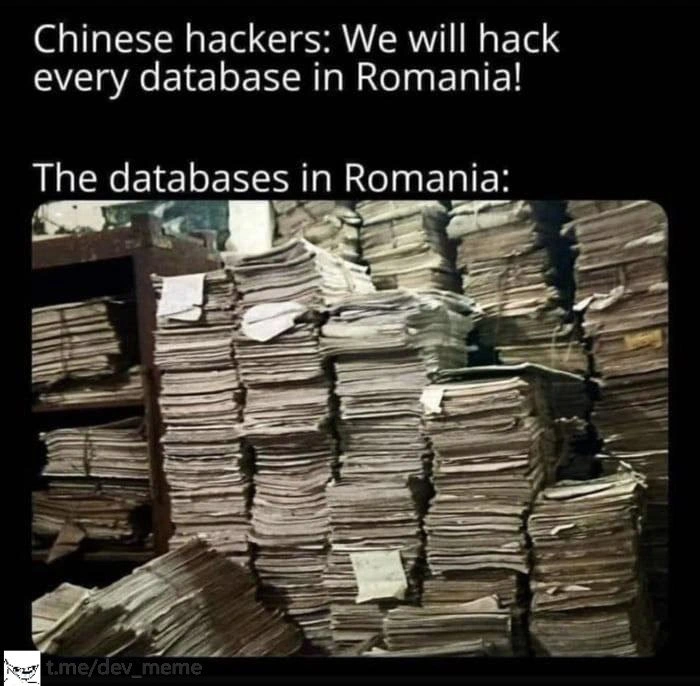
Let’s break this down in simpler terms. In modern computing, a database is usually a digital repository of information – think of a big organized collection of data that lives on computers and can be searched or updated with software. Hackers target such databases by breaking into computer systems. For example, they might use hacking tools or tricks like SQL injection, which is a method where an attacker sneaks malicious commands into a program’s database queries (kind of like tricking the database into giving up secret information or doing something it shouldn’t). When the meme says “Chinese hackers: We will hack every database in Romania!”, it imagines some group of hackers confidently planning to breach all the computer systems that hold Romania’s data. This sets the stage, making us picture a high-tech cyber attack on servers and digital records.

Now the funny twist: “The databases in Romania:” with a photo of towering stacks of old paper files. Those piles of papers are the “databases” in this joke – not computers at all! This implies that (at least in the context of the meme) Romania’s records aren’t stored in modern SQL servers or fancy cloud storage, but rather in paper-based records locked away in storage rooms. In reality, many organizations (especially government offices or older institutions) still have legacy systems where information is kept on paper or outdated mediums instead of modern digital databases. The meme exaggerates this to a comedic extreme by showing an archive that looks decades old. You see uneven towers of yellowed documents and folders. It’s chaotic and completely offline. There’s no computer network to log into, no server to exploit – just stacks of paper in a room.

This situation is what IT folks jokingly call the ultimate air gap. An “air-gapped” system is one that’s not connected to any network or the internet. It’s a security measure to prevent remote hacking – if a computer isn’t online, hackers can’t reach it through cyberspace. In this case, Romania’s “databases” being on paper is like an extreme form of being air-gapped: there aren’t even computers to connect. It’s totally analog. Hackers could send all the viruses in the world, but a sheet of paper won’t catch them (unless it’s a paper cut from a very angry sysadmin 😅 — tech humor!). In practical terms, you can’t hack a filing cabinet with code. If you wanted to steal data from these paper records, you’d have to actually go there in person, open the cabinet or sift through the piles, and pull out the files. That’s a physical security problem (involving locks, doors, guards, etc.), not a cyber one.

For a junior developer or someone new to IT, the humor here comes from the huge contrast: Hackers are expecting to do some cool computer attacks, but there’s no computer to attack. Imagine preparing all your elite coding skills to break into a system, typing furiously, only to realize the “system” is literally a room filled with papers. It’s like planning to launch a space rocket but arriving at a horse-and-buggy station – the context is completely mismatched. Those paper stacks represent legacy data storage. They’re essentially an old-fashioned “database” where data is stored in folders on shelves instead of on a disk drive.

This also touches on the topic of modernization in IT. Converting all those paper documents into a digital format (scanning them, typing the information into a computer database, etc.) is a huge project that perhaps hasn’t been done yet. Many governments and companies around the world are still in the process of doing exactly that – taking offline storage like paper and putting it into computers so it can be easily searched, backed up, and yes, protected with digital security measures. Until they do, the data is kind of “safe” from hackers simply because hackers can’t access something that isn’t online. But it also means that data is harder to use and prone to other problems (paper can be lost or damaged, and finding anything in those stacks might be like finding a needle in a haystack).

Some key terms in this meme, defined more simply:

  • Database (modern definition): A digital collection of organized information, usually stored in a computer system. Example: a library catalog on a computer or a customer records system for a bank. You can query (ask questions of) a database using a language like SQL (Structured Query Language).
  • Legacy system: An old system or technology that is still in use, even if newer technology exists. Often legacy systems are outdated or inefficient, but they haven’t been replaced yet because migrating away from them is hard or costly. Here, the paper archives are a super legacy system – about as old-school as it gets.
  • Air-gapped: Describes a computer or network that is physically isolated from unsecured networks like the public internet. It’s a security strategy. For example, some sensitive military or research computers are air-gapped to prevent any online hacking. In this meme, the “air gap” isn’t just a disconnected computer – it’s no computer at all, just paper.
  • Hack (in this context): To break into a computer system or network without permission, usually by finding weaknesses in security. Hackers use software tools, knowledge of vulnerabilities, or clever tricks to get into systems and access data.

The meme is a tech humor way to say: “Haha, you can’t hack us if we haven’t even put our data online!” It’s highlighting the almost absurd level of being behind the times — which ironically provides protection against cyber attacks. It resonates with developers and IT workers because it’s a scenario we sometimes joke about: the most secure computer is one that’s turned off (or in this case, a “computer” that’s actually just paper in a cabinet). It also hints at real issues in tech: not everyone has the latest systems, and lots of places have data on paper they’re struggling to modernize. So if you’re a junior dev, the takeaway is: a system that isn’t digital can’t be hacked through the internet. That’s the core of the joke. But keeping things only on paper comes with its own trade-offs, which is why everyone is pushing for digitization despite this “security” perk. After all, you can’t run analytics or quickly search through thousands of paper files the way you can with a proper digital database. The meme just finds the humor in the one upside of still being analog: being unhackable (by remote hackers), albeit unintentionally.

Level 3: Security by Antiquity

At first glance, this meme drops us into a clash between cutting-edge cyber warfare and legacy systems so old they’re literally made of paper. The top caption boasts, “Chinese hackers: We will hack every database in Romania!” — a pretty dramatic cybersecurity threat. Typically, when hackers target databases, they’re thinking of servers humming in data centers, full of SQL tables or NoSQL documents, all connected to the internet. They imagine performing SQL injection attacks, exploiting unpatched vulnerabilities, dumping data with slick SELECT * queries, or pulling off ransomware heists. But here comes the punchline: “The databases in Romania:” followed by an image of towering paper files stacked floor-to-ceiling. In other words, the “database” is literally an archive room of paper records. You can almost hear the hackers’ brains short-circuiting: you can’t DROP TABLE when the “table” is actually a wooden shelf holding dusty files.

This contrast is poking fun at the absurd mismatch between modern hacking techniques and archaic record-keeping. It’s a tongue-in-cheek example of air-gapped security taken to the extreme. An air gap normally means a computer system is physically isolated from any network – think of a top-secret server with no internet connection. But Romania’s paper “databases” are air-gapped by default: they’re not even on a computer, let alone a network! You could run the most advanced port scanner or brute-force attack, and it would be as effective as aiming a water pistol at a castle made of stone. The only way to breach these “databases” would be to physically enter the archive room and start leafing through folders. Good luck hacking a stack of yellowed files with Python scripts or malware – there’s no IP address for a filing cabinet. In cybersecurity terms, these records have an infinite firewall around them: the absence of electronics.

Ironically, this scenario highlights a form of security through obsolescence. In infosec we often joke about “security by obscurity” (hiding system details as a defense, which usually doesn’t work for long). But here it’s more like security by antiquity: the systems are so outdated (i.e., entirely analog) that modern hackers armed with 21st-century cyber weapons find themselves powerless. It’s as if Romania’s bureaucracy accidentally implemented the ultimate unhackable legacy data strategy: keep everything on paper-based records. No remote access, no digital attack surface. You can’t deploy a virus on a pencil-written ledger, and you definitely can’t perform an XSS attack on a stack of stationery. One could joke that the Romanian IT department’s intrusion detection system is a night watchman checking ID badges at the archive entrance.

Of course, behind the humor is a nod to the modernization gap many organizations (and governments) face. Digitizing decades of paper documents is a colossal task – scanning, data entry, validating records – and until it’s done, those archives remain “offline storage.” Many countries and enterprises still juggle such LegacySystems where part of the data lives in old formats or physical files. The meme specifically singles out Romania, possibly referencing a stereotype (or partial reality) about Romanian bureaucracy being heavy on paperwork. Whether fair or not, the comedic image of floor-to-ceiling files is an exaggerated stand-in for any under-funded, old-school record system. Those piles represent technical debt in physical form – a database that you can literally trip over. It’s a backlog of modernization: all that data hasn’t been migrated to a digital DatabaseManagementSystem, so it sits in manila folders and binders, waiting for some poor soul to eventually digitize it (or for a stray spark to turn it into ashes). Meanwhile, from a cybersecurity standpoint, it’s oddly safe from remote hackers. You can’t phish a piece of paper over email, and a ransomware gang can’t encrypt a cabinet of documents from across the world. In a world of high-profile data breaches and leaked records, an old archive room is almost security utopia by comparison – albeit unintentional.

However, the seasoned engineer in me (with the sarcasm of a battle-scarred veteran) has to point out: “unhackable” doesn’t mean accessible or efficient. Sure, those paper records are safe from Chinese hackers typing furiously in Beijing, but they’re also a nightmare for the Romanian clerks who need to find a single file among thousands. It’s like achieving 100% uptime by never deploying changes – technically true, but at what cost? Here, security comes at the expense of speed and convenience. Need to query this “database”? Forget SQL – you’ll be lucky to get a response by next week after manual digging. Also, while no cyber attack can touch these papers, they’re vulnerable to very old-fashioned threats: fire, flood, misfiling, coffee spills, or rats with a taste for cellulose. In other words, this isn’t a recommended security model so much as a darkly funny consequence of falling behind in IT modernization. The meme gets a knowing laugh from senior devs and IT pros because it captures that “so absurd it’s true” scenario: sometimes the reason a system is safe from hackers is not superior skill, but simply that it’s been left in the past. Legacy systems often stick around out of necessity or inertia, and here that legacy is literally piles of paper. The hackers threaten to breach every database, but Romania’s data can’t be breached with code – you’d need a crowbar and a truck, not a zero-day exploit. In a way, this meme is a tech-world twist on “you can’t hack what isn’t online,” illustrating how a gap in technology (while usually a disadvantage) can occasionally thwart even the most determined cyber attackers.

So the humor lands on multiple levels: it’s a DatabaseHumor gem showing the absurdity of trying to brute-force hack something that has no digital presence, and a nod to Security ironies (the best firewall might just be a wall of file cabinets). It speaks to developers, IT workers, and cybersecurity folks who’ve dealt with creaky old systems and know that sometimes the biggest obstacle to hacking is no system at all. In summary, this is both a relatable tech joke and a subtle commentary: no matter how advanced your hacking skills, you’re going to feel pretty foolish if your target database is an offline archive from the 1970s. Sometimes, the joke’s on the hacker – you can’t deploy malware.exe on paper, and there’s no SQL to inject into a typewriter ledger. As the meme implicitly teases, Romania’s ultimate defense against a high-tech data breach might just be its low-tech bureaucracy.

Description

A two-part meme that contrasts a modern cybersecurity threat with an archaic reality. The top text declares, 'Chinese hackers: We will hack every database in Romania!'. Below this, the text 'The databases in Romania:' introduces an image of a room crammed with floor-to-ceiling stacks of old, dusty, and disorganized paper documents, bundled with string. The humor lies in the absurdity of the situation: the hackers' sophisticated digital attack methods are completely useless against a non-existent digital infrastructure. The so-called 'databases' are analog, making them immune to cyberattacks and highlighting the concept of 'security through obsolescence.' The meme serves as a commentary on the state of legacy systems, particularly in bureaucratic or government contexts, where digitization has not yet occurred
Comments

9
Anonymous ★ Top Pick Their disaster recovery plan is just a very good fire extinguisher
  1. Anonymous ★ Top Pick

    Their disaster recovery plan is just a very good fire extinguisher

  2. Anonymous

    Advanced persistent threat meets advanced persistent paper: every SELECT needs a flashlight, a forklift, and the clerk who remembers the foreign keys - good luck scripting that exfil

  3. Anonymous

    The most effective air-gapped system isn't one with no network connection - it's one that predates TCP/IP entirely. Romania's paper-based 'database architecture' achieves perfect isolation from remote code execution by implementing a write-only append log with O(n²) retrieval complexity and built-in ransomware immunity

  4. Anonymous

    When your disaster recovery plan is 'hope the building doesn't catch fire' and your access control is literally a locked door, you've achieved what modern security architects can only dream of: a truly air-gapped, zero-trust architecture where the attack surface is measured in square footage rather than IP addresses. The irony is that these paper stacks probably have better GDPR compliance than most cloud databases - good luck exfiltrating petabytes of data one manila folder at a time

  5. Anonymous

    PaperDB: air-gapped, horizontally scalable by adding cabinets, ACID guaranteed because nothing ever commits, and query latency measured in interns

  6. Anonymous

    Unhackable by design: cellulose NoSQL with manual sharding, write-ahead-pen logging, and query latency measured in interns per shelf

  7. Anonymous

    The ultimate air-gapped database: so legacy it's vulnerable only to floods and archivists on strike

  8. @montanaseller 5y

    https://t.me/dev_meme

  9. Deleted Account 2y

    ah yes. is very funny. As a Romanian i can confirm this.

Use J and K for navigation