The Ultimate Satirical Jab at 'Rockstar Developer' Buzzwords
Why is this Languages meme funny?
Level 1: Literal Rockstar
Imagine your teacher always says, “I need some rockstar students in this class!” – meaning she wants really great students. One day, to be funny, you and your friend actually start acting like rock stars in class: you wear a rockstar costume, play a toy guitar, and write your homework as if it’s a song. 📜🎸 Now when the teacher says “I want a rockstar student,” you can point to yourself literally singing your math answers like lyrics. It makes everyone laugh and it shows the teacher how silly that phrase is if you take it literally. In the same way, programmers got tired of bosses and recruiters asking for a “rockstar developer” (meaning an amazing coder), so they made an actual coding language called Rockstar where the code looks like rock music lyrics. It’s a joke to make people stop and think, “Oh, maybe calling programmers ‘rockstars’ is kinda funny if you take it literally.” Essentially, they turned a figure of speech into a real thing to poke fun at it. It’s like saying: “You want a rockstar? Okay, here’s a real rock star… now in programming!” The result is both super silly and really clever – and that’s why it’s funny.
Level 2: Sing-along Syntax
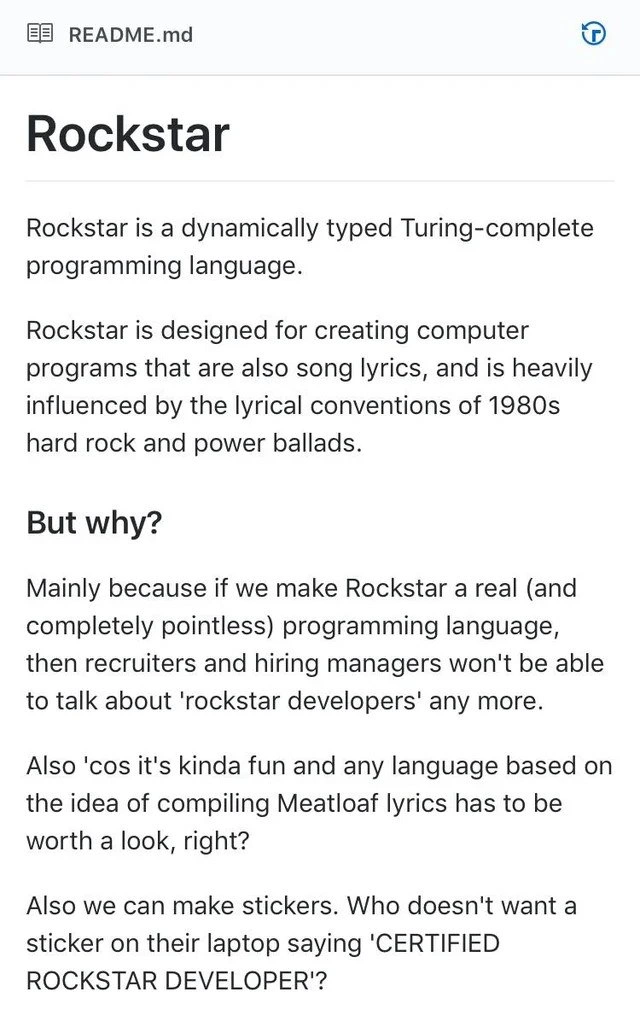
Let’s break down what’s going on in this meme in plain terms. The image is a snippet from a project’s README.md (a documentation file) on a code hosting site (like GitHub). It’s describing a programming language called Rockstar that someone created as a joke. Rockstar is an example of an esoteric language (often called an esolang). An esoteric language is a programming language built more for fun, experimentation, or satire than for practical software development. Think of it as a coding toy or a parody. For instance, there’s a language where programs look like Shakespeare plays, and one that looks like chef recipes. Rockstar’s gimmick is that programs written in it look like the lyrics to an 1980s rock song.
Now, the README text uses some technical terms to sound serious (which is part of the humor). It says Rockstar is “dynamically typed” and “Turing-complete.” Here’s what that means:
Dynamically typed: In some languages like C++ or Java, you have to declare the type of each variable (say it’s an integer, or a string, etc.) before using it, which is called static typing. Dynamically typed languages (like Python, JavaScript, or Ruby) don’t require that; you can just start using a variable and it can hold any type of value, and the language figures out the types on the fly as the program runs. Rockstar being dynamically typed means when you use a word in your song-code (say, the variable
MidnightorDream), you don’t have to define it as a number or text — the language will just roll with it. This makes sense for a made-up language because it lets the code read more naturally like English lyrics without a lot of technical declarations.Turing-complete: This is a computer science way of saying the language is as powerful as any general-purpose programming language. In theory, a Turing-complete language can solve any computation problem (anything any other programming language can do), given enough time and memory. For a language to be Turing-complete, it usually needs features like the ability to do loops or repeats, make decisions (if-else logic), and read/write some kind of memory. Declaring Rockstar Turing-complete is a tongue-in-cheek brag: it means that even though Rockstar is a joke, you could actually write real programs in it (they would just look like epic rock ballads!). This isn’t just hypothetical – the creators likely ensured Rockstar has all the necessary ingredients (perhaps hidden behind rock-and-roll terminology) to technically count as a real programming language. For example, maybe there’s a way to loop by repeating a chorus, or a way to do math by singing about numbers. It’s all part of the joke that Rockstar isn’t just a silly idea, it works (at least for some definition of working).
The README then asks “But why?” – why would someone make this? The answer it gives is essentially: because it’s funny and it makes a point. In the text, they explain that if Rockstar (the programming language) exists (even if it’s “completely pointless”), then recruiters and hiring managers can’t casually throw around the term “rockstar developer” without sounding like they want someone who codes in this goofy language.
To give some context, calling someone a “rockstar developer” is a trendy way of saying “an awesome, superstar programmer.” It’s business slang. Non-technical recruiters often use it in job ads, like “Seeking a Rockstar Engineer” to mean they want a highly skilled, rock-star-level coder. A lot of actual developers find this term silly or overused – after all, being good at coding has nothing to do with rocking out on a stage. It’s just a metaphor that became a buzzword. By inventing a programming language literally named Rockstar, techies are jokingly forcing people to take that metaphor literally. It’s as if to say, “Oh, you want a Rockstar developer? Do you mean a developer who knows the Rockstar programming language? Otherwise, maybe just say you need a skilled developer.” It’s a fun form of protest against cheesy corporate lingo.
The reference to Meatloaf lyrics and power ballads is part of the humor and design of the language. Meat Loaf was a famous rock singer known for his long, dramatic rock ballads in the 1970s and 1980s (like “Bat Out of Hell” or “I’d Do Anything for Love”). The idea of “compiling Meatloaf lyrics” means taking something like the over-the-top lyrics from a Meat Loaf song and running them through a compiler as code. 🤯 Normally, compilers only understand very formal code, but Rockstar language is designed so that a big melodramatic verse is valid code. For example (just a conceptual example), in Rockstar you might write:
Tommy was a lonely whale
Midnight took the lights away
Tommy sang a soulful song
The above isn’t actual Rockstar code I know for sure, but it gives the flavor: it reads like mysterious song lyrics. In a real Rockstar program, each sentence would correspond to some operation – maybe assigning values or doing arithmetic, but written in a poetic, metaphorical way. The second line might metaphorically subtract something (“took the lights away”) from Tommy (which could be a variable). The specifics aren’t obvious unless you learn the Rockstar syntax, but the key is that reading it feels like reading music lyrics, not normal code. That’s why “any language based on the idea of compiling Meatloaf lyrics has to be worth a look” – it’s such a wacky idea that programmers find it amusing and intriguing.
Finally, the README joke mentions making stickers: “Who doesn't want a sticker on their laptop saying 'CERTIFIED ROCKSTAR DEVELOPER'?” In developer culture, it’s very common to decorate your laptop with stickers from programming languages, frameworks, or funny tech jokes. It’s a way to show your interests or sense of humor. A “Certified Rockstar Developer” sticker would be hilarious because it sounds like bragging (“I’m a rockstar developer!”) but literally refers to knowing this esoteric Rockstar language. It’s the kind of tongue-in-cheek credential that only other programmers would chuckle at. In short, the whole thing is a big inside joke: by actually learning or using Rockstar the language, you become a “Rockstar developer” in the most literal, cheeky sense, and you can flash that title as a badge of honor (or geeky humor).
So, to recap in simpler terms: Someone made a fake-but-real programming language called Rockstar that lets you write code as if you’re writing 80s rock song lyrics. They did this mostly to poke fun at the term “rockstar developer” that recruiters use. The language is fully capable (you could write real programs in it, since it’s Turing-complete), but it’s totally meant for laughs. The image in the meme is from the project’s introduction, explaining all of this with a straight face, which makes it even funnier. It’s a mix of techie humor, pop culture, and a little jab at hiring practices, all rolled into one goofy README page.
Level 3: Battle of the Buzzwords
On an industry level, this meme is a hilarious takedown of tech hiring clichés and buzzwords. The term “rockstar developer” has been a cringy staple of job listings for years – startups and recruiters say they want a “Rockstar programmer” or “Code ninja” as shorthand for an über-talented, high-performing coder. Seasoned developers have grown tired of these labels; after all, writing clean code at 2 AM in pajamas isn’t exactly shredding a guitar on stage. Here, the dev community fought back with pure satire: make “Rockstar” a real programming language. 😂 Now when HR boasts, “We’re hiring a Rockstar developer,” we can smirk and ask, “Oh, you mean someone proficient in the Rockstar language?” This README screenshot is from an actual open-source esoteric language called Rockstar – yes, it really exists! The author explicitly explains the prank in the “But why?” section:
But why?
Mainly because if we make Rockstar a real (and completely pointless) programming language, then recruiters and hiring managers won’t be able to talk about ‘rockstar developers’ any more.
It’s an ingenious geeky joke born out of collective eye-rolling at recruiter lingo. Veteran devs find this uproariously on point because it flips a tired metaphor on its head. Instead of aspiring to be “rockstar developers,” we can now earn the tongue-in-cheek title of Certified Rockstar Developer by actually coding in Rockstar. (Cue the laptop stickers! Who wouldn’t want a sticker proclaiming that absurd achievement? 😏)
This meme also pokes fun at the grandiosity often found in tech culture. The Rockstar language is described in totally serious tone – “dynamically typed,” “influenced by 1980s hard rock” – as if it’s a groundbreaking new tool, when in reality it’s a labor of love and laughter. Experienced engineers recognize the pattern: we often see overhyped jargon in product announcements, but here the hyperbole is deliberately ridiculous. By invoking 1980s hard rock and power ballads, the language taps into pop culture that many devs adore (who hasn’t coded while listening to Bon Jovi or Guns N’ Roses? 🎸). It’s a celebration of nerdy creativity: someone literally sat down and designed a full programming language syntax where programs read like Meatloaf lyrics. That’s a level of dedication to a joke that commands respect from senior devs who’ve seen their share of off-the-wall side projects.
Importantly, the humor works on multiple layers that resonate in the software world:
- Hiring Satire: It undermines a recruiting buzzword. The next time a hiring manager says they need a “rockstar,” devs can deadpan, “Do you mean a developer who codes in Rockstar? Because I know power ballads, but maybe we should just say we need a great programmer.” The absurdity might make them drop the buzzword altogether.
- Tech Culture In-Joke: It references the long-standing joke about “rockstar developers” and extends it. There’s even a touch of office culture commentary: calling someone a rockstar never actually made sense (we write code, we don’t sell out arenas). Now it makes even less sense unless they literally code in a rock language!
- Esoteric Language Tradition: Older devs remember languages like Brainfuck, INTERCAL, LOLCODE, or the Shakespeare Language – all created for laughs or art. Rockstar fits right in, and those who know this tradition chuckle at seeing a new entry that hits a very contemporary joke. It’s the community’s way of blowing off steam and showing that programming can be fun and irreverent.
- The Sticker and Title Gag: Tech folks love their ironic titles and swag. By obtaining (even unofficially) a “CERTIFIED ROCKSTAR DEVELOPER” status, a programmer gets to playfully one-up the corporate lingo. It’s like saying, “You wanted a rockstar? I’ll be a literal Rockstar, certificate and all.” This is classic developer humor – taking things to absurd literal conclusions.
Ultimately, the meme highlights a truth elders in the field appreciate: words matter. If you throw around flashy labels without thought, don’t be surprised if engineers turn it into a literal joke. It’s a gentle form of rebellion against tech’s tendency to glamorize and buzzwordify everything. And of course, it’s a reminder that we code not just for money or fame, but sometimes just for the fun of it – even if that means compiling a power ballad for a laugh. In the battle of buzzwords vs. developers, this time the developers got the last laugh by turning “rockstar” into their own inside joke. 🤘
Level 4: Turing-Complete Tomfoolery
At the deepest technical level, this meme spotlights some computer science satire hidden in plain sight. The README proudly declares Rockstar as “a dynamically typed Turing-complete programming language.” These are weighty terms usually reserved for serious language design discussions. Turing-complete means the language can simulate a Turing machine – in other words, given enough time and memory, Rockstar can compute anything any conventional language like C++ or Python can. This is a bold (and humorous) claim because it implies that even a joke language based on rock lyrics has all the logical power of serious languages. Under the hood, to be Turing-complete Rockstar must support constructs like conditional branching and loops (perhaps disguised as verses and choruses!) and ways to manipulate data (variables likely named after 1980s rock themes). Achieving Turing-completeness in an esoteric language often involves clever tricks: for example, a looping structure could be hidden in lyrics like a “repeat the chorus” metaphor, or a goto might be phrased as “take it from the top” (like restarting a song). The creators aren’t just joking around – they designed Rockstar with enough complexity so that you could, in theory, implement any algorithm (yes, even write a program to calculate prime numbers or run a web server) using power-ballad lyrics. This puts Rockstar in the proud tradition of esoteric languages that are deliberately Turing tarpits – systems where “everything is possible but nothing of interest is easy.” Being dynamically typed is another technical flourish: it means variables in Rockstar don’t have a fixed type, just like how in Python or JavaScript you can set a variable to a number then later to a string. Dynamic typing fits the rock-n-roll vibe – free-flowing and not too strict on rules. It also makes parsing English-like code feasible: you wouldn’t want to specify data types in the middle of your song’s poetic flow! The README’s straight-faced use of these terms parodies the way new languages market themselves. It’s as if Rockstar’s designer wrote an academic specification for a totally legit programming language, except that language happens to let you croon your code. This contrast between formal CS theory and rock lyric silliness is the core of the technical humor. It reminds seasoned devs that beneath all the fun, Rockstar isn’t just a joke – it’s a fully capable (if impractical) programming language that cleverly abuses the theoretical flexibility of computation. Who knew you could push the Church–Turing thesis to stadium rock levels?
Description
A screenshot of a README.md file for a programming language named 'Rockstar'. The document explains that Rockstar is a dynamically typed, Turing-complete programming language designed to create programs that are also 1980s power ballad lyrics. The 'But why?' section reveals the true purpose: to create a real, albeit pointless, programming language called Rockstar so that 'recruiters and hiring managers won't be able to talk about 'rockstar developers' any more.' It also humorously mentions the fun of compiling Meatloaf lyrics and the appeal of 'CERTIFIED ROCKSTAR DEVELOPER' laptop stickers. This is a classic piece of developer satire, mocking the overuse of corporate jargon in the tech industry by taking a buzzword to its most literal, absurd conclusion. For senior developers, it's a deeply resonant joke about the disconnect between HR-speak and engineering reality
Comments
17Comment deleted
The only thing more painful than a job description asking for a 'rockstar developer' is trying to debug a variable named 'A lonely street of dreams' in a language based on 80s power ballads
We migrated the onboarding script to Rockstar - HR stopped asking for “rockstar devs,” but now the CI pipeline fails whenever the linter can’t parse a key change, and the only way to pass code review is to turn the build volume up to 11
Finally, a programming language where "I would do anything for love, but I won't refactor that" is valid syntax
Finally, a programming language that lets you write code that's as maintainable as a 1980s power ballad - technically impressive, emotionally overwrought, and absolutely nobody can figure out what's happening in the bridge. Now when recruiters ask for 'rockstar developers,' you can legitimately claim certification in a Turing-complete language where 'Tommy used to work on the docks' is valid syntax. It's the ultimate defense against job postings seeking 'ninjas,' 'gurus,' and 'wizards' - just point them to your GitHub where you've implemented FizzBuzz in compiled Meatloaf lyrics
Rockstar: the only Turing-complete language that made “rockstar developer” a literal job requirement - our code reviews now read “key change is fine, but the chorus relies on implicit coercion.”
Now when HR asks for a 'rockstar engineer,' we can reply: which runtime - Meatloaf LTS or Power‑Ballad Nightly?
Rockstar lang: where 'rockstar devs' finally get a Turing-complete home - until recruiters demand it scale to enterprise ballads
https://www.youtube.com/watch?v=6avJHaC3C2U&t=12s Comment deleted
thanks for another hour of procrastination!👍😎 Comment deleted
That's an hour well spent😏 Comment deleted
That's the best talk I've seen Comment deleted
If you are interested, the creator of the Rockstar language speaks in more details about what the language is and why he created it. The guy is a great presenter. Interesting to watch Comment deleted
Great comment, thank you! Comment deleted
modern problems require modern solutions Comment deleted
wow Comment deleted
Code example: The spiral takes my soul The moon is all over me Let my life be the moon over the moon The night was gone If my soul is my life Give back the night The circle is me If my soul is the circle Give back my life Until the circle is my soul Let the moon be the night Let the night be my life Put the moon with my life into my life Build the circle up Give back the night and my life Listen to the nature Shout the spiral taking the nature Comment deleted
Don't be a square my d00d Comment deleted