Skip to content
DevMeme
736 of 7435
The Deceptively Simple 'pip install'
Dependencies Post #835, on Nov 20, 2019 in TG

The Deceptively Simple 'pip install'

Why is this Dependencies meme funny?

Level 1: Small Task, Big Mess

Imagine you ask your parent if you can grab one toy from the closet, and they say “sure, it’ll be quick.” You open the door expecting a simple, fast grab… but WHAM! A whole pile of toys comes tumbling out on top of you. That one tiny request turned into a big cleanup adventure. This meme is just like that: the character Rick thought getting one thing (a Python package) would be a quick 2-minute job, but instead tons of other stuff came with it and caused chaos. It’s funny because he expected it to be easy and fast, but ended up overwhelmed by a lot more than he asked for. The faces of the characters (Morty screaming and Rick facepalming) show the shock and regret — just like you’d feel if a simple chore suddenly became a huge mess. The joke teaches that sometimes in life (and coding), a small task can unexpectedly become a big project.

Level 2: Package Pile-up

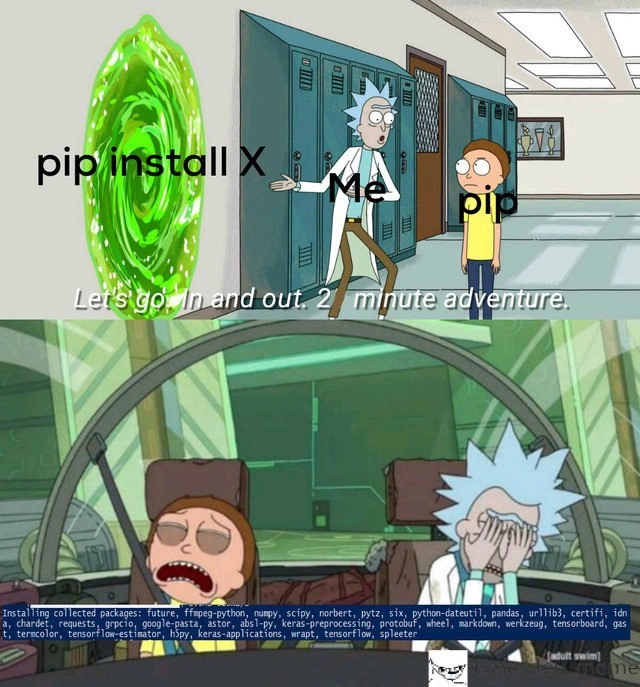
This meme uses a scene from Rick and Morty to illustrate a classic programming surprise. Rick is a cartoon scientist who often drags his anxious grandson Morty on wild escapades. In the top image, Rick (labeled “Me”) confidently tells Morty (labeled “pip”) “Let’s go. In and out. 2-minute adventure.” That’s Rick saying an errand will be quick. In the developer world, “pip” refers to the Python package installer (pip actually stands for “pip installs packages”). So the meme sets up pip as the sidekick being led into what’s supposed to be a simple task. The “portal” Rick opens, labeled pip install X, is like the door to getting a new Python library — you type that command to add library X to your project. The joke is that this portal doesn’t lead to a quick stop; it leads to a crazy journey.

In the bottom panel, we see Morty screaming in panic and Rick holding his face in regret. They’re inside Rick’s spaceship now, implying the adventure went out of control. Over that image, there’s a terminal output showing pip doing a lot more work than expected. It lists a bunch of package names being installed: future, ffmpeg-python, numpy, scipy, norbert, pytz, six, python-dateutil, pandas, urllib3, certifi, idna, chardet, requests, grpcio, google-pasta, astor, absl-py, keras-preprocessing, protobuf, wheel, markdown, werkzeug, tensorboard, gast, termcolor, tensorflow-estimator, h5py, keras-applications, wrapt, tensorflow, spleeter. Phew! That’s a long list. This is pip saying: “Okay, I’ll get your package X, but X needs all these other packages too, so I’m installing them as well.” This process is called resolving dependencies. A dependency is something a software package needs in order to work. For example, if you want to use a library for making charts, it might depend on another library for math calculations. Pip automatically finds and installs those for you.

What’s funny (and painful) here is how many dependencies there are. The developer only asked for one library (pip install X implies installing one package, possibly “spleeter” at the end of that list), but pip ended up pulling in dozens of others. This can happen when the requested library is built on top of many other libraries. It’s like ordering a simple burger and getting a whole combo meal with sides and drinks because the burger comes as part of a set. In this case, the presence of tensorflow in the list is a big clue. TensorFlow is a huge machine learning library. If the developer didn’t realize X relied on TensorFlow, they were in for a surprise. TensorFlow alone brings a lot of baggage (helpers like keras-preprocessing, tensorboard for visualization, protobuf for data format, etc., all visible in that list). So the “2-minute adventure” actually triggers a full installation of a machine learning stack, which can be heavy and time-consuming.

For a junior developer or someone new to Python, seeing pip scroll through all these names can be alarming. You might wonder: Did I do something wrong? Why is it installing absl-py or google-pasta? I never asked for those! But this is normal in Dependency Management. Library authors specify what other libraries their code needs. Pip reads that and grabs everything automatically from PyPI (the Python Package Index, which is the central repository of Python packages). Each line like Installing collected package: numpy is pip fetching and installing that requirement. So what started as installing one package (spleeter) turned into installing, say, 30 packages once all requirements were accounted for.

The meme is relatable because every developer eventually encounters this “dependency pile-up.” Maybe you run pip install for a simple audio or data processing tool and suddenly your computer is downloading a bunch of unfamiliar packages. It’s a running joke that a “quick fix” can pull in half the environment. This is sometimes called “dependency hell” when it gets out of hand — for instance, if two packages require different versions of the same library, you can get conflicts, or you end up with a really bloated project. There are ways to manage this: using a virtual environment (so these installs don’t mess with other projects), checking the package’s documentation for its dependency list beforehand, or choosing a lighter alternative. But often, we just type pip install and hope for the best.

In the Rick and Morty context, the line “In and out. 2-minute adventure.” was a joke in the show because that adventure escalated quickly. The meme borrows that to poke fun at how developers underestimate tasks. Package management in programming can be like an adventure: sometimes it’s smooth, but other times you’re running from one dependency to the next trying to get everything working. Morty (as pip) screaming is how it feels when your simple command starts throwing a wall of text at you — you’re like “Whoa, what is all this?” and Rick facepalming is the developer thinking “I can’t believe this is happening for a one-line install.” In summary, the meme humorously educates us: in software, even tasks that seem straightforward can hide a lot of complexity under the hood. That’s why all those package names flying by in the console is both funny and a little scary — it reveals the hidden world of dependencies that we normally don’t think about when saying “yeah, just add this library real quick.”

Level 3: Portal to Dependency Hell

In the top panel of the meme, Rick (the impulsive genius) is labeled “Me” — a developer confidently about to run pip install X. The glowing green portal he’s opening, labeled “pip install X,” represents the package manager door we open when we fetch a new library. Rick proclaims “Let’s go. In and out. 2-minute adventure.” These are famous last words in software development. Every senior engineer knows that “quick install” often spirals into a labyrinth of additional downloads. Here, Morty (labeled “pip”) stands nervously because pip — the Python installer — knows something Rick doesn’t: this journey is the gateway to Dependency Hell.

When you run pip install X, pip doesn’t just grab package X; it also retrieves everything X depends on, plus everything those dependencies require, and so on. This forms a dependency tree (or graph) that can fan out widely. In this meme’s bottom panel, Rick and Morty are in their spaceship mid-adventure: Morty is screaming in panic and Rick is facepalming as the “quick install” goes off the rails. The overlay of console text is an actual pip install output, showing Installing collected packages: and a huge list including numpy, scipy, pandas, requests, norbert, google-pasta, tensorflow, and spleeter. What was supposed to be installing one Python library (likely Spleeter, a music separation tool) has unlocked a flood of PyPI packages — from common ones like NumPy (for numeric computing) and Pandas (data frames) to heavy ones like TensorFlow (Google’s machine learning framework). Each of those has its own web of requirements. For example, installing spleeter implicitly brings in TensorFlow, which in turn requires protobuf (for protocol buffers), grpcio (for gRPC communication), absl-py (Abseil utilities), and many more. This cascade is pip methodically resolving transitive dependencies: X needs Y and Z; Y needs A, B, C; Z needs D and E… soon your environment is populated with dozens of packages.

The humor resonates with experienced devs because it’s so real. We’ve all confidently added a new library thinking it’s a minor tweak, only to watch our terminal spew a torrent of download links and compile messages for five minutes. It’s a rite of passage in Package Management. The meme exaggerates it perfectly: Rick’s swagger vs Morty’s dread mirrors a developer’s naive optimism versus pip’s dutiful compliance with an absurd request. The phrase “2-minute adventure” is pure TechHumor — an ironic nod to how simple tasks balloon in complexity. In practice, a pip install can turn into an odyssey not just in time but in potential troubles: version conflicts, large binary installs, maybe even compile errors if a package has a C extension. Seasoned engineers chuckle (or groan) because they remember those “quick fixes” that unexpectedly pulled in half the Internet. The bottom console text, with its endless list of packages, is the punchline: it visualizes DependencyHell. Each name in that list is a library being sucked through the portal. Even amusingly named ones like norbert and google-pasta are real packages (yes, Google really named a library “pasta”). The dependency tree spans everything from timezone data (pytz) to HTTP clients (urllib3, chardet, certifi, idna – all parts of the requests library stack). It’s a portrait of modern Dependency Management in Python: powerful but sprawling.

Crucially, this “odyssey” isn’t just a joke — it’s a commentary on software bloat and unforeseen complexity. Why do we end up installing 30 packages just for one feature? Because developers build on each other’s work: library X saves us from reinventing the wheel, but it brings its own wheels, engine, and sometimes the entire car. Over time, you accumulate layers. In Python’s ecosystem, big frameworks (like TensorFlow in our example) bundle a lot of functionality and thus a lot of dependencies. The result can be unwieldy. There’s a shared, slightly masochistic laughter here: of course a “quick” pip install on a Wednesday afternoon morphs into chasing segfaults in numpy at 7 PM. The meme strikes a chord because every experienced programmer has lived this — the code works on someone else’s machine after installing just one package, but on yours it triggers a comically long setup.py saga. Rick’s facepalm says it all: even the senior (Rick-like) devs sometimes underestimate these situations. We laugh because it’s better than crying. This is the essence of the joke: Expectation (“2 minutes, easy”) vs Reality (a dependency rollercoaster). And as any battle-scarred coder will tell you, it’s always a bigger adventure than you thought.

Description

A two-panel 'Rick and Morty' meme format illustrating the frustration of dependency management. In the top panel, Rick, labeled 'Me,' gestures towards a swirling green portal, labeled 'pip install X,' and says to Morty, labeled 'pip,' 'Let's go. In and out. 2 minute adventure.' This represents a developer's naive optimism when installing a single package. The bottom panel shows a traumatized Morty and a facepalming Rick inside their spaceship after the adventure, with a long, blue overlay of a `pip` installation log. The log lists a huge number of packages being installed, such as 'future', 'numpy', 'scipy', 'pandas', 'tensorflow', etc., implying a massive and unexpected cascade of dependencies. The joke lies in the stark contrast between the initial expectation of a quick task and the painful reality of a complex, time-consuming dependency resolution process, a common experience for developers, especially in the Python ecosystem

Comments

7
Anonymous ★ Top Pick I love the optimism of 'pip install'. It's like starting a new microservice: you think it's one small, self-contained thing, and six hours later you're debugging a transitive dependency from a library you didn't even know existed
  1. Anonymous ★ Top Pick

    I love the optimism of 'pip install'. It's like starting a new microservice: you think it's one small, self-contained thing, and six hours later you're debugging a transitive dependency from a library you didn't even know existed

  2. Anonymous

    “pip install spleeter”: because every throwaway script secretly longs to depend on TensorFlow and 300 transitive maintainers you’ll meet for the first time in the SBOM review

  3. Anonymous

    The only thing more optimistic than "pip install X" taking 20 minutes is believing your requirements.txt from 2019 will still resolve without breaking prod

  4. Anonymous

    Every senior engineer knows that 'pip install tensorflow' is the modern equivalent of 'hold my beer' - what starts as a simple 2-minute task inevitably spirals into a dependency resolution nightmare spanning hundreds of packages, version conflicts, and the existential realization that your virtual environment is now heavier than your actual codebase. The real adventure isn't the portal you enter, it's explaining to your manager why a 'quick library addition' consumed your entire sprint

  5. Anonymous

    “pip install X” - the 2‑minute adventure that ends with compiling SciPy, pulling in TensorFlow and FFmpeg via transitive deps, and a Docker image so large it’s basically a monolith

  6. Anonymous

    “pip install X” - and now my hello‑world container ships TensorFlow, 80 transitive deps, and a fresh CVE backlog

  7. Anonymous

    Pip install: the only portal where 'quick dependency' resolves to bootstrapping half of PyPI, proving time dilation is real in Python land

Use J and K for navigation