The Unsolicited App Pitch Experience
Why is this DevCommunities meme funny?
Level 1: Just Build It
Imagine you’re at school and a friend comes up to you and says:
“I have a brilliant idea for our science project: a rocket that can take our lunch to the moon! I drew it on this napkin. Can you build it for me?”
They’re really excited about the idea, but they want you to do all the hard work of making it real. They even add:
“I can’t help you build it or pay for the materials, but if it wins a prize, I’ll let you share the trophy!”
Sounds pretty unfair and unrealistic, right? You’d probably laugh or shake your head, because coming up with a wild idea is one thing, but actually building a rocket (or an app) takes a lot of time and effort. The person with the idea isn’t offering any help, they’re just offering you a reward that might never happen.
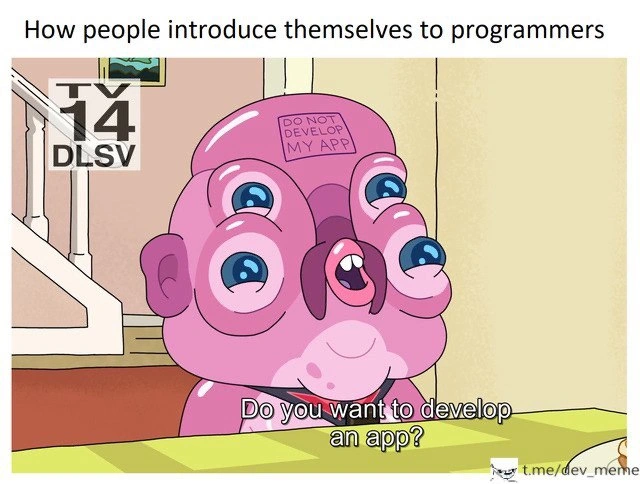
This meme is showing a situation just like that, but with apps. To a programmer, a random person immediately asking “Do you want to develop an app for me?” feels as absurd as someone asking you to magically build their crazy dream project for free. It’s funny because everyone can see the mismatch between how easy it is to imagine something and how hard it is to actually do it. The silly pink monster in the picture is basically how a programmer sees those wild requests — a bit overwhelming and out-of-the-blue. The humor comes from recognizing that feeling and thinking, “Oh boy, here we go again!”
Level 2: From Idea to App
If you’re a newer developer (or even just learning), you might have already encountered this situation: someone finds out you can code and immediately they want to share their “awesome app idea” with you. They’ll say something like:
“Wouldn’t it be cool if there was an app that does X, Y, and Z? Do you want to develop it?”
This meme pokes fun at exactly that moment. Here, the grotesque pink creature represents that person enthusiastically pitching you their concept. It’s exaggerated and silly-looking to show how awkward and one-sided these requests can feel to the programmer being asked. The text at the top “How people introduce themselves to programmers” is joking that instead of a normal “Hi, nice to meet you,” a programmer often gets greeted with “Hi, can you make my app idea?”
Let’s unpack some terms and ideas involved:
- Stakeholder (or Client): In software development, this is anyone who has a stake in the project or wants something built. In this scenario, the acquaintance with the idea is acting like a client or stakeholder – they have a vision of an app they want made. They might not be paying you (at least not upfront), but they are the ones defining what the app should be.
- Client Expectations: This refers to what the person who wants the software expects the final result to be like, and how fast or cheap they think it can be done. Often, non-technical folks have very high or unrealistic expectations. They might think the app will have every feature they imagine and be done in a month, because they don’t realize how much work is involved. Here the question “Do you want to develop an app?” shows an expectation that you, the developer, could just say “sure” and start building something great immediately, no big deal.
- Communication Gap: This is the misunderstanding that happens when technical people and non-technical people don’t quite speak the same language. The person with the idea might not know how to clearly describe what they need — maybe they just have a vague notion like “a social network for pets” written on a napkin. Meanwhile, the developer is thinking about technical details: “What features exactly? What platform? What’s the data model?” etc. The gap between those two mindsets often leads to frustration. The meme highlights this gap by showing how absurd the request looks from the developer’s side (hence the crazy monster image asking the question).
- Startup Culture: Over the last decade, there’s been a huge buzz around tech startups – small companies building apps that sometimes grow into giants like Uber or Facebook. Because of these success stories, a lot of people are eager to come up with “the next big app.” The meme’s joke about a “billion-dollar app idea” is referencing this. In startup culture, a billion-dollar idea means a concept that could turn into a company worth billions (often called a unicorn). The funny thing is, many people think just having an idea is enough. They see themselves as the next big entrepreneur, but they need someone to handle the coding part. So they approach any programmer they meet with great enthusiasm (and sometimes an oversupply of confidence).
- Scope Creep: This is a project term meaning the scope (the defined goals and features of the project) keeps creeping or expanding over time. If someone doesn’t start with a clear plan — and most casual idea-pitchers don’t — then if you agree to build their app, you might experience scope creep. For example, they ask for a simple photo sharing app, and once you start, they keep adding ideas: “Actually, it should also have a chat feature... and a shop... and maybe AI that does XYZ!” The project grows and grows because nothing was written down or agreed on at the start. Developers try to avoid scope creep by having a clear spec (specification) or MVP (Minimum Viable Product) — basically a basic version of the app to build first. But in these freeform “I have an idea” scenarios, scope creep is almost guaranteed because the idea isn’t fully thought out.
- Equity instead of Payment: Often, when these acquaintances ask you to build their app, they might not offer money. Instead, they’ll say something like, “I can’t pay you right now, but if this app makes money, I’ll give you a percentage of the profits or a share of the company.” That offer is known as giving equity (a piece of ownership) instead of direct payment. For a new developer, this might sound exciting — if the idea becomes the next Instagram, that percentage could be huge! But it’s a risky deal. Most of these ideas never actually turn into profitable businesses. So, what usually happens is the developer works for free (lots of evenings and weekends spent coding), and then the project fizzles out, and that “equity” ends up being worthless. This is why experienced developers are wary when someone says “I’ve got a great idea, we’ll split the profits.” It often means the person with the idea isn’t investing any of their own money, so they have little to lose, while you risk a lot of time.
So why is all this funny (and a bit painful) to programmers? Because it’s so common. Imagine you just learned to code and you’re proud of making a little website or a small game. Then someone assumes you can create the next Facebook overnight. They have no specs (detailed plan) at all — just excitement. You, as the developer, are expected to figure out all the details and also do the hard work. For example, someone might say “It’s like Instagram, but for pets!” and expect that one sentence to be enough instruction for you to build a full application.
The meme nails that feeling: the weird, five-eyed creature asking “Do you want to develop an app?” is like that person who barely says hello before dumping their giant idea on you. It highlights the communication gap: one side thinks it’s a quick favor or a one-week project, the other side (the developer) knows it’s a huge undertaking that could take months and lots of planning. The text on the creature’s forehead, “DO NOT DEVELOP MY APP,” is a humorous twist — it’s as if the person wants you to work on it but also is paranoid and saying “but don’t you dare run off with my idea!” It’s poking fun at how some folks both desperately want help and act overly protective of the idea at the same time.
For a junior developer or student, the takeaway is: it’s great when people are excited about tech ideas, but be aware of the real work involved in going from an idea to a real app. Building software isn’t magic at the push of a button; it requires clear communication, careful planning, time, and usually some resources (like money to pay for services, or simply the developer’s time which is valuable). This meme is a lighthearted warning of what it feels like when someone expects a programmer to magically deliver the next big app with none of that groundwork. It’s saying, “Hey, if you’ve felt this kind of pressure or awkwardness, you’re not alone.” Plenty of developers have experienced the random app idea pitch and learned to smile and respond with something like, “Okay, let’s slow down and talk about what this would take…” The laughter comes from recognizing the scenario and knowing how off-kilter it really is.
Level 3: Napkinware Pitches
In the wild world of startup dreams, an idea is often seen as a golden ticket — at least by those who aren’t writing the code. The meme’s absurd pink creature with multiple eyes and an octopus-like mouth exaggerates how a programmer perceives these encounters. It’s captioned “How people introduce themselves to programmers,” and indeed, every seasoned developer recognizes this horror story: you meet someone new, mention you write software, and instantly out pops their “billion-dollar app idea.” The creature even has “DO NOT DEVELOP MY APP” tattooed on its forehead like a bizarre NDA warning (Non-Disclosure Agreement vibes) — they’re terrified you might steal their genius idea, yet in the same breath they ask, “Do you want to develop an app?” for them. The paradox is hilarious and painfully familiar.
This humor lands so well with experienced devs because it satirizes the classic Idea Guy phenomenon in tech. That’s the person who assumes coming up with an idea is the hard part and implementation is just a minor detail. As developers, we know the ugly truth: ideas are cheap, execution is everything. We’ve all had some enthusiastic acquaintance or distant cousin who hears you do software and eagerly says:
“I’ve got the next Uber/Facebook! I just need someone to code it. We’ll be rich!”
The meme basically paints that person as a five-eyed monstrosity barging into your life with a cringey proposal. It captures the communication gap perfectly — they treat programming like a vending machine where you input an idea and output a fully-fledged app. They rarely grasp the extensive requirements gathering, design decisions, and engineering effort it actually takes to turn a half-baked concept into a working product.
From a senior developer’s perspective, the comedic nuance runs deeper. Notice the TV-14 DLSV rating icon jokingly placed in the image. This is a tongue-in-cheek hint that what follows this “introduction” might contain some strong language or violent urges — likely from the programmer silently screaming internally. 😅 It’s a funny nod to the mature content of a developer’s unfiltered reaction: “Are you kidding me? Another free labor request?!” Because let’s be honest, these pitches often boil down to, “I have the vision, you do all the work.” The proposer usually dangles vague promises of equity or a profit share instead of actual payment — essentially valuing the developer’s countless hours at $0 upfront. This equity_instead_of_payment scenario is so common it’s a running joke in tech circles. The meme’s creature might as well be saying: “I bring the million-dollar unsolicited_product_proposal, you bring months of coding and we'll split imaginary profits 50/50, deal?” And of course, the developer is expected to be grateful for the opportunity.
We also see a subtle hint at scope creep in how casually the question is posed: “Do you want to develop an app?” Just an app — no big deal, right? Any senior engineer knows that just an app can hide a universe of features and nightmare revisions. Often these folks have a feature list written on a napkin (literally scribbled bullet points of what the app “should do”) that’s laughably incomplete. There’s no understanding of scope, no specification document, probably not even a basic MVP (Minimum Viable Product) definition. If you naively say yes to such a pitch, you’re basically signing up to be a one-person R&D department, product manager, and engineer all at once — with the “client” continuously adding “one more cool feature” because nothing was clearly defined. It’s the perfect storm for endless scope creep and project failure. Veteran devs have learned to recognize this red-flag scenario a mile away. Some of us learned it the hard way by actually trying to help a friend-of-a-friend for “experience” or “exposure,” only to end up in a quagmire of moving goalposts and late-night coding sessions for a product that never launches.
To break it down in code, the situation looks a bit like:
if acquaintance.knows_you_are_programmer():
idea = acquaintance.pitch_app_idea()
if idea.is_billion_dollar and acquaintance.budget == 0:
acquaintance.offer_equity(payment="exposure")
developer.groan_and_escape() # politely declines and flees the scene
Every time that knows_you_are_programmer() condition triggers, an experienced developer’s mental alert goes off. We brace ourselves, because we’ve seen this loop before. The code above humorously captures the essence: non-technical person has “big idea,” assumes it’s trivially easy to implement, expects you to do it for free (or for imaginary future riches), and the wise developer’s response is to groan internally and find the nearest exit. In real life, of course, we try to communicate why their plan might be unrealistic or ask some pointed questions about requirements and funding. But nine times out of ten, as soon as you inquire “What’s your budget? What’s your timeline? Who’s your target user?” you either get blank stares or — poof — the conversation ends. 🤷♂️
Overall, the meme strikes a chord with engineers because it’s a cathartic exaggeration of a relatable developer experience. It playfully calls out the awkward reality: to some folks, discovering you can code is like finding a genie who can grant startup wishes. The veteran chuckles because behind the humor lies a trove of war stories about ill-fated side projects, poorly defined client expectations, and countless coffee meetings with someone convinced they’re sitting on the next tech unicorn. The grotesque creature is a perfect avatar for that mixture of naiveté and audacity — a monster that every programmer has met at least once. And like any good monster story, we’ve learned to run when we see it coming!
Description
A meme about the social interactions of programmers. The image has a top caption that reads, 'How people introduce themselves to programmers'. The visual is a screenshot from the animated series 'Rick and Morty,' featuring a pink, multi-eyed, somewhat grotesque alien character. On the character's forehead is a smaller creature holding a sign that explicitly says 'DO NOT DEVELOP MY APP.' Contradicting this sign, the subtitle at the bottom shows the character asking, 'Do you want to develop an app?'. This meme humorously captures the frustrating and contradictory experience many developers have when non-technical people pitch them unsolicited app ideas. It highlights the stereotype of the 'idea person' who approaches developers for free work, often without understanding the complexity involved, making the interaction feel both intrusive and nonsensical
Comments
7Comment deleted
The easiest way to end an unsolicited app pitch is to ask for the PRD and a market analysis. The sudden silence is your feature, not a bug
Heads up: if their spec fits on a cocktail napkin and their valuation fits in the trillions, your payment will probably fit in “exposure.”
After 20 years in tech, I've learned that "I have an idea for an app" is just someone asking you to build their entire startup for 10% equity and the promise of exposure, while they handle the "business side" which mysteriously never includes funding, customers, or a business model
Every senior engineer knows this feeling: the moment someone discovers you write code, they inevitably have 'this amazing app idea' that's 'basically just like Uber but for [insert absurd concept].' The stamp reading 'DO NOT DEVELOP MY APP' perfectly captures the internal screaming we all experience during these encounters - it's the professional equivalent of a restraining order we wish we could issue at networking events. The multiple eyes represent our heightened awareness scanning for escape routes while calculating the politest way to explain that 'I'll just need a developer' isn't actually a viable technical architecture
“Do you want to develop an app?” translates to: MVP = napkin, PRD = vibes, NFRs = “viral,” comp = equity, deadline = yesterday
If your intro is “Do you want to develop an app?”, mine is “Great - send the RFC, SLOs, and funding; equity isn’t a payment method.”
Unsolicited app pitches: the ultimate context switch tax, turning a 2-hour flow session into a requirements-gathering retrospective