Skip to content
DevMeme
2566 of 7435
A great disturbance in the k8s cluster
Containerization Post #2841, on Mar 15, 2021 in TG

A great disturbance in the k8s cluster

Why is this Containerization meme funny?

Level 1: When the Lights Go Out

Imagine you’re at home and suddenly all the lights go out at once. The TV turns off, your games stop, every room goes dark. You’d probably gasp and think, “Uh oh, something bad happened!” Maybe a fuse blew or the power in the whole neighborhood went out. It’s a spooky, alarming feeling because everything that was on just shut off together. Now picture your dad or mom saying in a slow, serious voice, like a wise wizard from a movie, “I sense a great disturbance in the house… as if millions of appliances suddenly cried out and were silenced. I fear a blackout has happened.” That’s a bit over-the-top, right? They’re talking about a power outage in an extremely dramatic way. It’s funny and a little scary at the same time.

This meme is doing the same thing, but with computers. Lots of programs (called pods) were running on many computers (a cluster), and then they all stopped at once. That’s like the whole neighborhood losing power and going dark. The person in the meme (a Jedi from Star Wars) is using a magical Force to feel that big problem, just like you’d notice all the lights going out. He says he’s afraid something terrible happened – and yes, if all those programs stopped, it is a big problem for the people who rely on them, kind of how a blackout is a big problem for everyone using electricity. We find it funny because he’s describing a tech problem (the computers crashing) in a very grand, dramatic movie style. It’s like using a line from a famous movie to talk about our lights going out. So even if you don’t know Kubernetes or pods, you can relate to that “oh no!” feeling when everything shuts down, and also chuckle at how theatrically it’s being described.

Level 2: Cluster Crash Course

Let’s break down what’s happening in this meme in simpler terms, and explain the tech jargon for newcomers. We have a reference to a Kubernetes cluster – often abbreviated as K8s (because there are 8 letters between K and s in “Kubernetes”). A Kubernetes cluster is a collection of servers (called nodes) that work together to run applications packaged in containers. Containerization is like putting an application and all its needed files into a little box (a container) so it can run the same anywhere. Kubernetes is the master coordinator that decides which node runs each container and makes sure everything stays up, kind of like a big automatic traffic controller for these container “boxes.”

Now, within Kubernetes, a pod is the smallest unit of deployment. You can think of a pod as a group of one or more containers that are meant to be deployed together. Usually, one pod = one instance of your application (for example, one microservice). If you have a web service that you want to scale out to handle more users, Kubernetes will create multiple pods (copies of that service). Pods are usually short-lived; they can be created and destroyed (terminated) regularly – for instance, when updating to a new version or if there’s a problem and Kubernetes replaces a broken one. When the meme says "millions of pods suddenly were terminated," it’s describing a scenario where a huge number of these application instances (pods) all stopped or died at almost the same time. That’s definitely not normal – it suggests something seriously wrong happened in the cluster (like a mass crash or someone accidentally deleting them).

The meme is referencing a famous Star Wars moment through a tech lens. In Star Wars, Obi-Wan feels a great disturbance in the Force (he psychically senses that a planet was destroyed and many lives were lost). In the meme, the “Force” is analogous to a super admin’s awareness of the system. In real life, how would an engineer sense a big problem in a Kubernetes cluster? Through monitoring and observability tools. These are dashboards, alerts, and logs that tell us about the health of our systems. For example, an observability dashboard might suddenly show that the number of running pods went from 500 down to 0 – a graph plummeting straight down. Or an alert might pop up on the on-call engineer’s phone saying “Major outage: many pods terminated!” That sudden change is the “disturbance” you feel in your gut when you’re responsible for keeping a service running.

Let’s decode some more terms: On-call means a specific engineer (or a rotation of them) is designated to respond to any problems, 24/7. If something breaks at 3 AM, the on-call person’s pager or phone will ring. It’s like being a firefighter for software systems – you have to jump into action when an alarm goes off. SRE, or Site Reliability Engineer, is a role often tasked with building and maintaining reliable systems, and they usually take turns being on-call to fix issues in production (the live environment users are using). So an SRE on-call would definitely be the “Jedi” awakened by a disturbance when a cluster catastrophically fails.

What about Kubelet and why would it crash-loop? The kubelet is a small agent program that runs on each node (machine) in a Kubernetes cluster. Its job is to start and stop pods on that machine as instructed by the central Kubernetes brain (the control plane). If something causes the kubelet on many nodes to crash or misbehave (for instance, a bad update or a bug in a new version of Kubernetes), then all those nodes might stop running their pods properly. A “crash loop” means a program crashes, restarts, and crashes again repeatedly. If multiple kubelets enter a crash loop, suddenly a lot of pods on all those nodes would get terminated or go offline because the thing that’s supposed to keep them running isn’t working. That’s a plausible technical cause for “millions of pods” vanishing: the very part of the system responsible for keeping pods alive has failed across the board.

Cluster outage panic is exactly what it sounds like: panic that occurs when an entire cluster (all those machines running your apps) has an outage (goes down). Usually, we design systems so that one machine going down isn’t too bad – other machines carry the load. But if an entire cluster fails, that means many services are down at once. For a newcomer, imagine if a company like Netflix had all its servers for streaming movies go down together – no one can watch anything, and the engineers are scrambling. That’s the level of panic we’re talking about. The meme expresses that with a dramatic flair (“I fear something terrible has happened”) which is both true (it is terrible for the team and users) and a bit tongue-in-cheek (gallows humor is common among engineers during high-stress outages).

Let’s connect the pieces with an example: suppose you’re a junior dev just learning about Kubernetes in your first job. One day, you help deploy a new version of your app. Unknowingly, the configuration file you applied had a tiny mistake – it told the cluster to reboot every pod in the system (not just your app!). Suddenly, every microservice, database, and cache that was running in that cluster starts shutting down to restart. Within a minute, nothing is responding. Senior engineers’ phones are all ringing. Even though you might not literally “feel a great disturbance in the Force,” you do see your Slack and monitoring tools blow up with alerts. One graph shows number of pods = 0. Another shows user requests failing 100%. Your heart sinks. This is the kind of event being referenced. It’s exaggerated as millions of pods to be funny, but it gets the point across: a large-scale outage in Kubernetes feels huge and scary.

Finally, consider observability in simple terms: it’s like the senses of your system. Just as Obi-Wan uses the Force to sense tragedy, engineers use observability signals (metrics, logs, traces) to sense problems. When the meme says “I felt a disturbance,” it implies the monitoring system (or the experienced gut feeling) alerted that something is off. It could be an alert saying “High error rate” or a dashboard tile turning bright red. That’s our version of a Spidey-sense or Jedi sense that something’s wrong in the tech Force. And when that alert involves many pods failing at once, you know it’s a big deal – hence the fear that “something terrible has happened,” i.e., an all-hands-on-deck outage.

So, in summary, this meme is mixing a pop culture quote with a real engineering nightmare scenario. For a junior engineer or someone new to Kubernetes:

  • K8s cluster: a bunch of computers running containerized apps together.
  • Pods: the little bundles of your app running in the cluster (many of them makes your app scalable).
  • Terminated pods: pods that have stopped, meaning parts of your app are down.
  • On-call SRE feeling a disturbance: an engineer gets alerted by monitoring tools that a lot of stuff just broke.
  • Fear something terrible happened: the engineer recognizes this is a serious, possibly catastrophic outage affecting many users.

It’s funny because it uses a super serious Star Wars moment to describe a tech incident, which is a bit dramatic and nerdy (in a lovable way). But it’s also a bit like an inside joke among developers: “May the Force (and our uptime) be with us, always.”

Level 3: Jedi On-Call

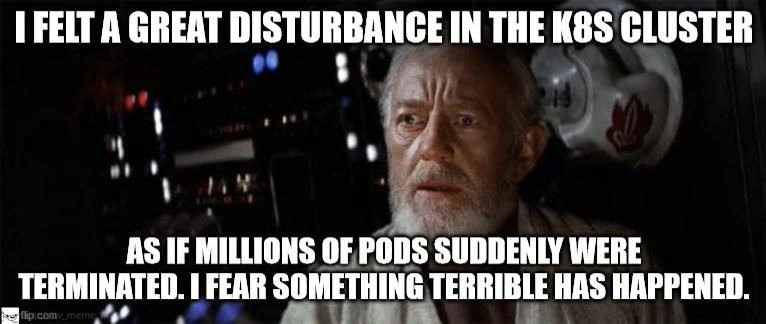
This meme strikes a chord with anyone who’s been on a late-night on-call rotation for a Kubernetes cluster in production. It humorously mashes up Star Wars drama with the very real panic of a production outage. In the image, Obi-Wan Kenobi is feeling a disturbance in the Force (in the movie, it’s the destruction of planet Alderaan). In our tech twist, the Force is the monitoring and instinct an SRE has for their system’s health, and Alderaan is the K8s cluster. The top caption reads, "I FELT A GREAT DISTURBANCE IN THE K8S CLUSTER," and the bottom continues, "AS IF MILLIONS OF PODS SUDDENLY WERE TERMINATED. I FEAR SOMETHING TERRIBLE HAS HAPPENED." This is basically an SRE’s way of saying: “I have a bad feeling about this… all our apps just went down at once.” It’s funny because it dramatises a very un-funny situation that seasoned engineers know all too well: mass pod termination and a cascading failure.

Why is this particular combination of elements so hilarious and painful? First, the Star Wars reference is instantly recognizable. Obi-Wan sensing a great disturbance is a scene signifying unimaginable loss. In tech, what’s the equivalent of an entire planet blowing up? Probably an entire cluster or data center going offline. The meme exaggerates by saying “millions of pods” – we know even large clusters don’t usually run millions of pods (that would be an absurdly big cluster!), but that hyperbole is part of the humor. It captures the feeling of a huge outage. When you’re on-call and suddenly see every dashboard light up red, it genuinely feels like millions of voices crying out in terror. All your services paging you at once is the tech version of an Alderaan moment.

The shared trauma here is real. Any SRE or dev who has been through a production outage has that moment of dread: maybe you’re sipping coffee and then all your alerting systems start screaming. Perhaps your Observability stack (metrics, logging, tracing) shows a sudden drop in traffic to zero, error rates spiking everywhere, or dozens of PagerDuty alerts firing simultaneously. It’s a punch to the gut – you feel it immediately. Experienced engineers joke that after enough on-call incidents, you develop a “spidey sense” (or here, a Jedi sense) for when the system is about to go down. Maybe you catch a whiff of high latency in a crucial service or an unusual pattern in logs right before the storm. In the meme, Obi-Wan represents that veteran engineer who can sense a major problem before even seeing the detailed metrics – a sixth sense honed by years of firefighting.

The industry pattern being satirized is the fragility of complex systems. We design Kubernetes clusters for high availability: pods are distributed, we have multiple nodes, auto-restart, etc. It’s supposed to handle failures gracefully. Yet, systemic failures still happen. The meme hints at scenarios we’re not proud of: a misconfigured update or a single point of failure that we didn’t eliminate. For example, imagine someone accidentally pushes a faulty config to the cluster – perhaps a mistaken kubectl apply -f that deletes all deployments, or an ill-thought autoscaler policy that evicts every pod. Suddenly, poof – critical pods start terminating left and right. Or consider the control plane bugs: a kubelet crash loop on each node caused by a bad container runtime update. One after another, nodes drop their pods and go dark. It’s a chain reaction, and within minutes the cluster’s workloads have vanished. That’s the “millions of pods suddenly silenced” moment. Everyone who has lived through a cluster or data center outage gets chills from those words.

Let’s talk real-world scenarios. A classic one: losing the etcd cluster (which stores all cluster state). Maybe an upgrade went wrong and etcd nodes all rebooted or lost connectivity. Kubernetes can’t reconcile state when etcd is down, so it stops making progress. Nodes might think “I can’t reach the master, I must be alone” and the master thinks “I’ve lost half my nodes, better mark them as dead.” Next thing you know, Kubernetes is terminating pods because it believes those nodes failed, or it can’t schedule new ones to replace normal churn. A particularly infamous case is when cloud networking issues cause half your nodes to become unreachable at once – the control plane declares them dead after the timeout and re-schedules those pods elsewhere just as the network heals, causing duplicate pods or widespread restarts. It’s incredibly chaotic – one minute everything’s fine, the next minute half the cluster is restarting and the other half is duplicating work. The meme’s dramatic phrasing perfectly captures that suddenness. One second, all services are humming; the next, a terrible thing has indeed happened and your cluster is in shambles.

We also see a nod to observability and monitoring in the way Obi-Wan “feels” the disturbance. In reality, how do we feel a disturbance in a K8s cluster? Through dashboards and alerts. It’s the Grafana graphs dropping to zero, the Prometheus alerts firing non-stop, the logs streaming errors like a TIE fighter screaming by. A senior engineer might relate: they’re tuned into these signals even before an alert triggers, noticing something off (CPU usage flatlining across many services at once, perhaps). The meme exaggerates it as a literal physical sensation, which is comedic because sometimes it does feel almost physical – your stomach drops in fear when you realize the magnitude.

The phrase “I fear something terrible has happened” is exactly the kind of understatement you’d make in the heat of the moment. Engineers often use dark humor to cope: “Uh, guys… I think something’s on fire. Like, whole cluster on fire.” That calm statement belies the panic inside. Obi-Wan in the image looks shaken but composed, much how an on-call engineer tries to stay calm while adrenaline surges. The humor also lies in the absurdity: a Jedi Master shouldn’t be worrying about container orchestration! But here we all are, treating a bunch of containers and pods with the gravity of life and death. It pokes fun at how seriously we take our systems (with good reason – user experience, revenue, and our on-call sleep are at stake!).

Now, why is fixing this scenario harder than it looks? If an entire cluster of pods is dying, you’re probably dealing with a root cause that’s not trivial. Maybe it’s a widespread bug, or a misconfiguration deployed everywhere (like a flawed container image or security policy causing crashes). The “obvious” fix (restart the cluster) might not be possible or could risk data loss. Maybe the issue is intermittent and hard to pin down – e.g., a network partition that comes and goes, which is the worst because you can’t easily apply a patch. The systemic issue is often that we put too many eggs in one basket. Perhaps all services were on one cluster without proper isolation or fault domains. So when something hits the cluster, it hits everything. Best practices say to use multiple clusters or regions, do gradual rollouts, etc., to avoid an Alderaan-scale wipeout. But reality? Deadlines, cost, and complexity lead teams to run huge multi-tenant clusters. That’s a single Death Star target if things go awry. And indeed, when it blows, everyone feels it.

Historically, the industry has seen some outages akin to this meme. Think of cloud provider region outages where many services fail at once. For example, an AWS outage can knock out many independent systems simultaneously — a lot of us have felt that disturbance when half the internet seems to go offline. Kubernetes itself had past issues (like etcd v2 to v3 migrations early on) where clusters could become unstable. Those war stories circulate among SREs like legend. We joke about “It’s always DNS” or “It’s always the network” because those seemingly small pieces can crater large systems. Here, the joke is “It’s always Kubernetes (K8s)” — our modern complicated infrastructure that works 99% of the time, but when it fails, it fails spectacularly.

The gap between best practices and reality is highlighted by the meme’s subtext: We know an entire cluster shouldn’t just die suddenly. We’re supposed to have redundancy, pod anti-affinity, multi-zone clusters, backups of etcd, pod disruption budgets, the whole nine yards of reliability engineering. Yet, somewhere, somehow, something was not truly highly available. Maybe we didn’t expect a sudden spike in load, or a hidden bug in the orchestrator code. Maybe a junior dev applied a config in production without knowing it would cause every pod to restart (oops, they added a label to a Namespace and the entire fleet rolled). Such a small action can cause an outsized impact – akin to one tiny exhaust port leading to the destruction of the Death Star. The meme resonates because everyone in tech has seen how a tiny misconfiguration or single failure can cascade – we laugh so we don’t cry.

Ultimately, this meme is both a chuckle and a chill down the spine for SREs and developers. It’s a funny nod to our geek culture (Star Wars quotes) and a reminder of our shared nightmares in production. We laugh because Obi-Wan’s solemn drama over a cluster outage is ridiculous… and yet we also laugh nervously because we’ve been Obi-Wan, staring at a Grafana graph at 2 AM, whispering “I fear something terrible has happened” when the cluster is suddenly quiet. In short, it’s a perfect storm of OnCallHumor: merging pop culture with the very real fear of a production outage, something terrible happening that you have to fix before all the customers (or your boss) notice. The next time your entire Kubernetes cluster goes down, you might just hear Obi-Wan’s voice in your head. And strangely, that thought is both comforting (at least we’re not alone in this feeling) and terrifying.

# A hypothetical scene in configuration form (just for flavor):
apiVersion: v1
kind: Disturbance
message: "Millions of pods have cried out and were suddenly silenced."
severity: critical
action: "Wake the Jedi (on-call engineer) immediately"

Level 4: The CAP Strikes Back

In a Kubernetes cluster, everything depends on a distributed control plane achieving consensus. At the heart is etcd, a key-value store using the Raft consensus algorithm to keep the cluster’s state consistent (who is running what, where). This is the cluster’s Jedi Council, so to speak. But distributed systems theory (think CAP theorem in action) dictates that if a network partition or major failure occurs, you may have to sacrifice availability to preserve consistency. In practice, if etcd loses its quorum (majority of servers), the entire cluster’s brain freezes up – it can’t reliably update or recover state. It’s as if the “Force” connecting all those pods suddenly went dark because the fundamental agreement of what exists and where is broken. Without consensus, the control plane can’t coordinate, and all those carefully scheduled pods become like orphaned processes in a void. They might still be running for a while on each node, but to the almighty cluster brain, they’re as good as gone. Eventually, as nodes report status or require instructions, everything grinds to a halt. The meme’s dramatic hyperbole of "millions of pods suddenly terminated" hints at a catastrophic cascade failure: in theory, a large-scale outage where countless container instances fail at almost the same time. This could happen if, say, the cluster’s network fabric experiences a massive partition (the dark side of distributed networking) or a bug triggers simultaneous evictions on all nodes. We’re talking about a worst-case scenario that engineers dread – the Alderaan of outages.

Under the hood, Kubernetes is designed to be resilient: controllers and kubelets try to heal or reschedule pods when something fails. But even these self-healing mechanisms have limits grounded in physics and math. If the control plane (API servers, scheduler, etcd) is down or brain-split, the cluster can’t respond to disturbances. It’s like a Jedi losing connection to the Force – chaos reigns because the usual rules (desired state enforcement, health checks) no longer apply. Theoretically, this meme evokes concepts of fault tolerance and blast radius in distributed computing. A well-architected system contains failures (one node dies, others carry on). But here we have a total systemic failure – the equivalent of all fault domains failing at once, a near-impossible $P(failure)$ that every SRE secretly plans for anyway. And the feeling of it? In control theory terms, a sudden and large deviation in system state sends a shock through monitoring systems – a spike in metrics or a drop to zero load across hundreds of services, a step function that stands out like a cosmic disturbance. The meme exaggerates to “millions” of pods to match Obi-Wan’s line, but it’s hinting at real distributed system nightmares: e.g., a configuration error propagating through a cluster at light-speed (one bad DaemonSet update that kills every container on every node simultaneously – essentially executing Order 66 on your microservices). Fundamentally, it’s humor built on the inevitability that distributed systems, no matter how advanced, can fail in spectacular, herd-like ways when their underlying consensus or connectivity is disrupted. Even the most sophisticated orchestration can fall apart in one tragic instant, much like a peaceful planet annihilated without warning.

Description

This is an image macro meme featuring a screenshot of an older, worried-looking Obi-Wan Kenobi from Star Wars: A New Hope. The top text, in a bold, white, all-caps font, reads: 'I FELT A GREAT DISTURBANCE IN THE K8S CLUSTER'. The bottom text continues the quote: 'AS IF MILLIONS OF PODS SUDDENLY WERE TERMINATED. I FEAR SOMETHING TERRIBLE HAS HAPPENED.' The meme humorously adapts Obi-Wan's famous line about the destruction of Alderaan to a modern-day IT catastrophe. It equates the galactic tragedy of a planet's destruction with the technical disaster of a massive Kubernetes (k8s) cluster failure where 'pods' (the basic execution unit in Kubernetes) are wiped out. For SREs, DevOps engineers, and anyone managing large-scale infrastructure, this captures the visceral, sinking feeling of a major production outage, making a highly technical and stressful event relatable through a popular culture reference
Comments

7
Anonymous ★ Top Pick The OOM killer is the Death Star of Kubernetes: it ruthlessly destroys things to 'maintain order', and you usually only find out what it did after it's too late
  1. Anonymous ★ Top Pick

    The OOM killer is the Death Star of Kubernetes: it ruthlessly destroys things to 'maintain order', and you usually only find out what it did after it's too late

  2. Anonymous

    Obi-Wan felt a million pods cry out because someone deployed a mutating admission webhook with a 500 ms timeout - proof that in Kubernetes, the Force is strong, but the API server is still the single point of failure

  3. Anonymous

    The real disturbance in the Force is when you realize someone ran 'kubectl delete pods --all-namespaces' in production instead of staging, and your PagerDuty is about to light up like the Death Star targeting system

  4. Anonymous

    When you accidentally run 'kubectl delete namespace production' without the '--dry-run' flag and suddenly feel millions of pods crying out in terror before being silenced. The real disturbance is explaining to stakeholders why the SLA just went from five-nines to zero-nines, and why your observability dashboard now looks like the aftermath of Order 66

  5. Anonymous

    You know it’s bad when you sense the pods crying out seconds before PagerDuty - right after someone ran 'kubectl delete pods --all -A' from the prod kube-context

  6. Anonymous

    Forgetting Pod Disruption Budgets: the Force's way of saying 'no voluntary mass terminations allowed'

  7. Anonymous

    Not the Force - just ArgoCD faithfully syncing a Helm default of replicaCount: 0 across prod. Congratulations, you’ve implemented serverless-by-accident

Use J and K for navigation