Reusable Code, Irreusable Architecture
Why is this CodeQuality meme funny?
Level 1: The Borrowed Machine
This meme is like saying, "I can build a car quickly by borrowing parts from a boat, a bicycle, and a lawn mower." Maybe it moves, but it looks strange, breaks in confusing ways, and nobody wants to fix it later. That is why programmers laugh: copying something that worked somewhere else can create a new thing that technically works but is awful to maintain.
Level 2: Copy, Paste, Regret
Code reuse means using existing code instead of writing everything again. That can be smart. If a project already has a well-tested function for validating email addresses, formatting money, or calling an internal API, reusing it can save time and reduce bugs.
Copy-paste programming is the rougher version. A developer copies code from one place, changes a few names, and hopes it fits the new situation. Sometimes it does. Sometimes it only looks like it does. The problem is that code often depends on invisible context: data shapes, configuration, database tables, authentication rules, library versions, and team conventions.
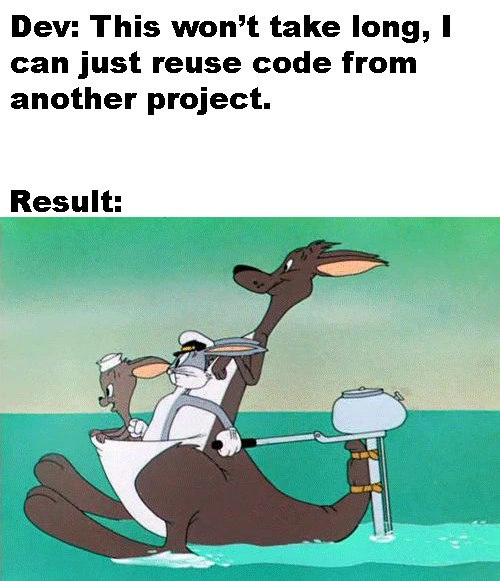
The meme's vehicle shows what happens when pieces are reused without a shared plan. It has something like a body, a seat, a steering part, and a motor, but they do not look like they were designed together. That is what a codebase can feel like when different projects, snippets, and emergency fixes are stitched into one feature.
Technical debt is the future cost created by a quick solution today. Like financial debt, it is not always bad. A shortcut can be reasonable if the team understands it and plans to pay it back. It becomes painful when everyone forgets why the shortcut exists, then builds more features on top of it.
Refactoring is the work of improving code structure without changing what the software does for users. In this meme, refactoring would mean replacing the improvised contraption with something designed for the actual job. That is usually harder than the original copy-paste decision, because now the weird solution has users, edge cases, and someone from product asking why the "working" thing needs time.
Level 3: Reuse Without Context
The top caption is the classic opening line of a future refactoring ticket:
Dev: This won't take long, I can just reuse code from another project.
Then the meme shows the Result:: a ridiculous improvised vehicle, part animal, part boat, part steering rig, part strapped-on outboard motor. It technically moves through water, which is exactly the problem. The post message says Hey, if it works..., and every engineer who has inherited CopyPasteCoding can hear the missing second half: "...until it becomes load-bearing."
The joke is not that code reuse is bad. Good reuse is one of the foundations of maintainable software. Libraries, shared modules, stable APIs, design systems, and platform abstractions exist because repeating the same logic everywhere is a good way to produce five versions of the same bug. The meme is about the dangerous kind of reuse: lifting code from another project without bringing along the assumptions that made it sensible there.
That animal-boat-motor contraption is a perfect visual metaphor for IntegrationPain. Each attached piece may be fine in isolation. The motor can push. The seat can seat. The straps can strap. The steering bits can suggest authority. But the assembled thing has no coherent architecture. It works by negotiation, not design.
That is how quick reuse becomes TechnicalDebt:
- The copied code expects a different data model, so adapters start multiplying.
- The original project used different error handling, so failures now look inconsistent.
- A helper function assumes one timezone, locale, or permission model, and the new system quietly disagrees.
- Tests are skipped because "this code already worked over there."
- Naming, dependencies, and configuration leak from the old project into the new one like archaeological sediment.
The expensive part comes later. At first, the reused code saves time. Then a bug appears in one project but not the other. Then both copies need a security fix. Then a developer finds an odd parameter nobody understands because it only mattered in the original codebase. Eventually the team cannot tell whether they own a reusable abstraction or a taxidermied shortcut with a motor bolted to it.
This is why experienced developers get suspicious of "I can just reuse it." The word just is doing a lot of unpaid labor. Real reuse requires boundaries: stable inputs and outputs, clear ownership, tests, documentation, versioning, and a reason the abstraction belongs in both places. Without those, reuse becomes a workaround wearing a fake mustache.
Description
The top text says "Dev: This won’t take long, I can just reuse code from another project." Beneath a bold "Result:" label, a cartoon image shows a bizarre improvised vehicle: a character is riding a large animal-like body fitted with a seat, straps, steering parts, and a small outboard motor in the water. The absurd stitched-together contraption represents what happens when code lifted from one context is forced into another without matching assumptions, interfaces, or architecture. The meme is about copy-paste reuse turning a quick win into integration debt and long-term maintenance pain.
Comments
1Comment deleted
It was reusable in the same sense that `/tmp/final_final2` is a release artifact.