Skip to content
DevMeme
886 of 7435
Deciphering Your Own Ancient Code
CodeQuality Post #1001, on Jan 27, 2020 in TG

Deciphering Your Own Ancient Code

Why is this CodeQuality meme funny?

Level 1: Worthiness Confirmed

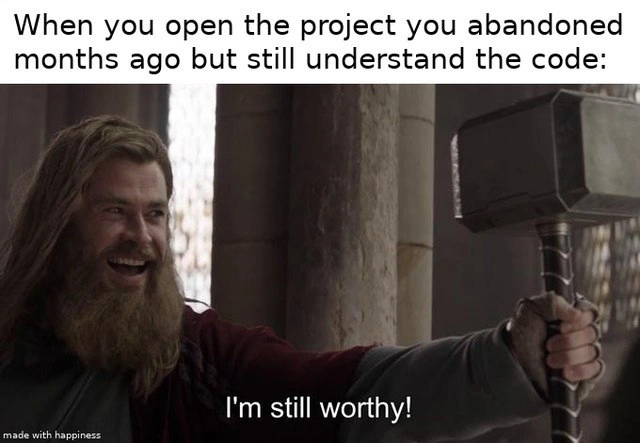
Imagine you wrote yourself a really clear note or a set of instructions a long time ago. Maybe it was how to build your favorite LEGO kit or how to finish a tricky level in a game. You put it away and forget about it for a while. Months later, you find that note again. You read it and instantly understand everything you meant – it’s like no time has passed at all. You think, “Hey, past-me did a great job! I still get it!” You feel proud and even a bit like a hero. That’s exactly the feeling this meme is talking about, but with coding. The picture shows a happy superhero lifting a magical hammer that only good, deserving heroes can lift. The text says, when you return to an old project and still understand your code, it’s like proving you’re a true hero. In simple terms: you came back to something tough that you made before, and it’s still easy for you to handle. It’s a funny, feel-good moment. Just like being able to lift a magic hammer means “I haven’t lost it, I’m still a hero!”, being able to read your old code easily means “I’ve still got it, I’m a good programmer!”. It’s a celebration of doing good work that stands the test of time, and it makes you feel on top of the world.

Level 2: Clean Code Triumph

This meme shows a scene with a Marvel hero (Thor) joyfully declaring, “I’m still worthy!” after lifting his magical hammer. The top caption sets up a situation every coder finds so relatable: “When you open the project you abandoned months ago but still understand the code.” If you’ve ever returned to an old school assignment or side-project after a long break, you might recall how often it’s hard to remember what your code does or how it works. Usually, it feels like someone else wrote it! But here, the developer opens their months-old project folder (perhaps some code they haven’t looked at in a long time) and is pleasantly surprised: everything makes sense. They can follow every line as if they wrote it yesterday. That’s a code comprehension victory! The image shows Thor lifting his hammer Mjölnir in triumph because, in Marvel lore, only someone who is truly “worthy” (noble and good) can lift that heavy enchanted hammer. The meme humorously compares being able to understand your old code to being worthy enough to lift Thor’s hammer. In other words, the developer feels like a hero – past-self left behind code so good that present-self can wield it with ease.

Why is this such a big deal? Well, let’s break down some key ideas (and common tags mentioned) that make code easy or hard to revisit:

  • Code Readability: This means how easy it is to read and understand the source code. High readability comes from things like clear naming and simple structure. For example, a readable code snippet might use descriptive names:

    # Clear, readable code example
    def get_user_full_name(user):
        return f"{user.first_name} {user.last_name}"
    
    full_name = get_user_full_name(current_user)
    print(full_name)  # It's obvious we're printing the user's full name.
    

    In contrast, low-readability code might look like:

    # Hard-to-read code example
    def g(u):
        return u.fn + " " + u.ln
    
    x = g(cu)
    print(x)  # Months later, you'd ask: what is g doing, and what are fn, ln, cu?
    

    In the first snippet, even if you wrote it months ago, you can guess what get_user_full_name does just by the name. In the second, g(u) with variables like fn and cu would be confusing without fresh context. This shows how meaningful naming and clarity make a huge difference. The meme’s scenario suggests that the old project had code closer to the first example – very readable.

  • Clean Code Principles: These are guidelines for writing code that’s easy to understand and modify. They include things like:
    Meaningful Names – using clear, descriptive names for functions and variables (e.g., calculateTotalPrice instead of calc1).
    Single Responsibility – each function or module should do one thing well, so you can grasp its purpose quickly.
    Don’t Repeat Yourself (DRY) – avoid duplicate code. If logic is written in one place, you don’t have to hunt through multiple spots to understand a behavior.
    Comments and Documentation – write a short note when code isn’t self-explanatory, or provide a README file. Good comments explain the “why” behind tricky code. That way, even if you forgot your reasoning, the comment jogs your memory.
    Consistent Style – formatting and organizing code in a standard way (maybe following a style guide) so nothing looks jarringly out-of-place when you return.
    Following such principles makes your code self-documenting to a large extent. The meme’s joy comes from the fact that past-you apparently did all this right! The code was written with care for CodeQuality, making it clean and logical, not a jumbled puzzle.

  • Refactoring: This is the practice of improving the code structure without changing what it actually does. Imagine you had something messy but working, and you took the time to tidy it up back then. For example, you might have split a long 300-line function into smaller helper functions each with a clear name. By refactoring continuously or before abandoning the project, you made sure the project wouldn’t turn into a scary LegacyCode heap. A “legacy system” usually means an old codebase that’s hard to work on because it’s outdated or overly complex. Here, your abandoned project could have become legacy (since you left it for months), but thanks to refactoring and clean code, it feels fresh and approachable when you return.

  • Technical Debt: This is a metaphor for shortcuts or sloppy code we write when we rush or don’t plan ahead. It’s like borrowing time – you get something to work quickly now, but you (or someone in the future) will have to pay back that debt by fixing or understanding the mess later. A high technical debt project is notorious for causing confusion and bugs down the line. In our scenario, the developer likely managed technical debt well. Maybe they avoided quick-and-dirty hacks and solved problems the right way, even if it took a bit longer. Because of that, there’s no “interest payment” of confusion due now. Returning to the project doesn’t require hours of deciphering weird code; it just clicks. That’s a massive DeveloperExperience win – it makes coming back to the project painless, even enjoyable.

All these factors combine to create a moment that feels like a self-worthiness moment for a programmer. The subtitle in the meme, “I’m still worthy!”, is exactly how it feels: “Wow, I can still understand this – I must have done a great job!” It’s both humorous and uplifting. Instead of the usual dread of opening an old codebase (where you expect to scream “What was I thinking?!”), you get a pleasant surprise. In developer humor, this is almost fantastical – hence the dramatic Thor analogy. After all, Thor’s hammer is literally a test of worthiness, and lifting it is a heroic accomplishment. Similarly, understanding an old codebase instantly is a heroic feat in programming terms. It means your past self wrote code so clean that even with memory gaps, the logic shines through clearly. For a junior developer, this meme is a great lesson: write code with your future self (and others) in mind. Do it well, and you’ll one day open that project folder like Thor strolling into the hall, finding your mighty hammer of code right where you left it, ready to be lifted without worry.

Level 3: The Mjölnir of Maintainability

In the world of software, code maintainability is a bit like Thor’s hammer Mjölnir – only those deemed “worthy” can lift it with ease. This meme strikes a chord with seasoned developers because it humorously captures a rare triumph: opening a months-old codebase and instantly comprehending every line. Usually, coming back to an abandoned project feels like deciphering ancient runes or facing a legacy system cursed with cryptic names and tangled logic. But in this glorious moment, past-you wrote such clean, well-structured code that present-you lifts the project effortlessly, proclaiming “I’m still worthy!” (just as Thor exults when he can still summon his hammer). The humor is equal parts pride and relief – pride that your old code is high quality, and relief that you don’t have to unravel a spaghetti mess. It’s an inside joke about CodeQuality: if you can understand code after a long hiatus, you must have done something exceptionally right.

From a senior developer’s perspective, the laughter comes with a knowing nod. We’ve all seen what usually happens: six months away from a codebase and it might as well have been written by a trickster Loki. Variable names like x or temp2 plague the code, functions do ten unrelated things, and there’s not a comment in sight. You open the file and think, “Who wrote this garbage?” only to check git blame and realize with horror it was you. 😅 That’s why this meme is so satisfying – it flips the script. Here, past-you was a hero who followed Clean Code principles, leaving behind a gift of clarity. The codebase isn’t a TechnicalDebt dungeon; it’s a well-lit library of logic. Every function and module has a purpose, names are descriptive, and the overall design makes sense immediately. In other words, the code passed the ultimate test: the test of time. The meme equates that success with being “worthy” of godly power, which is an exaggeration that feels earned when you’ve experienced the opposite far too often.

There’s an underpinning truth in this humor about DeveloperExperience (DX). Good DX isn’t just about slick tools or fast build times – it’s also about the developer’s ease in reading and modifying code. When you return to a project and can onboard yourself in minutes, that’s peak DX achieved through code quality. Industry wisdom and painful lessons have taught senior devs to strive for such maintainability. You’ll hear battle-scarred engineers joke that “code isn’t just written for the computer, it’s written for the poor human who has to read it later” – and that human might be you, months or years down the line. The meme’s triumphant tone echoes the satisfaction of following that advice. It slyly celebrates practices like refactoring and thoughtful design. Perhaps the project was continuously refactored to eliminate “code smells” (bad patterns that make code hard to maintain). Maybe you paid off little bits of technical debt as you went, ensuring no ugly hacks were hiding to bite you later. The result? Coming back to the code feels like meeting an old friend rather than confronting a snarling bugbear of confusion. In an industry littered with cautionary tales of indecipherable legacy code, a moment of easy code comprehension truly feels almost mythical. It’s the software equivalent of pulling Excalibur from the stone – or in this case, lifting Mjölnir – confirming that your craftsmanship from months ago is still righteous.

Digging a bit deeper, there’s also an element of imposter syndrome being vanquished here. Often developers fear that their past work might not live up to current standards or that they’ve forgotten everything. Discovering that you still grok the old code means you were a better engineer than you might have given yourself credit for. As Thor proves his continued worthiness despite his doubts, the developer proves that their skills (and discipline in writing clean code) were real. This can be a big confidence boost. Under the hood, what made this possible is likely adherence to fundamentals: low cognitive complexity (each function or module was simple enough to understand on its own), high cohesion and low coupling (each part of the code handled one job and didn’t create tangled interdependencies), and maybe even some documentation or helpful comments for future-you. These are concepts senior devs champion precisely because they make code resilient to the passage of time. It’s heartwarming (and a bit funny) to see those abstract principles pay off in such a tangible, almost cinematic way. The meme, by invoking a pop culture moment of heroic validation, gives a standing ovation to maintainable code. It’s a senior developer’s inside joke that writing clear code is a superpower – one that might just make you feel like an Avenger when you realize your old project doesn’t need Avengers-level rescuing after all.

Description

A two-panel meme. The top panel contains the text: 'When you open the project you abandoned months ago but still understand the code:'. The bottom panel features a screenshot from the movie 'Avengers: Endgame', where a bearded, long-haired Thor joyfully catches his hammer, Mjolnir, with a look of immense relief and validation. The subtitle reads, 'I'm still worthy!'. The meme humorously captures a common developer experience: returning to an old project and fearing that the code will be incomprehensible. Being able to understand one's own past work is a significant confidence boost, affirming that the code was well-written and documented, thus making the developer feel 'worthy' of their skills. It's a relatable feeling of triumph over the 'amnesia' that often sets in after switching contexts
Comments

7
Anonymous ★ Top Pick The greatest gift you can give your future self is not comments, but code that's so clean you don't remember writing it, yet you still understand it
  1. Anonymous ★ Top Pick

    The greatest gift you can give your future self is not comments, but code that's so clean you don't remember writing it, yet you still understand it

  2. Anonymous

    Reopening a repo after two quarters and still parsing every class? That’s not Mjolnir - it’s just the payoff of ADRs, ubiquitous language, and a strict “no cleverness after 6 pm” commit policy

  3. Anonymous

    The real superpower isn't lifting Mjolnir - it's writing code so clean that even your future self, after months of context switching through three different frameworks and a complete mental garbage collection, can still parse it without needing to git blame yourself into an existential crisis

  4. Anonymous

    The real superpower isn't writing code that works today - it's writing code that your future self can understand six months later without a single git blame session or archaeological dig through commit history. Most of us open old projects expecting to find Lovecraftian horrors of nested callbacks and cryptic variable names, only to discover we actually followed SOLID principles and wrote meaningful comments. It's the developer equivalent of Thor realizing he's still worthy: that rare moment when past-you actually did future-you a solid by not naming everything 'temp', 'data', or 'handleStuff2_final_ACTUAL'

  5. Anonymous

    Mjolnir lifts for the worthy; git checkout -b resurrects for the readable

  6. Anonymous

    When you can grok a repo you abandoned six months ago, that’s not memory - it’s DDD names, ADRs, and tests acting as your future self’s linter

  7. Anonymous

    Opening a repo you ghosted for two quarters and still understanding it is the senior dev’s Mjolnir test: boring names, ADRs, and tests that read like user stories - past-you avoided cleverness, so future-you is still worthy

Use J and K for navigation