Skip to content
DevMeme
887 of 7435
The Evolutionary Ladder of Code Commenting
CodeQuality Post #1002, on Jan 27, 2020 in TG

The Evolutionary Ladder of Code Commenting

Why is this CodeQuality meme funny?

Level 1: Hidden Message Trick

Imagine you and your friends have different secret codes for passing notes, and each code is wackier than the last. First, one friend uses a plain old sticky note (that’s like a normal comment – obvious and simple). Then another friend writes a note in invisible ink (that’s a bit more special, like the HTML <!-- --> style – still a hidden message but in a different way). Then someone else uses pig Latin or a secret language to hide their message (think of that like using the # symbol – a different language’s way to hide text). Finally, one super sneaky friend doesn’t write a note at all – instead they hide their message inside a homework answer that looks normal but actually isn’t needed. For example, on a math worksheet they might write an extra equation that spells out a word, but the teacher ignores it because it looks like work. That’s like writing var s = "this is a comment"; in code – it looks like a real part of the assignment, but it’s actually just a hidden note saying “this is a comment”! In the meme, the man’s reaction gets more and more amazed with each new secret-message method. By the end, he’s completely shocked and excited, because the last trick is so clever and unexpected. In simple terms, this meme is funny because it’s showing a person getting over-the-top excited about increasingly silly ways to hide a message, just like a programmer might laugh at all the bizarre ways we can hide notes in code. It’s like a little story of surprise: the more creative the hidden note, the bigger the “Wow!”

Level 2: Comment Camouflage

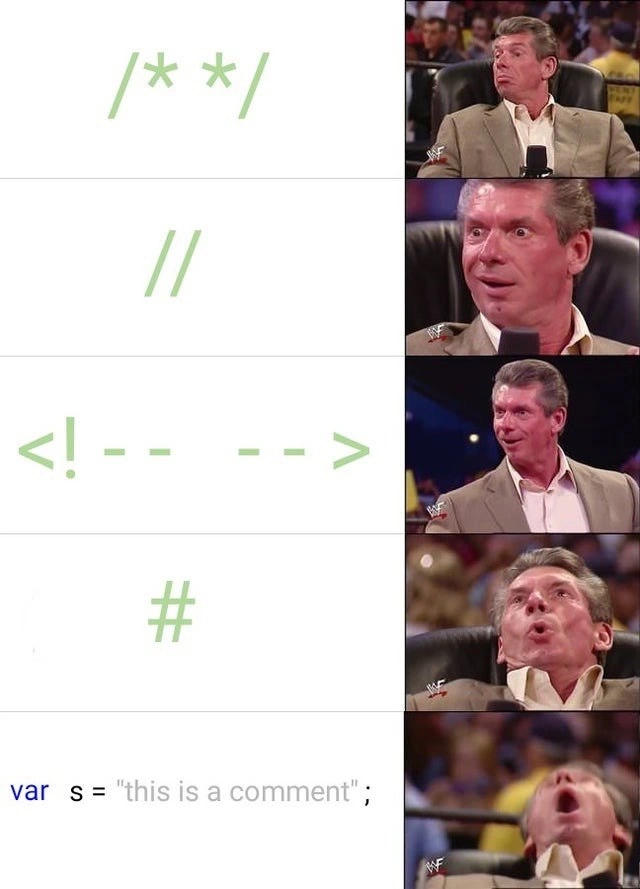
Let’s break down what’s happening in simpler terms. This meme features five ways to write a comment in code, and a funny series of reactions to each one. In programming, a comment is just text in the source code that the computer completely ignores – it’s there to help humans understand the code or to temporarily disable code without deleting it. Different programming languages use different symbols to start and end a comment. The meme lists these common comment syntaxes:

  • /* ... */ – This denotes a block comment in languages like C, C++, Java, and JavaScript. Anything between /* and the matching */ is treated as a comment (ignored by the compiler). Developers often use it to comment out multiple lines of code or write longer explanations. It’s highlighted in green in the image, meaning it’s recognized as a comment by the code editor. In the meme, the reaction to this is very mild – because it’s a totally normal thing every coder has seen. It’s like the baseline comment style.

  • // – These two slashes start a single-line comment in many languages (C++, Java, C#, JavaScript, and more). When the computer runs the code, it ignores everything from // to the end of that line. This is probably the most familiar comment style for modern programmers – great for short notes or quickly disabling one line of code. The meme’s second reaction image (Vince looking a bit intrigued) suggests, “Okay, that’s cool, a single-line comment, still pretty standard.” It’s a step up only in the sense that it’s another common style – maybe the joke is that Vince is like, “Oh yeah, I like those, quick and easy!”

  • <!-- ... --> – These brackets with exclamation and dashes are how you write a comment in HTML (or XML). For example, in an HTML file you might see: <!-- TODO: Add navigation menu --> as a note that doesn’t show up on the webpage. This syntax is completely different from the C-style and C++-style comments – it comes from the world of web markup. The meme shows Vince’s eyes getting wide at this point. For someone used to writing code, seeing an HTML comment might be a surprise because it’s not something you’d use in a typical program (.html files aren’t source code in the same way). It’s like a twist – “Whoa, where did an HTML comment come from?” But developers still recognize it instantly (we often work on web stuff too). So the meme is having fun with the fact that we have to know this odd <-- --> syntax for web content.

  • # – The pound sign (hash) is used for comments in many scripting languages and config files. In a Python script, for instance, you write # this is a comment and Python will ignore everything after the #. Same in Bash/Shell scripts (# starts a comment) and in other languages like Ruby or Perl. Even many configuration files use # to denote lines that are just notes. By the fourth panel, Vince is shown basically mind-blown, which is humorous because # isn’t exotic – but in the context of this meme, it’s yet another completely different comment symbol. For a developer, switching between languages means remembering “Oh, this is a Python file, I use # for comments, not //”. The meme exaggerates the excitement as if each new comment style is more shocking. Really, it’s poking fun at how we programmers carry a lot of syntax rules in our heads, and seeing them all lined up is both funny and a tiny bit absurd.

  • var s = "this is a comment"; – This last one is not an official comment syntax at all! It’s a line of JavaScript code that creates a variable s and sets it equal to the text "this is a comment". In a normal program, that line would actually run – it would allocate memory for the string and store it in s. However, if nothing ever uses s afterward, the program doesn’t really do anything with it (except waste a tiny bit of memory). In other words, it’s a no-op – an operation that has no effect on the program’s behavior. So why write it? The idea is that a programmer could use this as a makeshift comment. Maybe some automated tool or strict boss said “Don’t use actual comments,” or maybe it’s done as a joke. By writing a string in code, they’ve hidden their comment in plain sight. The meme’s final image shows Vince completely losing it – because this is such a wild and sneaky approach that it’s both hilarious and startling. It’s as if the meme is saying, “Using a normal comment didn’t impress him, but using actual code to do the job of a comment blew his mind!” This highlights a real developer in-joke: sometimes, to get around restrictions (like a linter that flags commented-out code or a code-review rule against comments), programmers come up with creative hacks. It’s funny to us because it’s overly complicated and counter-intuitive – why not just use a real comment? Well, maybe you’re trying to avoid detection. It’s a bit like commenting without writing a comment. For example, a linter (a code quality tool) might ignore this because technically, there is no comment, just an unused variable (which some linters might warn about too, but let’s assume this slipped through).

So, panel by panel, the meme goes from the ordinary to the bizarre in terms of commenting. The right side images amplify this by showing Vince McMahon’s reaction getting more and more enthusiastic. This sequence is a popular reaction meme format – the joke is that each new item on the list is more exciting or crazy than the last. By the time we reach a fake-comment-as-code, any developer reading it is chuckling and thinking, “I know all these comment styles… wait, what, that last one is actually code!?” It’s a relatable humor moment because we’ve all seen weird things done in code. The categories and tags clue us in: this is LanguageComparison/SyntaxHumor – highlighting differences in languages – and also a bit of CodeQuality humor, pointing out the lengths devs might go to bend the rules. In short, the meme is funny because it’s a geeky inside joke: you have to know what each of those symbols means in programming, and if you do, you’ll get why the progression from normal comments to a fake comment is comedic. It’s the ultimate “comment syntax showdown” that only programmers would find this exciting and hilarious!

Level 3: Comment Syntax Smackdown

On the left side of this meme, we have a cross-language tour of comment syntax – and on the right, wrestling mogul Vince McMahon escalating from calm to utterly blown away. Developers from different backgrounds immediately recognize each comment style and the humor comes from how increasingly unconventional they get:

  • /* ... */ – The classic C-style block comment opens the show. It's old-school but standard in C, C++, Java, and more. Nothing shocking here – Vince is sitting calmly. Why? Every seasoned dev has used /* block comments */ to temporarily disable a chunk of code or add multi-line explanations. This syntax is so normal it's almost boring (hence Vince’s neutral expression). Internally, compilers and interpreters simply treat anything between /* and */ as whitespace. Fun fact: block comments can't be nested in C, which has surprised many a developer (comment out a section that itself contains /*...*/ and you'll get a compile error). But overall, this first panel is basic stuff – no one’s falling out of their chair over a well-behaved comment delimiter.

  • // – Next up, the single-line comment used in C++, C#, Java, and many modern languages. Vince leans in with mild interest. Why the subtle excitement? // wasn’t in the original C language; it was popularized by C++ (borrowed from BCPL) and later added to C in the C99 standard. It’s a quality-of-life improvement for developers: just type // and everything to the right is ignored. Simple, ubiquitous, and super convenient for commenting out one liners or adding quick notes. A senior developer knows that under the hood, the language’s lexer strips out these comments during tokenization. It’s still nothing wild – but seeing // might remind us of cleaner code and modern conventions, hence a bit of an “Oh, nice” reaction. Still, compared to what’s coming, // is tame and expected, so Vince’s excitement is only starting to build.

  • <!-- ... --> – Now things get interesting. This HTML comment appears, and Vince’s eyes widen. We’ve left the realm of C-like languages and entered HTML/XML territory, where <!-- comment --> is how you hide text in markup. For a software developer used to coding, seeing an HTML comment in this lineup is surprising and humorous – it’s like a wrestler from a different league entering the ring. HTML comments are not meant for general-purpose code; they’re for web pages, and everything between <!-- and --> is ignored by the browser rendering the page. Developers recognize this instantly (we’ve all inspected web page source and seen human instructions hidden in these). The meme is riffing on our polyglot knowledge: a programmer’s brain has a lookup table of comment syntaxes for each context. Vince’s astonishment here says, “Whoa, we’re even bringing HTML into this?” The escalation is funny because it’s unexpected: mixing markup language quirks into a programming meme. Also, the HTML comment is multi-line capable and originates from SGML (standardized in the early web standards) – it shows up in .html files, XML configs, even inside script templates. By the third panel, we’re clearly pushing beyond everyday code commenting, tickling the part of a developer’s brain that loves obscure language quirks.

  • # – The fourth panel drops a simple # and Vince is rocked back in amazement. This green # is the comment token in shell scripts, Python, Ruby, Makefiles, and many config files. It’s a one-character comment marker, but seeing it after HTML is like another curveball. Why is this exciting? Because # represents yet another domain of coding. In Unix shell scripts and Python programs, everything after a # on a line is ignored. It’s straightforward, but the surprise comes from context-switching: one second we’re thinking about HTML, now we’re in a Bash or Python mindset. Only a well-seasoned dev immediately recognizes all these forms without missing a beat. The meme is celebrating that breadth of knowledge. It’s a bit tongue-in-cheek about how developers carry around dozens of little syntax rules in their head. Vince’s extreme reaction here reflects an inner monologue: “They even threw a shebang-style comment in there? Incredible!” (We call it shebang since #! at the top of scripts indicates the interpreter; the # is repurposed for comments elsewhere.) Technically, the # comment is parsed by interpreters by ignoring everything from # to end-of-line (except in languages where # has other meaning, like Python doesn’t use it for division or anything, so it’s unambiguous). We’re now at a point where the meme has shown four distinct commenting conventions spanning systems programming, web markup, and scripting – a comment syntax comparison extravaganza. For a senior developer, this progression itself is hilarious because it’s so nerdy: it’s like a parade of inside jokes from different corners of programming.

  • var s = "this is a comment"; – The final panel is the coup de grâce. Here we see an actual JavaScript code snippet: a variable assignment of a string that reads like a comment. Vince McMahon is literally falling out of his chair in euphoric shock at this one. Why? Because this is not a comment at all – it’s a sneaky hack. The developer has written a piece of code that does nothing useful except convey a message. In JavaScript (as well as many dynamic languages), you can write an expression or a statement that doesn’t affect the program – it’s just ignored at runtime (aside from maybe allocating an unused variable). By writing var s = "this is a comment";, the coder is basically simulating a comment: they’re storing a string with the text they want to say, but then never using it. It’s effectively a fake comment disguised as code. This is hysterically funny to developers because of how ridiculous and roundabout it is. It’s like bypassing the rules of engagement: maybe a linter or coding standard disallows real comment blocks (some strict style guides or code golfing scenarios can be like this) or flags large comment sections as “bad practice”. But by embedding the text in a dummy string, the code passes those checks because, hey, technically it’s valid code, not a comment! It’s the kind of cheeky move you only see from a programmer who’s either extremely frustrated or having some fun with the reviewers. Linting tools (static code analyzers) that complain about commented-out code might totally miss this because it isn’t a comment at all. A senior engineer reading this will likely facepalm and chuckle: someone actually went this far just to leave a note or disable code! It’s a double-edged sword for code quality – on one hand, it’s creative, on the other hand it’s horrendously confusing for maintainers who later wonder, “Why do we have an unused variable called s with a random string?” This highlights the eternal struggle between developers and their tools/policies: if you make a rule against something (like “no commented-out code in commits”), devs might find a quirky workaround. There’s a famous parallel in Python where people use triple-quoted strings as multiline comments – since an unused string literal is ignored by Python, it acts like a comment. This JavaScript trick is in the same spirit, but arguably even more convoluted. The meme’s climax is emphasizing just how far things have escalated from a plain old /* ... */ to writing actual code as a comment. Vince’s final over-the-top reaction captures our mixture of astonishment, amusement, and horror at this tactic. We’re simultaneously laughing and thinking, “Please tell me I’ll never see this in a real codebase.”

At this highest level, the meme speaks to experienced devs by referencing multiple language syntaxes and an outrageous code-quality hack. The humor lands because it’s a shared absurdity: only in programming do we juggle such varied comment symbols – and only a cheeky developer would treat actual code as a “secret comment” to outsmart the system. This is prime CodingHumor: it merges knowledge of different languages (C, HTML, Bash, JavaScript) with the inside joke that developers sometimes engage in a game of cat-and-mouse with code reviewers or linters. Ultimately, it’s a celebration of both our language fluency and our propensity for creative (if questionable) solutions. The result is a meme that’s as technically layered as it is ridiculous, eliciting knowing laughs from anyone who’s ever had to comment out code in anger or desperation.

Description

A five-panel meme using the 'Vince McMahon Reaction' or 'Expanding Brain' format. The left column displays different ways to write comments in code, escalating in absurdity, while the right column shows Vince McMahon's increasingly excited reactions. The sequence begins with standard comment syntax: `/* */` (multi-line C-style), then `//` (single-line C-style), `<!-- -->` (HTML), and `#` (scripting languages like Python). McMahon's reactions grow from mild interest to wild enthusiasm. The final panel, the punchline, shows a line of JavaScript code: `var s = "this is a comment";`. This is not a comment but an actual variable assignment. McMahon's reaction is one of ultimate, mind-blown ecstasy. The joke satirizes coding practices, presenting the most absurd and incorrect way to 'comment' code as the most enlightened, a piece of humor that resonates with experienced developers who have seen all manner of questionable code quality and anti-patterns
Comments

7
Anonymous ★ Top Pick This is how you write a comment that passes the linter, the compiler, and the code review, but fails the sanity check
  1. Anonymous ★ Top Pick

    This is how you write a comment that passes the linter, the compiler, and the code review, but fails the sanity check

  2. Anonymous

    When the style guide bans /* */, the linter rejects //, and the security scanner freaks over <!-- -->, you end up declaring const _ = 'comment'; - peak dev steganography

  3. Anonymous

    I've seen production code where someone wrote an entire design document in concatenated string literals because "the compiler strips them out anyway" - turns out they'd been shipping 2MB of their architectural decisions to every customer for three years

  4. Anonymous

    The real horror isn't the string-as-comment antipattern - it's realizing this was probably someone's 'clever' workaround because their minifier was stripping actual comments, and now it's in production, passing code review, and somehow became the team standard. At least it's better than the legacy codebase where comments are stored in a separate database table with foreign keys to line numbers

  5. Anonymous

    Pro tip: if your minifier keeps stripping comments, assign them to a var so they survive to prod, ruin tree‑shaking, and show up in the i18n catalog - nothing says senior engineering like paying to localize your sarcasm

  6. Anonymous

    Since the build strips comments, we document hacks as string literals - portable across stacks and guaranteed to reach prod alongside the bug (and a few extra KB)

  7. Anonymous

    The enterprise comment: heap-allocated, grep-proof, and primed for that next OOM killer surprise

Use J and K for navigation