Skip to content
DevMeme
2110 of 7435
Reject Modernity, Embrace Tradition in Web Dev
Frontend Post #2358, on Nov 25, 2020 in TG

Reject Modernity, Embrace Tradition in Web Dev

Why is this Frontend meme funny?

Level 1: Trendy vs Trusty

Imagine you have a shiny new toy that everyone is excited about – it has lots of cool features but also a lot of complicated instructions. Then you have your old favorite toy that you’ve played with forever – it’s simple, reliable, and you know exactly how it works. This meme is joking that in the world of making websites, sometimes it’s better to stick with the trusted old toys (the basic building blocks like HTML, CSS, and JavaScript) instead of always chasing the new fancy toys (the latest popular frameworks like React or Angular). It’s funny because usually people think new things are better, but here we’re saying the old, simple things might actually make us happier (or at least less confused!). It’s like choosing grandma’s classic cookie recipe over a super complicated modern dessert – sure, the new dessert is fancy, but nothing beats the familiar comfort of the classic that always works.

Level 2: Back to Basics

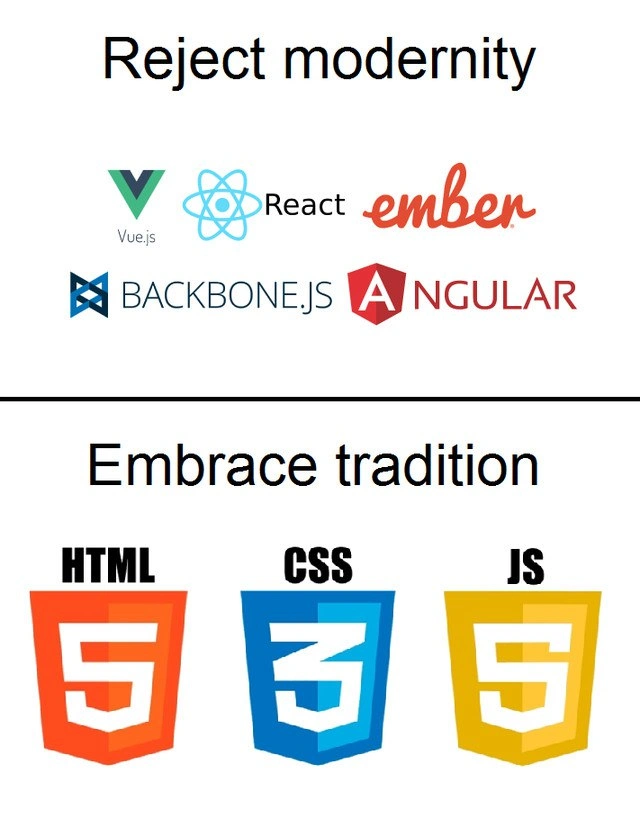
Let’s break down the meme’s meaning in plainer terms. The top half, captioned "Reject modernity", shows logos of popular JavaScript frameworks:

  • React (light-blue atom logo) – a library for building UI components, very popular for interactive web apps.
  • Angular (red shield with an A) – a full-fledged front-end framework by Google (the modern successor to AngularJS) that provides a complete solution for building single-page applications.
  • Vue.js (green and blue V logo) – a progressive framework known for being lightweight and easy to integrate.
  • Ember (red ember script logo) – an older framework that provided an all-in-one approach to building web applications.
  • Backbone.js (blue diagonal X logo) – one of the earlier JavaScript frameworks, which introduced a structure (models, views, routers) for web apps back in the early 2010s.

All of these are FrontendFrameworks that developers use to structure and simplify building complex websites. They are considered "modern" because they abstract away a lot of the manual work. Instead of directly handling the Document Object Model (DOM) and events with plain JavaScript, you use these frameworks’ conventions, write in their specific style (for example, React uses JSX syntax, Angular uses TypeScript and decorators), and the framework takes care of updating the page efficiently.

Now, the bottom half says "Embrace tradition" and shows the classical badges for HTML, CSS, and JS. These badges (orange for HTML5, blue for CSS3, yellow for JS) are the official icons for the core web technologies standardized by the W3C (World Wide Web Consortium). HTML (HyperText Markup Language) is what defines the structure of web pages (headings, paragraphs, buttons, etc.). CSS (Cascading Style Sheets) defines the presentation (layout, colors, fonts). JavaScript (JS) is the programming language that runs in the browser to make pages interactive (respond to clicks, change content dynamically, etc.). When we say "vanilla JS", we mean using plain JavaScript without any libraries or frameworks – basically, just the pure language as it runs in the browser.

So, the meme is jokingly proposing that we stop using fancy frameworks (“reject modernity”) and just write websites using plain HTML, CSS, and JS (“embrace tradition”). This is funny to web developers because in recent years there’s a feeling of framework fatigue – so many new tools and framework wars (debates about React vs Angular vs Vue, etc.) that it can be overwhelming, especially to newcomers. If you are a junior developer, you might have felt pressure to learn React or Angular because most job postings mention them. It might seem like just knowing the basics isn’t enough. But then you hear experienced devs joke that after all the churn, those basic skills are the real essentials. It’s a bit comforting and a bit ironic. The meme reflects an inside joke in the WebDev community: that sometimes the simplest solution (just using the core web technologies directly) is the best, or at least the one that causes the least headaches.

This meme also parodies a popular internet meme format "Reject modernity, embrace tradition". That format is used to humorously suggest that an older, classic thing is superior to whatever is new and trending. In our context, the “tradition” is just building a web page by writing an .html file with a <script> tag, styling with a .css file – no build tools, no complex JavaScript frameworks, just the raw basics. There’s a nostalgic element here: long-time web developers remember when that’s how all websites were built. For a newcomer, it highlights an important point: HTML/CSS/JS are the foundation. Even if you use React or Vue, at the end of the day you need to understand those fundamentals. And if frameworks ever feel too much, you can always make a simple project with just a text editor and a browser – no fancy setup required.

To illustrate the difference in approach:

Modern Framework Approach "Vanilla" Web Approach
Use npx create-react-app (a CLI tool) to scaffold a new React project with dozens of dependencies. Create a new folder with an index.html file, maybe a styles.css and a script.js.
Write JSX/Components and rely on a virtual DOM diff algorithm (React) or complex state management (Angular/Vue). Write a simple HTML structure and use document.querySelector or onclick handlers to add interactivity.
Bundle and transpile code with tools like Webpack, Babel (so that JSX or ES6+ features work in all browsers). Possibly no build step at all – the browser directly reads your HTML, CSS, and JS as-is.
Download a large runtime or library (hundreds of kilobytes of JS) for the framework’s core. Only the code you write is shipped – often just a few kilobytes for simple functionality.
Framework specific syntax and learning curve (components, services, hooks, etc.). Standard web APIs and syntax – what you learn works everywhere, since it’s just plain JavaScript.

The table above shows that while frameworks are powerful (especially for big applications with lots of moving parts), they add complexity and overhead. The "traditional" approach with HTML/CSS/JS is straightforward for smaller projects or for learning purposes. A junior developer can relate if they’ve tried to set up a project in React or Angular – there’s a lot of setup and new concepts – versus just opening up a code editor and writing a bit of HTML and JS which runs immediately. The meme humorously exaggerates this contrast.

In essence, FrontendHumor like this meme speaks to the feeling of being overwhelmed by rapidly changing tech. It’s a nod to javascript_framework_fatigue: the idea that every year there’s something new to learn or some tool becoming obsolete. It reassures that the core skills (HTML, CSS, JS) are "tradition" worth embracing. After all, if you understand those, you can pick up any framework more easily – and you won’t be completely lost if the framework du jour falls out of fashion. This joke helps newer devs see that even seasoned programmers sometimes feel nostalgic for simpler times, and it highlights an ongoing conversation in web development about balancing new technologies with fundamental knowledge.

Level 3: Hype Cycle Hangover

The meme taps into a shared front-end developer experience: enduring the endless parade of new JavaScript frameworks and then longing for the simplicity of the old ways. The top panel’s command to "Reject modernity" with logos of React, Vue.js, Ember, Backbone.js, and Angular is dripping with irony. Each of those logos represents a once-hyped frontend framework or library that promised to revolutionize WebDevelopment. If you’ve been around long enough, you’ve seen this hype cycle: one year everyone swears by Backbone, next year it’s AngularJS, then React comes along and saves the day, until Vue or the next shiny tool appears. This churn is often dubbed "JavaScript fatigue" or FrameworkChurn—developers get exhausted jumping from one trendy tool to the next. The meme humorously prescribes a remedy: in the lower panel, "Embrace tradition" shows the classic shields for HTML5, CSS3, and JS (JavaScript). It’s suggesting that maybe we should return to basics instead of constantly chasing frameworks.

Why is this funny to an experienced dev? It’s the absurd whiplash between hype and reality. Many of us have war stories of a new framework-of-the-month that we painstakingly adopted, only to see it become legacy code within a couple of years. Framework wars in the industry have led to countless rewrites, heated debates, and blog posts declaring "X is dead, long live Y!". Each framework comes with its own build tools, CLI commands, and ~500MB of node_modules/ (yes, looking at you React and Angular projects). After slogging through breaking changes and endless plugin updates, the thought of just opening a plain .html file with a <script> tag feels almost nostalgic. The meme exaggerates this feeling for comedic effect: it’s like telling us battle-scarred devs to throw out our elaborate modern toolchains and rediscover the simplicity (and stability) of a static HTML+CSS+JS page.

This contrast also highlights a truth: HTML, CSS, and vanilla JavaScript are the bedrock of the web. No matter how modern your framework is, under the hood it ultimately has to output HTML for structure, CSS for style, and JS for dynamic behavior. Senior engineers know that frameworks abstract these basics to help manage complexity in large apps, but they also know those abstractions can backfire. The joke is that after fighting with complex state management, virtual DOM diffing, and endless dependency updates, writing raw document.getElementById() might actually feel liberating. It’s the hype cycle hangover: after the excessive celebration of new tech, you wake up craving something simple and reliable. The IndustryTrends_Hype being satirized here is the notion that "modern = better", when sometimes tradition (the tried-and-true fundamentals) can be a smarter choice — or at least a saner default.

To put it in perspective, this meme uses the "Reject modernity, embrace tradition" template (a popular meme format) to poke fun at our field’s tendency to over-engineer. It resonates especially with seniors who have rewritten the same UI five times in five different frameworks. As a darkly humorous aside, many of us have joked that our job is basically deleting someone’s jQuery to put in AngularJS, then deleting that to put in React, and so on. In the end, the user’s browser just needs an HTML file, some CSS for layout, and JavaScript to handle interactions. The modern frameworks certainly provide power and structure, but this meme dryly suggests that maybe our vanilla_js (plain JavaScript) wasn’t so bad after all. After surviving enough 3:00 AM production issues caused by complex build pipelines or state libraries, the idea of a simple static site starts sounding like comfort food. This ironic truth — that sometimes the tradition is more appealing than the modernity — is what makes the meme instantly relatable and FrontendHumor-ous.

In summary (for the seasoned perspective): the humor comes from seeing the cycle of framework_wars and JavaScript framework fatigue distilled into a simple “before/after” format. It’s a gentle roast of our industry’s obsession with the Next Big Thing, reminding us that underneath all the hype, those basic HTML/CSS/JS skills are timeless and always waiting with open arms when the framework du jour inevitably breaks our heart.

Description

A two-panel 'Reject modernity, Embrace tradition' meme contrasting web development technologies. The top panel, labeled 'Reject modernity,' displays the logos of five popular and historically significant JavaScript frameworks: Vue.js, React, ember, BACKBONE.JS, and ANGULAR. The bottom panel, labeled 'Embrace tradition,' features the large, iconic shield logos for HTML5 (orange), CSS3 (blue), and JS (yellow). The meme humorously advocates for a return to the foundational 'vanilla' technologies of the web, eschewing the complexity and constant churn of the frontend framework ecosystem. This sentiment resonates with experienced engineers who have witnessed the rise and fall of many frameworks and appreciate the stability and directness of the core technologies
Comments

21
Anonymous ★ Top Pick The 'Embrace tradition' stack's biggest dependency is just the W3C spec, which is a lot lighter than a node_modules folder and has fewer breaking changes
  1. Anonymous ★ Top Pick

    The 'Embrace tradition' stack's biggest dependency is just the W3C spec, which is a lot lighter than a node_modules folder and has fewer breaking changes

  2. Anonymous

    ADR-2025-042: Replaced our 5 MB React bundle with a 5 KB index.html; performance improved, cognitive load plummeted, and the only breaking change was having nothing left to debate in the next front-end guild meeting

  3. Anonymous

    After 15 years of watching frameworks rise and fall, you realize the real legacy code was the npm packages we accumulated along the way - and that jQuery site from 2009 is still running while your React 16 app needs a complete rewrite

  4. Anonymous

    After spending three weeks configuring webpack, babel, and wrestling with breaking changes across Vue 3, React 18, and Angular 15 migrations, that senior architect who keeps muttering 'just use HTML and CSS' while sipping coffee doesn't seem quite so out of touch anymore. Turns out the real framework was the `<div>` tags we made along the way

  5. Anonymous

    After four SPA rewrites and a thesis on hydration, we shipped the 2025 stack: HTML, CSS, and one <script>; CI is now scp and npm audit returns enlightenment

  6. Anonymous

    After three quarters arguing SSR vs CSR vs ISR vs RSC, we deleted package.json, shipped a form and some links, and Core Web Vitals finally went green

  7. Anonymous

    Vanilla JS: the only 'framework' whose major version hasn't nuked your production app in 25 years

  8. @meowmeowang 5y

    >Backbone >modernity

  9. @bit69tream 5y

    php

  10. @i_wdt 5y

    if backbone modernity then jQuery must

  11. @AuroraStudio 5y

    о опять англичане с русскими никами)

    1. @glcky 5y

      а их сейчас в микрософт и гугл захантят из комментариев

  12. D Y 5y

    А зачем цсс? Инлайн стили. Джс вообще не нужен

  13. Alexey 5y

    Как будто нижние трое куда то делись

  14. @Flam_Su 5y

    нахуй CSS. Верстаем таблицами ))

    1. @daemon4647 5y

      угу. Иногда даже ровнее получается. :D

  15. Deleted Account 5y

    Reject humanity Become monke

  16. @daemon4647 5y

    jQuery — наше все. :D

    1. @x_Arthur_x 5y

      Можно и без него, vanilla FTW

      1. @daemon4647 5y

        там сильно много геморроя с совместимостью между браузерами :)

  17. Deleted Account 5y

    Agreed.

Use J and K for navigation