The Art of Persuading QA: It's a Feature, Not a Defect
Why is this QA meme funny?
Level 1: I Meant To Do That
Imagine you’re playing with your friend and you accidentally knock over a cup of water. Uh-oh, water everywhere! 😯 But instead of getting upset, you quickly say, “No, wait – I meant to do that! I was cleaning the floor.” You pretend that the spill was on purpose, like a special plan to help out. Now, your friend or your parent hears this and decides to go along with it: “Oh, you were cleaning? That’s very thoughtful!” Instead of anyone getting mad, they smile and maybe even give you a happy hug for “trying to help.” Suddenly, your little accident isn’t seen as a mistake anymore. It’s almost like you turned it into a good thing. Both of you end up laughing and feeling good.
That’s exactly what’s happening in the meme, but with software. The developer made a program do something unexpected (kind of like spilling water by accident). When the tester asked about it – basically saying “Hey, this looks like a mistake” – the developer said, “I did that on purpose, it’s supposed to be that way!” (just like claiming you spilled water to clean the floor). The tester believed the explanation and wasn’t upset about it anymore. In fact, they both felt relieved and happy, and they hugged. It’s a funny and warm feeling – turning an “oops” into an “okay!” So the meme is joking about that happy ending moment when a possible mistake is treated as a planned idea and everyone is friends again.
Level 2: It’s Not a Bug
Let’s break down what’s happening in simpler terms. In software development, a bug (also called a defect) is when the software doesn’t behave as expected. For example, if clicking a “Save” button doesn’t actually save your work, that’s a bug. A feature, on the other hand, is a behavior that is expected and intended – something the software is supposed to do. Now, sometimes there’s a funny situation where a developer tries to claim that a surprising or odd behavior in the app isn’t a mistake at all, but actually a planned feature. That’s exactly the joke here: “It’s not a bug, it’s a feature.”
In the meme, the tester (often part of the Quality Assurance (QA) team) initially thought they found a bug – something wrong with the software. QA testers are professionals whose job is to test the software and find problems so they can be fixed. They’ll follow a test plan or checklist, click all the buttons, try all sorts of inputs, and report anything that seems off as a potential defect. The developer (the person who wrote the code) doesn’t always agree that every reported issue is truly a bug. Maybe the software behaves in a weird way, but the developer has a reason for it or it matches some written requirement that the tester wasn’t aware of.
For a junior developer or someone new to this process, it helps to know that communication is key. Often what looks like a mistake can sometimes be a misunderstanding. For instance, imagine the requirements document said, “The app should warn the user after three failed login attempts.” If the tester sees the app warnings happening after four failed attempts, they might log a bug: “Warning appears one attempt late.” The developer might come back and say, “We intentionally chose 4 attempts instead of 3 as a small improvement to user experience – it’s not a defect but a design choice.” In this example, the developer is reframing the unexpected behavior (warning on 4th attempt) as an intended design feature rather than a bug. The tester then has to decide, “Oh, was this actually on purpose?” If convinced, the tester will close the bug report, essentially agreeing it’s “not a bug.”
The meme’s image of a hug between “Me” (the developer) and “Tester” humorously symbolizes that agreement. It’s like saying, “Thank you for understanding!” In real life, developers and testers don’t usually hug it out in the office (at least not literally!), but they do have to work together closely. Sometimes that involves a bit of debate. Testers advocate for the best experience for the user – they’ll call out anything that seems wrong. Developers sometimes have insights into why something was built a certain way, or they might be under constraints that the tester doesn’t know about. When a tester and a developer come to an understanding, it’s a positive moment. Both sides learn something: either the tester learns that the behavior was intentional (or at least acceptable), or the developer learns the behavior truly is a problem and needs fixing. Here, we’re seeing the scenario where the tester was persuaded by the developer’s explanation.
This is a common part of the QA process. In agile teams, for example, there might be a bug triage meeting where each reported issue is discussed by the team. The severity is determined, and sometimes issues get reclassified. “Reclassified” means they might decide an item logged as a bug is actually a new feature request or just an acceptable quirk. In everyday terms, the team might say, “We see this issue, but it’s minor or intended, so we won’t change it.” They could label it as “Won’t Fix” or “By Design” in the tracking system. For a junior dev, the surprising thing is that this isn’t necessarily bad – if every odd behavior were strictly labeled a bug, you could end up changing things that many users didn’t mind or which might conflict with some other requirement. So part of the dev–QA communication is deciding what really needs to be fixed vs. what can be left as-is.
The phrase “not a bug, a feature” is a bit of an inside joke among tech folks. It pokes fun at how developers sometimes defend their work. Imagine you write a piece of code, and it does something unexpected. Someone points it out, and you scramble to think, “Did I mess up, or can I justify this?” If you can find a justification, however flimsy, you might jokingly say, “Oh that? That’s on purpose!” Everyone knows it’s a bit of a stretch, but sometimes, if the issue is minor, the team will roll with it or save it for later. The result is a shared laugh and an understanding — exactly like the meme’s joyful hug. It highlights the human side of software development: devs and testers might tussle a bit over issues, but at the end of the day, they respect each other and can even find humor in these situations. This is why the meme is labeled under TestingHumor and DeveloperHumor – it’s showing a funny moment that’s very relatable if you’ve been through the dev vs tester dance.
So, in simpler summary: The developer managed to convince the tester that an unexpected behavior wasn’t actually a mistake. The tester finally agreed, meaning they won’t call it a bug anymore. Both are happy and relieved – hence the hug. It’s a lighthearted take on how sometimes developers use good communication (and maybe a little charm or cheeky persuasion) to get everyone on the same page. After all, devs and QA are on one team despite the occasional communication gap. When that gap is closed – even if by creatively redefining a problem – it feels like a win for team harmony.
Level 3: Embrace That Feature
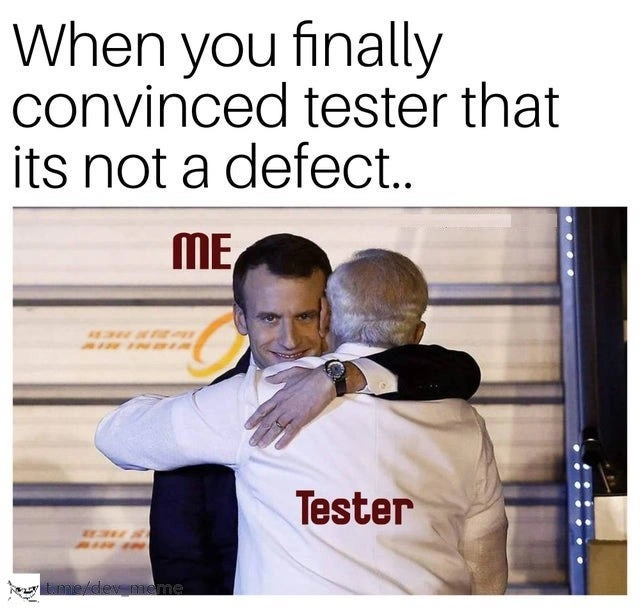
This meme captures that classic showdown between developer and tester over whether something in the software is a bug or a feature. The caption "When you finally convinced tester that it’s not a defect..." sets the stage: a developer (labeled "ME") is hugging a tester after a successful bug triage meeting outcome. The developer wears a victorious grin that practically screams: “Gotcha! It’s working as intended!” This is an instance of the time-honored tech trope, “It’s not a bug, it’s a feature,” taken to a comedic extreme.
For seasoned developers and testers, this image hits close to home. We’ve all experienced that tense moment in a QA vs Dev discussion where a tester logs what they believe is a defect, but the developer pushes back, insisting it’s by design. Perhaps the specification was ambiguous, or maybe the developer is just desperately trying to avoid more work on a Friday afternoon. Either way, the situation often turns into a friendly debate:
- Tester: “The app shouldn’t do X. This looks like an error.”
- Developer: “Actually, we implemented it this way on purpose – it’s a feature to help the user!”
In real projects, these exchanges happen during bug triage or stand-up meetings. The team weighs if an unexpected behavior aligns with requirements or user stories. The humor here comes from relatable truth: sometimes devs use silver-tongued reasoning to reframe a bug as intended behavior. It might involve citing an obscure line in the requirements or retroactively documenting the odd behavior as a “feature.” Senior engineers know this dance all too well. If the tester buys the explanation, the issue might get marked as WONTFIX or resolved as “Working as Intended” in the tracking system. That’s essentially an official way of saying: “Not a bug – no code change needed.” For a harried developer under a tight deadline, convincing QA to accept the current behavior can feel like a major victory. No new bug ticket means no last-minute scramble, and the release can ship on time. Production issue denial? Maybe a little. But in context, it can be a strategic call – perhaps fixing the bug would break something else or the team decides the behavior isn’t actually hurting the user experience. Seasoned devs have seen cases where fixing one bug might spawn two more, so occasionally the pragmatic choice is to call the oddity a feature and move on.
This meme also shines a light on the developer-tester relationship and the communication behind software quality. Testers (in Quality Assurance (QA) roles) are tasked with being critical – they look for inconsistencies and problems so the team can improve the product. Developers, on the other hand, take pride in their work and can become defensive when it’s critiqued. It’s a little like a friendly sparring match: both sides want a good product, but they have different approaches. The tester’s job is to find bugs in software, while the developer often feels pressure to show there are no bugs (or at least none that can’t be explained away). There’s an underlying communication gap at play: maybe the requirements were not crystal clear, or the developer’s understanding of “correct behavior” differs from the tester’s expectations. The humor of “convincing QA it’s not a defect” comes from bridging that gap—through charm, reason, or creative interpretation—until both sides agree. The hug in the image symbolizes the resolution of that brief conflict. It’s the QA-Dev armistice: no hard feelings, we’re on the same team, let’s celebrate that we won’t be filing this as a bug after all. The tester might be rolling their eyes while hugging, and the developer’s smile might be a mix of relief and cheeky triumph, but ultimately they’re camaraderie personified. This little victory is a shared joke in the office. It’s a prime example of TestingHumor in software culture—DeveloperHumor that’s instantly recognizable to anyone who’s been in those bug/feature debates. We laugh because at some point, we’ve all been that developer trying to sell a story, or that tester reluctantly accepting it.
What makes this meme especially funny to experienced folks is the grain of truth behind the exaggeration. In reality, a bug doesn’t truly disappear just because you call it a feature—but in corporate software life, negotiating expectations is part of the game. The phrase “It’s not a bug, it’s an undocumented feature” has been around for decades as a tongue-in-cheek way to say, “Yes, the software behaves oddly, but let’s pretend we planned it that way.” This kind of relatable humor eases the tension that can exist in the QA process. The hug hints that despite any bickering, developers and testers are ultimately partners. After all, both roles share the goal of delivering quality software. When they finally agree—whether by genuine understanding or humorous resignation—it’s a moment of relief. You can almost hear the team joking, “We’ll just put this in the release notes as a feature and call it a day!” accompanied by laughter. That laughter and relief are what the hug in the meme is all about. It’s the emotional payoff after a potentially heated discussion: both sides accept a resolution and maintain good rapport. For a senior developer, seeing this feels both amusing and nostalgic: countless meetings and bug triage sessions flash by where a “defect vs feature” argument ended with a chuckle and “okay, we’ll let it slide.” In short, the meme humorously celebrates that communication win-win moment, where what could have been an unresolved production issue turns into an inside joke and a strengthening of the developer-tester bond.
Description
The meme consists of a photograph with a caption at the top that reads, 'When you finally convinced tester that its not a defect..'. The photo features two men hugging. The man facing the camera, labeled 'ME' in red text, has a smug, triumphant grin while looking over the other man's shoulder. The second man, whose back is to the viewer, is labeled 'Tester' in red text on his white jacket. The image captures a moment of fake camaraderie after a contentious debate. This meme humorously illustrates the classic adversarial dynamic between developers and Quality Assurance (QA) testers. It pokes fun at the 'art of negotiation' where a developer successfully persuades a tester that a reported bug is actually intended behavior, a 'feature,' or something that won't be fixed, thus avoiding extra work. For senior engineers, this is a deeply relatable scenario involving communication, diplomacy, and the occasional bending of definitions to close a ticket
Comments
7Comment deleted
My favorite part of the SDLC is the 'dialog-driven development' phase, where the success of a feature is determined not by code quality, but by my ability to convince QA the bug is just their monitor's calibration issue
Nothing bonds dev and QA quite like quietly updating the PRD during triage so the race condition is now an “optimistic concurrency feature.”
After 15 years in the industry, I've learned that 'works as designed' is just developer speak for 'the requirements were ambiguous enough that technically this nightmare is compliant with the spec we got three sprints ago.'
The eternal dance of 'it's not a bug, it's a feature' - where developers become master negotiators, QA engineers become skeptical philosophers, and the line between defect and design decision blurs into a Schrödinger's bug that's simultaneously both until product management observes it. This meme captures that rare, beautiful moment when a developer successfully argues that the unexpected behavior is actually 'emergent functionality' or 'undocumented edge case handling,' and the tester, exhausted from the fifth round of ticket ping-pong, finally accepts the closure. In reality, we all know this 'feature' will resurface in production as a P0 incident at 3 AM, but for now, let's celebrate this diplomatic victory and the temporary peace treaty between dev and QA
Senior triage move: cite “as per spec,” flip the Jira to Won’t Fix, and watch a P0 blocker gracefully degrade into a change request faster than our test coverage after Friday hotfix
That fleeting sprint-ender: turning a P1 'defect' into 'as designed' without touching a line of code
Enterprise alchemy: tweak the acceptance criteria, paste the PRD link in Jira, and a Sev‑2 becomes “By Design.”